AlphaFold vs ESMFold vs RoseTTAFold vs SWISS-MODEL: accuracy compared
How far apart the predictors are, and how to spot a failure

Matic Broz, PhD14 min
Which predictor is most accurate?
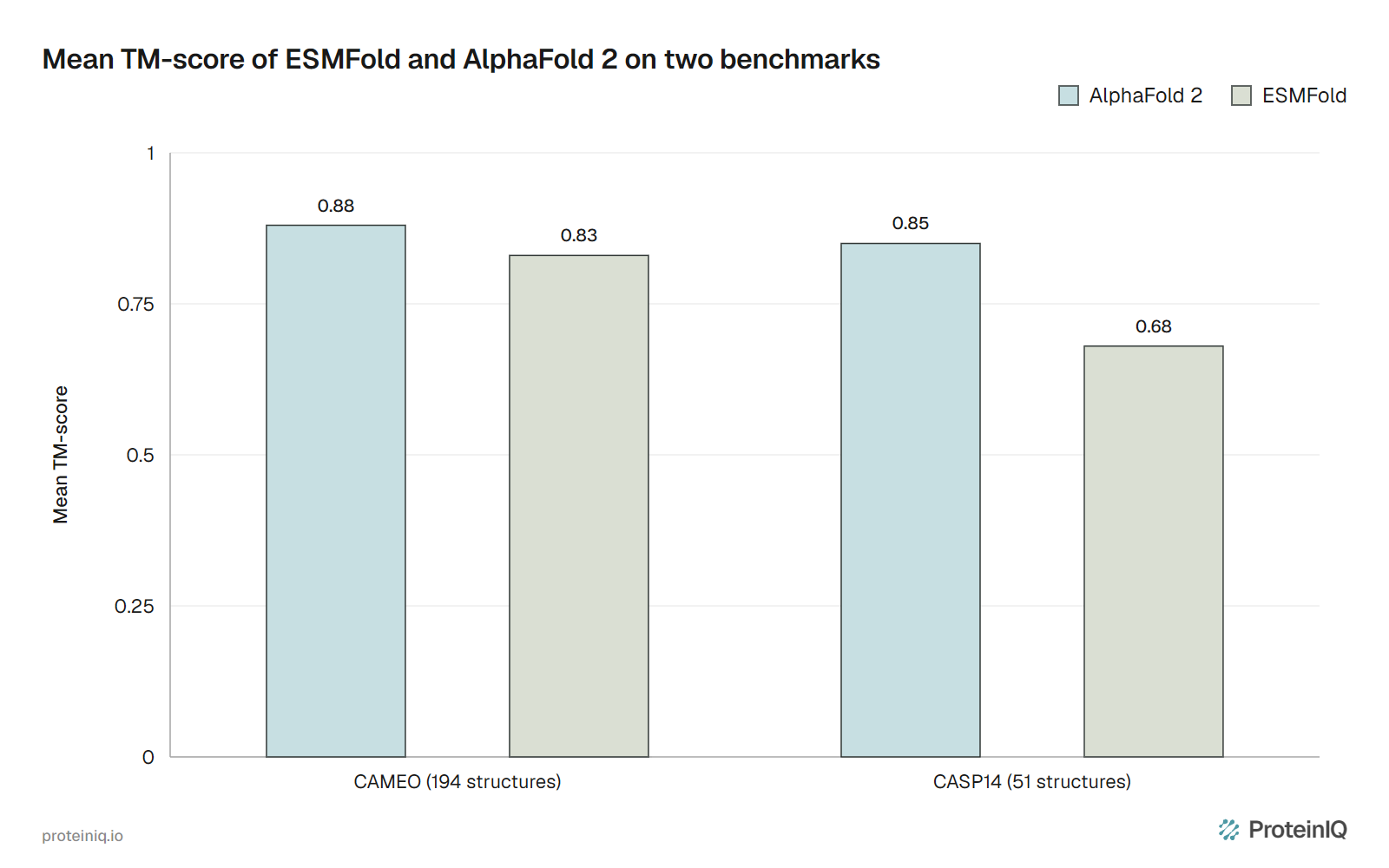
AlphaFold 2 is the most accurate of the four on average, but on most proteins the four sit closer together than the headline numbers suggest. In published benchmarks ESMFold trails AlphaFold 2 by 0.05 TM-score on CAMEO and 0.17 on CASP14, RoseTTAFold's 2021 model trails it at CASP14 too, and SWISS-MODEL is only as good as the solved structure it copies.[3][5][8]
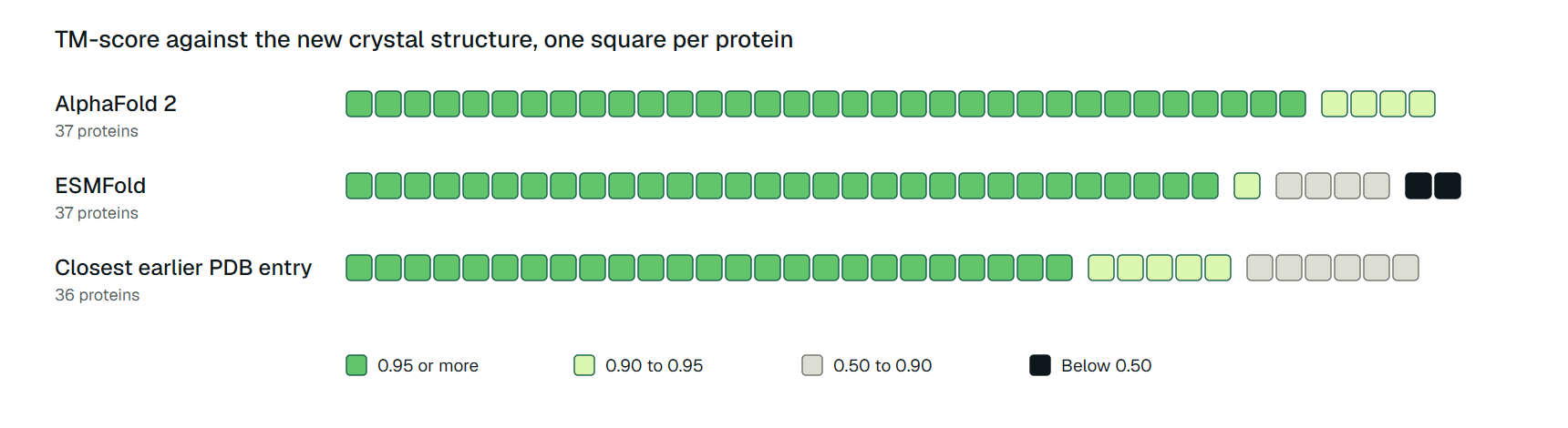
Our own test shows the shape of that gap. On 37 proteins released after June 2023, the median difference between AlphaFold 2 and ESMFold was 0.013 TM-score and 32 of 37 were within 0.05. Yet ESMFold's mean fell to 0.925 because 3 models failed outright, at TM-scores of 0.35, 0.36, 0.62. One was a viral polyhedrin (PDB 8QQC) that AlphaFold 2 placed at 0.998 and ESMFold at 0.362, and ESMFold's own mean pLDDT for that model was 29.
So the choice rests on more than a ranking. Each tool reads a different kind of relative: an alignment of sequences for AlphaFold 2 and RoseTTAFold, what a language model learned from them for ESMFold, one solved structure for SWISS-MODEL. Speed, license and the molecules you want in the model decide the rest.

Why AlphaFold is the reference
AlphaFold 2 builds a multiple sequence alignment of related proteins first, then reads the evolutionary signal in it with its Evoformer. At CASP14 in 2020 it reached a median backbone error of 0.96 Å against 2.8 Å for the next best method.[1] Most people run it through ColabFold, which replaced the original database search with MMseqs2 and made the alignment step 40 to 60 times faster.[2]
The alignment is also its dependency. The AlphaFold authors found that accuracy falls substantially when the median alignment has fewer than about 30 sequences, and that gains are small beyond about 100.[1] AlphaFold 2's weights allow commercial use, as the AlphaFold license guide explains. AlphaFold 3 widens the inputs to ligands and nucleic acids but keeps that dependency; the AlphaFold 2 vs 3 comparison covers what it adds.
ESMFold trades accuracy for speed
ESMFold replaces the alignment with a protein language model. ESM-2 has read hundreds of millions of sequences, so a single sequence goes in and a structure module builds coordinates from the language model's representation.[3]
The cost is accuracy on hard targets. On 194 CAMEO structures released in April to June 2022, ESMFold had a mean TM-score of 0.83 against 0.88 for AlphaFold 2 and 0.82 for RoseTTAFold. On the 51 CASP14 targets the gap widened to 0.68 against 0.85, more than three times as large.[3][4]
The authors also found that the language model's perplexity on a sequence predicts how well ESMFold folds it (Pearson r of −0.55 on CAMEO and −0.67 on CASP14), which is why its own pLDDT is worth reading.
The gain is speed: 14.2 seconds for a 384-residue protein on a V100 GPU, about six times faster than a single AlphaFold 2 model before the alignment search is counted.[3] That made a metagenomic atlas of more than 617 million structures practical. The original repository is archived under the MIT license, and Biohub's newer ESMFold2 adds complexes.
RoseTTAFold spans three generations
RoseTTAFold, from David Baker's group, passes information between a sequence track, a distance track and a coordinate track. Its 2021 paper reported that it came close to AlphaFold 2 at CASP14 without matching it, and that on 69 medium and hard CAMEO targets in a five-week blind window it outperformed Robetta and SWISS-MODEL, among other servers.[5]
It was also cheap: about 10 minutes on an RTX 2080 for a protein under 400 residues, after roughly 1.5 hours of sequence and template search.[5] The search, not the network, was the slow part.
Two later models carry the name. RoseTTAFold All-Atom, published in 2024, adds small molecules, metals and nucleic acids.[6] RF3, released in 2025 under a BSD license, follows AlphaFold 3's scope and is the one hosted on ProteinIQ as RosettaFold3.[7] So a search for RoseTTAFold finds a 2021 protein predictor, and a search for what to run today finds RF3, with a different input list.
SWISS-MODEL copies a template
SWISS-MODEL does not predict a fold. It searches for a solved structure with a similar sequence, aligns yours to it and builds a model on that backbone, keeping the template's ligands and oligomeric state.[8] Each model gets a QMEANDisCo score from 0 to 1 that estimates its quality per residue.[9] AlphaFold Database structures have been usable as templates since 2023.[11]
How good the result is follows from one number, the identity between your sequence and the template. In a community assessment, Akdel and colleagues compared AlphaFold 2 models with the SWISS-MODEL Repository for 11 species and found that AlphaFold 2 could confidently model on average 25% more residues.[10]
They also noted that homology-based predictions of stability changes lost performance with templates below 40% sequence identity.[10] A template is strong when a close relative is solved and empty when it is not.
Boltz and the AlphaFold 3 family
Boltz-2 belongs to a different group. It follows AlphaFold 3's design,[12] so it accepts ligands, DNA and RNA with the protein, and it adds an affinity estimate for small molecules; its authors report structure accuracy that matches or beats Chai-1 and Protenix while trailing AlphaFold 3 on recent PDB entries and antibodies.[13]
Code and weights are MIT licensed. For a protein alone it is not the natural first choice, and for a ligand it does what the first three models cannot. AlphaFold docking vs co-folding shows what that looks like for two kinase inhibitors.
What 46 recently solved proteins show
We took X-ray structures from the Protein Data Bank released between June 2023 and June 2025 at 2.0 Å or better, with one protein chain, 80 to 300 residues and a UniProt reference (2,663 entries), and drew 150 at random.[15] After dropping UniProt sequences outside 50 to 400 residues and proteins with no AlphaFold Database entry, and keeping one entry per protein, 46 remained. The same set underlies the AlphaFold 2 vs 3 comparison.
For each protein we scored three things against chain A of the new crystal structure with US-align, as a TM-score normalized by the crystal chain length.[14] The AlphaFold 2 model is the AlphaFold Database entry for the protein.[16] The ESMFold model came from folding the full-length UniProt sequence through Meta's ESM Atlas API.[17]
The third score stands in for homology modeling: the closest PDB entry released before June 2023, picked by sequence identity and coverage, aligned to the new structure. We did not run SWISS-MODEL itself, so that score is the backbone a perfect template copy would inherit, not a SWISS-MODEL result.
The ESM Atlas API timed out repeatedly on 9 of the 46 sequences, so ESMFold was scored on 37. The missing proteins include the two on which AlphaFold 2 did worst, which makes the AlphaFold 2 average below look better than it would on the full set. On all 46 proteins AlphaFold 2 averaged 0.965 and scored 0.90 or more on 44.
| Route | Mean TM-score | Median | At 0.90 or more | Lowest |
|---|---|---|---|---|
| AlphaFold 2 (AlphaFold Database) | 0.981 | 0.992 | 37 of 37 | 0.911 |
| ESMFold | 0.925 | 0.976 | 31 of 37 | 0.350 |
| Closest earlier PDB entry (template copy) | 0.953 | 0.984 | 30 of 36 | 0.580 |
The medians are close and the means are not, so the difference sits in the tails. What separates the routes is how often each one fails, and how. AlphaFold 2 never fell below 0.911 on these 37. ESMFold failed on 3, all of them proteins that already had a near-identical entry in the PDB. The template route was nearly perfect when such an entry existed and weak when it did not.
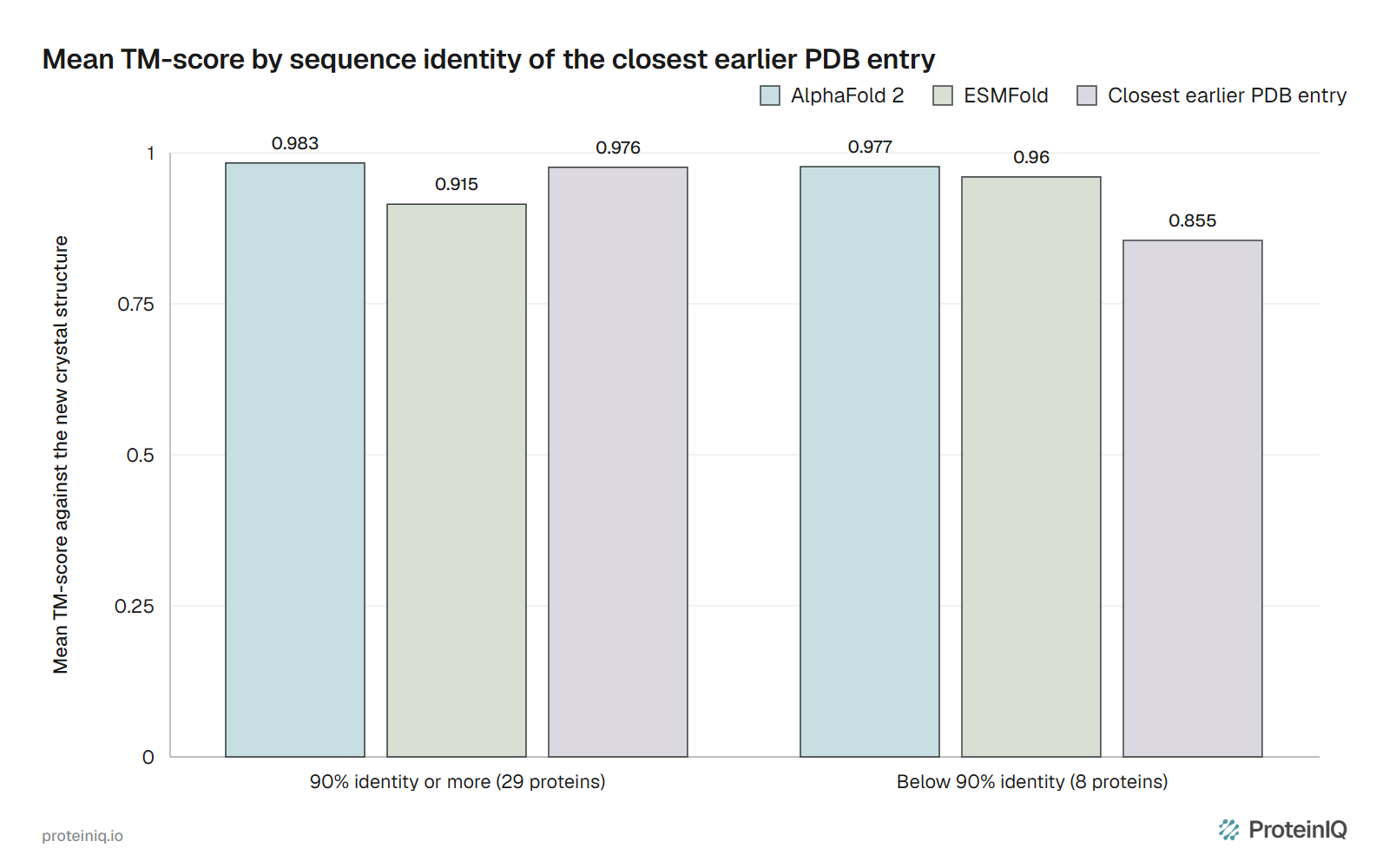
With an earlier entry at 90% identity or more, copying it scored 0.976 on average, level with AlphaFold 2 at 0.983 and well above ESMFold at 0.915. It came within 0.02 of AlphaFold 2 on 26 of those 29 proteins and beat it on 14.
Below that identity, the template average dropped to 0.855 while AlphaFold 2 held at 0.977 and ESMFold at 0.960. That echoes the community assessment above, a template that works until the relative is distant, though here on only 8 proteins.[10]
Where the predictors disagree
Table 2 lists the proteins on which the routes split, plus the one that defeated both AlphaFold 2 and the template copy. The pLDDT column is the mean pLDDT of the ESMFold model, scaled to 0 to 100.
| Protein | AlphaFold 2 | ESMFold | ESMFold mean pLDDT | Closest earlier entry |
|---|---|---|---|---|
| 8QQC, Viral polyhedrin crystal (cypovirus CPV14) | 0.998 | 0.362 | 29 | 0.999 |
| 8AYT, Sudan virus VP40, W95A mutant | 0.919 | 0.350 | 29 | 0.943 |
| 8A6R, Engineered GFP, rsEGFP2 with chlorinated chromophore | 0.964 | 0.617 | 43 | 0.999 |
| 8IN4, Sea hare hydrolysis-enhancing protein | 0.420 | not scored | not scored | 0.294 |
Three things stand out.
ESMFold's 3 failures carry mean pLDDT values of 29, 29, 43, while all 33 models with a mean pLDDT of 70 or higher scored at least 0.89. A low pLDDT is a reason to switch tools, not to refine the model.
The earlier entry was as good as AlphaFold 2 wherever it was nearly identical, which is why the first check for any protein is the PDB itself. And the sea hare enzyme 8IN4, with a closest earlier entry that covered 21% of its sequence, is the one protein that defeated AlphaFold 2 (TM-score 0.420) and the template copy (0.294) together. Its AlphaFold 2 pLDDT, 74.7 against a median of 92.7 elsewhere, said so.
Read this as a small test, not a ranking. The proteins skew toward ones with solved relatives, 8 is a small group for the low-identity comparison, we scored the fold with TM-align rather than residue by residue, and the ESMFold set is missing 9 proteins. The TM-score is forgiving of local errors, so it says nothing about side chains or ligand pockets.
Which predictor should you use?
Start with the cheapest check, an existing structure, and move toward prediction only as far as the protein requires. Table 3 turns that into a sequence.
| Your situation | Start with | Check |
|---|---|---|
| Protein is in the PDB or the AlphaFold Database | The experimental structure, or the database model | Whether the construct and any mutations match |
| A close homolog is solved, with a ligand or cofactor you want kept | A template-based model such as SWISS-MODEL | Template identity and the QMEANDisCo score by residue |
| New single chain, accuracy matters | AlphaFold 2 with an alignment | pLDDT and the PAE domain map |
| Thousands of sequences, or no time for alignments | ESMFold | Keep models with mean pLDDT of 70 or more; rerun the rest with AlphaFold 2 |
| Protein with a ligand, DNA or RNA | Boltz-2, Chai-1 or RF3 | Pose validity, for example with PoseBusters |
| Complex of protein chains | AlphaFold-Multimer or an AlphaFold 3 style model | ipTM and the interchain PAE |
Whatever you pick, compare two predictors when the answer matters. Where AlphaFold 2 and ESMFold agreed within 0.05 in our test, both scored 0.90 or more on 30 of 32 proteins; where they differed by more, ESMFold was the lower of the two in 5 of 5. Reading pLDDT, the PAE domain map and, for complexes, ipTM together is covered in the structure confidence guide.
AlphaFold, ESMFold and RoseTTAFold tools on ProteinIQ
Look for an existing structure first, then predict, then check the model against what is known. SWISS-MODEL is an external web server, so it has no entry here.
- AlphaFold database download fetches a precomputed AlphaFold model, and Foldseek finds structurally similar proteins in the PDB.
- AlphaFold2 predicts a chain or complex with an alignment, and ESMFold or ESMFold2 predict a single sequence quickly.
- Boltz-2, Chai-1 and RosettaFold3 co-fold a ligand, DNA or RNA with the protein.
- US-align compares a model with a reference structure, and MolProbity checks geometry and clashes.
 Open the AlphaFold2 ubiquitin examplePredict protein structures and complexes with single-sequence or MSA-assisted folding.Open example
Frequently asked questions
Is AlphaFold more accurate than ESMFold?
Yes on average. On CAMEO, ESMFold reached a mean TM-score of 0.83 against 0.88 for AlphaFold 2, and on CASP14 0.68 against 0.85.[3] In our test of 37 recent proteins the median gap was 0.013, with ESMFold failing on 3. ESMFold is about six times faster per model and needs no alignment.
Is AlphaFold better than RoseTTAFold?
AlphaFold 2 was more accurate than the 2021 RoseTTAFold at CASP14, and RoseTTAFold's mean TM-score on CAMEO (0.82) sat just below ESMFold's.[4][5] RoseTTAFold's authors reported it as cheaper to run, at about 10 minutes per protein on one GPU once alignments exist. Its current open successor, RF3, follows AlphaFold 3's design and handles ligands and nucleic acids.
Is AlphaFold better than SWISS-MODEL?
It depends on the template. SWISS-MODEL builds on a solved homolog and keeps its ligands, and a nearly identical template scored as well as AlphaFold 2 in our test (0.976 against 0.983). With a distant template, AlphaFold 2 scored 0.977 against 0.855, and a community assessment found AlphaFold 2 could model 25% more residues than the SWISS-MODEL Repository.[10]
Which is faster, AlphaFold or ESMFold?
ESMFold. It folded a 384-residue protein in 14.2 seconds on a V100, about six times faster than one AlphaFold 2 model, and that comparison leaves out AlphaFold 2's alignment search.[3]
How does Boltz compare with AlphaFold?
Boltz-2 follows AlphaFold 3's design, adds ligands and nucleic acids, and carries an MIT license, but its authors report that it trails AlphaFold 3 on recent PDB entries and antibodies.[13] For a single protein chain, AlphaFold 2 is the simpler choice.