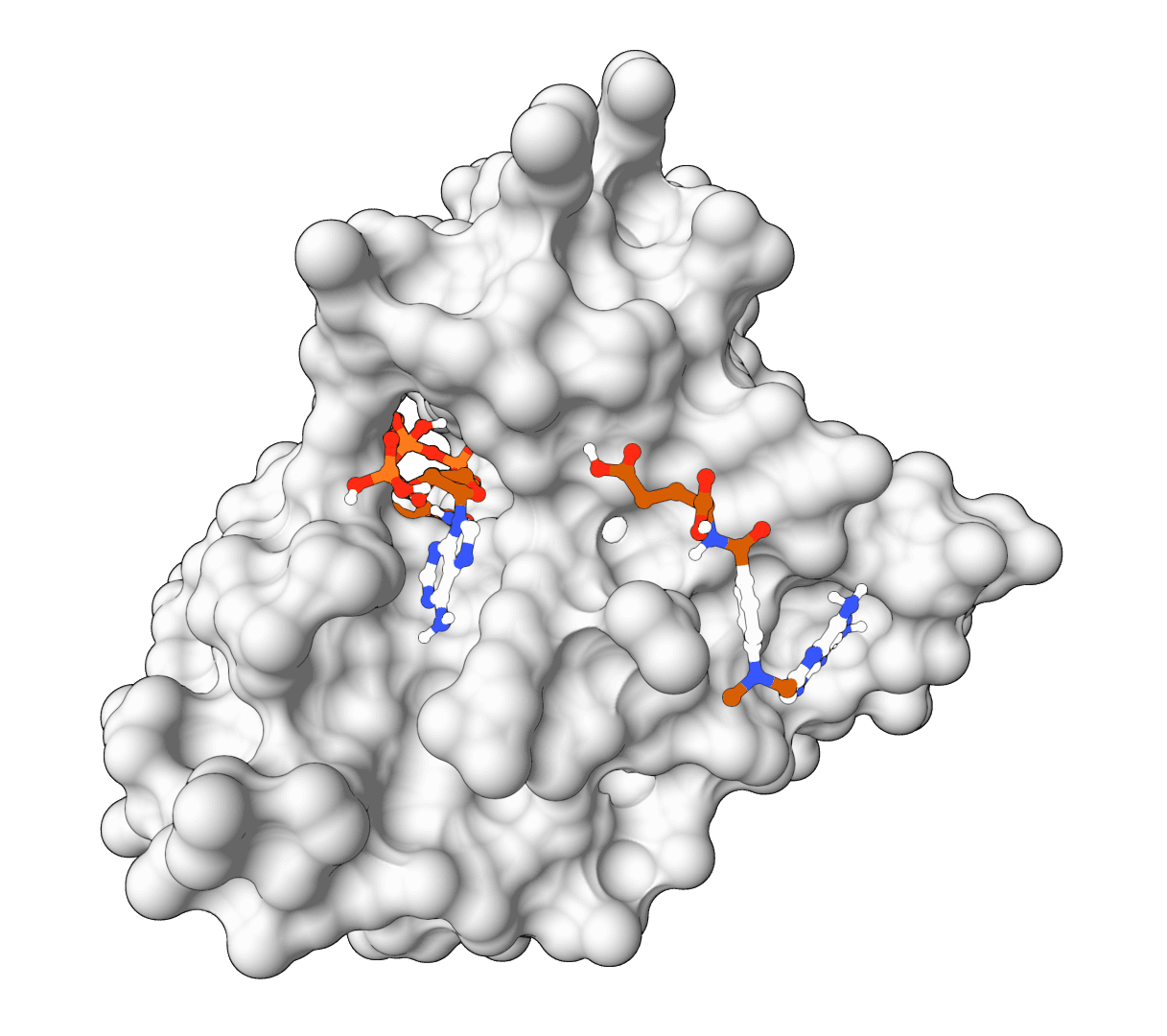
Dock ligands into protein structures and estimate binding modes, poses, and affinity scores. Learn more
Input
Automatic repairs supported missing atoms when needed. It can retain waters and other components. Review the receptor before docking.
AutoDock Vina webserver overview
AutoDock Vina is an open-source molecular docking engine for predicting protein-small-molecule binding poses. ProteinIQ runs AutoDock Vina 1.2.7 with Vina, Vinardo, or AutoDock4 scoring and returns ranked poses, affinity estimates, RMSD bounds, preparation records, and downloadable files.
The webserver supports single-ligand docking, independent batch docking, simultaneous ligand docking, selected flexible receptor residues, hydrated ligand workflows, zinc metalloprotein workflows, and score, local, or randomize operations. The AutoDock Vina online guide covers structure preparation, pocket selection, validation, and worked examples.
Pricing
AutoDock Vina jobs start at 15 credits. A standard single-ligand docking run starts at 20 credits. ProteinIQ calculates the exact price from the submitted structures and settings before submission.
Single-ligand docking
| Ligand heavy atoms | Exhaustiveness 8 | Exhaustiveness 32 | Exhaustiveness 64 |
|---|---|---|---|
| Up to 30 | 20 credits | 40 credits | 57 credits |
| 60 | 26 credits | 51 credits | 73 credits |
| 100 | 31 credits | 61 credits | 87 credits |
| 150 | 36 credits | 71 credits | 100 credits |
Batch docking
| Ligands | Exhaustiveness 8 | Exhaustiveness 32 | Exhaustiveness 64 |
|---|---|---|---|
| 2 | 28 credits | 56 credits | 80 credits |
| 3 | 36 credits | 72 credits | 102 credits |
| 5 | 52 credits | 104 credits | 148 credits |
| 10 | 92 credits | 184 credits | 261 credits |
Simultaneous co-docking
| Ligands | Exhaustiveness 8 | Exhaustiveness 32 | Exhaustiveness 64 |
|---|---|---|---|
| 2 | 40 credits | 80 credits | 114 credits |
| 3 | 100 credits | 200 credits | 283 credits |
| 4 | 240 credits | 480 credits | 679 credits |
| 5 | 500 credits | 1,000 credits | 1,415 credits |
These baseline prices assume Dock, a compact search box, a receptor with up to 4,000 protein atoms, and ligands with no more than 7 rotatable bonds. Batch and simultaneous prices assume up to 30 heavy atoms per ligand. Larger search boxes, receptors, or more flexible ligands increase the exact quote.
Score only, Local only, and Randomize only start at 15 credits. The scoring function and number of returned poses do not currently change the estimate.
Inputs
One receptor and at least one ligand are required. The selected ligand mode determines whether one ligand is docked, several ligands are docked independently, or several ligands are placed in the same pocket.
| Input | Accepted formats | Limits and behavior |
|---|---|---|
Receptor | .pdb, .ent, .cif, .mmcif, prepared .pdbqt, or an RCSB PDB ID | Maximum 50 MB. Prepared PDBQT receptors are used as submitted. Other structures follow the selected receptor preparation method. |
Ligand | SMILES, .pdbqt, .sdf, .mol, .mol2, .smiles, .smi, .txt, or .csv; PubChem identifiers are also accepted | Maximum 50 MB. Hosted preparation supports up to 32 rotatable bonds, 150 heavy atoms, and 300 total atoms per ligand. |
Job name | Text | Optional label for the run. |
Settings
Defaults and ranges follow the ProteinIQ AutoDock Vina tool definition. Dependent controls appear when their parent mode is selected.
Docking and pocket
| Parameter | Type | Default | Description |
|---|---|---|---|
Ligand mode | enum | Single ligand | Single ligand, Simultaneous co-docking with up to 5 ligands, or Batch docking with up to 10 ligands. |
Scoring function | enum | Vina | Vina, Vinardo, or AutoDock4. Zinc and hydrated workflows require AutoDock4. |
Exhaustiveness | integer | 8 | Search thoroughness, 1 to 64. |
Number of poses | integer | 9 | Maximum poses, 1 to 50. |
Pocket definition | enum | Automatic | Automatic uses a detected bound ligand or falls back to the whole receptor. Strict Bound ligand only, Select residues, Manual coordinates, and Whole protein choices are also available. |
Bound ligand residues | string | optional | Comma-separated chain:residue IDs. Defines the pocket, then removes those residues. |
Binding-site residues | string | conditional | Comma-separated chain:residue IDs. Required for Select residues; residues remain in the receptor. |
Pocket padding (A) | number | 5 | Padding on each side of a ligand or residue pocket, 0 to 20 in 0.5 steps. |
Center X (A) | number | 0 | Manual box center on the X axis. |
Center Y (A) | number | 0 | Manual box center on the Y axis. |
Center Z (A) | number | 0 | Manual box center on the Z axis. |
Size X (A) | number | 25 | Manual box size on the X axis, minimum 1. |
Size Y (A) | number | 25 | Manual box size on the Y axis, minimum 1. |
Size Z (A) | number | 25 | Manual box size on the Z axis, minimum 1. |
Whole-protein padding (A) | number | 4 | Padding around receptor bounds, 0 to 20 in 0.5 steps. |
Receptor preparation and workflow
Automatic runs PDB2PQR when standard protein residues have reconstructable missing atoms, including structures with linked or modified residues. Bond records must reference existing, unambiguous atoms. Preparation checks for lost heavy atoms or changed residue identities before Meeko assigns docking charges and atom types. PDB2PQR may adjust atom positions during its native repair; the preparation report records those changes. Unresolved alternate conformers, duplicate atom identities, insufficient reconstruction coordinates, or missing atoms above PDB2PQR's 10% repair limit prevent automatic repair. Choose Always PDB2PQR to request preparation even when no missing atoms are detected.
Automatic uses direct Meeko when no supported missing-atom repair is needed. Direct Meeko retains deposited waters unless they are explicitly selected in Residues to remove. Automatic PDB2PQR repair removes waters; the Retain waters during PDB2PQR switch applies to explicitly selected PDB2PQR preparation. Prepared receptor PDBQT files bypass these preparation steps and retain their submitted charges and atom types.
Waters, cofactors, bound ligands, and alternate conformers need to match the intended receptor model. Component warnings invite review and do not reject a structure merely because it contains nonstandard residues. Meeko makes the final chemistry check. For example, an unexpected inter-residue bond involving HOH A:791 requires inspection of that water and its nearby atoms. Adding A:791 to Residues to remove is appropriate only when that water should be excluded. Preparation does not retry by deleting a failing component or changing chemistry automatically.
Missing binding-site selections and inputs beyond PDB2PQR's supported reconstruction limits are rejected before submission when those conditions can be determined from the selected inputs. A receptor that needs explicit component removal or conformer selection is checked by the native preparer after those choices are applied. Large search boxes produce a warning rather than an arbitrary size restriction.
| Parameter | Type | Default | Description |
|---|---|---|---|
Docking operation | enum | Dock | Dock, Score only, Local only, or Randomize only. |
Receptor preparation method | enum | Automatic | Automatic, Direct Meeko, or Always PDB2PQR. Prepared PDBQT is unchanged. |
Use PROPKA protonation | boolean | false | Runs PROPKA during Always PDB2PQR preparation. |
Receptor pH | number | 7 | PROPKA pH, 0 to 14 in 0.1 steps. |
Retain waters during PDB2PQR | boolean | false | Keeps compatible deposited waters during PDB2PQR preparation only. |
Remove detected ligand-like chains | boolean | true | Removes detected ligand-like chains and stale linked records. |
Residues to remove | string | optional | Meeko deletion specification for waters, ligands, ions, or other components. |
Residue template assignments | string | optional | Meeko assignments in chain:residue=template form. |
Default alternate location | string | optional | Alternate-location ID applied to residues with multiple conformers. |
Residue alternate locations | string | optional | Residue-specific choices, for example A:42=B,B:17=A. |
Blunt polymer ends | string | optional | Meeko polymer-end termination specification. |
Delete residues Meeko cannot parameterize | boolean | false | Deletes incomplete or unsupported residues and records their IDs. |
Flexible residues | string | optional | Side chains in chain:residue form. |
Random seed | integer | 0 | Nonzero values make identical runs reproducible. |
Hydrated ligand workflow | boolean | false | Includes ligand-associated waters. Requires one ligand, Dock, and AutoDock4. |
Zinc metalloprotein mode | boolean | false | Enables zinc-specific parameters. Requires AutoDock4. |
Search and output controls
| Parameter | Type | Default | Description |
|---|---|---|---|
Energy range (kcal/mol) | number | 3.0 | Retains poses within 0.1 to 20 kcal/mol of the best pose. |
Min RMSD between poses (A) | number | 1.0 | Minimum pose separation, 0.1 to 5. |
Max evaluations | integer | 0 | Scoring-evaluation limit, up to 2147483647. 0 uses Vina's heuristic. |
Grid spacing (A) | number | 0.375 | Affinity-map spacing, 0.1 to 1 in 0.025 steps. |
Force even voxels | boolean | false | Requests even affinity-map voxel counts for Vina or Vinardo. |
Set unbound ligand energy | boolean | false | Enables a supplied unbound energy in Score only mode. |
Unbound ligand energy (kcal/mol) | number | 0 | Unbound ligand energy used when enabled. |
Local optimization max steps | integer | 0 | Step limit in Local only, up to 2147483647. 0 uses Vina's heuristic. |
Randomization max steps | integer | 10000 | Clash-avoidance step limit in Randomize only, 0 to 100000. |
Disable post-docking refinement | boolean | false | Skips final local optimization for Vina or Vinardo. |
Use custom scoring weights (advanced) | boolean | false | Enables weights for the selected scoring function. |
Custom scoring weights
These fields are available when Use custom scoring weights (advanced) is enabled. The defaults are the tool's current Vina, Vinardo, and AutoDock4 values.
| Parameter | Type | Default | Description |
|---|---|---|---|
Vina gauss1 | number | -0.035579 | Vina weight. |
Vina gauss2 | number | -0.005156 | Vina weight. |
Vina repulsion | number | 0.840245 | Vina weight. |
Vina hydrophobic | number | -0.035069 | Vina weight. |
Vina hydrogen | number | -0.587439 | Vina weight. |
Vina glue | number | 50 | Vina weight. |
Vina rotation | number | 0.05846 | Vina weight. |
Vinardo gauss1 | number | -0.045 | Vinardo weight. |
Vinardo repulsion | number | 0.8 | Vinardo weight. |
Vinardo hydrophobic | number | -0.035 | Vinardo weight. |
Vinardo hydrogen | number | -0.6 | Vinardo weight. |
Vinardo glue | number | 50 | Vinardo weight. |
Vinardo rotation | number | 0.05846 | Vinardo weight. |
AD4 van der Waals | number | 0.1662 | AutoDock4 weight. |
AD4 hydrogen bond | number | 0.1209 | AutoDock4 weight. |
AD4 electrostatic | number | 0.1406 | AutoDock4 weight. |
AD4 desolvation | number | 0.1322 | AutoDock4 weight. |
AutoDock4 glue | number | 50 | AutoDock4 weight. |
AutoDock4 rotation | number | 0.2983 | AutoDock4 weight. |
Outputs
| Output | What it contains |
|---|---|
Structure | Interactive receptor and ligand poses for inspecting binding geometry. |
Data | Docking affinity, RMSD lower and upper bounds, and native energy terms. Score only and Local only also return the named energy-term vector. |
Files | Individual pose PDBQT files, a combined native PDBQT, prepared receptor and ligand files, optional PDB2PQR output, and preparation metadata. Hydrated workflows include their additional water-containing files. |
Logs | The curated run.log with preparation, resolved automatic-pocket decisions, box, docking, and output details. |
Understanding docking results
AutoDock Vina scores are approximate model outputs. Within a run that uses the same receptor preparation, ligand representation, box, scoring function, and settings, more negative affinity values rank as more favorable. Scores from different scoring functions or differently prepared systems are not directly comparable.
| Result | Interpretation |
|---|---|
| Affinity | Predicted binding score in kcal/mol. It is useful for within-protocol ranking, not as a measured binding constant. |
| RMSD lower and upper bounds | Distance from the best returned pose cluster. They describe pose similarity, not experimental accuracy. |
| Energy terms | Components of the selected scoring model. AutoDock4 includes map-based electrostatic and desolvation terms; Vina and Vinardo use different empirical terms. |
| Pose geometry | Contacts, clashes, ligand strain, protonation, alternate locations, waters, and box placement still require structural inspection. |
Related tools
AutoDock-GPU
GPU-accelerated molecular docking using the AutoDock4 force field. Up to 56x faster than serial AutoDock via CUDA parallelization of the Lamarckian Genetic Algorithm.
FlowDock
FlowDock predicts protein-ligand complex structures and binding-affinity scores using geometric flow matching.
GNINA
GNINA is a molecular docking tool that combines traditional physics-based docking with deep learning CNN scoring for protein-small-molecule complexes. It provides accurate binding predictions with confidence scores, optimized for high-throughput virtual screening.
PandaDock
Open-source molecular docking platform using physics-based scoring functions. CPU-optimized algorithms achieve sub-angstrom accuracy (0.014A RMSD) without GPU requirements.
SMINA
SMINA is a fork of AutoDock Vina with enhanced scoring functions, custom scoring support, and 10-20x faster minimization. Ideal for scoring function development, pose refinement, and high-performance docking workflows.
DiffDock-L
DiffDock-L is a state-of-the-art molecular docking tool that uses diffusion models to predict how small molecule ligands bind to protein targets. It generates multiple binding poses with confidence scores.
DynamicBind
DynamicBind is an AI-powered protein-ligand binding prediction tool that recovers ligand-induced conformational changes from unbound protein structures. It predicts both ligand binding poses and protein conformational changes.
SigmaDock
SigmaDock is a fragment-based molecular docking tool using SE(3) equivariant diffusion models to predict how small molecule ligands bind to protein targets. Presented at ICLR 2026, it generates multiple binding poses with Vinardo scoring.
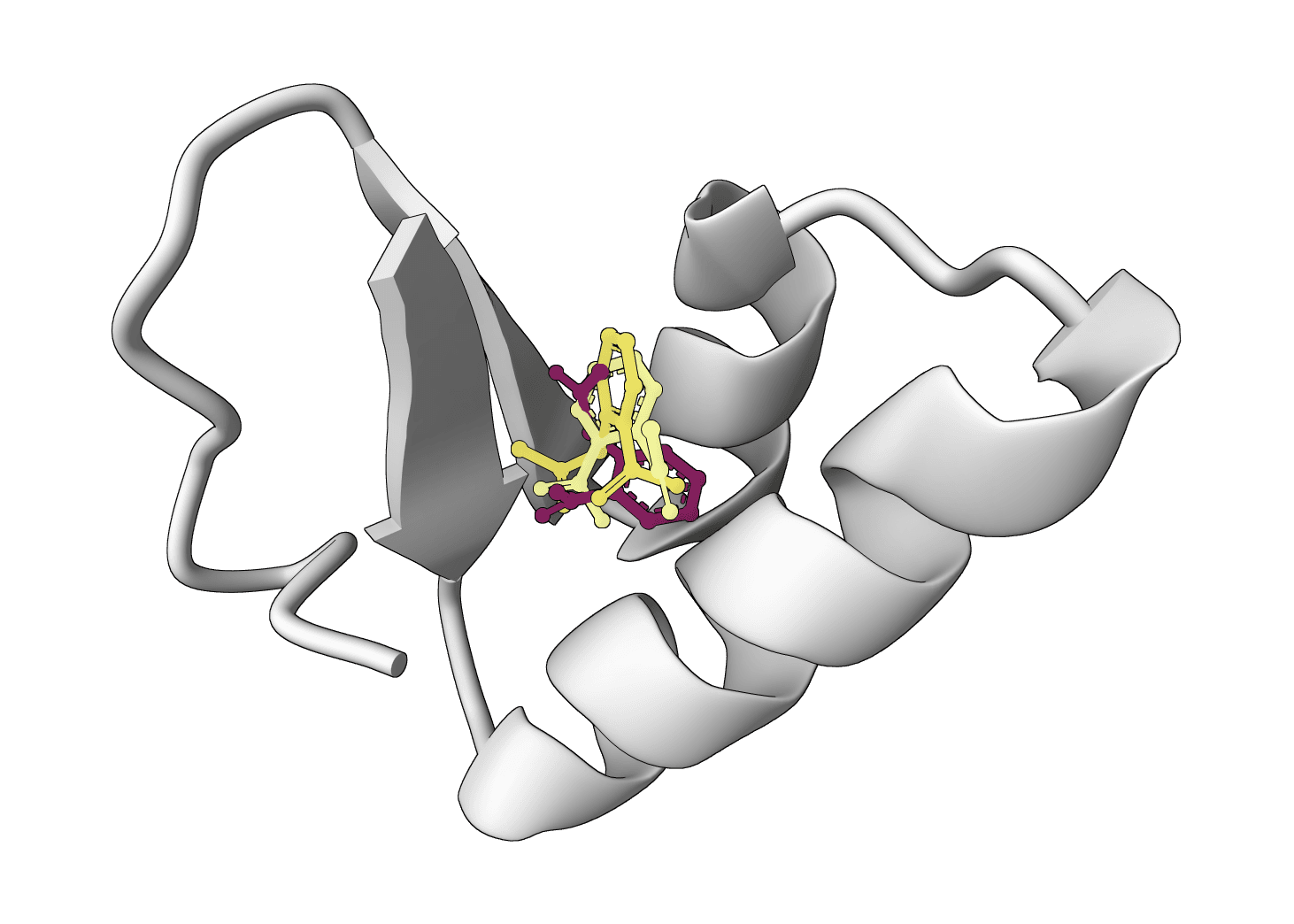
SurfDock
SurfDock is a surface-informed diffusion generative model for protein-ligand docking, published in Nature Methods 2024. It leverages protein surface geometry to guide a diffusion process for reliable and accurate protein-ligand complex prediction.
TEMPL Pipeline
TEMPL Pipeline predicts protein-ligand poses by finding similar protein templates, aligning template ligands, generating constrained conformers, and ranking poses with shape and pharmacophore scores.