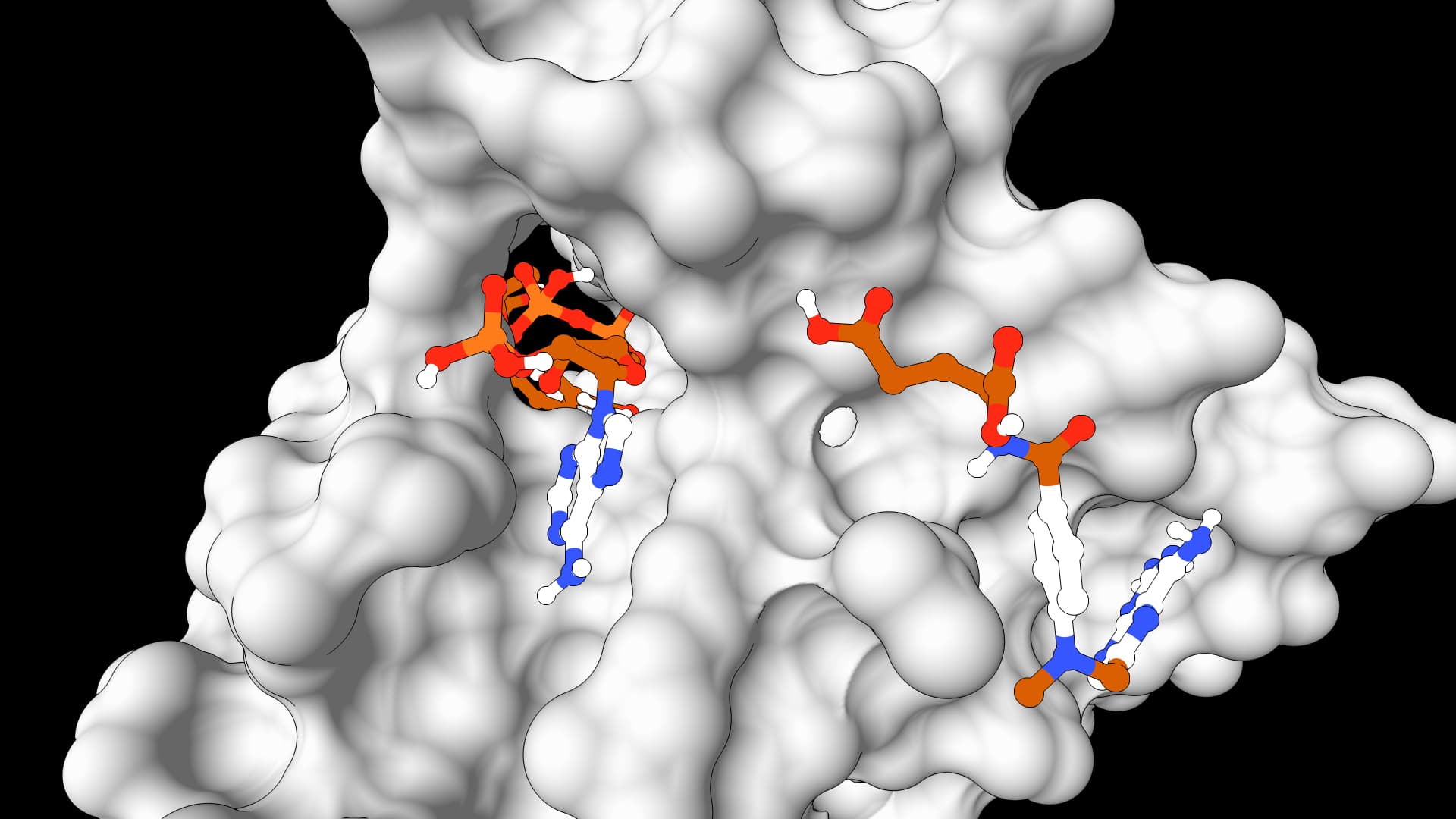
AutoDock-GPU
Dock ligands with AutoDock4 scoring, CUDA acceleration, and flexible receptor sidechains.
What is AutoDock-GPU?
AutoDock-GPU is a GPU-accelerated implementation of AutoDock4, one of the most widely-cited docking programs in computational drug discovery. It predicts how small molecules bind to protein targets using the classic AutoDock4 physics-based force field, with reported speedups of up to 56x over single-threaded AutoDock4.
The key distinction from AutoDock Vina is the scoring function: AutoDock-GPU uses the original AutoDock4 force field with explicit terms for van der Waals interactions, hydrogen bonding, electrostatics, and desolvation. This physics-inspired approach behaves differently than Vina's empirically-optimized scoring, particularly for metal-containing binding sites and systems with complex electrostatics.
AutoDock-GPU is developed by the Forli Lab at Scripps Research and is open-source under the GPL license.
How does AutoDock-GPU work?
AutoDock-GPU combines pre-calculated grid maps with the Lamarckian Genetic Algorithm (LGA) to efficiently search conformational space on GPUs.
The AutoDock4 scoring function
The scoring function estimates binding free energy () through five physics-based terms:
- Van der Waals (): Lennard-Jones 12-6 potential modeling steric interactions
- Hydrogen bonding (): 12-10 potential with a directional term favoring optimal H-bond geometry
- Electrostatics (): Coulombic interactions with a distance-dependent dielectric
- Desolvation (): Energy penalty for displacing water from hydrophobic surfaces
- Torsional entropy (): Penalty proportional to rotatable bonds lost upon binding
These interaction energies are pre-calculated by AutoGrid at 0.375 Å resolution and stored as 3D grids. During docking, energies are rapidly looked up via trilinear interpolation rather than computed pairwise—this is what enables ~250 million scoring function evaluations per docking job.
The Lamarckian Genetic Algorithm
The LGA is a hybrid global-local search strategy:
- Population initialization: Random poses (position, orientation, torsion angles) are generated
- Genetic evolution: New poses are created through crossover and mutation of parent poses
- Local refinement: ~6% of the population undergoes local search optimization each generation
- Lamarckian inheritance: Improved poses from local search re-enter the population (unlike Darwinian evolution where acquired traits aren't inherited)
- Termination: Search stops when maximum evaluations or generations are reached
Multiple independent LGA runs (controlled by Number of LGA runs) explore different regions of conformational space. The best pose across all runs is returned by default, or multiple ranked poses can be requested.
Local search methods
AutoDock-GPU supports four local search optimizers:
ADADELTA (gradient-based): Uses scoring function gradients to descend toward energy minima. Converges faster for flexible ligands (8+ rotatable bonds) and typically requires 6-23x fewer evaluations than Solis-Wets. Recommended for most applications.
Solis-Wets (random): Applies random perturbations to pose variables, accepting improvements probabilistically. Better for small, rigid ligands (≤7 rotatable bonds) where gradient information is less beneficial.
Steepest-Descent and FIRE (gradient-based): Additional native minimizers for controlled comparisons. AutoDock-GPU's ligand-based evaluation heuristics support only ADADELTA and Solis-Wets, so these two methods use the configured maximum evaluation count directly.
GPU parallelization
AutoDock-GPU exploits three levels of parallelism:
- High-level: Multiple LGA runs execute simultaneously across GPU threads
- Medium-level: Individuals within a genetic generation are processed in parallel
- Low-level: Fine-grained tasks (rotation, scoring) are distributed across work-items
This hierarchical approach produced speedups of up to 56x in the published benchmark, depending on the GPU and system size. A single GPU can screen 2,000-40,000 ligands per day.
Grid maps
Grid maps pre-calculate interaction energies between each ligand atom type and the receptor at every point in space. This upfront cost (handled automatically by ProteinIQ via AutoGrid4) enables extremely fast scoring during the docking search—~250 million scoring evaluations per job by looking up cached values rather than computing pairwise interactions. Grid maps are cached per receptor, so docking additional ligands against the same protein reuses existing maps.
How to use AutoDock-GPU online
ProteinIQ handles Meeko preparation, grid map generation, and GPU scheduling automatically—no local installation of AutoDock-GPU, AutoGrid, Meeko, or CUDA toolkits required.
Inputs
| Input | Description |
|---|---|
Receptor | PDB, prepared rigid-receptor PDBQT, or RCSB PDB ID. PDB is prepared with Meeko without rebuilding missing residues or heavy atoms. Prepared PDBQT passes through with its supplied charges and atom types. For flexible docking, supply a rigid PDBQT that excludes the moving sidechains, plus their separate flexible-residue PDBQT. Repair incomplete structures first with PDB Fixer. |
Ligand(s) | SMILES, SDF, MOL, or PDBQT. Screen up to 200 compounds using multiple files, an SDF library, one SMILES per line, name<TAB>SMILES, or CSV with name and smiles columns. Ligands containing metals are not supported; use GNINA instead. |
Flexible Residues | Optional PDBQT file specifying receptor sidechains that should flex during docking. Allows modeling induced-fit effects at the binding site. |
Reference Ligand | Optional PDBQT, SDF, or MOL ligand used for native RMSD analysis and reference-energy reporting. Without this input, native RMSD uses the initial coordinates of each docked ligand. |
Settings
Docking parameters
| Setting | Description |
|---|---|
Number of LGA runs | Independent genetic algorithm runs (1–100, default 20). More runs explore more conformational space. Use 20 for screening, 50–100 for thorough analysis of lead compounds. |
Binding site and poses
| Setting | Description |
|---|---|
Best pose only | When enabled (default), returns only the top-scoring pose per ligand. Disable to output multiple ranked poses from independent LGA runs. |
Number of poses | Poses to return per ligand (1–20, default 5). Only active when Best pose only is disabled. |
Configure search space | When enabled, allows manual specification of the binding site location. By default, the entire protein surface is searched (blind docking). |
Search mode | Auto uses the receptor bounding-box midpoint, 10 Angstrom padding on each side and even grid dimensions. Manual accepts center coordinates and even grid-point counts from 20 to 254 per axis. At the default spacing, 254 intervals span 95.25 Angstroms. A focused box reduces the search space for a known binding site. |
API settings
The web form uses the default search and scoring settings. The API also accepts the settings below. Open API above the inputs and select All to copy a request with every default. The tool's API schema lists the accepted values and limits.
| Setting | API field | Default | Description |
|---|---|---|---|
| Local search method | local_search | ADADELTA | Also accepts Solis-Wets, Steepest-Descent, or FIRE. Native evaluation heuristics apply to ADADELTA and Solis-Wets. |
| Max evaluations per run | num_evals | 2500000 | With heuristics enabled, the default leaves the native estimate active. Change the value to cap the heuristic, or disable heuristics to use it directly. |
| Random seed | seed | 0 | Zero uses automatic seeds. A positive seed does not guarantee identical results across GPU hardware or execution order. |
| Grid spacing | grid_spacing | 0.375 | Affinity-map spacing in Angstroms. |
| Contact analysis | contact_analysis | false | Adds distance-based contact analysis to DLG and XML. |
| Raw pose files | pose_output_mode | ranked | Optional native best-pose and final-population files, in addition to the ranked poses. |
| Final-population files per run | pose_file_count | 0 | Used with pose_output_mode: "upstream-best-and-clustered". |
The API also exposes population size, mutation and crossover rates, local-search limits, convergence controls, symmetry-aware RMSD, clustering tolerance, the unbound ligand model, and intramolecular scoring options. Their defaults follow AutoDock-GPU. Intramolecular smoothing changes the ligand calculation; receptor maps keep their established AutoGrid smoothing.
Virtual screening
Supply one receptor and a compound library. ProteinIQ prepares each ligand, generates maps for the library's atom types and invokes AutoDock-GPU's native file-list execution. Results include per-compound DLG and XML, selected poses, and ranking.csv, ordered by the best native binding energy per compound. More negative energies rank first. Different scaffolds can have different scoring biases, so use the ranking to prioritize compounds for further review.
Docking one ligand and screening a library use the same AutoDock4 search and scoring. AutoDock-GPU does not provide Vina's score-only or local-only task modes.
Results
Results include a ranking.csv ranking compounds by best predicted affinity (most negative first), complete torsion-aware PDBQT pose files, the Meeko-prepared receptor and ligands, the AutoGrid parameter file, raw DLG/XML records, and pinned runtime provenance. When multiple poses are requested, each ligand's top N poses are returned ranked by binding energy. Optional --npdb files represent poses from the final LGA populations; they are not cluster representatives.
Understanding the results
Binding affinity interpretation
AutoDock-GPU reports binding affinity in kcal/mol. More negative values indicate stronger predicted binding:
| Range | Interpretation |
|---|---|
| -4 to -6 | Weak binding |
| -6 to -8 | Moderate binding |
| -8 to -10 | Strong binding |
| < -10 | Very strong binding |
AutoDock4 and Vina scoring functions are calibrated differently—affinities should not be compared directly between the two programs. Scores below -12 kcal/mol may be scoring artifacts rather than true predictions, particularly for ligands with many rotatable bonds or poses with unphysical geometry. Visual inspection of such poses in the 3D viewer is recommended.
Limitations
- AutoDock-GPU handles molecules up to about 32 rotatable bonds effectively. For larger peptides or macrocyclic compounds, the search space becomes too large for the LGA to explore adequately. DiffDock handles flexibility differently and may be more suitable.
- AutoDock-GPU v1.6 has fixed limits of 256 combined ligand and flexible-residue atoms, 32 ligand-system atom types, and 57 combined ligand and flexible-residue rotatable bonds. ProteinIQ applies the stricter 32-rotatable-bond product limit to each ligand before docking.
- The protein backbone remains rigid during docking. Sidechain flexibility can be modeled by providing a flexible residues PDBQT file, but large-scale conformational changes are not captured.
- AutoDock-GPU's atom type parameterization does not cover metal coordination in ligands. For metalloligands, use GNINA.
When to use AutoDock-GPU vs alternatives
| Scenario | Recommended tool |
|---|---|
| General-purpose docking | AutoDock Vina |
| Need AutoDock4 force field | AutoDock-GPU |
| Metalloproteins (Zn, Fe, heme) | AutoDock-GPU or GNINA |
| Unknown binding site | DiffDock |
| Pose accuracy priority | GNINA |
| High-throughput screening | AutoDock-GPU |
| Reproducing legacy AD4 results | AutoDock-GPU |
AutoDock-GPU is the best choice when AutoDock4 scoring is specifically needed (e.g., for consistency with published results) or when screening large compound libraries where GPU acceleration provides the biggest advantage. For individual dockings, runtime is comparable to Vina (1–5 minutes). The speed advantage emerges in batch screening: once grid maps are generated for a receptor, subsequent ligands dock very quickly, enabling 2,000–40,000 compounds per day per GPU.
Comparison to other docking tools
| Feature | AutoDock-GPU | AutoDock Vina | GNINA | DiffDock |
|---|---|---|---|---|
| Scoring | AutoDock4 force field | Vina/Vinardo/AD4 | CNN + Vina | Confidence score |
| Search | Lamarckian GA | BFGS + random | BFGS + random | Diffusion model |
| Speed | Very fast (GPU) | Fast (CPU) | Moderate (GPU) | Slower (GPU) |
| Grid maps | Pre-computed (AutoGrid) | On-the-fly | On-the-fly | None |
| Best for | AD4 scoring, HTS | General use | Pose accuracy | Blind docking |
Related tools

PandaDock
Physics-based molecular docking with CPU-optimized hierarchical algorithms

SMINA
Enhanced molecular docking with custom scoring functions and fast minimization

AutoDock Vina
Dock ligands into protein structures and estimate binding modes, poses, and affinity scores.

FlowDock
Geometric flow matching for generative protein-ligand docking and affinity prediction.

GNINA
Dock small molecules into proteins using CNN scoring and physics-based pose optimization.

DiffDock-L
Predict protein-ligand binding poses and confidence scores without a predefined binding site.

DynamicBind
Predict protein-ligand binding poses while modeling ligand-induced conformational changes.

SigmaDock
Fragment-based SE(3) equivariant diffusion docking for protein-ligand binding pose prediction

SurfDock
Surface-informed diffusion generative model for reliable and accurate protein-ligand complex prediction
TEMPL Pipeline
Template-based protein-ligand pose prediction with MCS-guided conformer generation.