Screen compounds for oral bioavailability using molecular weight, LogP, hydrogen bond donor, and acceptor limits. Learn more
Input
What is Lipinski's rule of 5?
Lipinski's rule of five (Ro5), also known as Pfizer's rule of five, is a guideline for evaluating the druglikeness of chemical compounds. The rule estimates whether a compound with pharmacological or biological activity has physicochemical properties consistent with being an orally active drug in humans.
Christopher A. Lipinski formulated the rule in 1997 based on analysis of orally administered drugs, which tend to be relatively small and moderately lipophilic. The name derives from the cutoff values for four parameters, three of which are multiples of five.
Criteria
Poor absorption or permeation is more likely when more than one criterion is violated:
| Property | Threshold | Rationale |
|---|---|---|
| Molecular weight | Da | Larger molecules diffuse more slowly across membranes |
| Partition coefficient (LogP) | High lipophilicity reduces aqueous solubility | |
| Hydrogen bond donors | Counted as N–H and O–H bonds | |
| Hydrogen bond acceptors | Counted as nitrogen and oxygen atoms |
A compound violating one criterion may still be orally active. Two or more violations indicate probable absorption problems via passive diffusion.
How to calculate Lipinski's rule of 5 online
The easiest way to get Lipinski's values for any set of molecules is to use ProteinIQ's online Lipinski's rule of five calculator. You can input just smiles (up to tens of thousands of molecules) or tab-delimited list with names of molecules and smiles formula.
Input
The calculator accepts SMILES notation in two formats:
Plain SMILES, one compound per line:
CCO
CC(=O)Oc1ccccc1C(=O)OTab-delimited, with a compound name followed by SMILES, separated by a \t):
ethanol	CCO
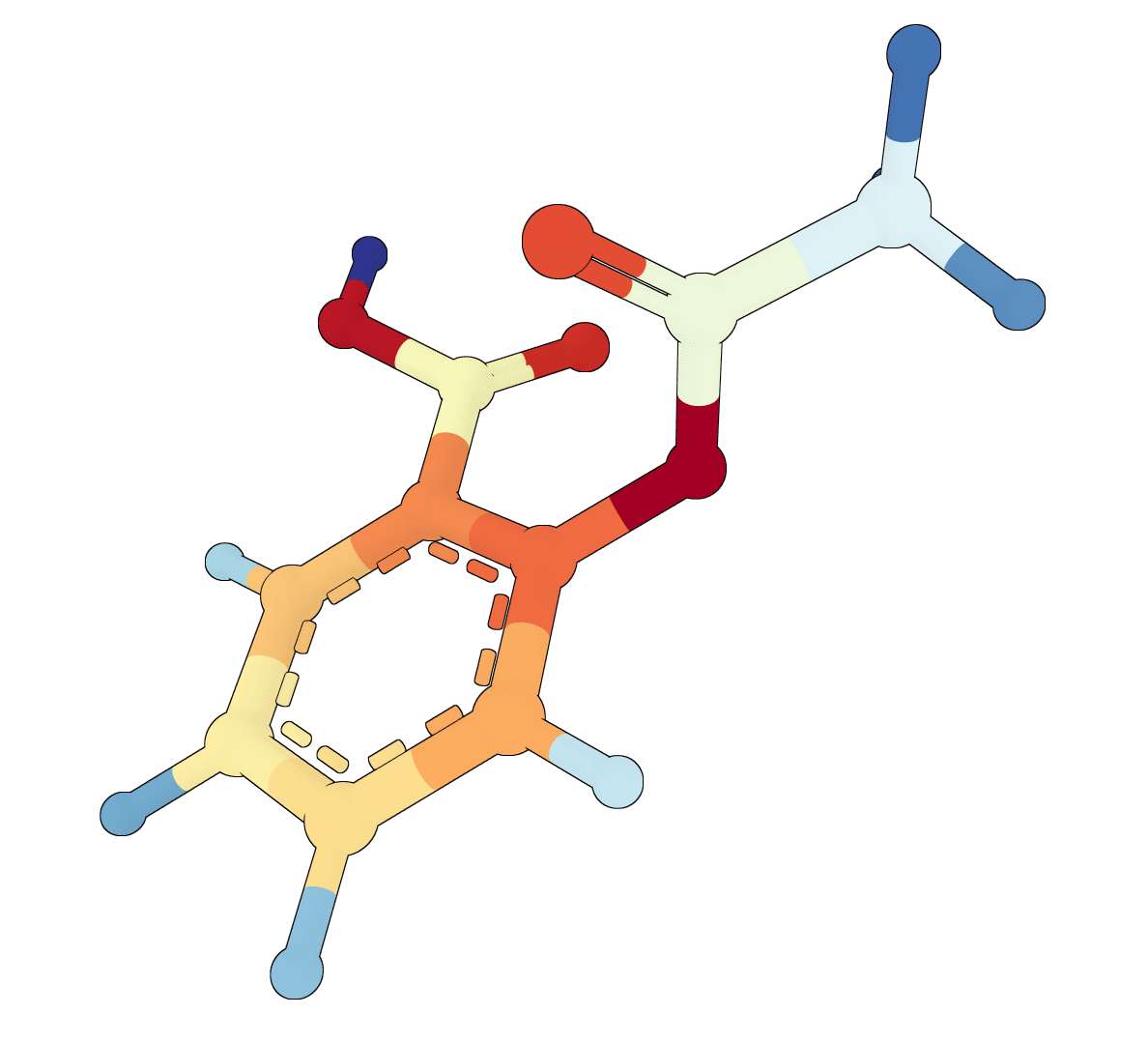
aspirin	CC(=O)Oc1ccccc1C(=O)O
Tab-delimited input preserves compound names in results. Plain SMILES input assigns generic identifiers (Compound_1, Compound_2, etc.).
You can also retrieve compound from PubChem by name or CID using the batch fetcher.
Output
The following is a sample result from our Lipinski's rule calculator of 10 SMILES.
| Name | SMILES | Weight (Da) | LogP | HBD | HBA | Violations | Passes RO5 |
|---|---|---|---|---|---|---|---|
| 2-Hydroxy-3-oxobutyl phosphate | CC(=O)C(COP(=O)(O)O)O | 184.08 | -0.95 | 3 | 4 | 0 | true |
| Acetaminophen | CC(=O)NC1=CC=C(C=C1)O | 151.16 | 1.35 | 2 | 2 | 0 | true |
| Aspirin | CC(=O)OC1=CC=CC=C1C(=O)O | 180.16 | 1.31 | 1 | 3 | 0 | true |
| Atorvastatin | CC(C)C1=C(C(=C(N1CCC(CC(CC(=O)O)O)O)C2=CC=C(C=C2)F)C3=CC=CC=C3)C(=O)NC4=CC=CC=C4 | 558.65 | 6.31 | 4 | 5 | 2 | false |
| Caffeine | CN1C=NC2=C1C(=O)N(C(=O)N2C)C | 194.19 | -1.03 | 0 | 6 | 0 | true |
| Ciprofloxacin | C1CC1N2C=C(C(=O)C3=CC(=C(C=C32)N4CCNCC4)F)C(=O)O | 331.35 | 1.58 | 2 | 5 | 0 | true |
| Fluoxetine | CNCCC(C1=CC=CC=C1)OC2=CC=C(C=C2)C(F)(F)F | 309.33 | 4.44 | 1 | 2 | 0 | true |
| Metformin | CN(C)C(=N)N=C(N)N | 129.17 | -1.24 | 3 | 1 | 0 | true |
| Sitagliptin | C1CN2C(=NN=C2C(F)(F)F)CN1C(=O)CC(CC3=CC(=C(C=C3F)F)F)N | 407.32 | 2.02 | 1 | 5 | 0 | true |
| Sunitinib | CCN(CC)CCNC(=O)C1=C(NC(=C1C)C=C2C3=C(C=CC(=C3)F)NC2=O)C | 398.48 | 3.33 | 3 | 3 | 0 | true |
The outputs are relatively self-explanatory:
- Name: molecule name you provided (Compound_1, Compound_2, etc. if you haven't provided the names)
- SMILES: The SMILES formula of the compound
- Weight [Da]: Molecular weight of the compound
- LogP: Calculated octanol–water partition coefficient
- HBD: Count of N–H and O–H groups
- HBA: Count of N and O atoms
- Violations: Number of Ro5 criteria exceeded (0–4)
- Passes RO5: True if ≤1 violation
When to use Lipinski's rule of five?
The rule serves as a preliminary filter rather than a definitive predictor. Compounds passing all criteria may fail in development for other reasons (toxicity, metabolic instability, lack of efficacy), while some rule-violating compounds achieve clinical success.
- Virtual screening: Filtering large compound libraries to prioritize candidates with favorable absorption properties
- Lead optimization: Guiding structural modifications to improve druglikeness
- Drug design: Establishing physicochemical boundaries for new molecular entities
Limitations
The rule applies specifically to oral drugs absorbed via passive transcellular diffusion. Several categories of clinically successful compounds violate Ro5:
- Natural products: Cyclosporine (MW = 1202 Da), erythromycin, and other macrocyclic compounds exceed multiple thresholds but achieve bioavailability through active transport or by adopting conformations that mask polar groups
- Transporter substrates: Compounds recognized by intestinal uptake transporters (PEPT1, OATP family) can achieve absorption despite unfavorable physicochemical properties
- Beyond rule of five (bRo5) compounds: Protein–protein interaction inhibitors often require larger molecular surfaces, leading to deliberate Ro5 transgression. These compounds may achieve oral bioavailability through intramolecular hydrogen bonding, chameleonicity, or active transport
- Formulation technologies: Prodrugs, lipid-based formulations, nanoparticles, and amorphous solid dispersions can enable oral delivery of otherwise poorly absorbed compounds
The rule does not apply to non-oral routes (intravenous, subcutaneous, inhaled) where gastrointestinal absorption is not required.
Related tools
Brenk filter
Identify toxic, reactive, and pharmacokinetically problematic molecular fragments using structural alert patterns
Lead-likeness filter
Screen for lead-like compounds using stricter molecular descriptor criteria than Lipinski or Veber rules for early-stage drug discovery
PAINS filter
Screen compounds for Pan-Assay Interference patterns that cause false positives in biological assays
Veber's rule
Screen molecular flexibility and polarity using Veber's rotatable-bond and topological polar surface area criteria.
ADMET-AI
Predict ADMET (Absorption, Distribution, Metabolism, Excretion, Toxicity) properties from SMILES strings using machine learning models trained on Therapeutics Data Commons datasets.
Admetica
Predict 22 ADMET properties from SMILES strings with the native Admetica Chemprop models from Datagrok.
eToxPred
Predict toxicity and synthetic accessibility of small molecules using machine learning. eToxPred combines toxicity risk assessment with synthetic accessibility scoring to help prioritize drug candidates.
QEPPI
Quantitative estimate for protein-protein interaction inhibitor potential. Evaluates drug-likeness for compounds targeting PPIs.
Structural alert screening
Screen compounds for structural toxicity alerts using PAINS, Brenk, and NIH filters. For focused screening, see PAINS Filter, Brenk Filter, or Veber's Rule.
AF2BIND
AF2BIND predicts ligand-binding residues from a protein structure using AlphaFold2 pair representations and a 20-residue bait sequence.