A scientist at a biotech company folds a target and a candidate binder on AlphaFold Server, gets a confident complex, and drops it into a project update. That use breaks the terms: AlphaFold Server and the AlphaFold 3 weights behind it are for non-commercial work only. Run the same job with AlphaFold 2 and nothing stops the company from using the result, because its code is Apache 2.0 and its weights are CC BY 4.0.
So the answer depends on the version. AlphaFold 2, ColabFold and the AlphaFold Database allow commercial use with attribution. AlphaFold 3 is available to companies only through a paid Google Cloud subscription. Several models with the same scope, including Boltz-2, Chai-1 and OpenFold3, carry permissive licenses on both the code and the weights.
Which AlphaFold versions allow commercial use
AlphaFold 2 is the open one. Google DeepMind released its code under Apache 2.0 and its trained parameters under CC BY 4.0, a license that allows commercial use as long as you credit the source.[1] ColabFold, which runs AlphaFold 2 with fast MMseqs2 alignments, is MIT licensed and loads the same parameters.[2]
AlphaFold 3 is split in two. Its source code moved from the non-commercial CC BY-NC-SA 4.0 license to Apache 2.0 on June 9, 2026, but the commit relicensed only the code.[3] The weights are still downloaded from Google under separate terms of use.[4] Those terms limit them to universities, non-profits and other non-commercial organizations, and forbid any use in connection with commercial activities, including research on behalf of a company.[5]
The restriction follows the predictions. Under the AlphaFold 3 Output Terms, a structure produced with the weights stays non-commercial in anyone's hands, and it may not be passed to a company except through a scientific publication or an open-source release.[6] Both sets of terms also forbid using AlphaFold 3 output to train a structure prediction model similar to AlphaFold 3.
AlphaFold Server runs AlphaFold 3 for free under the same non-commercial limit, with one more rule: its output may not feed an automated system that predicts protein binding to ligands or peptides, and the terms name Glide and AutoDock as examples.[7] A complex from the server cannot become the receptor for molecular docking in AutoDock Vina, even in academic work. A structure you predict with AlphaFold 2 or Boltz-2 can.
Companies that need AlphaFold 3 itself can license it through Google Cloud. AlphaFold 3 on the Gemini Enterprise Agent Platform is cleared for commercial use, but access goes through an allowlist and a commercial subscription arranged with a Google Cloud account team, and each endpoint needs its own A3 GPU virtual machine.[8]
The AlphaFold Protein Structure Database is the simplest case. Its more than 261 million predicted models are available for academic and commercial use under CC BY 4.0, so a company can download and build on them with attribution.[9]
| Version | What you get | License or terms | Commercial use |
|---|---|---|---|
| AlphaFold 2 and AlphaFold-Multimer | Code and weights | Apache 2.0 code, CC BY 4.0 weights | Yes, with attribution |
| ColabFold | Pipeline running AlphaFold 2 weights | MIT code, CC BY 4.0 weights | Yes, with attribution |
| AlphaFold 3, self-hosted | Code and weights | Apache 2.0 code since June 2026, AlphaFold 3 terms for weights and output | No, non-commercial organizations only |
| AlphaFold 3 on Google Cloud | Hosted model | Commercial subscription | Yes, after allowlist approval |
| AlphaFold Server | Free web service | AlphaFold Server terms | No |
| AlphaFold Database | Precomputed structures | CC BY 4.0 | Yes, with attribution |
Commercially licensed alternatives to AlphaFold 3
Since 2024, several groups have released models that predict the same mixed protein complexes as AlphaFold 3, with DNA, RNA, ligands and modified residues. Most come with licenses that cover the weights as well as the code. Boltz-2.1 is the exception: its developer sells it as a hosted service under its own terms.
| Model | Code license | Weights license | Commercial use |
|---|---|---|---|
| Boltz-2 | MIT | MIT | Yes, including affinity prediction |
| Boltz-2.1 | Not released | Not released, hosted API only | Yes, under Boltz's API terms |
| Chai-1 | Apache 2.0 | Apache 2.0 | Yes, including drug discovery |
| OpenFold3 | Apache 2.0 | Apache 2.0 | Yes |
| IntelliFold-2 | Apache 2.0 | Apache 2.0 | Yes |
| RoseTTAFold3 | BSD 3-Clause | BSD 3-Clause | Yes |
| Protenix | Apache 2.0 | Apache 2.0 for v1 and earlier, proprietary for v2 | Yes, with v1 weights |
Boltz-2 license
Boltz-2's code and weights are both MIT licensed, and its authors state that they are free for academic and commercial use.[10] The license covers the affinity module as well as structure prediction, so the binding affinity estimates Boltz-2 reports can be used commercially along with the complexes.
Boltz-2.1 license
Boltz-2.1 is not part of that MIT release. Boltz offers it through its hosted API, so its use is governed by Boltz's API terms rather than an open-source license.[11] Those terms separate a company calling the API for its own work from a platform building Boltz models into a product, which needs Boltz's integration terms. ProteinIQ runs Boltz-2.1, BoltzMol-1 and BoltzProt-1 under those integration terms.
Chai-1 license
Chai-1 is released under Apache 2.0 for both the code and the model weights, and Chai Discovery says this covers commercial use, including drug discovery.[12] The license applies to Chai-1 only. The company's antibody design model, Chai-2, is not part of that release.
OpenFold3 license
OpenFold3, the AlQuraishi Lab and OpenFold consortium's open reimplementation of AlphaFold 3, is Apache 2.0, and the project describes its repository as free for academic and commercial use.[13] The parameters published on Hugging Face are listed under the same license.[14]
IntelliFold-2 license
IntelliFold-2's code and model parameters are Apache 2.0.[15] Since June 2026 it runs on AlphaFold 3's inference code, a change its developers tie to that code's move to Apache 2.0. The repository ships IntelliGen AI's own weights and none of AlphaFold 3's, so the non-commercial weight terms do not reach it.
RoseTTAFold3 license
RoseTTAFold3 (RF3) ships in the Institute for Protein Design's Foundry package under a BSD 3-Clause license that explicitly covers the model weights as well as the code.[16] The same license applies to RFdiffusion3 and to the Foundry builds of ProteinMPNN and LigandMPNN.
Protenix license
Protenix shows why the weights need a check of their own. ByteDance releases the project, code and model parameters, under Apache 2.0, but the newer Protenix-v2 weights are proprietary and are not released under any open-source license.[17] Protenix on ProteinIQ runs the Apache-licensed v1 weights.
Protein design and language model licenses
Design tools follow the same logic, with one difference: some of them install other software that needs a license of its own. That is the case for BindCraft, the one model in Table 3 whose standard setup is not fully open for companies.
| Model | Task | License | Commercial use |
|---|---|---|---|
| RFdiffusion | Backbone generation | BSD, code and weights | Yes |
| RFdiffusion3 | All-atom design | BSD 3-Clause, code and weights | Yes |
| ProteinMPNN | Sequence design | MIT, code and weights | Yes |
| LigandMPNN | Sequence design around ligands | MIT, code and weights | Yes |
| RFantibody | Antibody and nanobody design | MIT | Yes |
| BoltzGen | Binder design | MIT, code and weights | Yes |
| Proteina-Complexa | Binder design | Apache 2.0 code, NVIDIA Open Model License weights | Yes |
| BindCraft | Binder design | MIT code, CC BY 4.0 AlphaFold 2 weights | Yes, but the stock pipeline needs a PyRosetta license |
| FreeBindCraft | Binder design | MIT, with PyRosetta optional | Yes, when run without PyRosetta |
| ESM-2 and ESMFold | Language model and folding | MIT | Yes |
| ESM C, ESMFold2 and ESM3 open | Language model, folding and generation | MIT since May 2026 | Yes |
RFdiffusion license
RFdiffusion is released under a BSD license that covers the code and the downloadable weights, and its documentation states that it is free for non-profit and for-profit use.[18] RFdiffusion3 uses the Foundry license described above. ProteinMPNN, the usual next step for designing sequences onto generated backbones, is MIT licensed.[19] Its sibling LigandMPNN publishes both code and model parameters under MIT as well.[20]
RFantibody, which adapts RFdiffusion to antibody design, is also MIT licensed.[21] So is BoltzGen, the Boltz team's binder design model: its code is MIT, and its weights on Hugging Face are listed under the same license.[22][23] Unlike Boltz-2.1, BoltzGen runs from the open release.
Proteina-Complexa license
NVIDIA releases Proteina-Complexa's code under Apache 2.0 and its weights under the NVIDIA Open Model License.[24] That second license is NVIDIA's own, but it states that the models are commercially usable and that NVIDIA claims no ownership of the outputs. A different license on the weights does not always mean a restriction; it means reading a second document.
BindCraft license
BindCraft's code is MIT, but its install script adds PyRosetta, and the documentation notes that PyRosetta requires a license for commercial purposes.[25] The stock pipeline uses Rosetta to relax designs and score their interfaces, so a company running it as published needs a Rosetta commercial license on top of the open-source one.
On ProteinIQ, BindCraft runs without PyRosetta. Designs are relaxed with OpenMM, and the Rosetta energy filters are replaced by AlphaFold 2 confidence and geometry checks, so protein binder design with it needs no Rosetta license. FreeBindCraft, an MIT-licensed fork of BindCraft 1.52, takes the same route with a --no-pyrosetta option: OpenMM handles relaxation, and open-source tools compute shape complementarity and surface area.[26]
ESM license
Every current ESM model can be used commercially. ESM-2 and the original ESMFold are MIT licensed.[27] The newer models were not: until May 2026, ESM C 600M and the ESM3 open model carried EvolutionaryScale's Cambrian Non-Commercial License, ESM C 300M had a separate open license, and ESM C 6B was offered only through an API.[29]
That month, Chan Zuckerberg Biohub, which now publishes the ESM repository, moved its models to MIT, including ESM C, ESMFold2 and the ESM3 open model.[28] If your team ruled out ESM C 600M or ESM3 for commercial work in 2025, that decision is worth revisiting.
Why the license on GitHub is not the whole answer
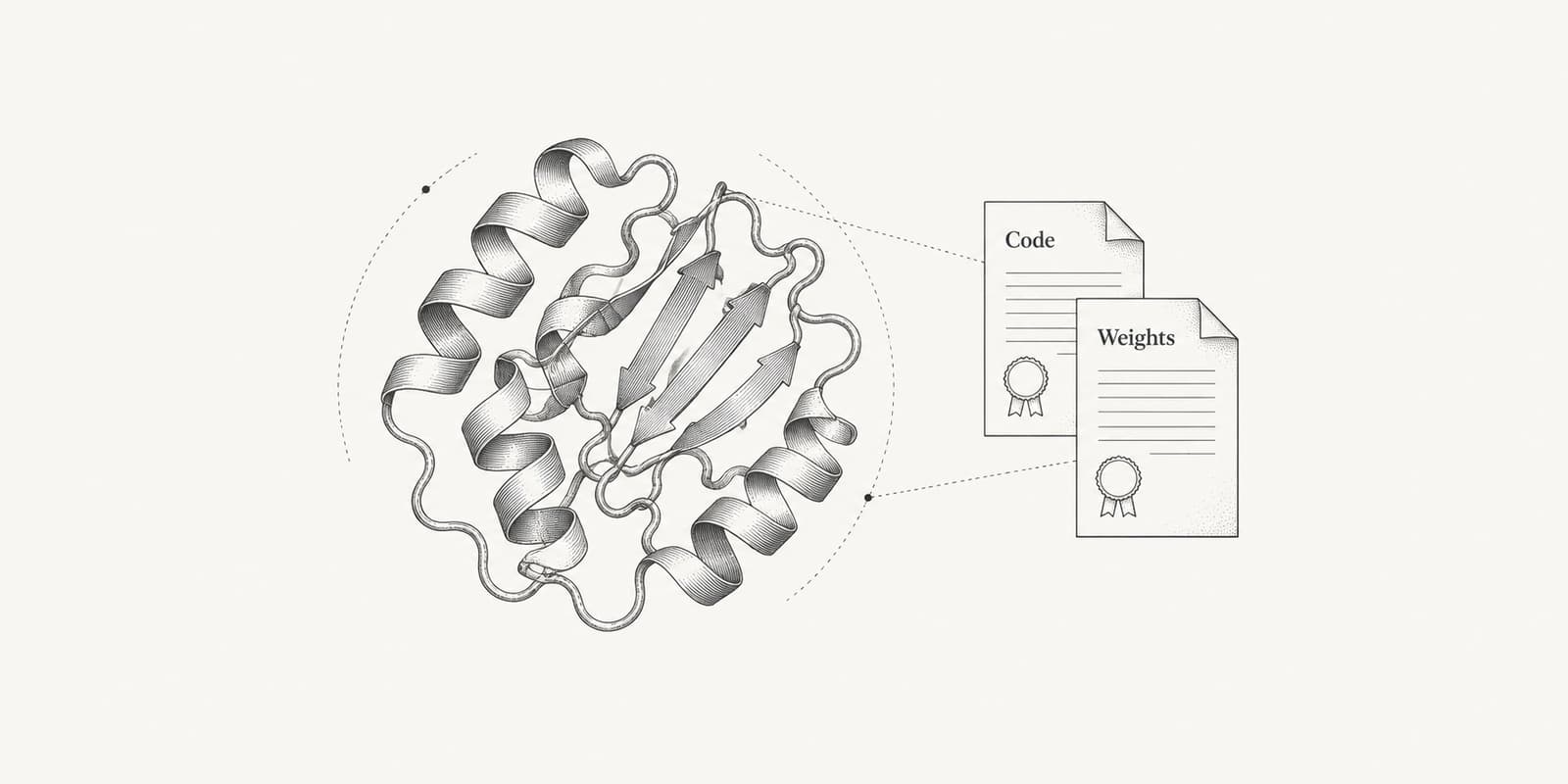
AlphaFold 3 shows why one license is not enough: the same repository holds Apache code and non-commercial weights. In practice, a model is usable for commercial work only when four layers allow it:
- the code license
- the weights license, which can differ from the code
- software the pipeline installs and runs, such as PyRosetta in BindCraft
- outside services a run depends on, such as a public alignment server or a hosted API, which set their own terms
The third layer is the one people miss. A pipeline can be MIT on GitHub and still install a component that is free only for non-commercial use. Read the install script as well as the LICENSE file, and check which steps the default settings run.
Services come last. AlphaFold 2 and most models in Table 2 can use multiple sequence alignments, and many setups fetch them from ColabFold's public MMseqs2 server. Its maintainers ask for serial queries from a single IP address and no use from multiple computers, which does not fit a company running many predictions in parallel.[2]
Finally, check what the terms say about the predictions. Permissive licenses such as MIT, Apache 2.0 and BSD place no conditions on the structures you generate. AlphaFold 3 and AlphaFold Server attach terms to the output itself, so the restriction travels with the file to whoever receives it.[6]
Running these models on ProteinIQ
ProteinIQ hosts a model only when all four layers allow paid hosting. That is why the AlphaFold 3 weights are absent, why Protenix runs its v1 weights and why BindCraft runs without Rosetta. Every model linked in Tables 2 and 3 runs in the browser without installing anything, from protein structure prediction with AlphaFold 2 or Boltz-2 to backbone design with RFdiffusion.
Companies that need several seats, invoices or a data processing agreement can buy through enterprise plans. Licenses were checked against each project's repository and terms on October 16, 2026, and they change, as AlphaFold 3 and ESM showed this year. This page summarizes public terms and is not legal advice.