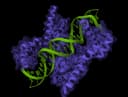
Open-source biomolecular structure prediction with Protenix
Open-source biomolecular structure prediction with Protenix
Protenix is ByteDance Research's open-source reproduction of AlphaFold 3. Give the Protenix server on ProteinIQ a protein, DNA or RNA sequence, a ligand and a metal ion, and one run returns the whole complex as ranked mmCIF models with Protenix's own confidence files, shown in a 3D viewer next to a table of scores.
ProteinIQ runs the open Protenix v1 checkpoints with version 2.0.0 of the protenix software package. The 368-million-parameter v1 base model is the default, and six other base, mini and tiny checkpoints are available for comparison or faster runs. A default job samples five structures from one seed, ranks them by Protenix's ranking_score, and skips the MSA search unless you turn it on.
ByteDance released Protenix-v2, a 464-million-parameter model, on 8 April 2026. The Protenix README says its weights are proprietary, carry no open-source licence and may not be distributed without the rights holder's written consent, so ProteinIQ does not run it. The version numbers invite confusion: protenix 2.0.0 is the software release, while the model here is v1 or an older v0.5 checkpoint.
ByteDance hosts its own Protenix server, linked from the Protenix repository. Its sign-in page says the server is free for all applications, including commercial use, and that you sign in through a link sent by email. It covers proteins, ligands, ions, DNA, RNA and covalent modifications, and it also hosts PXDesign for binder design. ProteinIQ is not affiliated with ByteDance, and this page is not the official service.
What ProteinIQ adds is the surrounding workspace. Jobs are saved in your history next to every other tool, the ranked models open in a 3D viewer with a Data table of scores, and the native confidence JSON downloads with each model.
You can also upload precomputed paired, unpaired and RNA alignments, choose among seven v0.5 and v1 checkpoints, send a predicted structure straight to MolProbity, fpocket or a Ramachandran plot, and, on paid plans, submit the same job through the ProteinIQ API.
It also leaves things out. Covalent bonds, residue and nucleotide modifications, contact or pocket restraints and structural templates have no inputs here, and a job is limited to 4,000 residues across all molecules.
Protenix jobs start at 50 credits. The quote depends on the size of the complex, the checkpoint, the number of predicted structures, the MSA search and Training-Free Guidance. The exact quote is calculated before submission.
ProteinIQ sizes a job by the larger of its token count and one tenth of its estimated heavy-atom count. In practice an amino acid counts as about 1 token, a nucleotide as about 2.2 and a ligand as about 1 per 10 heavy atoms. A 300-residue protein with ATP and a magnesium ion therefore prices like the protein alone, while adding two 100-nucleotide DNA strands moves it into the next size band.
| Job size (tokens) | Default | Use MSA on | 5 seeds | 5 seeds and MSA | Protenix mini | Protenix tiny |
|---|---|---|---|---|---|---|
| Up to 150 | 50 | 75 | 83 | 165 | 50 | 50 |
| 151 to 500 | 75 | 150 | 165 | 330 | 50 | 50 |
| 501 to 1,000 | 150 | 300 | 330 | 660 | 53 | 50 |
| 1,001 to 1,500 | 250 | 500 | 550 | 1,100 | 88 | 63 |
| 1,501 to 2,000 | 400 | 800 | 881 | 1,761 | 140 | 100 |
| 2,001 to 2,500 | 600 | 1,200 | 1,320 | 2,640 | 210 | 150 |
| 2,501 to 3,000 | 900 | 1,800 | 1,981 | 3,961 | 315 | 225 |
| 3,001 to 4,000 | 1,250 | 2,500 | 2,750 | 5,500 | 438 | 313 |
The table assumes the default Protenix v1 base model, 5 samples per seed and Training-Free Guidance off; 5 seeds means 25 structures. The mini column applies to all three mini checkpoints. Training-Free Guidance adds 20 percent, and the constraint checkpoint 10 percent. The 2025 data-cutoff base model costs the same as the default, and Export atom confidence JSON does not change the price.
Each molecule is a separate entry, with up to 10 entries of each type. Every job needs at least one molecule, and the total across all molecules may not exceed 4,000 residues.
| Input | Accepted forms | Notes |
|---|---|---|
| Protein | FASTA sequence, PDB or ENT file up to 50 MB, or RCSB PDB ID | The 20 standard amino acids plus X. Gaps and stop symbols are rejected before the job is charged. |
| Ligand | SMILES or CCD code (for example ATP) as text, SDF, MOL or MOL2 file up to 10 MB, or PubChem | Ligand files must contain 3D coordinates. |
| DNA | FASTA sequence, or FASTA or PDB file up to 10 MB | A, T, G, C. |
| RNA | FASTA sequence, or FASTA or PDB file up to 10 MB | A, U, G, C. |
| Ion | CCD code, such as ZN, MG, CA or FE | One ion per entry. |
| Paired MSA | Pasted or uploaded .a3m, up to 25 MB | Attached to a protein chain label. Requires Use MSA. |
| Unpaired MSA | Pasted or uploaded .a3m, up to 25 MB | Attached to a protein chain label. Requires Use MSA. |
| RNA MSA | Pasted or uploaded .a3m, up to 25 MB | Unpaired alignment attached to an RNA chain label. Requires Use MSA. |
Protenix uses a 3D ligand file's coordinates as the ligand's reference conformer. An SDF or MOL ligand drawn in 2D, with every z-coordinate at zero, has no conformer to read, so ProteinIQ passes its structure to Protenix as canonical SMILES and Protenix generates the conformer with RDKit, exactly as for a typed SMILES. Stereocenters come from the drawing's wedge bonds, unmarked ones stay unassigned, and the ligand's atoms in the result are numbered in SMILES order rather than file order. A 2D ligand named by an atom-level covalent bond or contact is refused instead, because the renumbering would move the constraint to another atom. A protein PDB file supplies its sequence only; its coordinates are not used as a template.
Precomputed alignments attach to the chain letters shown on the protein or RNA cards. When there is only one eligible chain, the target label can stay blank and the alignment attaches to that chain automatically. If you need a FASTA file first, TXT to FASTA converts pasted sequences.
| Parameter | Type | Default | Description |
|---|---|---|---|
Model seeds | integer | 1 | Number of random seeds, 1 to 5. Seeds start at 101, and each seed runs its own diffusion sampling. |
Model | enum | Protenix v1 base (368M, training cutoff 2021-09-30) | Checkpoint used for inference. See the model table below. |
| Parameter | Type | Default | Description |
|---|---|---|---|
Use MSA (2x credits) | boolean | false | Runs the official Protenix MSA search before prediction and doubles the quote. The search has a 15-minute limit; if it runs out, the job fails instead of continuing without MSA. |
Samples per seed | integer | 5 | Structures generated per seed, 1 to 5. The job returns seeds × samples predictions, up to 25. |
Training-Free Guidance | boolean | false | Applies geometric and physical guidance during diffusion sampling to improve plausibility. Adds 20 percent to the quote. |
Export atom confidence JSON | boolean | false | Saves Protenix's atom-level full_data JSON for each prediction, which includes the token-pair PAE matrix. Output files get larger; the price does not change. |
| Model | Parameters | Notes |
|---|---|---|
| Protenix v1 base, cutoff 2021-09-30 | 368M | Default model for general structure prediction. |
| Protenix v1 base, cutoff 2025-06-30 | 368M | Trained on structures released up to mid-2025. Prefer the 2021 model when benchmarking against structures released after 2021, to avoid training overlap. |
| Protenix constraint base | 368M | Checkpoint built for contact and pocket guidance. ProteinIQ has no restraint inputs, so it runs unconstrained here. |
| Protenix mini | 135M | Mini model listed as the fast option. Priced at 0.35 times the base model above the 50-credit minimum. |
| Protenix mini ISM | 135M | Lightweight mini variant. |
| Protenix mini default | 134M | Lightweight mini variant. |
| Protenix tiny default | 109M | Fastest and cheapest checkpoint, for quick estimates before a full run. |
Results open in three tabs. Viewer shows each predicted structure in 3D, Data lists the predictions with their scores, and Files holds every download.
| Output | Format | Contents |
|---|---|---|
prediction_rankNN.cif | mmCIF | One predicted structure per sample, with per-atom pLDDT in the B-factor column. |
| Summary confidence JSON | JSON | Protenix's native summary_confidence file for each prediction: ranking_score, plddt, ptm, iptm, gpde, per-chain and chain-pair scores, has_clash, disorder and num_recycles. |
| Atom confidence JSON | JSON | Optional full_data file with per-atom pLDDT, token-pair PAE and PDE, and contact probabilities. |
The confidence JSON files are Protenix's own output and are not modified.
Protenix ranks samples with the AlphaFold 3 formula, 0.8 × ipTM + 0.2 × pTM + 0.5 × disorder minus 100 when chains clash. In the current Protenix code the disorder term is always zero, so the score is effectively 0.8 × ipTM + 0.2 × pTM, and any sample with has_clash set drops far below the rest. Within a seed, the sample with the highest ranking_score is written first.
Two consequences follow. For a single chain, ipTM is zero, so ranking_score is just a fifth of pTM and tops out at 0.2; it is not comparable between a monomer job and a complex job. And the score is for choosing between samples of one job, not a probability that the complex is right.
Start with the top-ranked model, confirm has_clash is false, then compare it with the next few. When the top models agree, the prediction is stable; when they place a chain or ligand differently, the arrangement is uncertain whatever the scores say. US-align or the RMSD calculator puts a number on that agreement.
pLDDT is reported per atom in the CIF and averaged to a 0 to 100 plddt in the summary file. Ligand and ion atoms get their own values, so a ligand pose can be judged separately from the pocket around it.
| pLDDT | Reading |
|---|---|
| Above 90 | High confidence in local geometry, including side chains. |
| 70 to 90 | Backbone likely correct. |
| 50 to 70 | Low confidence; use with caution. |
| Below 50 | Unreliable, often disordered. |
Treat a region below 50 as unplaced, whatever shape it takes in the viewer. Long disordered tails and loops lower the averaged scores without saying anything about the folded core, so check where the low values sit before discarding a model.
pTM rates the whole assembly and ipTM rates how the chains sit relative to each other. The AlphaFold 3 reading carries over: ipTM above 0.8 is a confident complex, 0.6 to 0.8 is a gray zone, and below 0.6 the arrangement has likely failed, while pTM above 0.5 suggests the overall fold is right. The ipTM vs pTM explainer covers why disordered regions pull ipTM down.
The global ipTM averages every interface in the job. With three or more chains, read chain_pair_iptm instead: it holds one score for each pair, so you can see which interface is confident and which is not. Each ligand and ion is its own chain in Protenix output, so the protein and ligand entry rates that ligand's placement.
chain_iptm, chain_ptm and chain_plddt summarise each chain. gpde is Protenix's global predicted distance error, where lower is better.
The summary file does not contain the full PAE matrix. Turn on Export atom confidence JSON to get token_pair_pae, which shows whether domains and chains are placed correctly relative to each other. Low PAE between two chains supports the interface; high PAE says their relative position is a guess even when each chain is confident on its own. The structure prediction confidence guide puts these scores in a reading order.
Protenix follows the AlphaFold 3 architecture. A trunk builds representations of every token and token pair from the sequences, chemistry and optional alignments, and a diffusion module starts from random atom coordinates and denoises them into a structure. Each seed and sample draws a different starting point, which is why one job returns several structures.
For proteins, an MSA supplies evolutionary context: conserved residues and co-evolving pairs constrain which residues sit close together. The MSA search is also the main source of runtime variation. If you already have alignments, precomputed .a3m files replace a new search for the chains they are attached to.
The confidence heads are trained alongside the structure model. They report how internally consistent a prediction is, not whether it matches an experiment. A model that copies a homolog with a different binding mode can score well and still be wrong, so validation tools such as MolProbity remain useful after a high-confidence run.
The main differences are molecule scope, evolutionary inputs, guidance options, and whether the result describes one structure, an ensemble, or binding affinity.
| Tool | Best for | Key distinction |
|---|---|---|
| Protenix | General all-atom complexes | Multiple model sizes, protein and RNA MSAs, optional atom confidence; no affinity prediction or user restraints. |
| Boltz-2 | Protein-ligand structure and affinity | Returns binder probability and affinity estimates; supports templates, constraints, and CCD covalent bonds. |
| Chai-1 | Guided complex prediction | Combines MSA and template search with contact, pocket, and modified-residue inputs. |
| OpenFold 3 | Open AlphaFold 3 research workflows | Trainable research preview with automatic MSA generation and low-memory inference. |
| RosettaFold3 | Alternative all-atom complex prediction | Handles proteins, DNA, RNA, and ligands with multi-model sampling. |
| IntelliFold 2 | Fast multi-component prediction | Offers a fast Flash model, optional MSA generation, and ranked complex structures. |
| AlphaFold2 | Protein monomers and multimers | Established protein-only workflow with single-sequence or MSA-assisted prediction. |
| ESMFold2 | Protein chains and protein complexes | Language-model folding with no MSA search and optional PAE and pair-chain ipTM outputs. |
| ESMFold | Rapid single-sequence protein folding | Predicts protein structures without an MSA and returns PDB, pLDDT, and optional PAE. |
| AlphaFlow | Protein conformational ensembles | Samples multiple structures to represent flexibility rather than one static prediction. |
| HighFold | Cyclic peptide structures | Models head-to-tail cyclization and disulfide constraints with an AlphaFold2-derived method. |
Protenix is a strong default for unconstrained complexes containing several molecule types. Boltz-2 is the clearer choice for ligand affinity or pocket guidance, while Chai-1 is useful when templates, known contacts, or modified residues should influence the model. More options for multi-chain targets are compared under protein complex structure prediction.
Folding models predict structures from sequences and chemical inputs. For docking into a prepared receptor, AutoDock Vina searches a defined box and reports scores in kcal/mol, while DiffDock predicts ligand poses without a predefined box.

Predict 3D structures for proteins, ligands, DNA, RNA, and multi-component complexes.

Predict controllable biomolecular structures for proteins, ligands, DNA, RNA, and complexes.

All-atom biomolecular structure prediction

Open-source AlphaFold3-based structure prediction for proteins, ligands, DNA, and RNA

Open-source structure prediction for proteins, nucleic acids, and ligands

Predict biomolecular complex structures and binding affinities for proteins, ligands, DNA, and RNA.

Low-memory Boltz inference for biomolecular structure and affinity prediction

Structure and binding prediction for proteins, DNA, RNA and ligands.

Predict paired antibody variable-domain structures from heavy and light chain sequences.

Generate protein conformational ensembles from sequence or structure inputs.