Design de novo protein binders for target surfaces using structure-guided sequence generation. Learn more
Input
What is BindCraft?
BindCraft designs de novo protein binders against a target structure by combining AlphaFold2-guided backbone hallucination, ProteinMPNN sequence redesign, and PyRosetta interface scoring. It is built for cases where the goal is not to rank existing binders, but to generate entirely new mini-proteins that recognize a chosen surface patch.
The method is strongest on structured protein surfaces with clear geometric constraints. It is less reliable on highly flexible, disordered, or poorly resolved targets, where the hallucinated binder can optimize against an uncertain surface.
How to use BindCraft online
BindCraft on ProteinIQ accepts a target PDB structure plus chain selection, runs the native multi-stage binder-design pipeline in the cloud, and returns ranked binder-target complexes, full accepted-design metrics, and the remaining native CSV and artifact files for download in one job.
Inputs
| Input | Description |
|---|---|
Target Protein | One target structure in .pdb or .ent format. A structure can also be fetched from RCSB in PDB format. |
target_chains | Target chain ID or comma-separated chain list, for example A or A,B. Only the selected chains are used during design. |
hotspot_residues | Optional residues, ranges, or whole chains such as 56, 1-10, A15, A1-10,B1-20, or A. Unchained values use the first selected target chain. |
Settings
| Setting | Description |
|---|---|
num_designs | Number of final accepted designs requested. Higher values increase runtime because more successful trajectories must pass filtering. |
length_min | Minimum binder length in residues. Shorter binders are faster to search but may not provide enough interface area for difficult targets. |
length_max | Maximum binder length in residues. Larger binders can cover broader interfaces but expand the search space. |
plddt_threshold | Displayed on the familiar 0-100 scale, default 80. Internally this is converted to the native normalized 0.8 threshold and written into Average_pLDDT, 1_pLDDT, and 2_pLDDT. |
ptm_threshold | native normalized pTM filter threshold, default 0.55. Applied to Average_pTM, 1_pTM, and 2_pTM. |
i_ptm_threshold | native normalized interface pTM threshold, default 0.5. Applied to Average_i_pTM, 1_i_pTM, and 2_i_pTM. |
design_algorithm | 4stage (default), 3stage, or 2stage. The four-stage preset is the default and gives the most thorough optimization. |
use_multimer | Uses the AlphaFold2-multimer design preset, default true. This matches the default_4stage_multimer.json configuration. |
sample_models | Randomly samples AlphaFold2 model parameters during design, default true, which reduces overfitting to one parameter set. |
Outputs
| Output | Description |
|---|---|
| Ranked complex PDBs | Primary outputs for accepted binder-target complexes, preserving BindCraft's native filenames. Below-threshold candidates are secondary outputs. |
final_design_stats.csv | The accepted-design table produced by native BindCraft. ProteinIQ preserves this ranking and surfaces the full metric record in the Data tab. |
mpnn_design_stats.csv | Statistics for all ProteinMPNN redesign attempts, including accepted and rejected candidates. |
trajectory_stats.csv | Metrics for the hallucination trajectories before final sequence redesign. |
failure_csv.csv | Running counts of filter failures and rejection reasons across the job. |
bindcraft.log | Combined native stdout and stderr plus the reviewed BindCraft and ColabDesign source revisions. |
| Remaining native artifacts | Below-threshold PDB candidates, HTML trajectory animations, PNG plots, ZIP archives, FASTA files, JSON files, and text artifacts are returned when full diagnostic artifacts are enabled. |
How does BindCraft work?
AlphaFold2-guided hallucination
BindCraft uses AlphaFold2-Multimer as an optimization target rather than only as a predictor. The sequence is updated iteratively so that the predicted complex improves interface confidence, binder compactness, and other structural objectives.
Hotspot residues change the loss function, not the final scoring rule. A hotspot list can steer the search toward a preferred epitope, but the model can still drift toward a nearby surface if that geometry produces a more favorable predicted interface.
Multi-stage optimization
The 4stage protocol moves through progressively more discrete sequence representations. Early stages optimize softer sequence distributions, later stages enforce one-hot amino acid identities and mutation steps. The shorter 3stage and 2stage presets reduce compute cost by dropping some of that optimization path.
This matters most on difficult targets. Easy targets often produce acceptable binders under more than one preset, while hard interfaces benefit from the broader exploration provided by the four-stage search.
ProteinMPNN redesign and binder-alone validation
After a promising backbone is found, ProteinMPNN redesigns the binder sequence around that geometry. native BindCraft then re-predicts the binder-target complex and also predicts the binder alone, which is why the accepted-design table includes both interface metrics and binder-only validation metrics such as Average_Binder_pLDDT, Average_Binder_pTM, Average_Binder_pAE, and Average_Binder_RMSD.
Filtering and relaxation
native filtering is applied at multiple points. Early AlphaFold checks screen out weak trajectories, final acceptance combines the Average_* and model-indexed thresholds, and PyRosetta relaxation adds interface energetics and packing metrics such as Average_dG, Average_PackStat, Average_ShapeComplementarity, and Average_dSASA.
Understanding the results
The viewer shows a compact subset of fields for fast triage. The Data tab now contains the full accepted-design row from final_design_stats.csv, which is the best place to inspect why one design outranks another.
A run can also finish with no accepted designs. This is still a valid native BindCraft outcome when execution ends before any trajectory passes the active filters. In that case, inspect failure_csv.csv and trajectory_stats.csv, then broaden the search, relax filters, or lower pLDDT, pTM, and i_pTM thresholds for exploratory runs.
Metrics that usually matter first
| Metric | What it means |
|---|---|
Average_i_pTM | Predicted interface confidence. This is usually the first metric to inspect because it reflects whether the binder-target geometry looks self-consistent. |
Average_pLDDT | Overall local confidence across the predicted complex. Low values usually mean uncertain backbone geometry. |
Average_pTM | Global fold confidence for the complex. Useful as a stability check, but less interface-specific than Average_i_pTM. |
Average_pAE | BindCraft's normalized predicted aligned error on a 0-1 scale. Lower is better; it is not reported in angstroms. |
Average_dG | PyRosetta interface energy in REU. More negative values suggest a more favorable interface after relaxation. |
Average_ShapeComplementarity | How well the two surfaces fit together geometrically. Higher values generally indicate tighter packing. |
Average_PackStat | Packing quality of the interface. Higher is generally better. |
Average_dSASA | Buried solvent-accessible surface area on binding. Larger interfaces often bury more area, but large buried area alone does not guarantee a good design. |
Average_n_InterfaceResidues | Count of residues participating in the interface. Helps distinguish point contacts from broader binding patches. |
Average_Hotspot_RMSD | Distance from the designed binder pose to the intended hotspot geometry when hotspot targeting is used. Lower is better. |
Average_Binder_RMSD | How much the binder-alone prediction drifts from the complex-derived backbone. Large drift suggests the binder may depend on the target to stay folded. |
Practical interpretation
High-confidence designs usually combine strong Average_i_pTM, acceptable Average_pLDDT, and favorable interface energetics. A design with excellent Average_dG but weak Average_i_pTM often reflects a Rosetta-favored interface built on an uncertain AlphaFold geometry. A design with strong interface confidence but poor binder-alone metrics may bind only in the model because the isolated binder is unstable.
The native rank in final_design_stats.csv should be treated as the starting point, not the final answer. For experimental follow-up, the most useful shortlist often balances:
- Interface confidence from
Average_i_pTM - Structural confidence from
Average_pLDDT - Packing and energetics from
Average_ShapeComplementarity,Average_PackStat, andAverage_dG - Binder-alone stability from
Average_Binder_pLDDT,Average_Binder_pTM, andAverage_Binder_RMSD
When to use BindCraft vs alternatives
BindCraft is for de novo binder generation. It is not the right choice when a sequence already exists and only structure prediction, affinity ranking, or docking is needed.
| Tool | Best use case |
|---|---|
| BindCraft | Designing brand-new protein binders to a known target surface |
| ProteinMPNN | Sequence redesign for an existing backbone, without the full binder-hallucination pipeline |
| EvoPro | Optimizing protein binder sequences with evolutionary search and structure prediction feedback |
| AlphaFold 2 | Structure prediction for an existing protein or complex sequence |
| DiffDock | Small-molecule docking, not protein-binder generation |
| AutoDock Vina | Physics-based small-molecule docking and pose ranking |
Related tools
EvoPro
Optimize protein binders using genetic algorithms combined with AlphaFold2 fitness evaluation and ProteinMPNN sequence design. EvoPro evolves protein sequences to maximize binding affinity and structural quality through iterative cycles of mutation, selection, and validation.
PepMLM
Design linear peptide binders for target proteins using a target sequence-conditioned masked language model. PepMLM generates peptide sequences optimized to bind specific protein targets based on ESM-2 protein language modeling.
BoltzGen
BoltzGen uses generative diffusion models to design protein, peptide, nanobody, and Fab binders against protein and small-molecule targets.
mBER
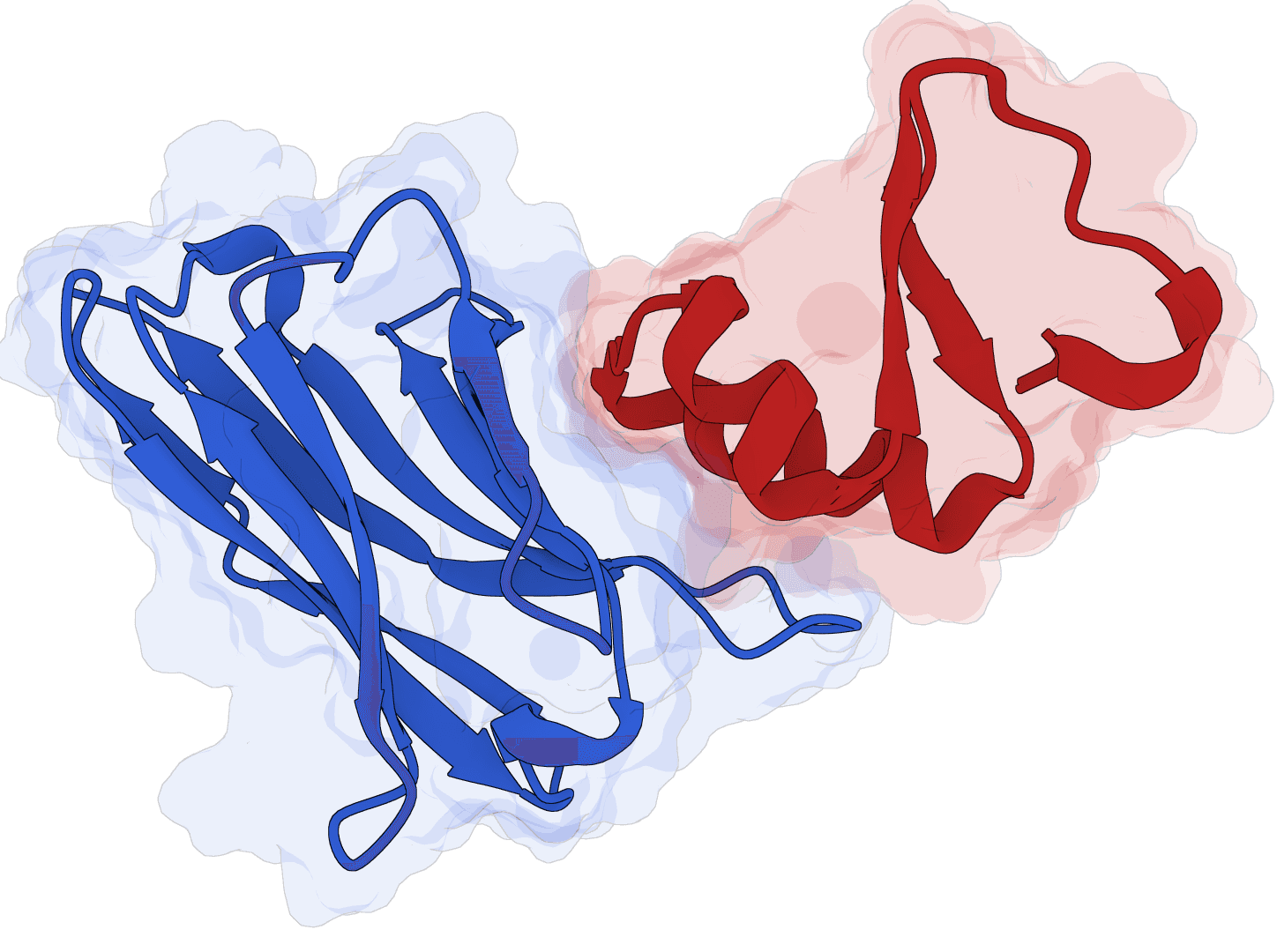
Design VHH nanobody binders using AlphaFold-Multimer with structure templates and sequence conditioning. mBER (Manifold Binder Engineering and Refinement) generates novel VHH antibody sequences that bind to user-specified target proteins.
PepMimic
PepMimic designs short peptides that mimic the binding interface of a known protein binder on its target. From a reference protein complex, a latent diffusion model generates peptide candidates constrained to the target interface, and each candidate is scored by interface-mimicry against the reference binder.
Proteina-Complexa
Design protein binders against a target structure with NVIDIA BioNeMo's Proteina-Complexa generative pipeline.
Genie 3
Generate protein structures and scaffolds with Genie 3, an all-atom SE(3)-equivariant diffusion model. Genie 3 supports unconditional protein generation, motif scaffolding, and hotspot-targeted binder design.
PocketFlow
PocketFlow is a structure-based molecular generative model that designs novel drug-like molecules within protein binding pockets. It uses autoregressive flow modeling with chemical knowledge to generate 100% chemically valid, highly drug-like compounds.
PocketXMol
PocketXMol is a pocket-interacting generative foundation model for small-molecule or peptide docking and design in protein binding pockets.
ProFam
ProFam-1 is a protein family language model for family-conditioned sequence generation. Provide a protein family in FASTA, A2M, or A3M format and generate new sequences with model likelihood scores for downstream ranking and screening.