TL;DR
- Run AlphaFold2 online by pasting a protein sequence into a webserver, choosing an MSA mode, and submitting. Results come back as ranked PDB models with per-residue confidence scores.
- MSA depth drives accuracy: single-sequence mode is fast but weaker, while a full sequence search recovers the evolutionary signal AlphaFold2 needs for hard targets.
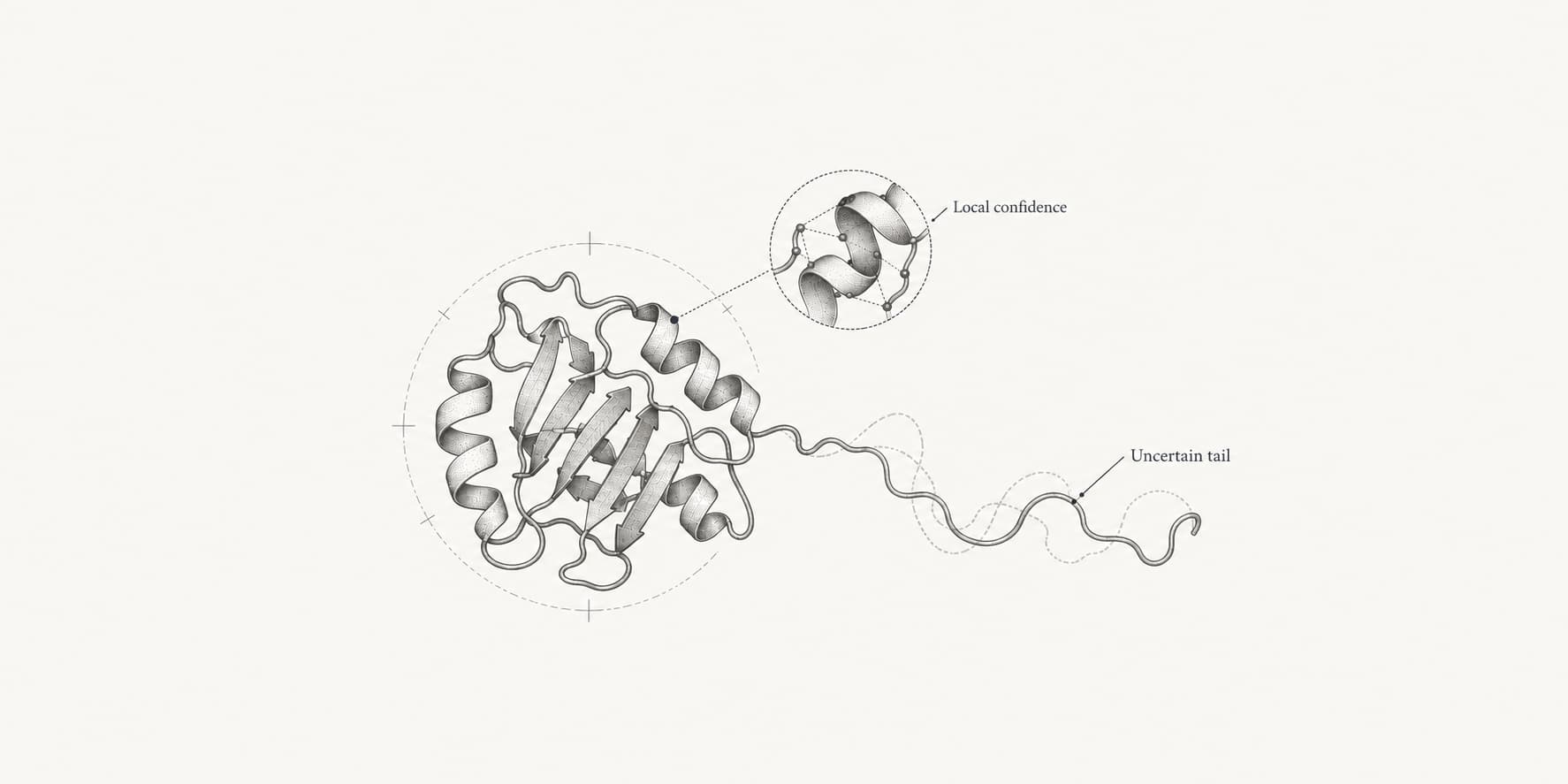
- pLDDT above 90 is very high confidence, 70-90 is confident, and regions below 50 often mark disorder or flexible structure.
- AlphaFold2 and AlphaFold-Multimer cover proteins and protein complexes only; ligands, DNA, and RNA need newer models such as Boltz-2 or Chai-1.
AlphaFold2 predicts a protein's 3D structure from its amino acid sequence, often to near-experimental accuracy.[1] You can run it in a browser without installing a single tool: paste your sequence, choose how much evolutionary information to use, and a few minutes later you get ranked PDB models with confidence scores for every residue.
To use AlphaFold2 online:
Open AlphaFold2 online
Open the AlphaFold2 webserver.
Add the protein sequences
Paste or upload FASTA, provide an A3M alignment, or fetch a protein from RCSB. Add each chain of a complex as a separate input.
Choose the MSA mode
Use single-sequence mode for a fast first check or a full database search for evolutionary context. Keep the other prediction settings at their defaults.
Submit the job
Review the chains and settings, then start the prediction.
Inspect and download the models
Check the ranked structures before reading confidence scores, then save the PDB files and supporting data.
ProteinIQ runs AlphaFold2 through ColabFold, the free implementation that replaced the original pipeline's heavy database downloads with a fast MMseqs2 search against a public MSA server.[2]
The webserver accepts protein sequences, precomputed A3M alignments, and RCSB sequence fetches. It displays each prediction in an interactive structure viewer alongside pLDDT, pTM, and PAE outputs and downloadable PDB files.
What is AlphaFold2?
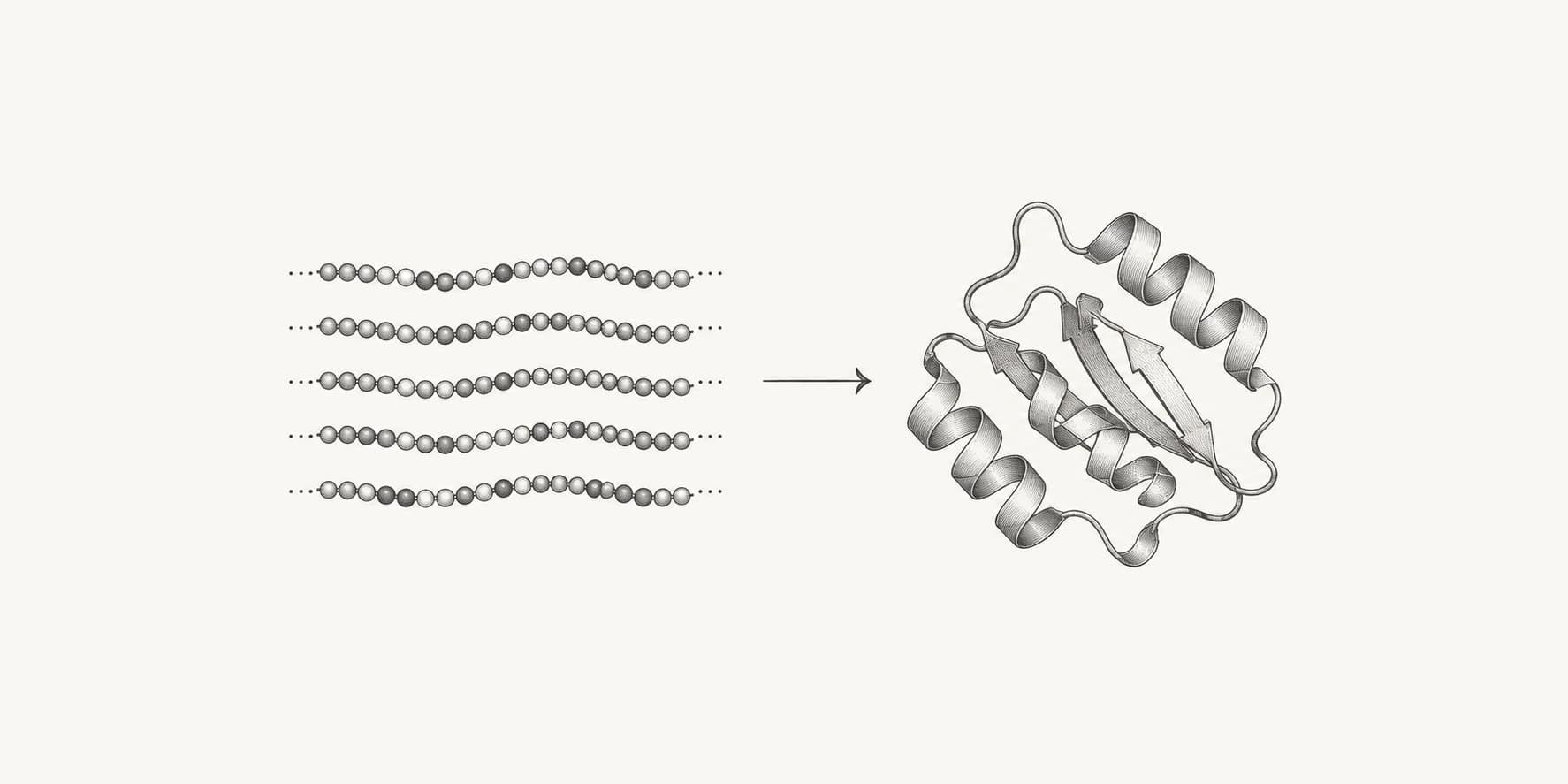
AlphaFold2 is a deep learning model from DeepMind that predicts protein structures from sequence. Published in Nature in July 2021, it builds on a simple biological idea: when two residue positions change together across evolution, they are often in physical contact. The model turns that coevolutionary signal, encoded in a multiple sequence alignment (MSA), into atomic coordinates.[1]
At the 14th Critical Assessment of protein Structure Prediction (CASP14), AlphaFold2 reached a median backbone accuracy of 0.96 Å r.m.s.d., while the next best method managed 2.8 Å.[1]
A carbon atom is about 1.4 Å wide, so on most blind test targets the model was effectively competitive with experiment. Demis Hassabis and John Jumper received the 2024 Nobel Prize in Chemistry for protein structure prediction.[7]
AlphaFold2 is strictly a protein model. It predicts monomeric proteins and, through the AlphaFold-Multimer variant, protein complexes, but it does not handle ligands, DNA, or RNA.[3] Newer systems such as Boltz-2 and Chai-1 extend structure prediction to those molecule types.
How does AlphaFold2 work?
AlphaFold2 treats structure prediction as a graph problem. Residues are nodes, and edges represent pairwise relationships that the network refines into a coherent 3D arrangement. The inputs are the query sequence, an MSA of its homologs, and optional templates from the PDB.[1]
The network has two main stages. The trunk, a stack of 48 Evoformer blocks, jointly processes two representations: an MSA representation that captures per-position evolutionary constraints, and a pair representation that captures predicted relationships between every pair of residues. The structure module then converts the refined features into explicit 3D coordinates.[1]
The Evoformer
The Evoformer is the architectural core. In each block, the MSA and pair representations exchange information: the MSA representation updates the pair representation through an outer product, and the pair representation in turn biases attention within the MSA. This two-way flow lets the model reason about spatial and evolutionary relationships at the same time.
Pairwise consistency is enforced with triangle updates. If residues i and j are close, and j and k are close, then i and k cannot be far apart. The network encodes that constraint so its pairwise description can fold into a single 3D structure.[1]
The structure module
After the Evoformer trunk, the structure module builds the backbone as a set of rigid frames, one per residue, each carrying a rotation and a translation. An equivariant attention mechanism called invariant point attention operates on these frames, and side-chain angles are predicted from the final activations.
The whole network runs with recycling: outputs feed back through the model several times, and each pass refines the structure further. This iteration is what lets the network resolve difficult targets.[1]
Why the MSA matters
MSA depth drives accuracy. In the original paper, accuracy dropped sharply when the median alignment depth fell below about 30 sequences, while gains beyond roughly 100 sequences were small.[1] That is why webservers let you choose how the MSA is built: single-sequence mode is fast but weaker on challenging targets, while a full database search recovers the evolutionary signal AlphaFold2 is built around.
How to use AlphaFold2 online
1. Open the AlphaFold2 webserver
Go to AlphaFold2 online.
The form accepts one or more protein chains, and each chain gets a chain ID such as A, B, or C. Chain IDs matter when you later map templates to specific chains or check the arrangement of a multimer result.
A job needs at least one protein sequence. AlphaFold2 predicts protein and protein complex structures, so a DNA, RNA, or ligand input alone is outside its scope.
2. Add your protein sequence
Paste the sequence using the one-letter amino-acid alphabet, or provide it in FASTA. Headers are optional for a single sequence, but valid FASTA is easier to reuse and audit. The TXT to FASTA converter can clean up unformatted sequence lists before submission.
| Input | Accepted formats | Limits and behavior |
|---|---|---|
| Protein sequence | Raw sequence or FASTA text | Up to 10 protein inputs |
| Sequence file | .fasta, .fa, .txt, .a3m | Up to 10 MB per file |
| RCSB entry | PDB entry fetched as FASTA | One fetch per input |
| Complex | One protein input per chain | Up to 10 inputs, 6,000 residues total |
The a3m format is useful when you already have a curated multiple sequence alignment from an external search and want to skip the MSA step.
For a complex, add each chain as its own input. AlphaFold2 accepts up to 10 protein inputs in one job, with 6,000 residues as the total length limit. Removing irrelevant chains or long disordered tails keeps large jobs manageable.
3. Choose an MSA mode
A multiple sequence alignment gives the model evolutionary information about which residues tend to vary together. AlphaFold2's MSA modes control how deep that search goes.
| Mode | What it does | Cost |
|---|---|---|
| No MSA | Single-sequence inference, similar to a fast single-sequence model | Free |
| UniRef only | Searches UniRef, faster than full search | Paid, 2x credits |
| UniRef + Environmental | Adds environmental and metagenomic sequences, the strongest evolutionary context | Paid, 2x credits |
| UniRef + Environmental (env-pair) | Same databases with environmental sequence pairing | Paid, 2x credits |
Free runs default to single-sequence mode. Paid plans can run the MMseqs2 database search through ColabFold, which is where AlphaFold2 recovers most of its accuracy on hard targets.
When several protein chains are present, the MSA search runs for each chain. You can also cap the number of MSA sequences (for example, 512, 256, or 128) to make long jobs faster, at some cost to accuracy on difficult proteins.
A practical workflow is to run one free single-sequence prediction first. Once the input and chain arrangement look correct, repeat the job with an MSA-enabled mode and compare the result.
4. Add templates only when they provide useful information
A structural template can guide AlphaFold2 toward a known fold. When templates are enabled, the MSA search queries the PDB for homologous structures.
Templates are useful when:
- A close homolog has already been solved
- You need a particular domain orientation or conformational state
- You want to preserve an experimentally supported backbone arrangement
The template date filter restricts the search to structures released before a chosen date, which matters for benchmarking. A poor template can bias the result, so run an untemplated prediction as a control whenever the template's relevance is uncertain.
5. Choose the prediction settings
For the first meaningful run, change as little as possible.
| Setting | Recommended starting value | When to change it |
|---|---|---|
| Number of models | 5 for best ranking, 1 for a quick look | Reduce to speed up exploratory runs |
| Number of recycles | 3, the benchmark default | Increase to 6-12 for difficult targets |
| Early stop tolerance | Disabled, then 0.5 | Enable to save time when the structure converges |
| Model type | Auto | Force monomer or multimer only for benchmarking |
| AMBER relaxation | Off | Enable when side-chain accuracy matters |
| Random seeds | 1 | Increase for more structural diversity |
Auto model type selects the pTM variant for single chains and the multimer variant for complexes. Forcing a specific type is only useful when you are reproducing a command-line run or comparing model versions.
6. Submit the job
Give the run a descriptive name that identifies the target and settings. For example:
HSP90_MSA_5models_3recyclesReview the chain order once more, then submit the job.
The completed result opens with three main views:
- Viewer: Interactive inspection of the ranked predicted structures
- Data: Confidence metrics in tabular form
- Files: PDB structures, PAE matrices, and supporting files
All result files can be downloaded for downstream analysis.
Example jobs are preloaded on the tool page, so you can open a finished ubiquitin or GCN4 homodimer run and inspect the results before submitting your own sequence.
How to interpret AlphaFold2 results
Inspect the structure first
Start with the highest-ranked model, but compare the alternatives before trusting any one.
Check:
- Whether the expected domains are folded
- Whether separate chains form a plausible interface in a multimer
- Whether low-pLDDT regions look like genuine flexibility or failed packing
- Whether different models converge on the same fold
A high confidence score cannot rescue a chemically impossible arrangement. Visual inspection comes before reading the confidence numbers.
Read pLDDT at the residue level
pLDDT estimates per-residue confidence and is stored in the B-factor column of the output PDB files.
| pLDDT | What it means |
|---|---|
| Above 90 | Very high local confidence |
| 70-90 | Confident backbone, side chains may vary |
| 50-70 | Low confidence, interpret with caution |
| Below 50 | Often disorder or partner-dependent structure |
Regions below 50 frequently correspond to intrinsically disordered regions rather than prediction failures. Do not trim them from the sequence just because they score low.[1]
Use pTM and ipTM for global and interface confidence
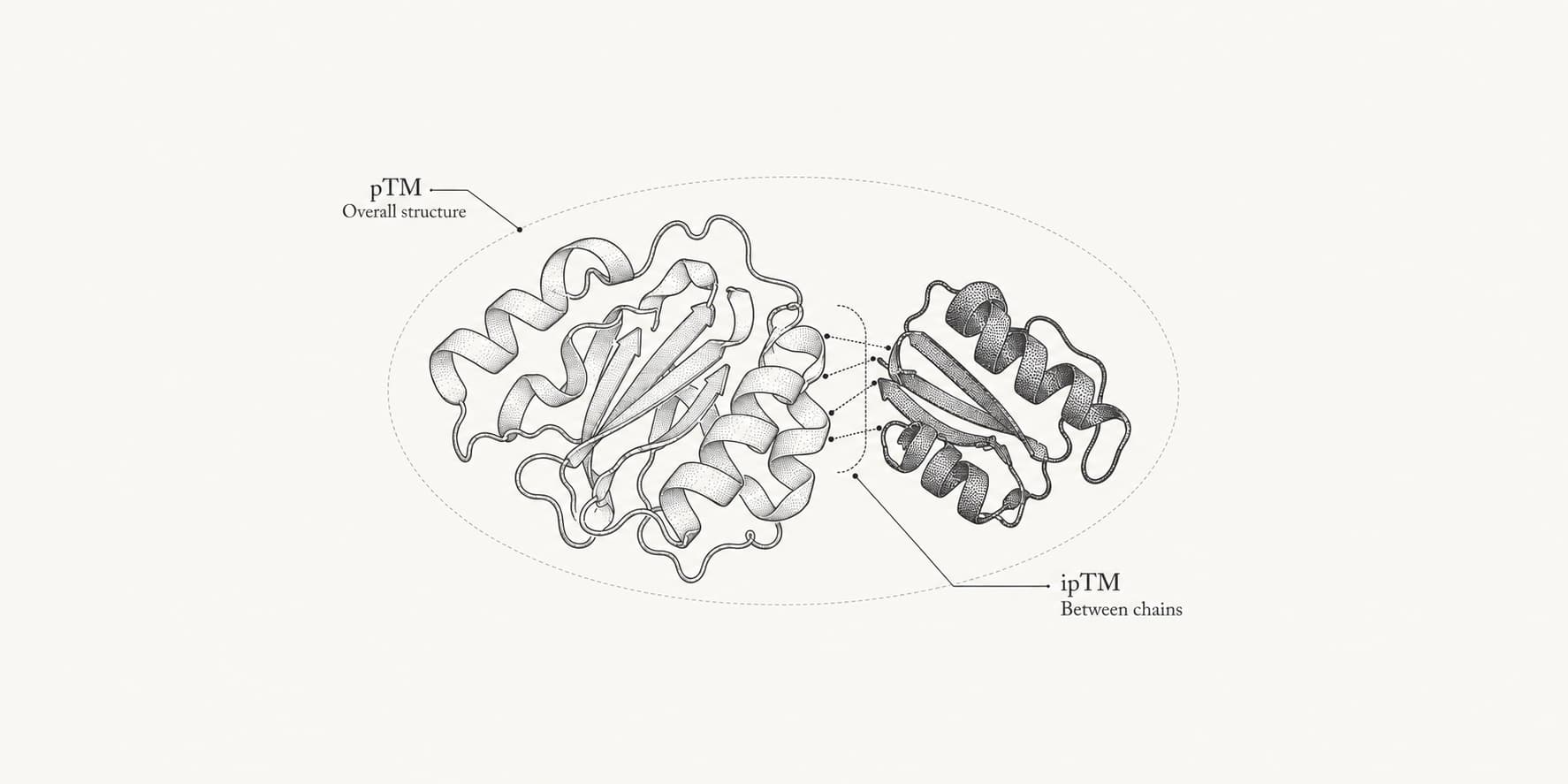
pTM estimates confidence in the overall fold on a 0-1 scale. Values above 0.7 indicate a confident global fold.[1]
For multimers, ipTM focuses on the interface between chains. The multimer ranking score is 0.8 x ipTM + 0.2 x pTM, and combined scores above 0.62 suggest a reliable complex.[3] A protein can have confident local folds while the relative placement of its chains remains uncertain, so check both numbers.
Use PAE for domain placement
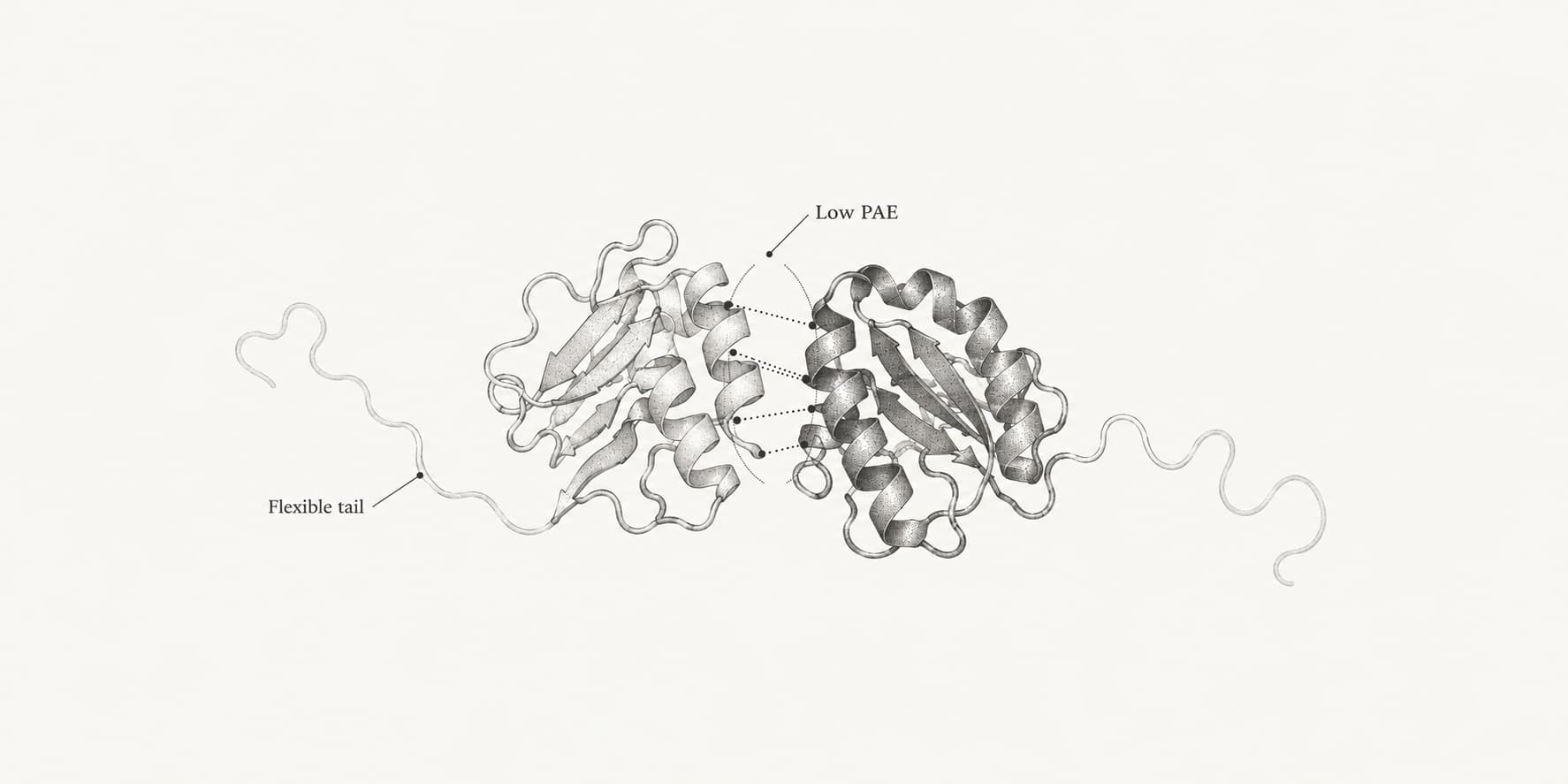
The predicted aligned error (PAE) matrix shows the expected position error between every pair of residues. Low PAE values mean the relative placement is confident.[1]
PAE is most useful for:
- Identifying well-structured domains (low intra-domain PAE)
- Assessing interfaces in multimers (low inter-chain PAE)
- Detecting flexible interdomain linkers (high PAE between domains)
The AlphaFold statistics guide explains how the same confidence scores are used across the AlphaFold database.
What can you use AlphaFold2 for?
Predicting a structure from sequence
When no experimental structure exists, AlphaFold2 gives you a starting point for interpreting function, finding conserved pockets, or designing mutations. The result is a hypothesis, not a solved structure, so confirm anything that depends on exact geometry against experiment or a complementary method.
Assembling protein complexes
AlphaFold-Multimer predicts how chains fit together, which is useful for understanding oligomerization and protein-protein interactions. Provide the chains with their intended stoichiometry and compare the ranked models rather than trusting a single interface.
Preparing structures for docking and simulation
docking and molecular dynamics workflows often need a 3D model when no crystal structure is available. Treat the predicted model as a starting structure and validate it before use.
Validating designs before synthesis
An AlphaFold2 model of a designed protein can be checked for plausibility before synthesis. Tools like MolProbity, DSSP, and FoldSeek can help you validate and compare what AlphaFold2 returns.
What are the limitations of AlphaFold2?
AlphaFold2 is highly accurate on globular proteins with enough evolutionary signal, but it has real limits:
- One static conformation, not ensembles, dynamics, or induced-fit changes.
- Protein-only: ligands, cofactors, DNA, and RNA are outside its scope.
- Accuracy drops when the MSA is shallow, which is common for engineered or orphan proteins with no detectable homologs.
- Low-confidence regions often correspond to genuine disorder or partner-dependent structure.
- Predicted side-chain rotamers are less reliable than the backbone, especially in low-confidence regions.
For a fast single-sequence option, ESMFold skips the MSA entirely and returns a structure in seconds. When you need complexes with ligands or nucleic acids, Boltz-2, Chai-1, or an AlphaFold3-class model like OpenFold 3 extends beyond what AlphaFold2 can predict.
Other ways to run AlphaFold2 online
The official AlphaFold Server from Google DeepMind is free for non-commercial research, but it runs AlphaFold 3, not AlphaFold2.[5] It predicts proteins alongside DNA, RNA, and ligands, and it needs a Google account.
If you want to run AlphaFold2 itself in a notebook, the ColabFold notebooks run free on Google Colab GPUs. Paste a sequence, run the cells, and download the results. Free Colab GPUs cap out around 2,000 residues per prediction.[4]
For proteins already covered by a database, you do not need to run anything. The AlphaFold Protein Structure Database holds precomputed AlphaFold2 models for millions of sequences under a CC BY 4.0 license.[6] The AlphaFold database downloader fetches them by UniProt accession.
AlphaFold2 alternatives
The best alternative depends on what you already have and what you need to predict.
| Tool | MSA | Speed | Complexes | Ligands, DNA, RNA |
|---|---|---|---|---|
| AlphaFold2 | Optional | Moderate | Yes (multimer) | No |
| ESMFold | None | Very fast | Limited | No |
| Boltz-2 | Optional | Moderate | Yes | Yes |
| Chai-1 | Optional | Moderate | Yes | Yes |
| OpenFold 3 | Yes | Slower | Yes | Yes |
AlphaFold2 remains the right choice when you want the established protein-only workflow with optional MSA-assisted folding. Use ESMFold when speed matters more than evolutionary context, and reach for the multi-molecule models when the system includes non-protein components.
Frequently asked questions
Is AlphaFold2 free to use online?
Yes. ProteinIQ's free runs use single-sequence mode with no MSA search, so you can predict structures without paying. MSA-assisted modes on paid plans search UniRef and environmental databases and cost twice the base credits.
Does AlphaFold2 need a protein structure?
No. You can provide a protein sequence and let AlphaFold2 predict the structure from it. A known structure can still be useful as a template, and conventional docking tools generally require a prepared receptor while AlphaFold2 can begin from sequence.
Does AlphaFold2 need an MSA?
No, but MSA depth drives accuracy. Single-sequence mode is faster and behaves like a fast single-sequence model, while a database search recovers the evolutionary signal AlphaFold2 is built around. Start without an MSA when checking an input or working with a designed protein, then compare with an MSA-enabled run when suitable homologs exist.
What does AlphaFold2 return?
Ranked PDB structure files, per-residue pLDDT confidence stored in the B-factor column, and, depending on the model, pTM, ipTM, and PAE matrices. The structures are viewable in a 3D viewer and downloadable.
How long does an AlphaFold2 run take?
It depends on sequence length and settings. Short proteins can finish in minutes; longer chains or runs with all five models, multiple recycles, templates, and AMBER relaxation take longer. The AlphaFold2 paper reports roughly one GPU minute per model for 384 residues.[1]
Can AlphaFold2 predict complexes with ligands?
No. AlphaFold2 and AlphaFold-Multimer predict proteins and protein complexes only. For systems with ligands, DNA, or RNA, use Boltz-2, Chai-1, or OpenFold 3.
A practical first-run recipe
For a first protein structure prediction:
- Add one protein sequence as FASTA.
- Leave templates and constraints empty.
- Run one single-sequence prediction to verify the input.
- Repeat with a full MSA search and all five models.
- Keep three recycling steps and the default early-stop setting.
- Download the PDB output and the confidence data.
- Inspect the top-ranked model, then compare the next two.
- Read pLDDT to find confident regions and likely disorder.
- Use pTM for overall confidence and PAE for domain placement.
- For a complex, repeat with the multimer model and check ipTM.
Run the first job with AlphaFold2 online, then add complexity only when the result or scientific question gives you a reason to do so.