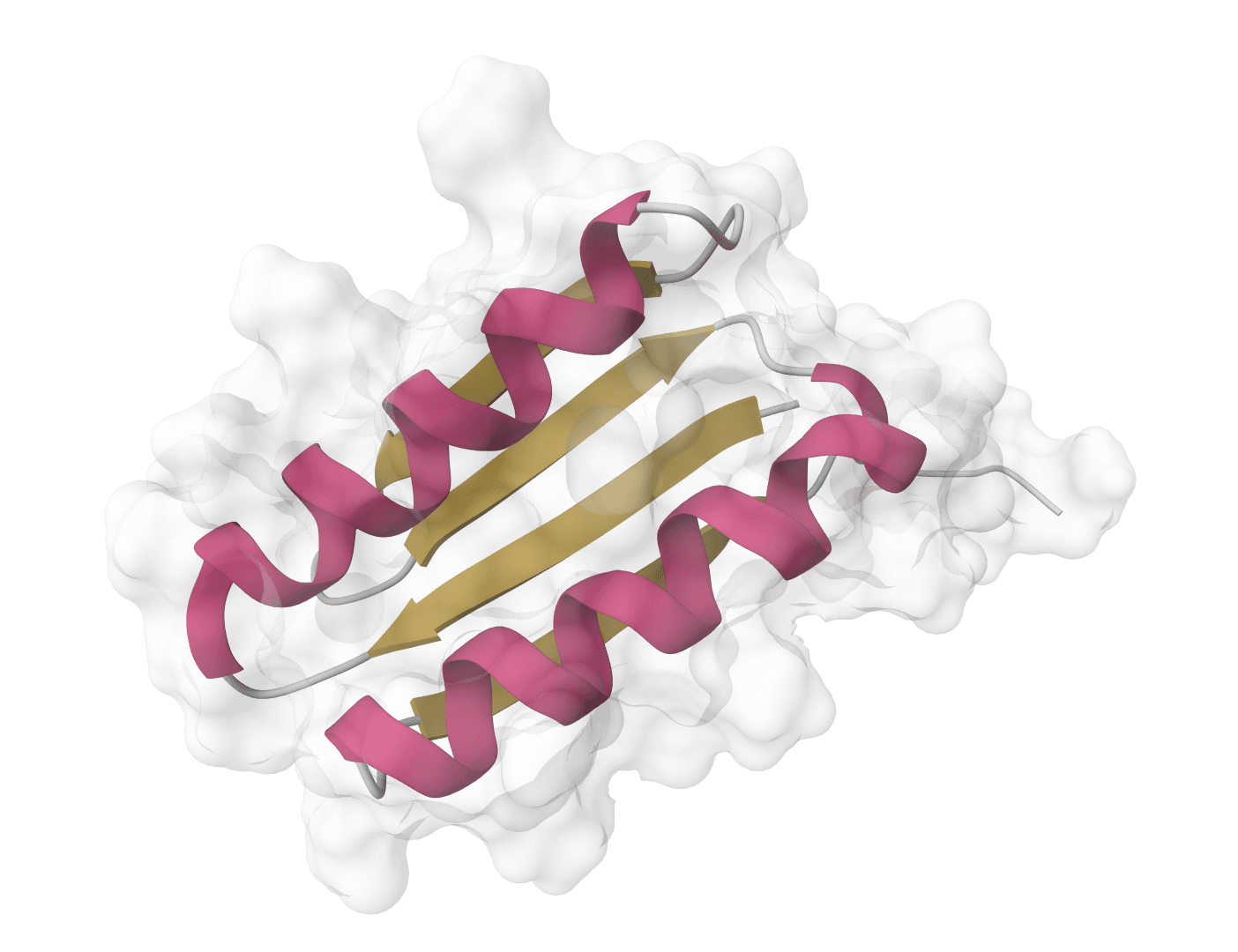
Assign helices, sheets, turns, bends, and PPII structure from atomic coordinates. Learn more
Input
What is DSSP?
DSSP is a coordinate-based program for assigning protein secondary structure. Wolfgang Kabsch and Christian Sander introduced the method to give structural biologists a consistent, physically motivated classification based on backbone hydrogen bonding and local geometry. It analyzes an existing three-dimensional model; it does not predict a fold from sequence.
ProteinIQ runs mkdssp 4.5.8, the maintained DSSP implementation. DSSP 4 uses annotated mmCIF as its primary result format, while retaining the fixed-width legacy DSSP format for structures whose identifiers fit its limits. The mmCIF result preserves the submitted atomic coordinates and adds both standard secondary-structure records for molecular graphics and detailed dssp_ categories for quantitative analysis.
DSSP is useful when secondary-structure assignments must be reproducible across experimental models, predicted structures, molecular-dynamics snapshots, or related conformations. Because the assignments come from coordinates, differences between runs can reveal genuine local structural changes, but can also reflect missing atoms, coordinate quality, or different DSSP versions.
How to use DSSP online
Submit one protein structure as a PDB or mmCIF file, a gzip-compressed coordinate file, or an RCSB PDB ID. ProteinIQ runs DSSP 4.5.8 and returns a residue-level assignment table, structure statistics, an annotated mmCIF, an interactive structure view, CSV projections, and the optional legacy DSSP file.
Inputs
| Input | Accepted values | Notes |
|---|---|---|
Protein structure | PDB, ENT, CIF, mmCIF, PDBx, or a gzip-compressed variant | One structure per job, up to 50 MB after decompression. |
RCSB PDB ID | A structure identifier such as 1CRN | ProteinIQ fetches the corresponding mmCIF coordinates from RCSB. |
DSSP analyzes one model and all its chains together, preserving inter-chain hydrogen bonds and sheets. When you upload a PDB containing multiple models, choose Model to analyze in the structure controls, then select Apply trim. Model 1 is selected by default. The selected model's coordinates and residue numbering are preserved; you can return to the original file with Reset. mmCIF inputs and API submissions use model 1. PDB files must be valid coordinate files and include records required by mkdssp, including CRYST1. Residues without the backbone atoms needed for assignment may be absent from the residue table.
Settings
| Setting | Default | Description |
|---|---|---|
Minimum PPII stretch | 3 | Minimum run of residues used to assign a polyproline II helix. DSSP 4.5.8 supports 2 or 3. |
Calculate accessibility | Off | Calculates per-residue solvent-accessible surface area for the annotated mmCIF. Legacy DSSP output includes accessibility as part of that format. |
Write loop annotations | Off | Writes unassigned stretches as OTHER records in the standard mmCIF _struct_conf category. It does not change which residues DSSP recognizes. |
Suppress detailed DSSP categories | Off | Omits the detailed dssp_ residue, bridge, ladder, and statistics categories while retaining standard mmCIF secondary-structure annotations. Residue and Statistics tables are empty when enabled. |
Include legacy DSSP file | On | Also requests the fixed-width .dssp result. Large or modern identifiers may not fit that format; the annotated mmCIF remains available and the run records a warning. |
Results
| View | What it contains |
|---|---|
Residues | The main result. One row per assigned residue with the DSSP code, helix and bridge markers, sheet topology, accessibility, backbone geometry, and Cα coordinates. |
Structure | The submitted coordinates with DSSP's standard helix, sheet, turn, bend, and PPII annotations. Select the Structure color mode to color the model by secondary structure. |
Statistics | Structure-level counts, accessible surface, disulfide-bridge counts, hydrogen-bond classes, and values normalized per 100 residues where DSSP reports them. |
Files | Annotated mmCIF, optional legacy DSSP, CSV projections, provenance, run log, and source diagnostics when present. |
The Structure view does not show a newly predicted conformation. DSSP leaves the atomic geometry intact and reannotates the standard _struct_conf, _struct_sheet, and _struct_sheet_range categories that molecular viewers use. The detailed eight-state assignment and numeric descriptors remain available in the Residues table.
How DSSP works
DSSP identifies recurring patterns in backbone hydrogen bonds, then combines those patterns into secondary-structure elements. Repeated turns form helices. Repeated bridges form ladders, and connected ladders form beta sheets. Local Cα geometry supplies complementary bend and chirality descriptors. DSSP 4 also recognizes polyproline II helices.
The one-character assignment summarizes a richer set of per-residue observations:
| Code | Assignment | Practical meaning |
|---|---|---|
H | Alpha helix | Repeating backbone hydrogen-bond pattern associated with an alpha helix. |
G | 3₁₀ helix | Tighter helical hydrogen-bond pattern. |
I | Pi helix | Wider helical hydrogen-bond pattern. |
P | Polyproline II helix | PPII geometry, supported by DSSP 4. |
E | Extended beta strand | Residue participating in a beta ladder. |
B | Isolated beta bridge | Beta bridge not extended into a longer ladder. |
T | Hydrogen-bonded turn | Turn defined by the DSSP hydrogen-bond pattern. |
S | Bend | Bend identified from local Cα geometry. |
| blank | No assignment | A recognized residue without one of the listed secondary-structure assignments. It is not automatically an error. |
DSSP assignment is deterministic for the same coordinate model, version, and settings. It is still a classification of a particular model, not a statement that the protein always occupies that conformation.
Understanding the results
Residue-level descriptors
| Column or group | Interpretation |
|---|---|
Chain, Residue ID, Residue | Identifies the assigned residue in the submitted structure. |
DSSP code | The one-character summary shown in the code table above. |
| Helix, bend, chirality, bridge, sheet, strand, and ladder fields | Detailed markers used to describe helical patterns and beta-sheet topology. |
Accessibility | Water-exposed surface area in Ų. This is absolute accessibility, not a residue-normalized fraction. |
TCO | Cosine of the angle between consecutive backbone carbonyl groups. Values are typically near +1 in alpha helices and near -1 in beta sheets. TCO is descriptive and is not used to define the assignment. |
Kappa | Virtual Cα bend angle defined from residues , , and . DSSP uses it when identifying bends. |
Alpha | Virtual Cα torsion angle describing local backbone chirality. |
Phi, Psi | Standard peptide-backbone torsion angles in degrees. |
Cα X, Cα Y, Cα Z | A copy of the residue's Cα coordinates from the submitted model. |
Accessibility depends on the complete coordinate context. In a multichain complex, neighboring chains can bury surface that would be exposed in an isolated monomer. DSSP ignores explicit water and other hetero atoms during this calculation, and incomplete or unusual residues can produce values that differ from expectations. For a dedicated surface-area calculation with its own output model, compare the result with SASA Calculator.
Structure statistics
The Statistics view preserves the categories and units reported by DSSP rather than collapsing them into a single score. A coordinate gap that breaks a peptide chain can increase the DSSP chain-segment count even when residues keep the same mmCIF chain identifier. Hydrogen-bond rows include raw counts and, where available, counts per 100 residues so structures of different sizes can be compared more carefully.
Comparing structures
Secondary-structure differences are most meaningful when the structures were prepared consistently and analyzed with the same DSSP version and settings. A code change near a missing residue or unresolved loop may reflect model completeness rather than a biological transition. MolProbity can help identify geometry and model-quality problems before interpretation; PDB Fixer is appropriate when missing atoms or residues must be repaired before rerunning the analysis.
For sequence-only secondary-structure estimates, use Chou-Fasman. If no coordinate model exists yet, ESMFold can generate a structure that can then be classified with DSSP. These methods answer different questions: prediction proposes structure from sequence, while DSSP assigns structural states to coordinates that already exist.
Related tools
MolProbity
Validate protein structure quality with all-atom contact analysis, Ramachandran plots, rotamer assessment, and geometry checks.
PDBsum
Generate a downloadable PDBsum structural summary report archive for a single protein structure.
pyRMSD
Calculate pairwise RMSD matrices for PDB structure ensembles with pyRMSD, including the condensed matrix and source statistics files.
Radius of gyration
Calculate the radius of gyration (Rg) for protein structures from PDB files. Supports multiple chains and atom selection options.
RMSD calculator
Calculate RMSD between protein structures with independent fit and measurement regions, explicit chain mappings, displacement profiles, coverage diagnostics, and fitted overlays.
SASA calculator
Calculate Solvent Accessible Surface Area (SASA) for protein structures using the Shrake-Rupley algorithm.
AllMetal3D
Predict metal and water binding sites in protein structures using 3D convolutional neural networks (AllMetal3D + Water3D).
DockQ
Assess docking model quality by comparing predicted complexes against native references. DockQ v2.1.3 supports protein, nucleic-acid, and supported small-molecule interfaces with native metrics.
IPSAE
Scoring function for interprotein interactions in AlphaFold2, AlphaFold3 and Boltz predictions. Calculates ipSAE, ipTM, pDockQ, pDockQ2, and LIS scores to assess protein-protein interface quality.
LocScale
LocScale performs physics-informed local sharpening of cryo-EM density maps using half-maps or full MRC/MAP volumes, with optional mask and reference-map inputs.