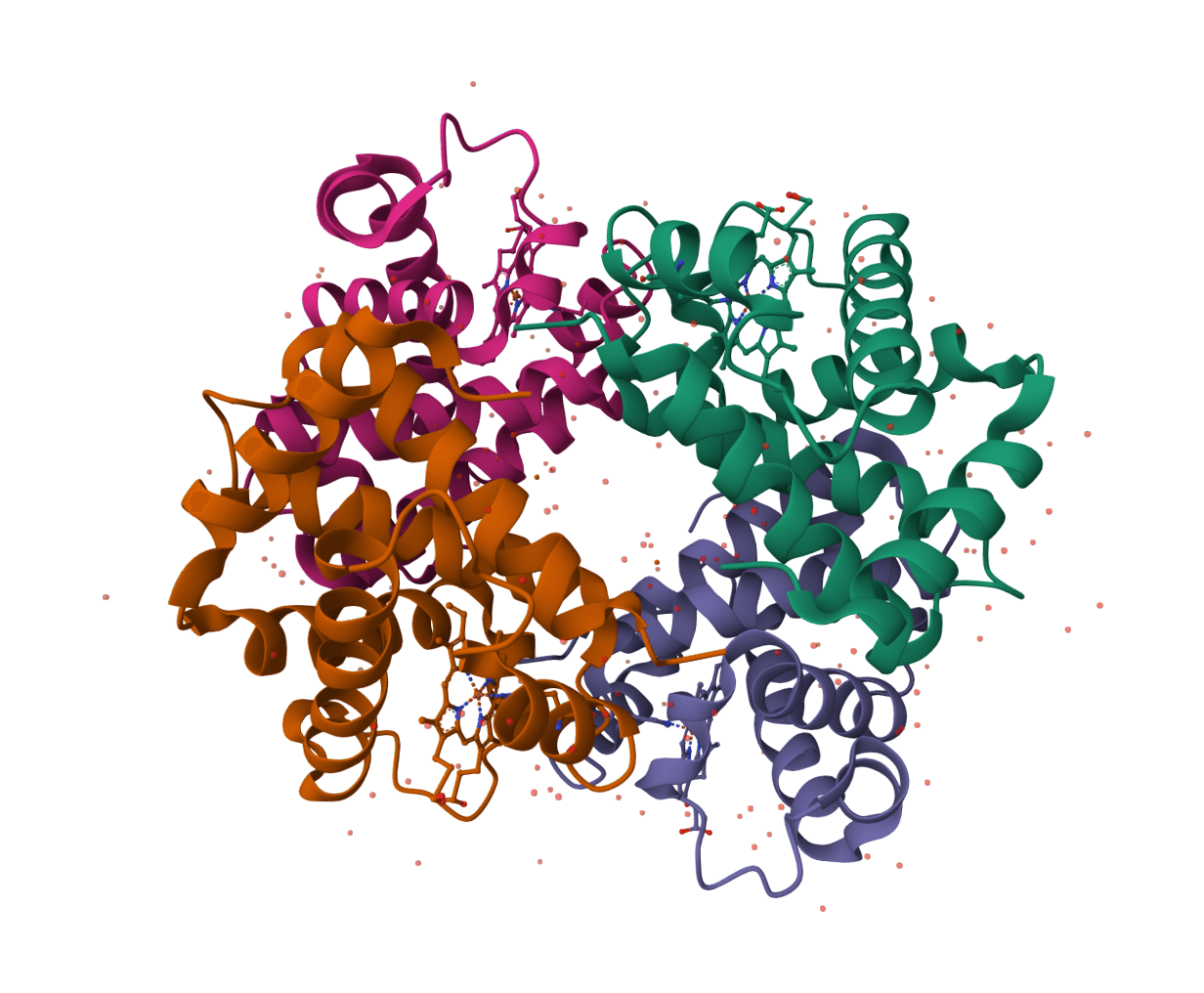
Calculate the radius of gyration (Rg) for protein structures from PDB files. Learn more
Input
What is radius of gyration?
The radius of gyration () quantifies the compactness of a protein structure. It measures how mass is distributed around a protein's center of mass—a compact, well-folded protein has a small , while an extended or unfolded structure has a larger value.
is widely used in structural biology to assess folding states, compare conformational changes, and validate computationally predicted structures. Molecular dynamics simulations track over time to detect unfolding events or conformational transitions.
For sequence-based analysis of protein properties like composition and charge, see Protein Parameters. To visualize your structure alongside calculations, use the PDB Viewer.
How to calculate the radius of gyration?
The radius of gyration is the root-mean-square distance of all atoms from the protein's center of mass. The formula is:
Where:
- is the mass of atom
- is the position of atom
- is the center of mass of all selected atoms
- is the total number of atoms
The tool uses atomic masses to weight each atom's contribution. Heavier atoms like sulfur have more influence than lighter atoms like hydrogen.
Atom selection
Different atom selections provide complementary information:
- All atoms: Uses every atom in the structure for a complete picture of molecular shape
- Backbone only (N, CA, C, O): Ignores side chains to focus on the protein fold itself
- Alpha carbons only (CA): Reduces noise from side chain conformations, commonly used in comparative analysis
Alpha carbon calculations are fastest and most reproducible across different structure sources (X-ray, NMR, computational models). Use all-atom calculations when side chain packing matters.
Empirical scaling
For globular proteins, follows a predictable relationship with chain length:
Where is the number of residues. A 100-residue globular protein typically has Å. Values significantly above this suggest extended conformations or multi-domain arrangements.
Input requirements
- PDB Structure: Upload a PDB file or fetch directly from the RCSB PDB by entering a 4-character PDB ID (e.g.,
1UBQ)
Settings
- Atom selection: Choose which atoms to include—all atoms, backbone only, or alpha carbons only
- Chains: Specify chain IDs to analyze (e.g.,
AorA,B). Leave empty to include all chains.
Understanding the results
The output table contains one row per chain or structure analyzed:
| Column | Description |
|---|---|
| ID | Structure/chain identifier |
| Num Atoms | Number of atoms included in the calculation |
| Rg (Å) | Radius of gyration in angstroms |
Interpreting values
The absolute value depends on protein size, so compare against expectations for your protein's length:
- Compact globular proteins: Å
- Multi-domain proteins: Often 10–30% larger than single-domain proteins of similar size
- Intrinsically disordered proteins: Can be 50–100% larger than folded globular proteins
When comparing structures, small differences (< 1 Å) are often within experimental or computational uncertainty. Larger changes (> 2–3 Å) typically indicate meaningful conformational differences.
Common applications
Radius of gyration analysis helps answer several structural biology questions:
- Model validation: Compare predicted structure to experimental SAXS measurements
- Folding assessment: Verify that computational models produce compact, realistic structures
- Conformational analysis: Detect domain movements or unfolding by comparing across conditions
- Quality control: Identify outliers in batches of predicted or modeled structures
Related tools
Aggrescan3D
Static-mode Aggrescan3D analysis for per-residue aggregation propensity from a single protein structure.
Protein charge plot
Plot net charge vs pH for protein sequences. Visualize how protein charge changes across pH 0-14 and identify the isoelectric point (pI) where the net charge crosses zero.
FindPept
Match experimental peptide masses against theoretical digest fragments of a protein sequence. Identify peptides from mass spectrometry data by peptide mass fingerprinting.
Hydropathy plot
Generate Kyte-Doolittle hydropathy plots to visualize hydrophobic and hydrophilic regions along protein sequences. Identify transmembrane domains and surface-exposed regions.
Hydrophobicity plot
Generate hydrophobicity plots using 24 different amino acid scales. Visualize hydrophobic and hydrophilic regions for protein analysis, epitope prediction, and membrane protein studies.
IPC 2.0 (isoelectric point calculator)
Isoelectric Point Calculator 2.0 - Predict protein/peptide isoelectric point (pI) using 18+ validated pKa scales, SVR models, and deep learning. Supports proteins, peptides, and comprehensive analysis.
Peptide cutter
Predict protease and chemical cleavage sites across a protein sequence for up to 39 enzymes simultaneously. Identify where each enzyme cuts, the cleavage residue, and context window around each site.
Peptide mass calculator
Cleave a protein sequence with a chosen protease and compute the masses of the resulting peptides. Supports multiple enzymes, missed cleavages, chemical modifications, and different ion types for mass spectrometry experiment planning.
PROPKA 3
Predict pKa values of ionizable groups in proteins and protein-ligand complexes from 3D structure. PROPKA calculates environment-driven pKa shifts for standard ionizable residues, terminal groups, and supported ligand atom types.
Protein parameters
Calculate sequence-derived protein properties including molecular weight, theoretical pI, extinction coefficients, aromaticity, secondary structure fractions, composition classes, instability, aliphatic index, and GRAVY.