The best protein structure prediction software in 2026
Which predictor to use for a single protein, a complex, a ligand or a moving structure

Matic Broz, PhD16 min
Five years after AlphaFold2, the most accurate structure predictor you can use is also the most restricted one. AlphaFold 3 predicts proteins together with DNA, RNA and ligands, but its free server allows 30 jobs a day for non-commercial work, and its weights are not open. Meanwhile the open models that copied its design, such as Boltz-2 and Chai-1, can be used commercially, and for a single protein chain AlphaFold2 is still hard to beat.
So the question is rarely which program is best overall. A 300-residue enzyme, an antibody bound to its antigen, a kinase with a drug in its pocket and a protein that flexes between two shapes each have a different best answer, and some of them are already answered in a database. This list matches the software to the job.
ProteinIQ runs AlphaFold2, ESMFold, Boltz-2, Chai-1 and BioEmu below in the browser, so read our enthusiasm with that in mind. All of them are also free to download and run yourself.
The best protein structure prediction software
- AlphaFold2 with ColabFold for single proteins and protein complexes
- ESMFold for fast single-chain predictions without a sequence alignment
- Boltz-2 for proteins with ligands, and for commercial co-folding
- Chai-1 for complexes when you know something about the interface
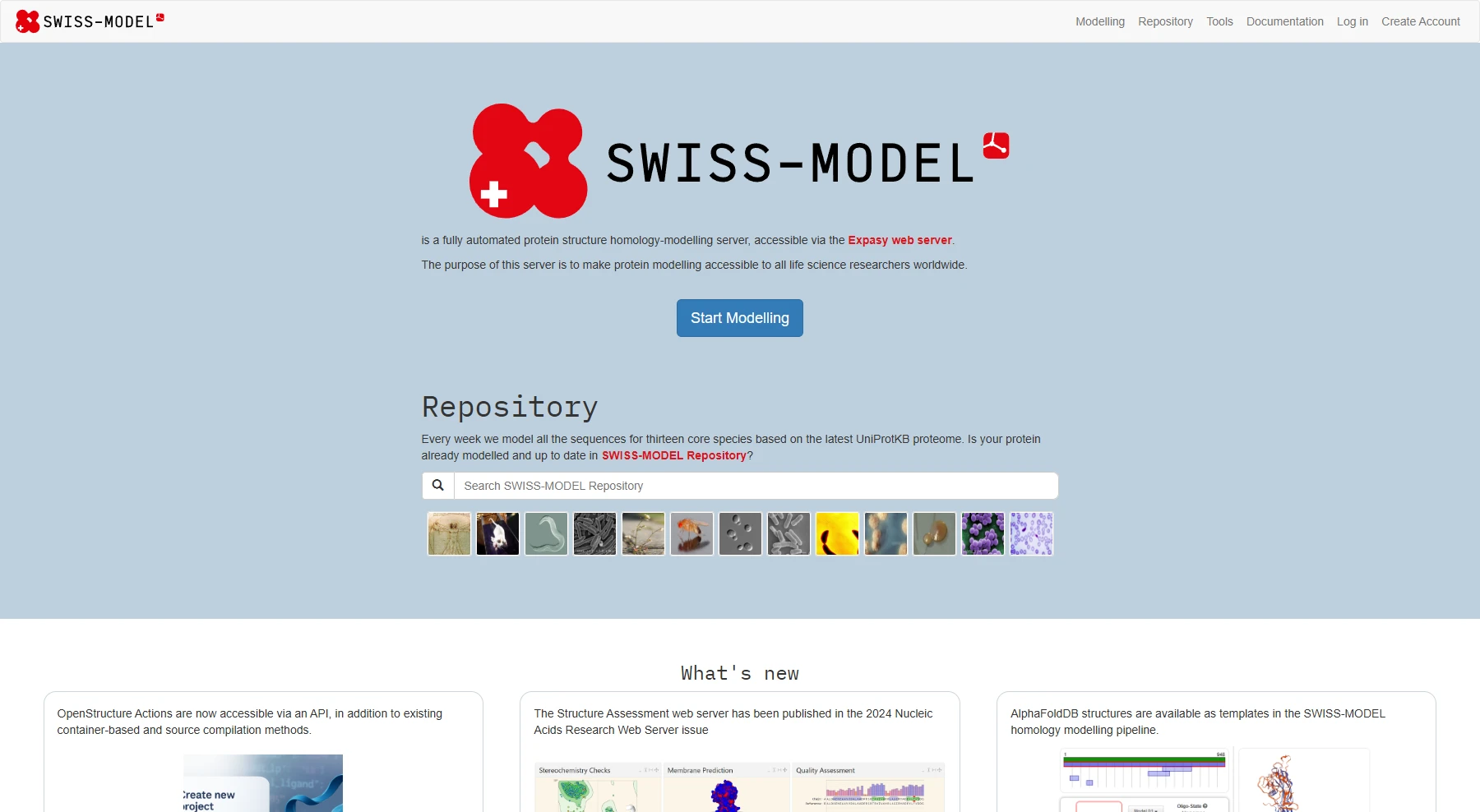
- SWISS-MODEL for homology models built on a known structure
- BioEmu2 for proteins that move between conformations
And AlphaFold 3 on AlphaFold Server, the reference the others are measured against.
What makes good protein structure prediction software?
A prediction is useful when it is close to the experimental structure and when it tells you honestly which parts are not. We looked first at published accuracy: GDT and lDDT for single chains, DockQ for interfaces, and ligand RMSD under 2 Å on the PoseBusters set for small molecules. Then at the confidence scores each tool returns, because a model without a trustworthy pLDDT or PAE is hard to act on.
We also weighed what a run needs (a multiple sequence alignment, a large GPU, a template), which molecule types it accepts and whether its license allows commercial use. Licenses, versions and server limits were checked on the official repositories and sites on November 3, 2026.
We left out programs without a release in recent years, servers that accept only academic users when an open alternative does the same job, and tools for a different problem, such as docking a ligand into a known structure. We also left out the AlphaFold Protein Structure Database, which is not a predictor but should be your first stop: it holds over 200 million precomputed models under a CC BY 4.0 license.[15]
The best protein structure prediction software at a glance
| Software | Best for | Molecules | Needs an MSA | Biggest gap | License |
|---|---|---|---|---|---|
| AlphaFold Server | Highest accuracy on complexes | Proteins, DNA, RNA, listed ligands, ions | Built in | Non-commercial, 30 jobs a day | Free for non-commercial use |
| AlphaFold2 | Single proteins and protein complexes | Proteins | Yes, for best accuracy | No ligands or nucleic acids | Apache 2.0, weights CC BY 4.0 |
| ESMFold | Fast single-sequence folding | Proteins | No | Less accurate on hard targets | MIT |
| Boltz-2 | Protein-ligand complexes and affinity | Proteins, DNA, RNA, any ligand | Recommended | Trails AlphaFold 3 on antibodies | MIT |
| Chai-1 | Complexes with known contacts | Proteins, DNA, RNA, any ligand | Optional | No release since March 2025 | Apache 2.0 |
| SWISS-MODEL | Template-based homology models | Proteins, with template ligands | No, needs a template | Nothing to build on without a homolog | Free web server, models CC BY-SA 4.0 |
| BioEmu2 | Conformational ensembles | Proteins, DNA, RNA, ligands | Yes | Preview release, no paper yet | MIT |
The reference standard for protein structure prediction
AlphaFold Server (web)
AlphaFold Server pros:
- AlphaFold 3 accuracy on proteins, nucleic acids, ions and common ligands, free and with no setup
- Supports modified residues and glycans
AlphaFold Server cons:
- Non-commercial use only, 30 jobs a day, and no arbitrary SMILES ligands
AlphaFold 3, from Google DeepMind and Isomorphic Labs, was published in Nature in May 2024. It replaced AlphaFold2's structure module with a diffusion model, which let one network predict proteins, DNA, RNA, small molecules and ions together. The paper reported clear gains over specialized tools on protein-ligand complexes and over AlphaFold-Multimer on antibody-antigen interfaces.[3] On the PoseBusters set, its released predictions placed 76% of ligands within 2 Å.[9]
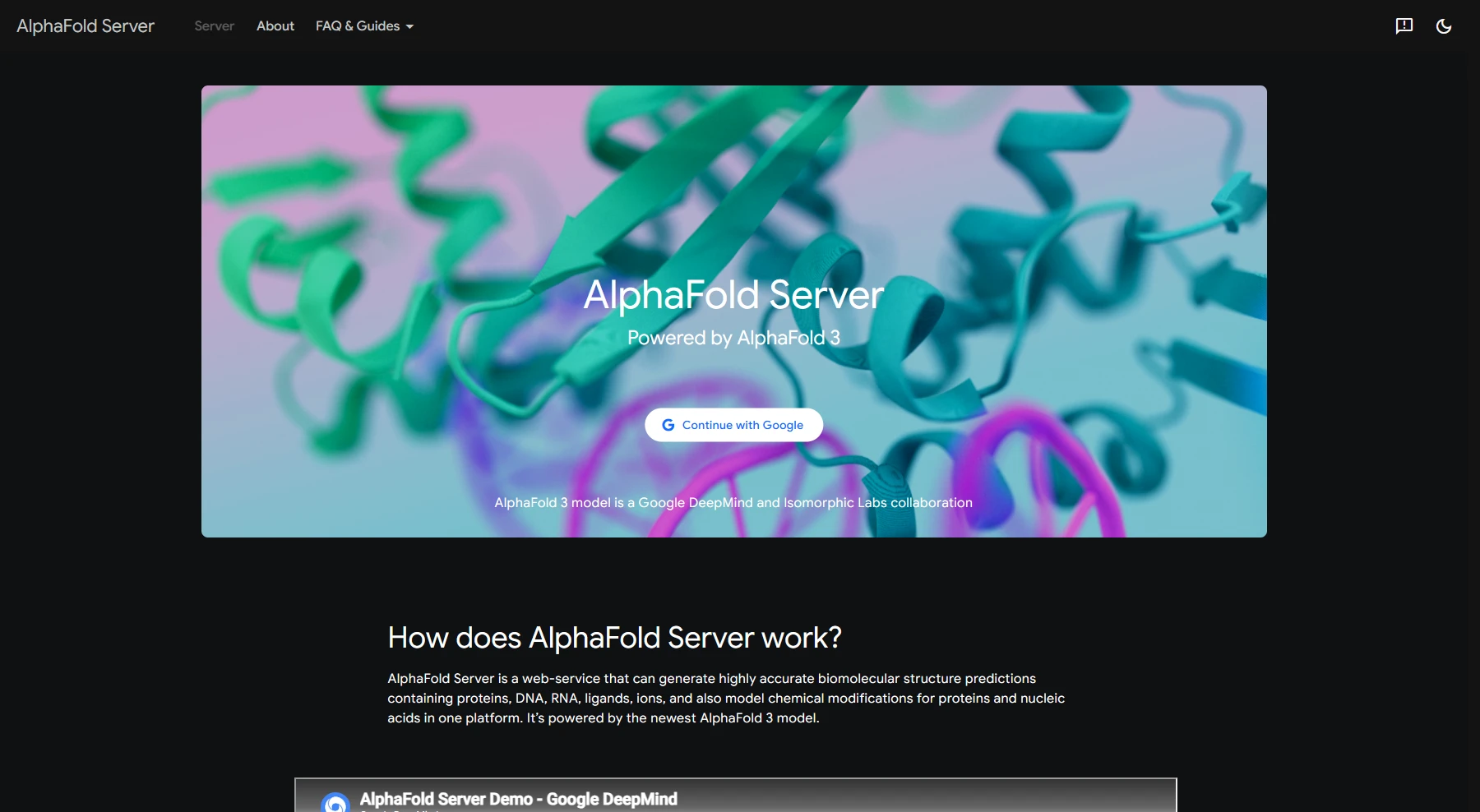
The server is the easy way in. You need a Google account; then each job can be up to 5,000 tokens, where a residue or nucleotide is one token and each ligand atom is another. Ligands come from a curated list (ATP, heme, FAD and similar) or a PDB Chemical Component Dictionary code, not from SMILES.[4]
The model code is on GitHub under Apache 2.0, and the latest release, 3.0.5, came out on October 30, 2026. The weights are free only to non-commercial organizations for non-commercial work, under terms that also bar training other models on the outputs.[5] Running it locally needs an 80 GB A100 or H100 and up to 1 TB of sequence databases. The AlphaFold license page covers what companies can and can't do.
AlphaFold Server price: Free for non-commercial use. Commercial access goes through Google Cloud.
Best protein structure prediction software for single proteins
AlphaFold2 and ESMFold both fold protein chains with no ligands or nucleic acids. AlphaFold2 builds a sequence alignment first and is the more accurate of the two; ESMFold reads one sequence with a language model and is several times faster.
AlphaFold2 with ColabFold (Linux, Google Colab, web)
AlphaFold2 pros:
- Still the most tested predictor for single chains, with confidence scores reviewers know how to read
- Weights under CC BY 4.0, so commercial use is allowed
AlphaFold2 cons:
- Proteins only: no ligands, nucleic acids or modified residues
- Needs a good alignment, and accuracy drops for orphan proteins with few homologs
AlphaFold2 won CASP14 in 2020 with a median backbone accuracy of 0.96 Å, against 2.8 Å for the next best method.[1] Its successor beats it on complexes and ligands, but for a single protein chain the gap is small, and AlphaFold2's weights carry no use restrictions. The AlphaFold Database was built with it.
ColabFold is how most people run it. Martin Steinegger's and Sergey Ovchinnikov's groups replaced the original database search with MMseqs2, which made alignments 40 to 60 times faster and brought throughput close to 1,000 structures a day on one GPU.[2] The current release is 1.6.3, under the MIT license. AlphaFold-Multimer, included in it, also predicts protein complexes and returns an ipTM score for the interface.
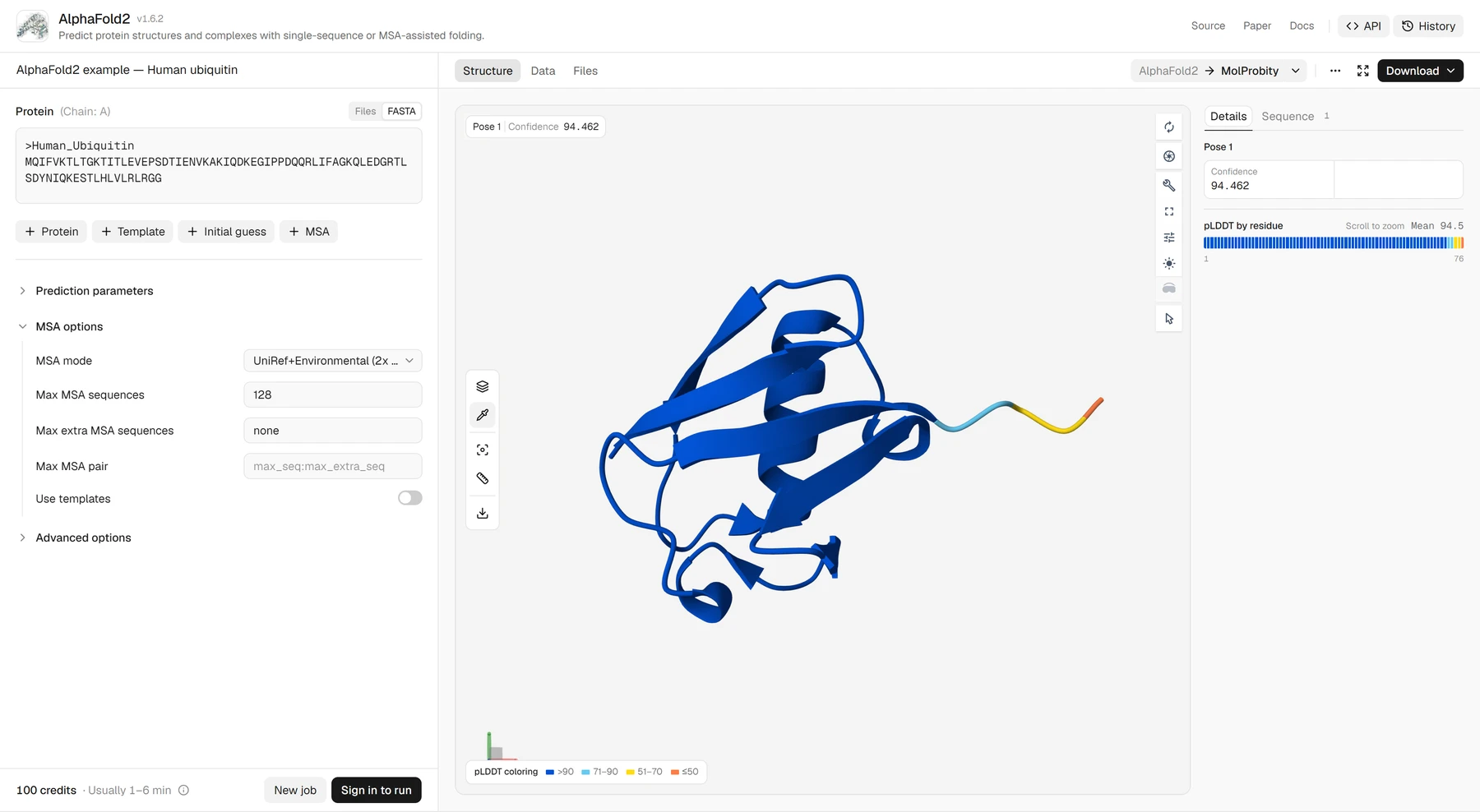
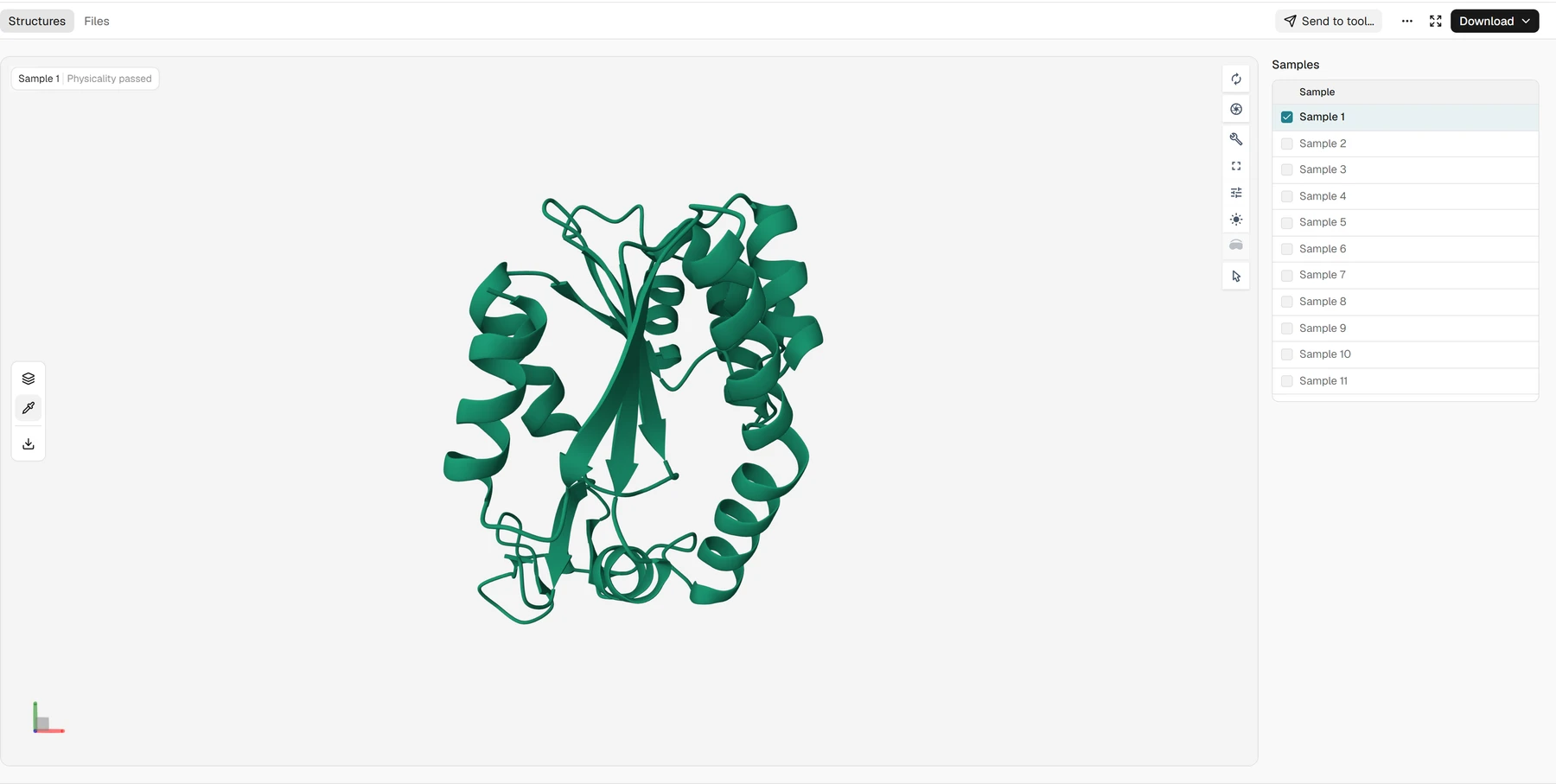
In the example above, ubiquitin folded with a confidence of 94.462 and a mean pLDDT of 94.5. Only the last few C-terminal residues fall below 70, which matches the flexible tail seen in crystal structures. The structure confidence guide explains how to read pLDDT, PAE and ipTM together.
AlphaFold2 price: Free and open source. On ProteinIQ, jobs start at 50 credits, and an MSA mode doubles that, so the ubiquitin job cost 100. A free account starts with 200 credits and gets 100 a month.
ESMFold (Linux, web)
ESMFold pros:
- Predicts from one sequence, so there is no alignment step and no sequence sent to an MSA server
- Fast enough to fold thousands of sequences
ESMFold cons:
- Less accurate than AlphaFold2 on hard targets with few known relatives
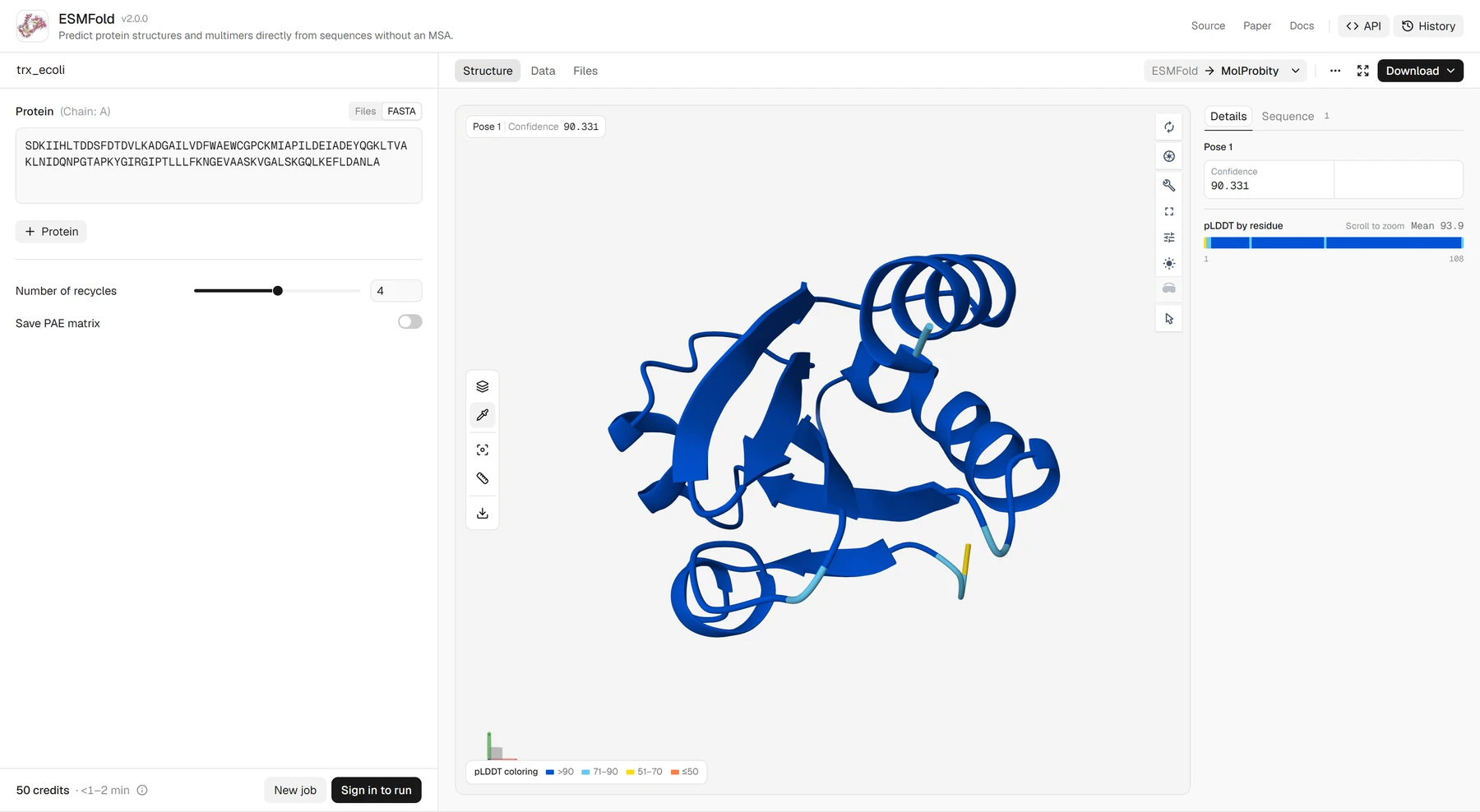
ESMFold, from Meta AI's protein team, swaps the alignment for a protein language model. ESM-2 has read hundreds of millions of sequences, and its internal representation of a single sequence carries much of the evolutionary signal an MSA would. The structure module then builds coordinates from it.[6] The protein language models guide explains how that works.
The trade is accuracy for speed. On CAMEO targets, ESMFold reached a mean TM-score of 0.83 against 0.88 for AlphaFold2; on the harder CASP14 set it was 0.68 against 0.85. In exchange it folded a 384-residue protein in 14.2 seconds on a V100, about six times faster than one AlphaFold2 model before counting the alignment AlphaFold2 also needs. Meta used it to predict more than 617 million metagenomic structures.[6]
The original repository is archived under the MIT license. Its successor, ESMFold2 from Biohub, adds complexes and an optional MSA; it is newer than this list's evidence bar, so it is under "Other" below.
ESMFold price: Free and open source. On ProteinIQ, a job up to 800 residues costs 50 credits.
Best protein structure prediction software for complexes with ligands and nucleic acids
Boltz-2 and Chai-1 both follow AlphaFold 3's design, take any ligand as a SMILES string and allow commercial use. Choose Boltz-2 when you want an affinity estimate for a small molecule, and Chai-1 when lab data tells you where the partners touch.
Boltz-2 (Linux, web)
Boltz-2 pros:
- Predicts proteins, nucleic acids and any ligand from a SMILES string, under the MIT license
- Adds a binding affinity estimate and a probability that the ligand binds at all
Boltz-2 cons:
- Its own authors report it still trails AlphaFold 3 on antibody complexes
Boltz-2 comes from the MIT Jameel Clinic and Recursion, and both code and weights are MIT-licensed, including for commercial drug discovery. It follows AlphaFold 3's design, and its authors report structure accuracy that matches or beats Chai-1 and Protenix while trailing AlphaFold 3 on recent PDB entries and antibodies.[7]
What sets it apart is the affinity module. Trained on measured IC50, Ki and Kd values, it reached a Pearson correlation of 0.66 with experiment on a four-target free energy perturbation benchmark, at more than 1,000 times less compute than FEP.[7] Read it as a ranking score for related compounds on one target, not as an IC50 to quote.
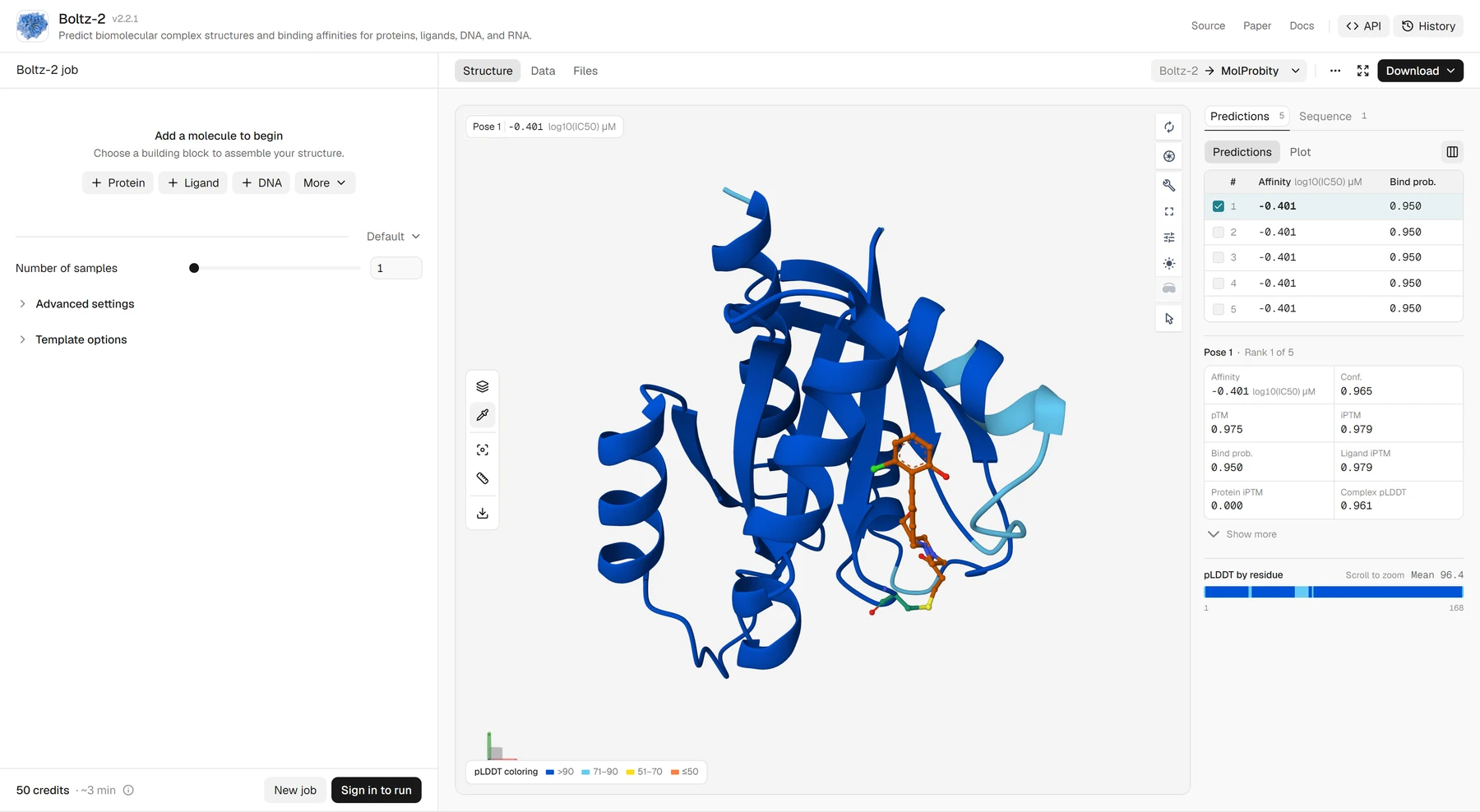
In the example above, KRAS G12C co-folded with its covalent inhibitor at a ligand iPTM of 0.979 and a binding probability of 0.950. Boltz-2 also accepts pocket and contact constraints and template structures. The latest release is 2.2.1.[8] For more on placing ligands, see the molecular docking software comparison.
Boltz-2 price: Free and open source. On ProteinIQ, jobs start at 50 credits.
Chai-1 (Linux, web)
Chai-1 pros:
- Accepts pocket, contact and covalent restraints, which sharply improve hard interfaces
- Runs in single-sequence mode with little loss on complexes
Chai-1 cons:
- Needs an 80 GB GPU for large systems, and has had no release since March 2025
Chai-1, from Chai Discovery, appeared in 2024 as the first open AlphaFold 3-class model. It placed 77% of PoseBusters ligands within 2 Å, level with AlphaFold 3's 76%. Its code and weights were later relicensed under Apache 2.0, which now allows commercial use.[9][10]
Its strongest feature is restraints. If you know an epitope from mutagenesis or a contact from crosslinking, Chai-1 can use it, and in the authors' tests one epitope restraint raised acceptable antibody-antigen predictions from 35% to 57% by DockQ.[9] That makes it a good fit for antibody structure prediction when lab data narrows the interface.
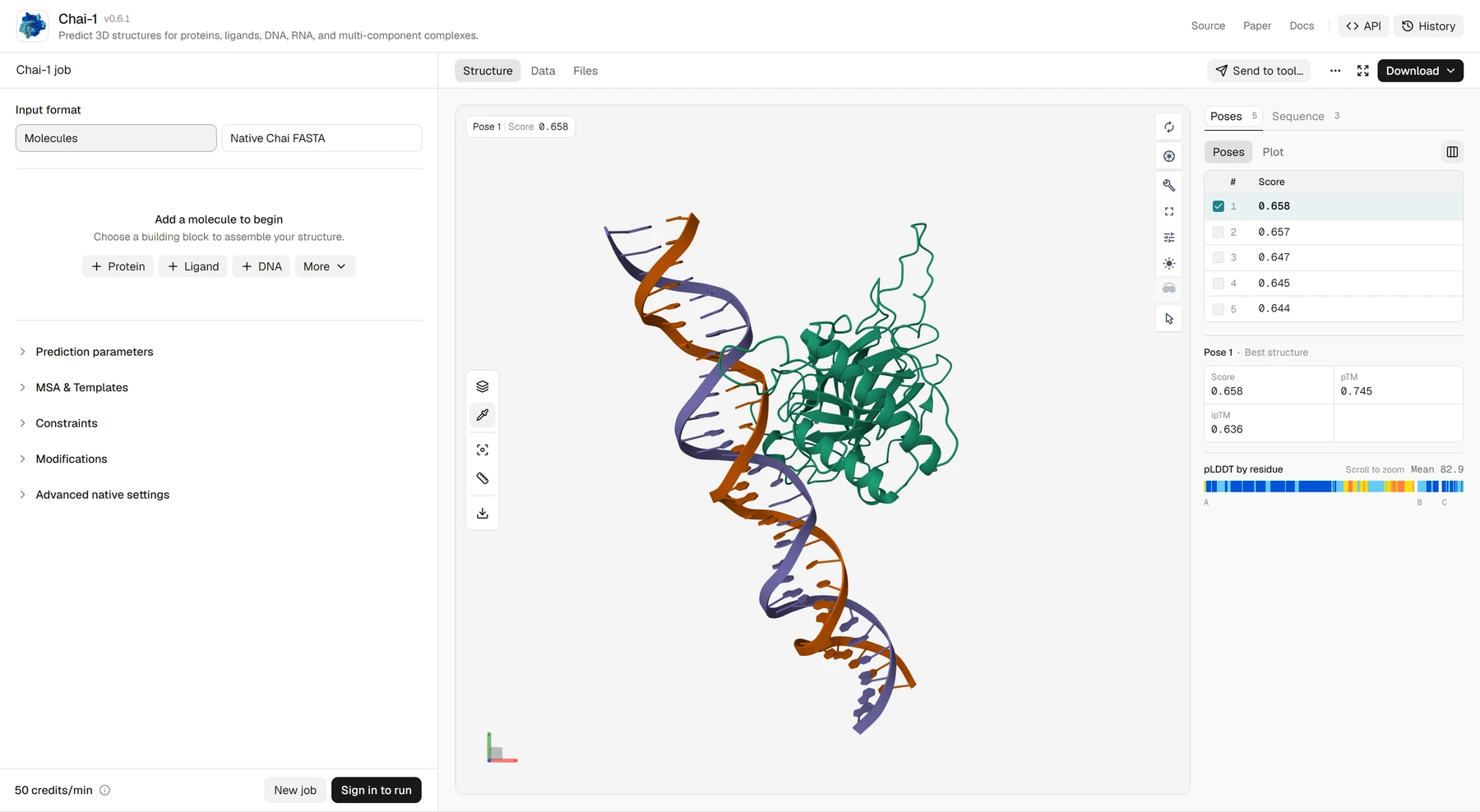
The p53 example above shows the other side. The full-length protein includes long disordered regions, and without restraints the model is unsure how the DNA-binding domain sits on the duplex. An ipTM of 0.636 is a warning, not a result, and adding a contact restraint would be the next step.
Chai-1 price: Free and open source. On ProteinIQ it costs 50 credits per minute of GPU time on a paid plan, so a 10-minute run costs 500 credits.
Best protein structure prediction software for homology modeling
SWISS-MODEL (web)
SWISS-MODEL pros:
- Builds on a real experimental structure, so ligands, cofactors and oligomeric state carry over from the template
- Free web server with no GPU, no setup and per-residue quality estimates
SWISS-MODEL cons:
- Only as good as the closest template; with no homolog in the PDB it has nothing to build on
Homology modeling predates deep learning by decades, and it still answers one question better than the newer tools: what does my protein look like if it is shaped like this solved relative? SWISS-MODEL, run by Torsten Schwede's group at the SIB Swiss Institute of Bioinformatics, searches for templates, aligns your sequence and builds a model that keeps the template's ligands and quaternary structure.[11] It now uses AlphaFold Database models as templates too.
Every model comes with QMEANDisCo, a per-residue quality estimate from 0 to 1 where values below 0.6 mark likely errors.[12] Interactive use is free, and the models are released under CC BY-SA 4.0.[22] The homology modeling page explains when a template beats a deep learning prediction.
SWISS-MODEL price: Free.
Best protein structure prediction software for conformational ensembles
Every predictor above returns one structure, or a handful that differ by noise. BioEmu2 samples the range of shapes a protein takes at equilibrium instead.
BioEmu2 (Linux, web)
BioEmu2 pros:
- Samples many structures from an equilibrium ensemble instead of one static model
- Handles complexes with nucleic acids and ligands, unlike the first BioEmu
BioEmu2 cons:
- A preview release (0.1.0rc0) with no paper yet; the published evidence is for BioEmu 1
Adenylate kinase spends its time opening and closing two lids around ATP, and one structure can't show that. BioEmu, from Microsoft Research AI for Science, was trained on more than 200 milliseconds of molecular dynamics and draws thousands of independent structures per hour on one GPU. In its Science paper, the relative free energies of the sampled states came within about 1 kcal/mol of experiment.[13]
BioEmu2, released on October 20, 2026 under the MIT license, extends that to complexes, DNA, RNA and ligands, and adds structure prediction and time-lagged propagation.[14] Because it is a release candidate without a paper, check important results against BioEmu, whose monomer predictions are published, or against molecular dynamics.
BioEmu2 price: Free and open source. On ProteinIQ it costs 20 credits per minute of runtime, about 71 credits for 16 samples.
Other protein structure prediction software to consider
Two more open reproductions of AlphaFold 3 are worth knowing. OpenFold3, from Mohammed AlQuraishi's lab and the OpenFold Consortium, releases code, weights and training code under Apache 2.0; its 0.5.1 release uses the OpenBind-0 weights but is still labelled a research preview.[17] Protenix from ByteDance reports beating AlphaFold 3 at a matched training cutoff with its v1 model, though its newest v2 weights are not openly licensed.[18]
RosettaFold3, the Baker lab's model under a BSD license, narrows the gap with AlphaFold 3 and handles chirality better than earlier versions.[19] ESMFold2, released by Biohub in 2026 under the MIT license, predicts complexes with an optional MSA; its benchmark numbers were not yet in a peer-reviewed paper when we checked.[20]
I-TASSER from Yang Zhang's lab remains a strong threading server, but it is limited to non-commercial users and needs registration.[21] For a protein that is already in the AlphaFold Database, download the AlphaFold model instead of predicting it again.
Which protein structure prediction software should you choose?
Start by checking the AlphaFold Database. If your protein isn't there, or you changed its sequence, fold a single chain with AlphaFold2 and fall back to ESMFold for large batches or sequences with few relatives. If a close homolog has been solved with the ligand or partner you care about, a SWISS-MODEL homology model may be more faithful than either.
For complexes, the CASP16 assessors found that groups building on AlphaFold 3 did better than those using AlphaFold-Multimer, and that extra sampling helped more than any single model change.[16] Use Boltz-2 when a small molecule is involved or you need commercial rights, Chai-1 when you have restraints, and BioEmu2 when the question is about motion. AlphaFold Server is the best free option for academic complexes within its limits. Whatever you run, validate the model with MolProbity and read its confidence before trusting it.