The best free molecular docking software in 2026
Which docking program to use, and when the free ones fall short

Matic Broz, PhD13 min
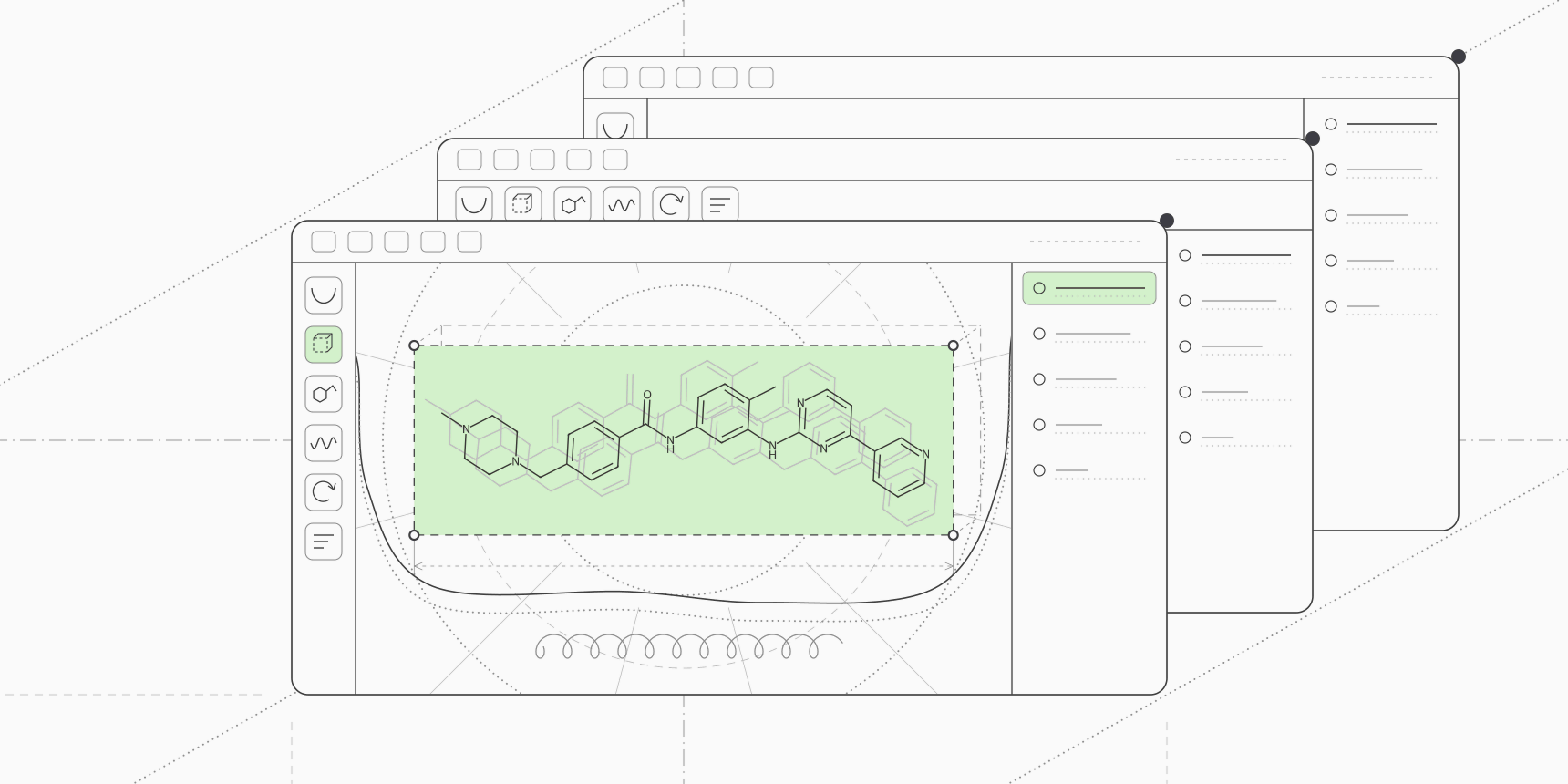
Docking is one of the few corners of drug discovery where the free software is as good as the paid kind, and often better documented. AutoDock Vina, the program most published docking studies still use, is open source. So are the deep learning methods that have overtaken it on some benchmarks since 2022. Schrödinger's Glide remains the commercial standard, but nothing in a typical academic docking project requires it.
The hard part is choosing. Vina, GNINA, DiffDock, DynamicBind and Boltz-2 answer different questions: where a ligand sits in a pocket you already know, where it might bind on a protein you know little about, how the protein moves when it does, and how tightly it binds. Picking the wrong one gives you a confident pose for the wrong question.
ProteinIQ runs every free program below in the browser, so read our enthusiasm with that in mind. The software itself is free to download whichever way you run it.
The best free molecular docking software
- AutoDock Vina for everyday docking into a known pocket
- GNINA for more accurate pose ranking in a known pocket
- DiffDock for blind docking when you don't know the binding site
- DynamicBind for unbound and predicted structures whose pocket has to move
- Boltz-2 for co-folding a complex from its sequence and estimating affinity
And Glide, for the jobs where paying still makes sense.
What makes good docking software?
Docking has two halves. A search algorithm proposes poses, ways the ligand could sit against the protein, and a scoring function ranks them. A program is useful when its top-ranked pose is close to the experimental one, usually judged as a heavy-atom RMSD under 2 Å from the crystal structure, and when that pose is physically sensible: no clashes, no impossible bond lengths.
We judged each tool on that pose accuracy, using the developers' published benchmarks and the independent PoseBusters comparison.[8] We also looked at what each one needs from you (a prepared receptor, a search box, a GPU), what it returns beyond a pose, and its license. A score in kcal/mol is not a measured affinity in any of these programs, which matters more than most comparisons admit.
We left out programs that are free only as a trial, programs without a release in recent years, and protein-protein docking tools, which solve a different problem; the protein-protein docking page covers those.
The best docking software at a glance
| Program | Best for | Needs a binding site | Needs a GPU | Biggest gap | License |
|---|---|---|---|---|---|
| Glide | Validated industrial docking and screening | Yes | No | Price | Commercial, quote only |
| AutoDock Vina | Everyday docking into a known pocket | Yes, as a search box | No | Scores are rough | Apache 2.0 |
| GNINA | More accurate pose ranking | Yes, or whole protein | Recommended | Linux only to install | Apache 2.0 |
| DiffDock | Blind docking | No | Yes | Poses can be physically invalid | MIT |
| DynamicBind | Apo and predicted protein structures | No | Yes | Modest top-pose accuracy | MIT |
| Boltz-2 | Co-folding and affinity ranking | No, only a sequence | Yes | Slowest per ligand | MIT |
The commercial standard for docking
Glide (Windows, macOS, Linux)
Glide pros:
- Decades of validation in pharmaceutical virtual screening
- Part of a full suite for protein preparation, induced-fit docking and free energy calculations
Glide cons:
- No published price and no free academic license for Glide itself
Glide is the docking program most pharmaceutical companies standardize on, and the reason is less raw pose accuracy than the system around it. Schrödinger's Maestro prepares the protein, assigns protonation states, generates ligand tautomers and hands the hits to induced-fit docking and free energy perturbation, all in one validated workflow.[12]
Schrödinger doesn't publish prices; licenses are quoted by module, core count and term. Some universities and consortia hold site licenses, so check before buying. If your group already lives in Maestro, Glide is worth keeping. If you are choosing from scratch for an academic project, the free programs below will do the job.
Glide price: Quote only, from Schrödinger.
Best free docking software when you know the binding site
When a structure has been solved with a ligand in the pocket, rigid docking into that pocket is still the most reliable approach. AutoDock Vina is the standard program for it, and GNINA runs the same kind of search but ranks the poses with neural networks, which picks the right one more often.
AutoDock Vina (Windows, macOS, Linux, web)
AutoDock Vina pros:
- The reference docking program that reviewers and collaborators expect
- Fast enough on a laptop CPU, with batch docking, co-docking and flexible side chains
AutoDock Vina cons:
- Its kcal/mol scores rank poses within one setup but correlate only loosely with measured affinity
AutoDock Vina was written by Oleg Trott in Arthur Olson's lab at Scripps Research, and Stefano Forli's lab maintains it today under the Apache 2.0 license. When it appeared in 2010, Trott and Olson reported that it found correct binding modes more often than AutoDock 4 while running about two orders of magnitude faster.[1] Version 1.2, released in 2021, added simultaneous docking of several ligands, hydrated docking, zinc metalloprotein parameters and Python bindings.[2]
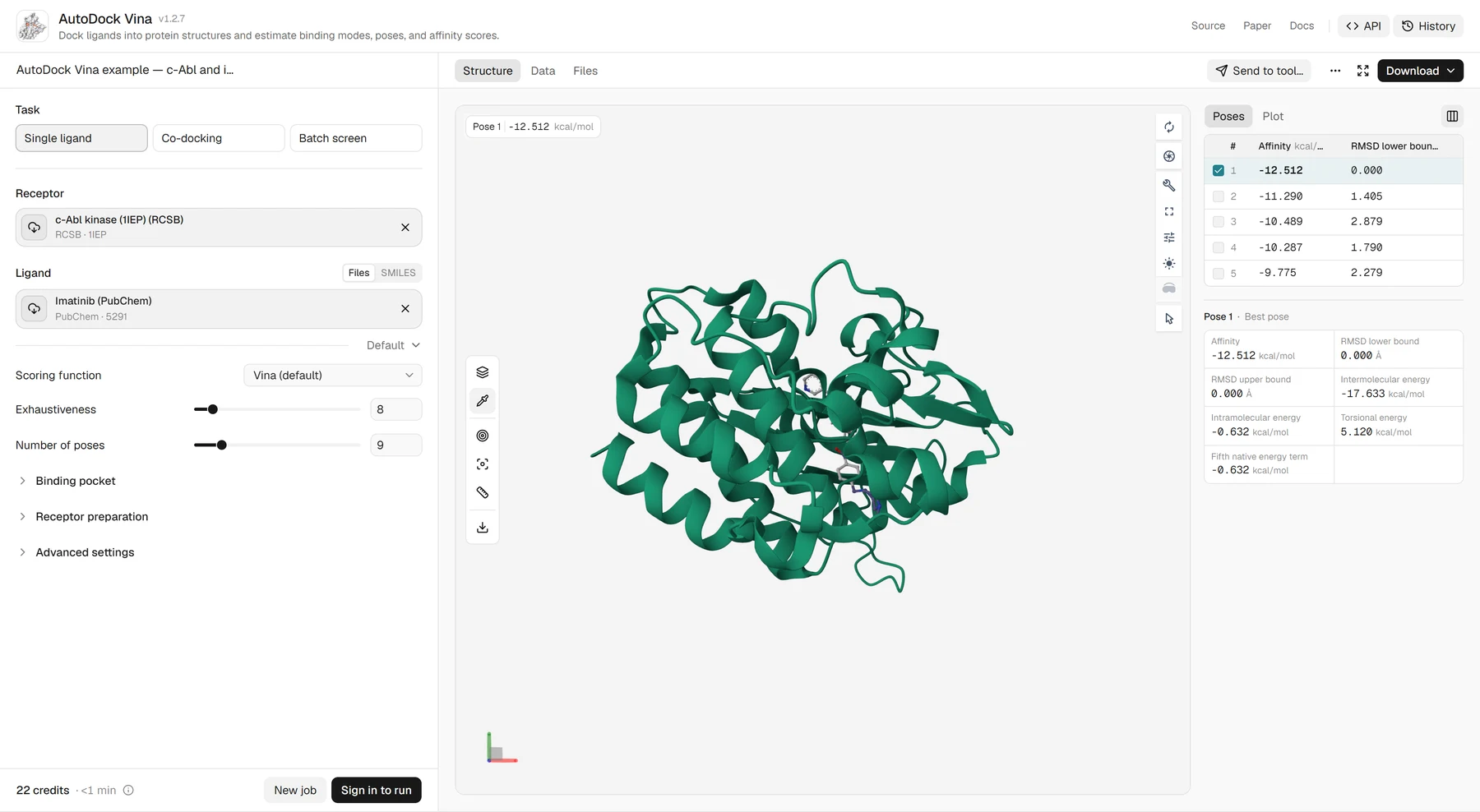
A run needs three things: a receptor, a ligand and a search box around the pocket. Locally, that means preparing PDBQT files with Meeko and choosing the box coordinates yourself. On ProteinIQ you can fetch the receptor by PDB ID and the ligand by name or SMILES, and Automatic places the box around a co-crystallized ligand. In the example above, imatinib docked into c-Abl kinase (PDB 1IEP) returned five poses, the best at −12.512 kcal/mol.
That number is where Vina is most often misread. A Vina score is useful for comparing poses of one ligand, and loosely for ranking related ligands against one prepared receptor. It is not a free energy of binding.
Its poses hold up better than its scores. On the Astex Diverse set in the PoseBusters study, Vina given a box around the crystal ligand placed 58% of ligands within 2 Å, and 56% were also physically valid; the authors found no deep learning method that beat classical docking on both counts.[8]
AutoDock Vina price: Free and open source. On ProteinIQ, a standard single-ligand run costs 20 credits, and a free account starts with 200 credits and gets 100 a month.
GNINA (Linux, web)
GNINA pros:
- Rescores Vina-style poses with convolutional neural networks, which picks the right pose more often
- Gives a pose confidence (
CNN Score) and a predicted affinity in pK units
GNINA cons:
- Distributed for Linux with CUDA; there's no Windows or macOS build
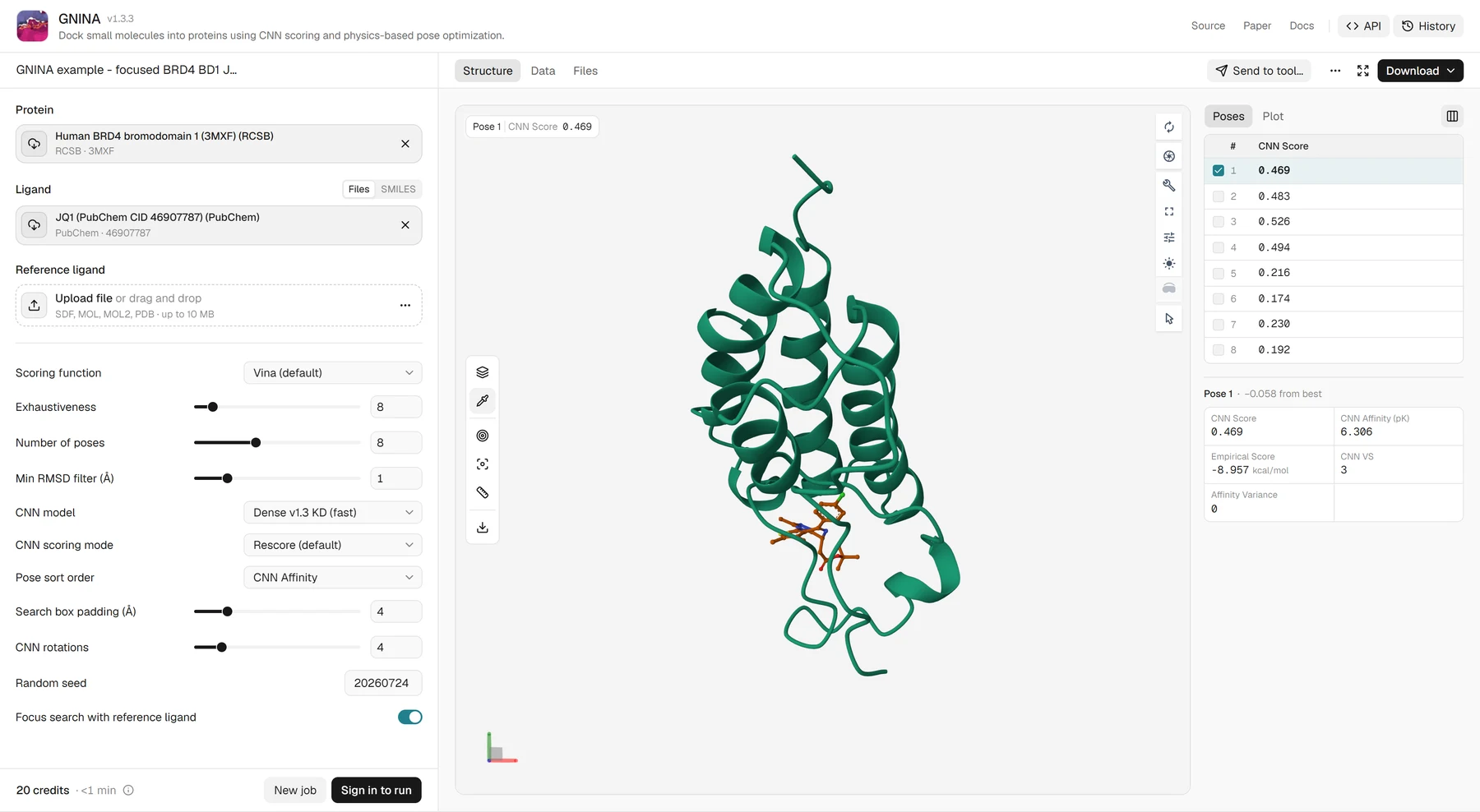
GNINA, from David Koes's lab at the University of Pittsburgh, keeps Vina's search and adds a second opinion. Every pose is scored by the empirical function and by 3D convolutional neural networks trained on crystal structures. In the GNINA 1.0 paper, the top-ranked pose was within 2 Å of the crystal pose 73% of the time in redocking, against 58% for Vina; in the harder cross-docking test the figures were 37% and 27%.[3]
The two CNN outputs answer different questions. CNN Score, from 0 to 1, estimates how likely a pose is to be correct; a top pose above 0.8 was right 79% of the time in redocking. CNN Affinity predicts binding strength in pK units, and in the BRD4 example above it reached 6.306 for JQ1. The GNINA CNN score explains how to read both.
The current release is 1.3.3, from June 2026, under the Apache 2.0 license.[4] It also contains everything in smina, the same lab's Vina fork for custom scoring functions and fast minimization.[5] If you only need those, SMINA runs on its own without a GPU.
GNINA price: Free and open source. On ProteinIQ, most focused docking runs cost 20 credits.
Best free docking software when you don't know the binding site
DiffDock (Linux, web)
DiffDock pros:
- Needs no binding site, only a protein and a ligand
- Accepts a protein sequence and folds it with ESMFold first
DiffDock cons:
- Confident poses can still have clashes or distorted geometry
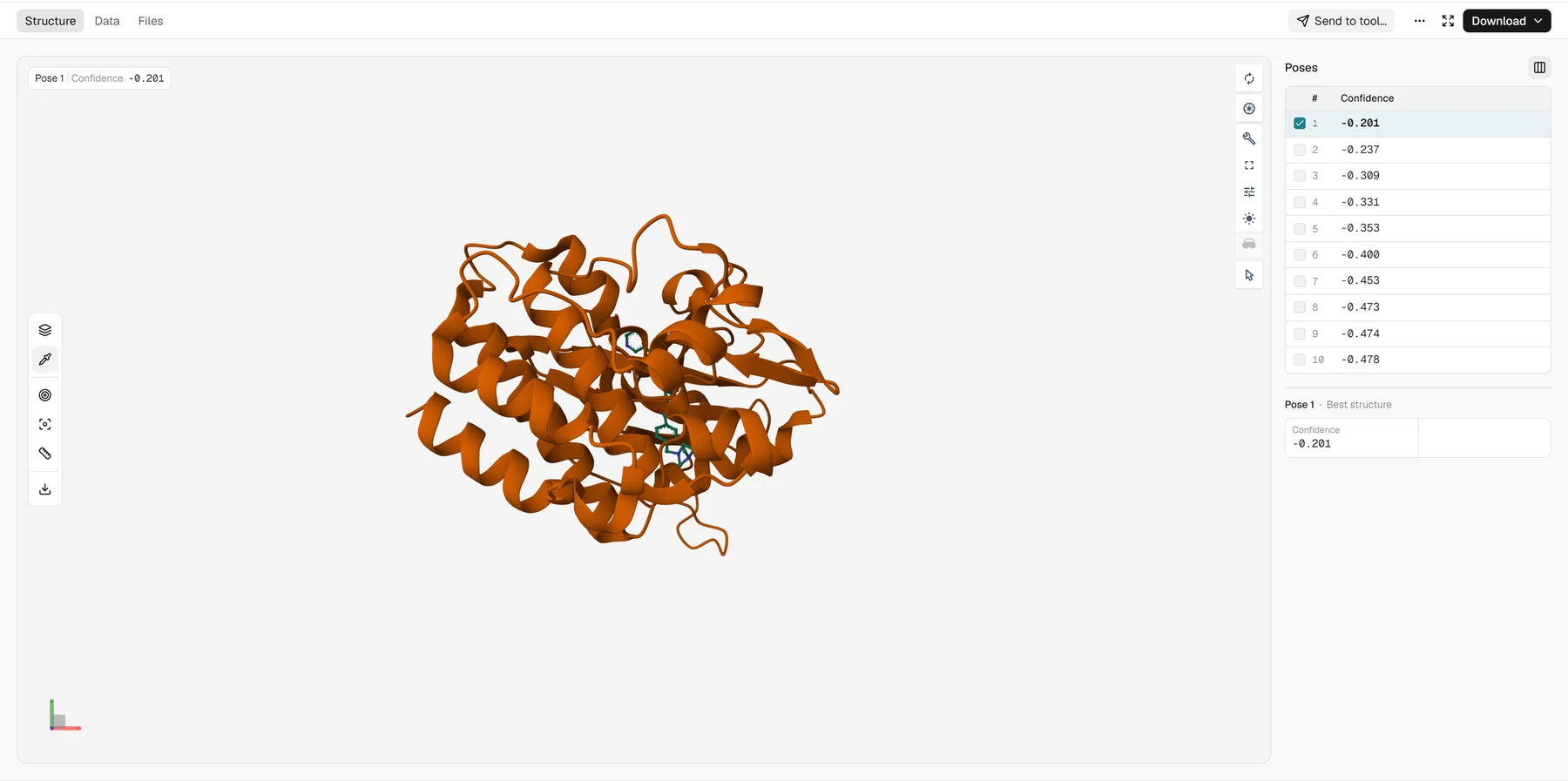
DiffDock, from Gabriele Corso and colleagues at MIT, treats docking as generation. It starts each sample from a random position and conformation and refines it by reverse diffusion, then a separate confidence model ranks the results. The current version, DiffDock-L, placed the top pose within 2 Å on 43% of the PDBbind test set, and 22.6% on protein domains unlike anything in its training data, up from 7.1% for the original model.[7]
That makes DiffDock a pocket finder more than a final answer. In PoseBusters, the original DiffDock placed 72% of Astex Diverse ligands within 2 Å, but only 47% were both close and physically valid.[8] The common workflow is to let DiffDock propose where the ligand goes, then refine that pocket with Vina or GNINA and check the result with PoseBusters. The blind docking page walks through it.
DiffDock is MIT-licensed, and the latest release is v1.1.3.[16] Running it locally needs a CUDA GPU and the ESM-2 protein language model.
DiffDock price: Free and open source. On ProteinIQ, a job costs 50 credits regardless of settings.
Best free docking software without a ligand-bound structure
Vina, GNINA and DiffDock all hold the receptor rigid. Many targets have no structure with a ligand bound, only an unbound crystal or an AlphaFold model whose pocket may be partly closed. DynamicBind starts from such a structure and lets the protein move as the ligand binds. Boltz-2 needs no structure at all: it predicts the protein and ligand together and estimates affinity.
DynamicBind (Linux, web)
DynamicBind pros:
- Moves the protein as well as the ligand, so it can dock into apo and AlphaFold structures
- Returns the predicted protein conformation for every pose
DynamicBind cons:
- About one top pose in three is near-native, so it needs checking
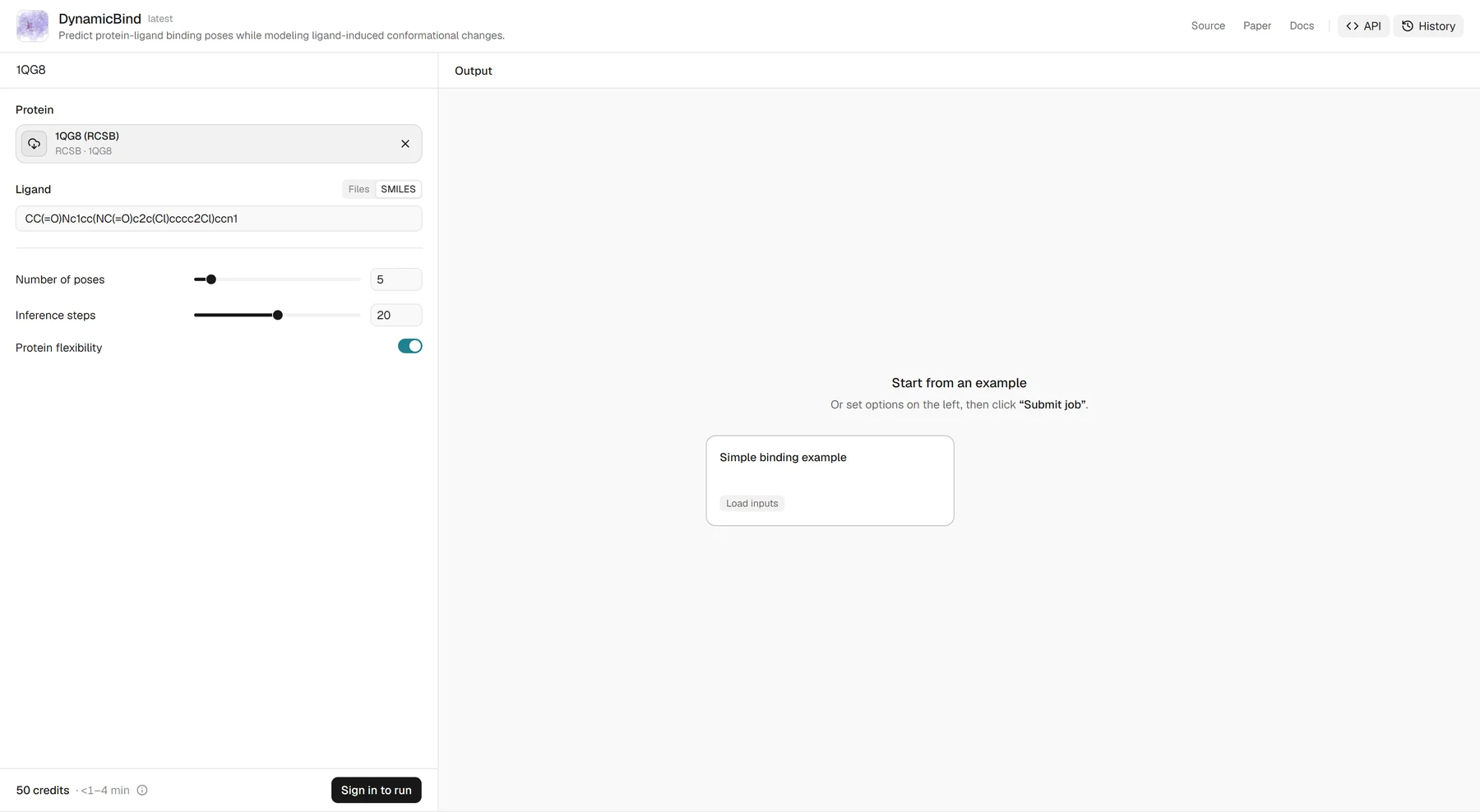
DynamicBind, published in Nature Communications in 2024, deforms the protein toward a ligand-bound shape as it places the ligand, moving side chains and the backbone with it.[9]
On the PDBbind test set, starting only from AlphaFold-predicted protein structures, the authors report that 33% of its ligand poses landed within 2 Å of the crystal pose and 65% within 5 Å.[9]
That is lower than rigid docking into a holo crystal structure, but it is the comparison that matters when no holo structure exists. Use it to generate plausible pocket shapes, then compare the poses by eye. The flexible molecular docking page compares it with ensemble docking.
DynamicBind price: Free and open source under the MIT license. On ProteinIQ, a job costs 50 credits.
Boltz-2 (Linux, web)
Boltz-2 pros:
- Predicts the whole complex from a sequence and a SMILES string, with no starting structure
- Adds a separate affinity estimate and a probability that the ligand binds at all
Boltz-2 cons:
- Far slower per ligand than docking, so it suits tens of compounds rather than millions
Boltz-2 is a co-folding model, not a docking program. Instead of placing a ligand into a fixed protein, it predicts the protein, ligand and any other chains together, the way AlphaFold 3 does. Its distinguishing feature is an affinity module, trained on measured IC50, Ki and Kd values, that its authors report ranks related compounds with accuracy approaching physics-based free energy methods at a fraction of the compute.[10]
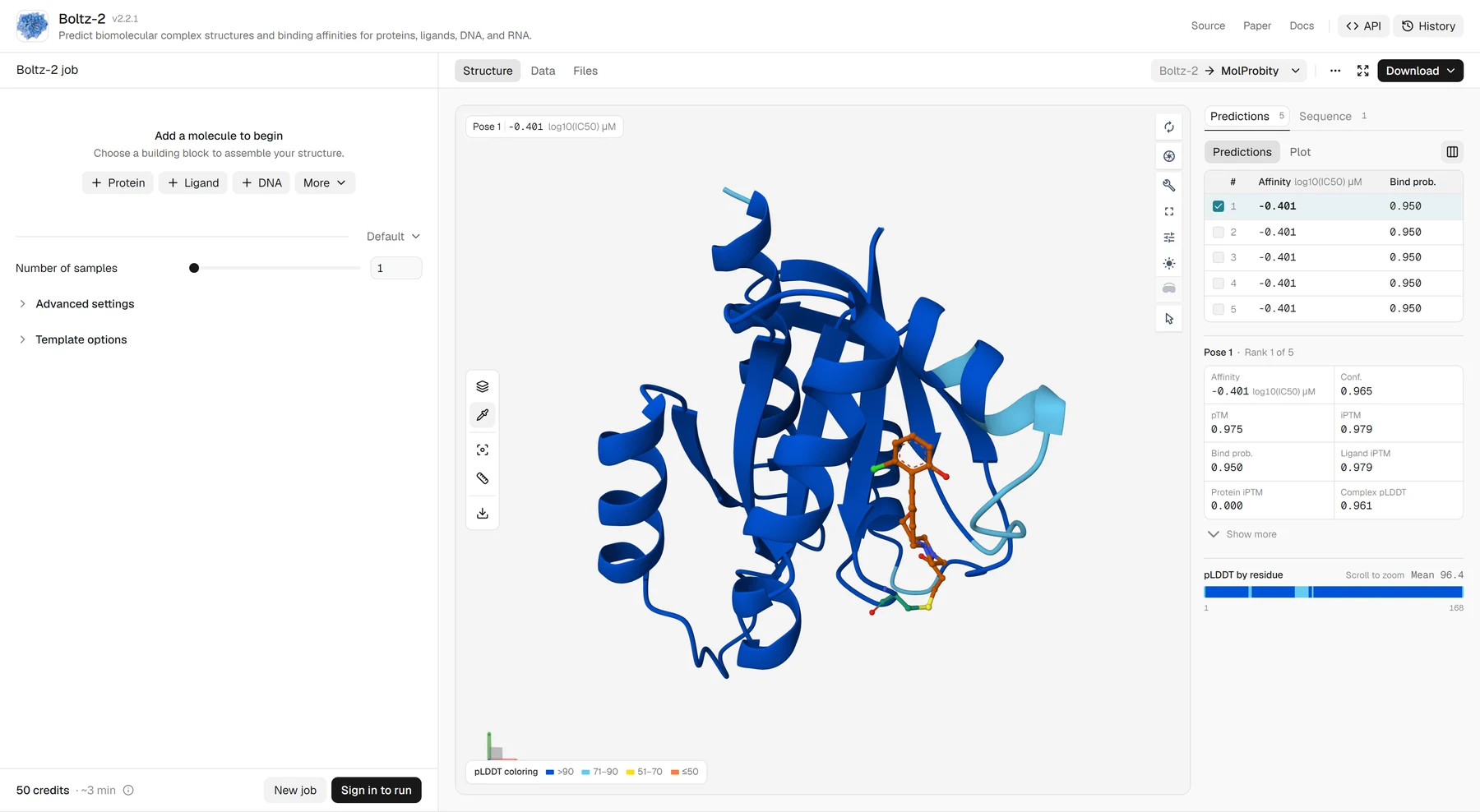
The example above co-folds KRAS G12C with a covalent inhibitor, joined by a bond constraint to cysteine 12; ligand ipTM is 0.979 and the binding probability 0.950. Read the affinity as a ranking score for related compounds on one target, not as an IC50 you could quote. Boltz-2 is MIT-licensed, including for commercial use, and the current release is 2.2.1.[11] Chai-1 and OpenFold3 are alternatives for the structure step.
Boltz-2 price: Free and open source. On ProteinIQ, jobs start at 50 credits.
Other free docking software to consider
AutoDock-GPU is the GPU port of AutoDock4, Vina's predecessor, with its physics-based force field and its own grid maps. Its developers report up to 56 times the speed of single-threaded AutoDock4, which makes it a good choice for screening large libraries with the AutoDock4 scoring function.[15]
SwissDock, from the Swiss Institute of Bioinformatics, is a free web server that runs Vina or its own Attracting Cavities algorithm, needs no login and has been used by more than 530,000 people.[13] PyRx is a desktop interface around Vina and Open Babel that many teaching labs use; older builds are free, and the project sells academic and commercial licenses for current versions.[14]
For protein-protein docking, the HADDOCK web server from Utrecht University is free for academic and non-profit users.
Which docking software should you choose?
If you know where the ligand binds and have a structure solved with a ligand in that pocket, start with AutoDock Vina and rescore the poses with GNINA. That combination is fast, well understood by reviewers, and as accurate as anything else in the PoseBusters comparison. If you don't know the pocket, run DiffDock first to find it, then refine there.
Use DynamicBind when the only structure you have is unbound or predicted, and Boltz-2 when you want to compare a short list of compounds on affinity or have no structure at all. Whatever you run, treat the top pose as a hypothesis: inspect the next few poses, check them with PoseBusters, and look at the contacts in PLIP. Pay for Glide when your organization needs the validated Schrödinger workflow around it, not for the docking alone.
If you are starting from a drawing rather than a file, the drawing to docking walkthrough takes a molecule from SketchIQ into Vina in a few minutes.