DNA vs RNA: structure, bases and nucleotides
One oxygen atom, one methyl group and what follows from them

Matic Broz, PhD14 min
What is the difference between DNA and RNA?
DNA and RNA are both chains of nucleotides, and they differ in three places. DNA's sugar is deoxyribose, which lacks the oxygen atom that ribose carries at its 2′ carbon. DNA uses the base thymine where RNA uses uracil. And DNA usually exists as two paired strands that store genes for the life of a cell, while RNA is copied from it as single strands that carry messages, build ribosomes and fold into working shapes.
The textbook list makes the strand count sound like the main difference, and it is the weakest of the three. A transfer RNA is a single strand, yet 42 of its 76 nucleotides sit in base-paired stems. The missing oxygen does far more.
Under conditions like those inside a cell, an RNA backbone link breaks on its own with a half-life of more than a year, about 13 years by the published rate constant, because that 2′ oxygen attacks the neighbouring phosphate.[1] Wolfenden's group puts the equivalent figure for DNA at 30 million years.[2] One atom buys DNA a factor of about two million in chemical lifetime.
The sugar decides stability and helix shape, the base decides how damage is caught, and pairing is the same in both: a purine with a pyrimidine, at a fixed width. Table 1 sets the two side by side.
| Feature | DNA | RNA |
|---|---|---|
| Sugar | 2′-deoxyribose (H at the 2′ carbon) | Ribose (OH at the 2′ carbon) |
| Bases | A, G, C, T | A, G, C, U |
| Usual form | Two antiparallel strands, often millions of base pairs long | One strand, tens to thousands of nucleotides, folded on itself |
| Double helix | B-form: 3.35 Å rise, about 10.4 base pairs per turn; can switch to A or Z | A-form only: 2.47 Å rise, about 11 base pairs per turn |
| Backbone half-life without enzymes | About 30 million years | About 13 years |
| Main jobs | Storing and copying genetic information | Messenger, transfer and ribosomal RNA, regulation, catalysis |
 Convert a DNA sequence to RNATranscribe a coding strand into its RNA sequence, T to U, with the strand kept in 5′ to 3′ order.Open tool
The 2′ oxygen and backbone stability
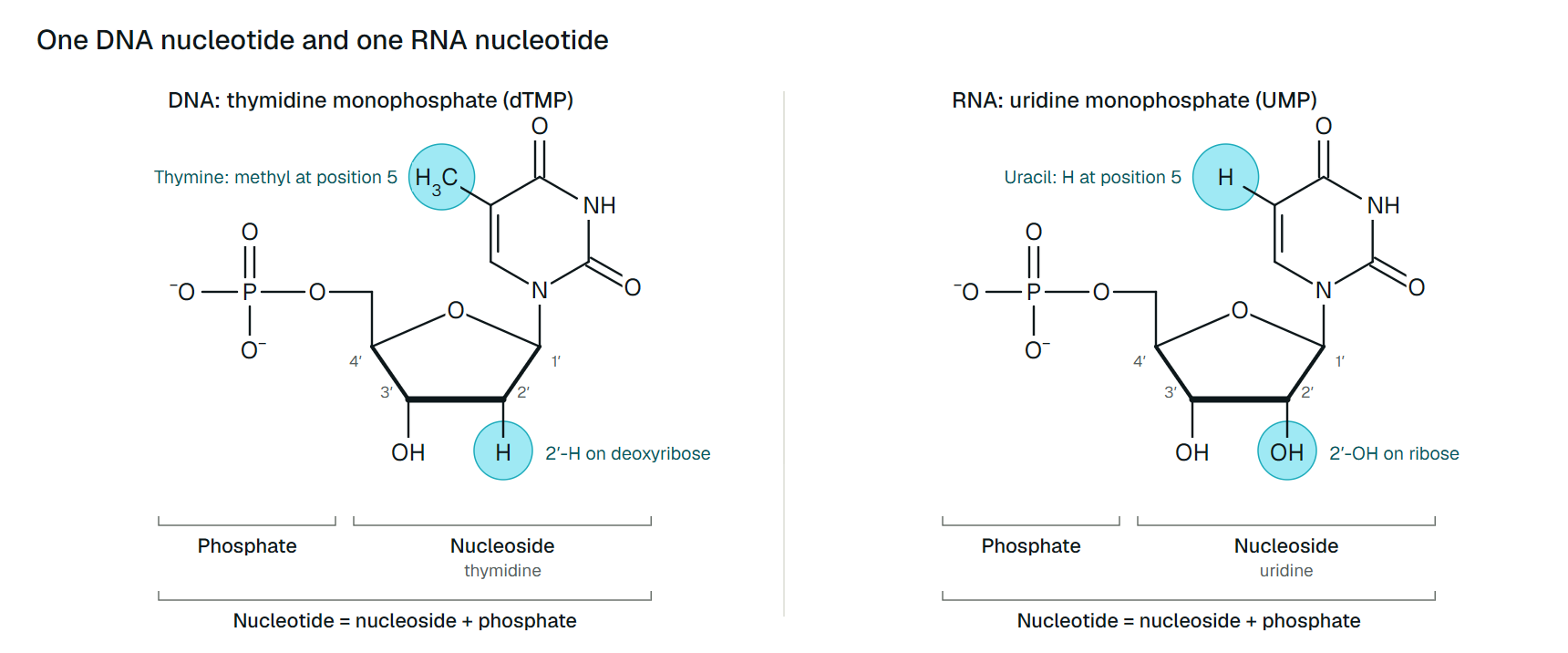
Figure 1 puts a DNA nucleotide next to an RNA nucleotide. Everything except two positions is identical: the phosphate, the five-membered sugar ring and the bond from the sugar's 1′ carbon to the base. The sugar differs at the 2′ carbon, which holds a hydrogen in DNA and a hydroxyl group in RNA.
That hydroxyl sits next to the phosphate that links one nucleotide to the next. Emilsson, Breaker and colleagues describe how the 2′ oxygen attacks the adjacent phosphorus and cuts the chain, a reaction DNA cannot run because it has nothing there to attack with. They give a rate constant of about 10⁻⁷ per minute under cell-like conditions, and ribonuclease A speeds the same reaction up until a link lasts microseconds.[1]
DNA's backbone has to wait for water to attack the phosphorus directly, which Schroeder and colleagues measured on a model phosphodiester at 30 million years.[2] The two numbers come from different model compounds, so read the ratio as an order of magnitude, about a million, not a precise constant.
The catch is that chemistry does not set how long RNA lives in a cell. A messenger RNA in a human cell lasts a few hours because enzymes degrade it on purpose, long before its backbone would break by itself.
The instability matters for the opposite case: a molecule that has to last. Lindahl, who began by watching purified tRNA decay in the test tube, found that DNA was "considerably more stable than RNA" but still slowly falls apart, and repair enzymes spend the cell's lifetime fixing it.[6][5] A genome kept in RNA would add backbone breaks to that workload.
Thymine vs uracil
The second difference is a methyl group. Thymine is uracil with a methyl at position 5, and the two pair with adenine in the same way. The methyl matters less for pairing than for proofreading.
Cytosine loses its amino group spontaneously and becomes uracil. Lindahl estimates about 300 cytosine and 5-methylcytosine deaminations per day in a transcriptionally active, replicating mammalian cell.[6] Because DNA uses thymine, any uracil in DNA is damage by definition, and uracil-DNA glycosylase removes it before the next round of replication turns the original G-C pair into A-T. If DNA used uracil as a normal base, the repair enzyme could not tell a real U from a deaminated C.
RNA does not need the distinction. Most transcripts are made, used and destroyed within hours, and a damaged copy can be replaced by transcribing the gene again. The separation is not absolute either: yeast phenylalanine tRNA carries 14 modified nucleotides among its 76, and one of them, at position 54, is 5-methyluridine, which is thymine on a ribose sugar.[3]
Why RNA is not really single-stranded
"Single-stranded" describes how RNA is made, not the shape it takes. An RNA strand pairs with itself wherever two stretches are complementary, and those stems with loops between them make up its secondary structure. In the 1.93 Å crystal structure of yeast tRNA-Phe, the four stems of the cloverleaf hold 21 base pairs, so 42 of 76 nucleotides (55%) are paired before counting the tertiary contacts that fold the cloverleaf into an L.[3]
The labels slip in the other direction too. Some viruses carry double-stranded RNA genomes, and some carry single-stranded DNA, which shows that strand number follows biology, not chemistry. The chemistry decides something more specific: what kind of double helix forms when RNA does pair.
DNA vs RNA helix structure
Watson and Crick's 1953 model described DNA as two antiparallel strands wound in a right-handed helix with the bases stacked inside.[4] RNA duplexes follow the same rules of pairing but take a different shape, and the cause is again the 2′ oxygen. It pushes the ribose ring into one pucker, C3′-endo, which shortens the distance between neighbouring phosphates and tilts the base pairs.
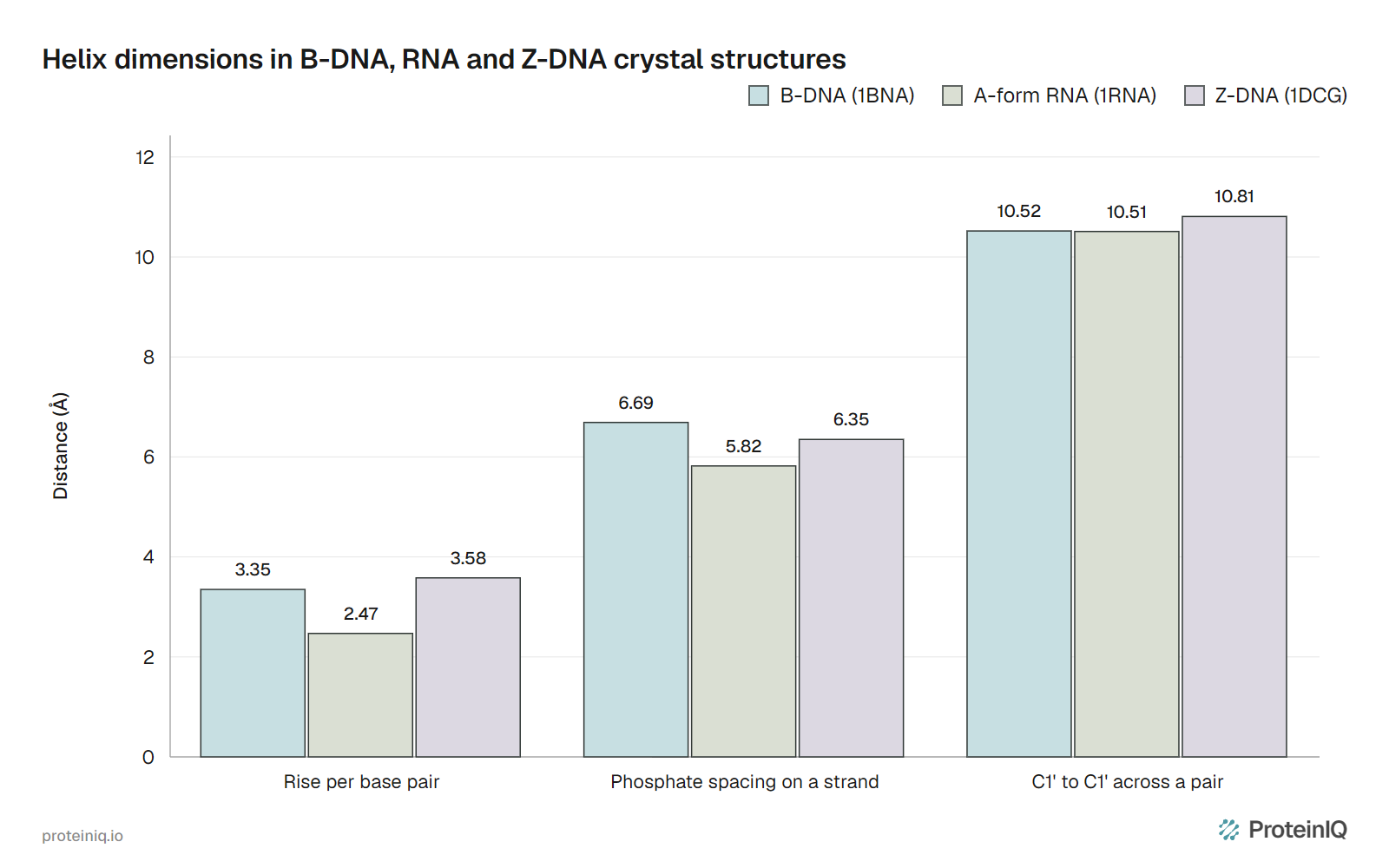
To see how large the effect is, we measured three crystal structures from the Protein Data Bank: the Dickerson B-DNA dodecamer CGCGAATTCGCG (1BNA, 1.9 Å), an RNA duplex of 14 base pairs (1RNA, 2.25 Å) and the Z-DNA hexamer CGCGCG (1DCG, 1.0 Å).[7][8][9] For each nucleotide we computed the sugar pucker phase and the distance to the next phosphorus; for each base-pair step, the rise and twist about a fitted helix axis.
The RNA was uniform in a way the DNA was not. All 28 RNA sugars sat in C3′-endo, with phase angles between 15° and 22°. In B-DNA, 22 of 24 sugars fell between 92° and 169°, the broad C2′-endo family, and the other two strayed toward C3′-endo. Deoxyribose can flip between puckers because nothing at the 2′ carbon holds it; ribose cannot.
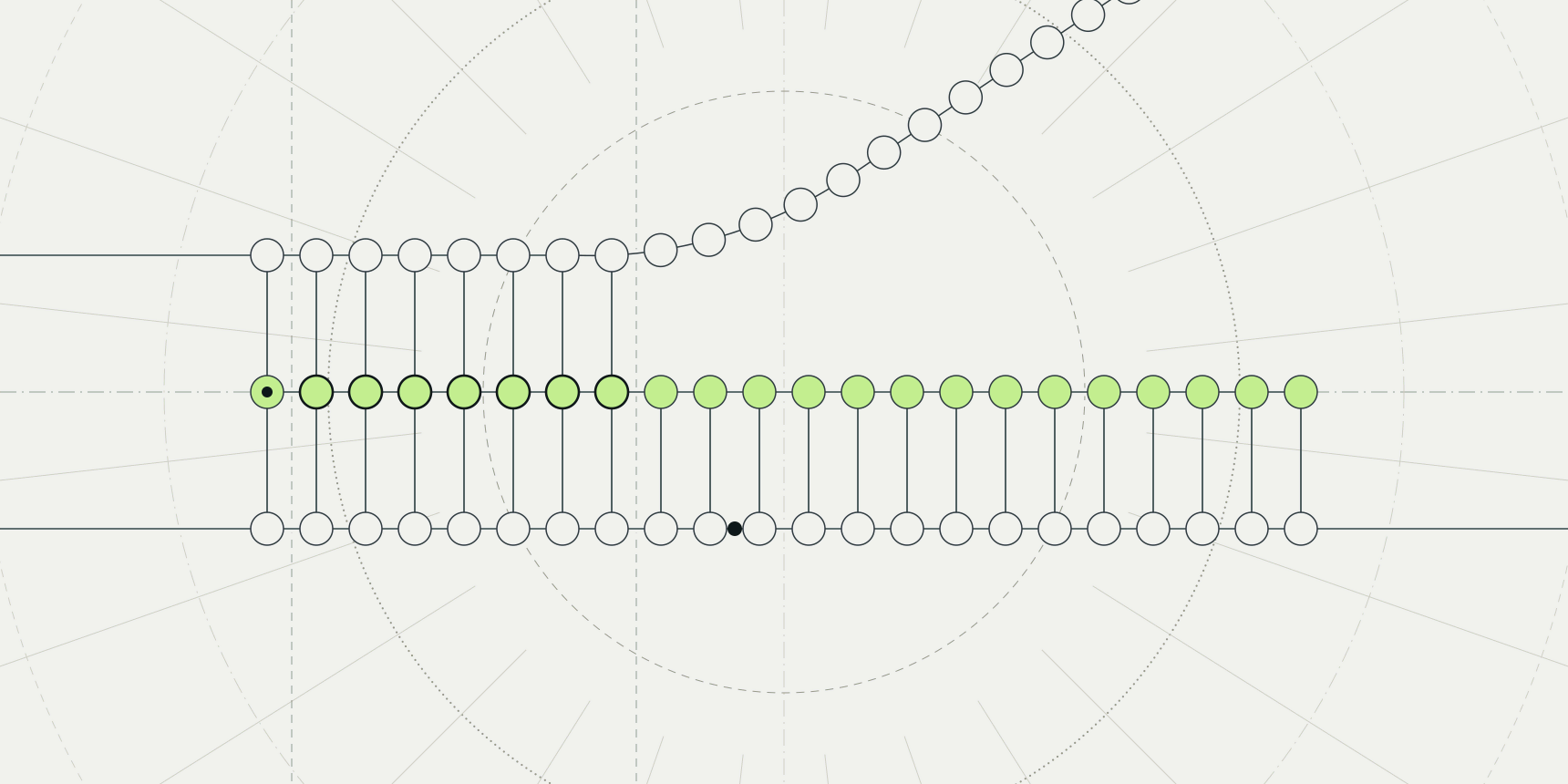
Figure 2 shows what the pucker does to the helix. Each RNA base pair rises 2.47 Å along the axis against 3.35 Å in B-DNA, and the RNA turns slightly less per step, about 11 base pairs per turn against 10.4. A 12 base-pair stretch is about 40 Å long as B-DNA and 30 Å long as RNA. The width across each pair barely moves (10.52 and 10.51 Å between the sugar carbons), so the RNA helix packs the same pairs into a shorter, fatter cylinder with a deep, narrow major groove.
DNA can adopt the A-form too, which is why the A and B labels predate RNA structures. Franklin and Gosling's DNA fibres switched between a drier A form and a wetter B form in 1953.[11] The odd one is Z-DNA, a left-handed helix that Wang, Rich and colleagues found in crystals of alternating CG.[10]
In 1DCG we measured twists that alternate between −8° and −52°, about 12 base pairs per left-handed turn, with the cytosine sugars in C2′-endo and the inner guanine sugars in C3′-endo. Z-DNA is a curiosity of particular sequences under particular conditions, not a third kind of genome.
Purines vs pyrimidines
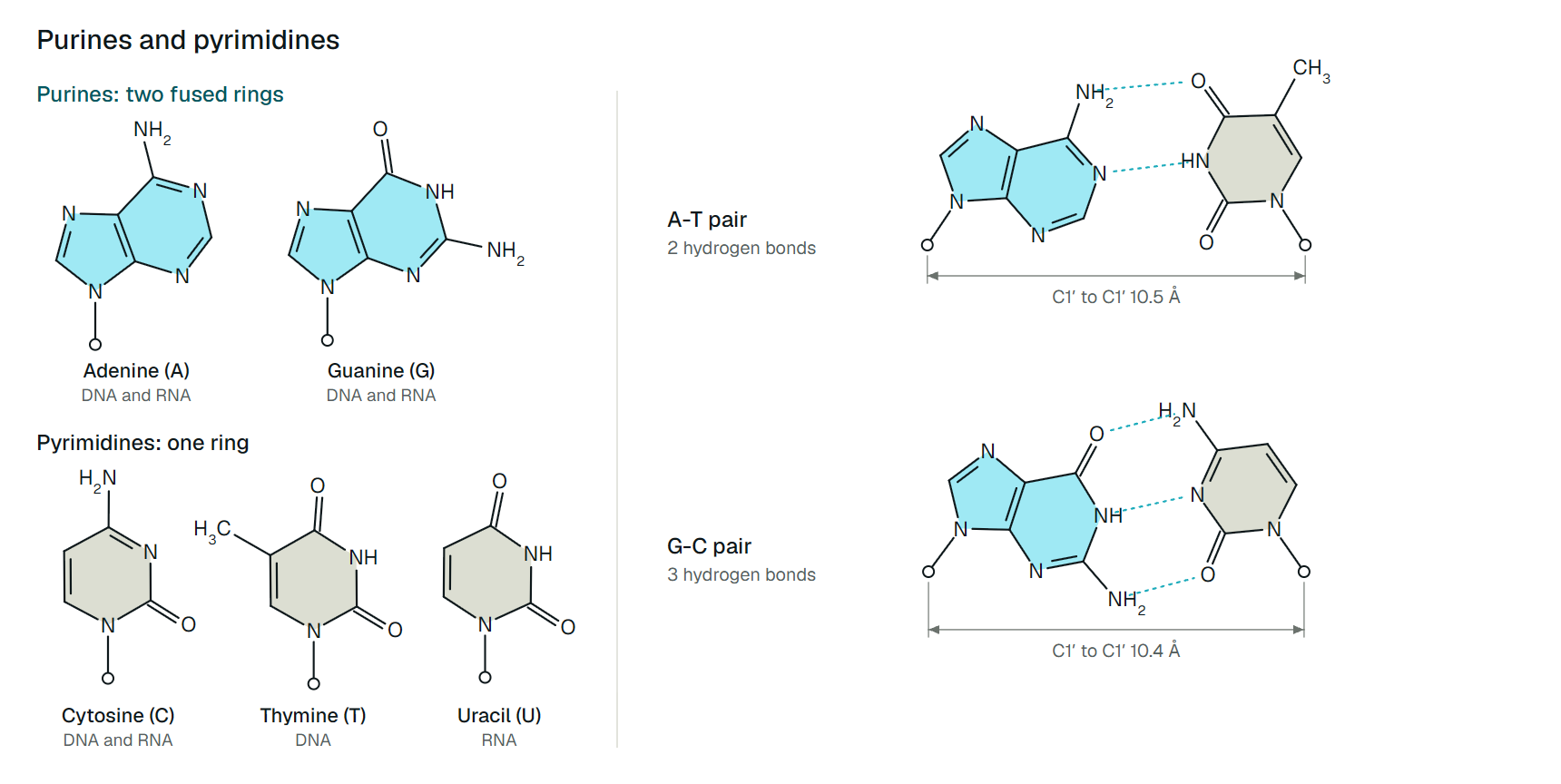
The five bases fall into two chemical families (Figure 3). Purines, adenine and guanine, have two fused rings: a six-membered ring joined to a five-membered one. Pyrimidines, cytosine, thymine and uracil, have a single six-membered ring. Both DNA and RNA use the same two purines; they differ only in which pyrimidine pairs with adenine.
Pairing always joins one of each. A purine with a pyrimidine spans the same width whichever pair it is: across the 10 inner pairs of 1BNA, the C1′ to C1′ distance was 10.52 ± 0.18 Å, and the A-T and G-C pairs in Figure 3 measure 10.5 and 10.4 Å. Two purines would be too wide for the backbone and two pyrimidines too narrow. G-C pairs hold three hydrogen bonds and A-T pairs two, which is why GC-rich DNA needs more heat to separate.
Chargaff measured the consequence before anyone knew the structure: in DNA from many species, adenine matched thymine and guanine matched cytosine.[12] In double-stranded DNA, purines therefore equal pyrimidines exactly, because every purine has a pyrimidine partner.
The rule says nothing about one strand on its own. Human mitochondrial DNA shows the gap clearly. We counted the bases in the 16,569 base-pair reference sequence, which by convention is written as the light strand: 30.9% A, 13.1% G, 31.3% C and 24.7% T, so the strand is 44.0% purines.[14][15] Its partner, the heavy strand, is guanine-rich and 56.0% purines.
Yet a single strand of a long bacterial chromosome comes out balanced. Our count on the E. coli K-12 genome gave 24.6% A against 24.6% T and 25.4% G against 25.4% C, 49.99% purines in one strand of 4.6 million bases.[16] Rudner, Karkas and Chargaff saw this in Bacillus subtilis in 1968, and it is now called Chargaff's second parity rule.[13]
An RNA strand has no partner to balance it, so no parity rule applies. A purine count that differs from 50% says nothing is wrong with an RNA, and in a DNA sample it means only that you are looking at one strand.
Nucleotide vs nucleoside
A nucleoside is a base joined to a sugar. A nucleotide is a nucleoside with one or more phosphate groups on the sugar's 5′ carbon, as the brackets in Figure 1 mark. DNA and RNA are polymers of nucleotides, each phosphate linking the 5′ carbon of one sugar to the 3′ carbon of the next. Table 2 gives the names, which differ more than the chemistry does.
| Base | Type | RNA nucleoside | DNA nucleoside | Monophosphates (RNA, DNA) |
|---|---|---|---|---|
| Adenine (A) | Purine | Adenosine | Deoxyadenosine | AMP, dAMP |
| Guanine (G) | Purine | Guanosine | Deoxyguanosine | GMP, dGMP |
| Cytosine (C) | Pyrimidine | Cytidine | Deoxycytidine | CMP, dCMP |
| Thymine (T) | Pyrimidine | 5-methyluridine (rare, modified tRNA) | Thymidine | dTMP |
| Uracil (U) | Pyrimidine | Uridine | Deoxyuridine (not a normal DNA unit) | UMP |
The difference has a practical edge in medicine. Nucleoside analogues have been used against cancer and viral infections for almost 50 years.[17] Most are given as nucleosides, or as nucleotides with the phosphate masked, because a charged phosphate crosses cell membranes poorly; the cell's own kinases then add the phosphates that turn the drug into a fake building block for DNA or RNA synthesis.
The same logic applies to approved oligonucleotide drugs, whose backbones are chemically modified so that they survive long enough to work.
DNA and RNA sequence tools on ProteinIQ
These tools follow the order of the article: convert between the two alphabets, check a strand's composition, then fold an RNA.
- DNA to RNA and RNA to DNA: swap T and U to get the RNA copy of a coding strand, or back.
- Reverse complement: write the partner strand, with purines and pyrimidines swapped by the pairing rules.
- GC content: count G and C, the pairs with three hydrogen bonds.
- Molecular weight: mass of a DNA or RNA strand from its nucleotides.
- RNAfold: predict which parts of a single RNA strand pair with each other.
- PDB viewer: open 1BNA, 1RNA or 1DCG to compare the helices in 3D.
 Fold an RNA strand on itselfMinimum free energy secondary structure: which bases of one RNA pair, and how stable the fold is.Open tool
Frequently asked questions
What are the three main differences between DNA and RNA?
DNA uses the sugar deoxyribose, RNA uses ribose, which has an extra hydroxyl group at the 2′ carbon. DNA uses thymine where RNA uses uracil. DNA is usually double-stranded and RNA single-stranded, although RNA pairs with itself: 42 of the 76 nucleotides in yeast tRNA-Phe sit in paired stems.[3]
Why is DNA more stable than RNA?
RNA's 2′ hydroxyl can attack the neighbouring phosphate and cut the chain. Under cell-like conditions an RNA link breaks with a half-life of more than a year, about 13 years by the published rate constant, while a DNA link would take about 30 million years.[1][2] In cells, enzymes degrade most RNA much sooner.
Which bases are purines and which are pyrimidines?
Adenine and guanine are purines, with two fused rings. Cytosine, thymine and uracil are pyrimidines, with one ring. Every Watson-Crick pair joins a purine to a pyrimidine, which keeps the pairs about 10.5 Å wide in our measurement of the B-DNA crystal structure 1BNA.[7]
What is the difference between a nucleotide and a nucleoside?
A nucleoside is a base attached to a sugar, such as adenosine or thymidine. A nucleotide adds one or more phosphate groups to that sugar, such as AMP, ATP or dTMP. DNA and RNA are chains of nucleotides.
Why does RNA use uracil instead of thymine?
Cytosine spontaneously loses an amino group and becomes uracil, about 300 times a day in an active mammalian cell.[6] Because DNA uses thymine, repair enzymes treat any uracil in DNA as damage. RNA is short-lived and can be remade from the gene, so it does without the methyl group that tells the two apart.
What is the difference between B-DNA, A-form RNA and Z-DNA?
B-DNA is the usual right-handed DNA helix, with about 3.4 Å per base pair and 10.4 pairs per turn in our measurement of 1BNA. RNA duplexes are A-form, shorter and wider, at about 2.5 Å per pair and 11 pairs per turn. Z-DNA is a left-handed helix formed by alternating CG sequences, about 12 pairs per turn.[9][10]