How long does DNA last?
DNA has no single lifespan. A bone study measured a 521-year half-life for a 242-base-pair fragment, while exceptional frozen sediment has preserved sequenceable DNA for about 2 million years.
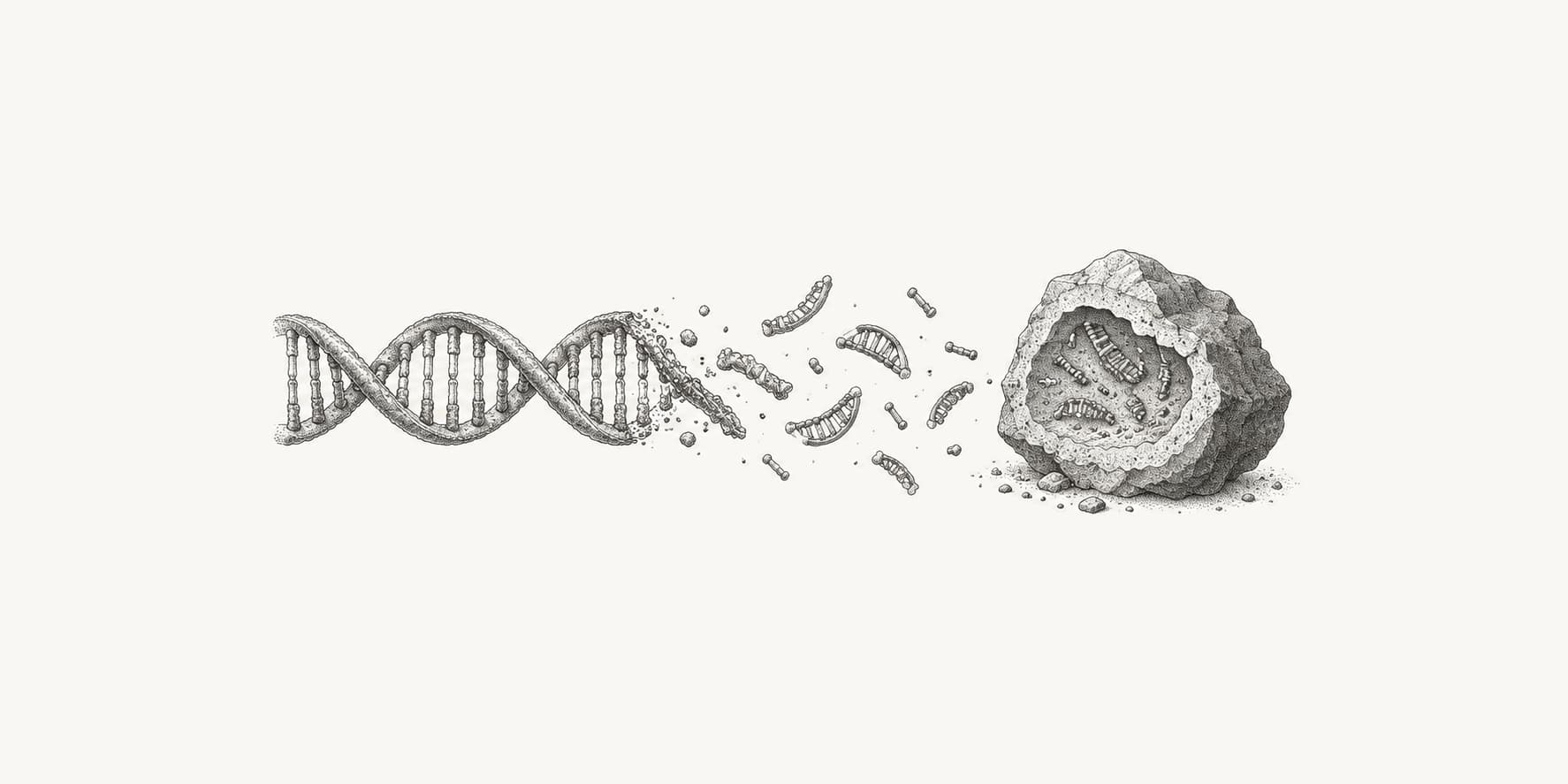
DNA can remain detectable for days, years, or millennia. The useful answer depends on what the DNA is in and what has happened to it. Heat, water, sunlight, microbes, and time all break molecules into shorter, chemically damaged pieces.
The often-quoted 521-year half-life is not an expiry date for all DNA. It describes one 242-base-pair mitochondrial DNA fragment in ancient bone. At the other extreme, researchers have sequenced DNA about 2 million years old from frozen Greenland sediment.
This article is about degradation and preservation. For the molecule's physical length, see how long DNA is in a human cell.
How long does DNA last?
DNA has no fixed lifespan: exposed traces may become unusable within days or months, while short fragments protected by cold, dry conditions can remain sequenceable for hundreds of thousands of years.
The clearest measured decay rate comes from 158 dated moa bones from New Zealand. The bones were 602 to 7,839 years old and came from three nearby sites with an estimated burial temperature of 13.1°C. The study found a half-life of 521 years for a 242-base-pair mitochondrial DNA target.[1]
A half-life means that the number of intact copies of that specific fragment fell by half every 521 years in the fitted model. After 1,042 years, one-quarter would remain. It does not mean that every DNA molecule disappears after 521 years.
The same model predicted far longer survival for shorter fragments in colder bone. At -5°C, a 30-base-pair fragment had a predicted half-life of 158,000 years. The average surviving strand would fall to one base pair after about 6.8 million years. The authors treated that as a theoretical limit under unusually favorable conditions, not a universal date when all DNA vanishes.[1]
The chart shows the study's model predictions for a 30-base-pair mitochondrial DNA fragment in bone. The half-life falls from 158,000 years at -5°C to 500 years at 25°C.[1]
Nuclear DNA also decayed at least twice as fast as mitochondrial DNA in the two moa specimens tested by high-throughput sequencing. The result is another reason a single “DNA half-life” cannot describe every genome, tissue, or environment.[1]
How long does DNA last after death?
DNA starts to degrade soon after death, but recoverable fragments can persist from days to more than a million years. The rate depends more on the tissue and its environment than on elapsed time alone.
Living cells continually repair damage to DNA. After death, repair stops. The cell's own nucleases cut DNA, microbes digest tissue, and water-driven reactions remove bases and break the sugar-phosphate backbone.[1][4]
Ancient DNA is therefore rarely intact. A review of specimens between 4 and 13,000 years old found that almost all recovered DNA had been reduced to fragments about 40 to 500 base pairs long. It also carried chemical damage, especially cytosine deamination near fragment ends.[3]
This distinction matters: detectable DNA is not the same as an intact genome. Modern sequencing can read many short fragments and place them against a reference sequence, allowing researchers to recover information long after long DNA molecules have broken apart. For context, a human genome contains about 3.1 billion base pairs.
Dense tissues can shield more DNA than soft tissue. One comparison of ancient human remains found average endogenous DNA contents of 40.0% in inner petrous bone, 16.4% in tooth cementum, and 2.2% in parietal skull bone. Even so, preservation varied widely among individuals and burial sites.[8]
What conditions preserve DNA the longest?
Cold, dry, dark, chemically stable conditions preserve DNA best. Heat, moisture, ultraviolet light, oxygen, acidity, and microbial activity speed up its loss.
Temperature has an especially large effect because it controls the rates of chemical reactions and microbial growth. Water enables hydrolysis, while sunlight causes direct photochemical damage. Burial chemistry matters too: pH, salts, oxygen, and contact with minerals can change how quickly DNA breaks down.[3][4]
The oldest DNA sequenced so far shows how unusual good preservation can be. Researchers recovered environmental DNA from Greenland sediment deposited about 2 million years ago. The site had a mean annual temperature near -17°C, and the DNA was bound to mineral surfaces in the sediment. The team calculated that the sample's 2 million years of thermal exposure was equivalent to only about 2,700 years at a constant 10°C.[2]
The surviving pieces were extremely short. The researchers modeled an average fragment length of roughly 50 base pairs if the sediment had remained frozen. Clay minerals, particularly smectite, can bind DNA and make it less accessible to degrading enzymes, adding another layer of protection.[2]
The 2-million-year record does not prove that DNA normally lasts that long. It shows that age alone is a poor predictor. A young sample kept warm and wet may yield less usable DNA than a much older sample held cold and dry.
How long does DNA last at room temperature or on a surface?
At room temperature, DNA can remain detectable for months or years, but the result depends on whether it is wet or dry, purified or cellular, protected or exposed, and on the surface beneath it.
A 2025 controlled study placed cellular and cell-free DNA on eight non-metal surfaces. Some DNA remained recoverable for the full one-year experiment on cardboard, cotton, paper, plastic, glass, laminate, and drink cans. Wood yielded no detectable DNA after four months. Recovery generally declined with time, but surface type and DNA form produced large differences.[5]
These findings do not mean that every fingerprint leaves a profile for one year. The experiment used known DNA deposits under defined conditions. Real traces can be much smaller, touched or cleaned, exposed to sunlight and rain, or mixed with other material.
Purified laboratory DNA is a different case. In a four-year comparison, protected dry DNA stored at room temperature could still be amplified and sequenced, although samples kept at -20°C produced longer reads and stronger signals. The authors concluded that dry storage can protect samples during shipment or freezer failure, but did not support replacing cold storage for long-term archives.[6]
Another study followed purified DNA for up to 365 days. DNA dried in a commercial protective matrix at room temperature gave recoveries similar to frozen controls and outperformed unprotected room-temperature DNA. Protection mattered most for samples containing less than 20 nanograms.[7]
For valuable samples, “still detectable” is too low a standard. Cold storage, stable pH, dryness, darkness, and clean handling preserve longer fragments and reduce chemical damage.