How long is DNA?
A typical human cell holds about 2 meters of nuclear DNA, divided among 46 chromosomes and packed into a microscopic nucleus.
TL;DR
- A typical human diploid cell contains about 2 meters of nuclear DNA before replication, equivalent to 200 centimeters or 6.6 feet.
- This length is distributed among 46 chromosomes, each containing a separate DNA molecule before replication.
- B-form DNA is about 2 nanometers wide, with an approximate spacing of 0.34 nanometers between neighboring base pairs.
- We combined published genome-length and cell-count estimates to calculate about 14 billion kilometers of nuclear DNA for a 70-kilogram reference male. This is a derived estimate, not a direct measurement.
A typical human cell contains approximately 2 meters of nuclear DNA, equivalent to 200 centimeters or 6.6 feet. This length is distributed among 46 chromosomes and compacted into a nucleus only a few micrometers across. The contrast between molecular length and nuclear size reflects the extensive folding of DNA within the cell.
At the scale of the body, DNA length is less well defined. We combined published estimates of DNA length per nucleus and the number of nucleated cells to calculate approximately 14 billion kilometers for a 70-kilogram reference male. Our estimate is calculated from existing studies. Its interpretation depends on cell composition, chromosome copy number, and the DNA included in the estimate.
How long is DNA in one human cell?
A typical diploid human cell contains about 2 meters of nuclear DNA before replication. Its 46 chromosomes comprise two sets, one inherited from each parent, with a combined sequence length of approximately 6 billion base pairs.[1]
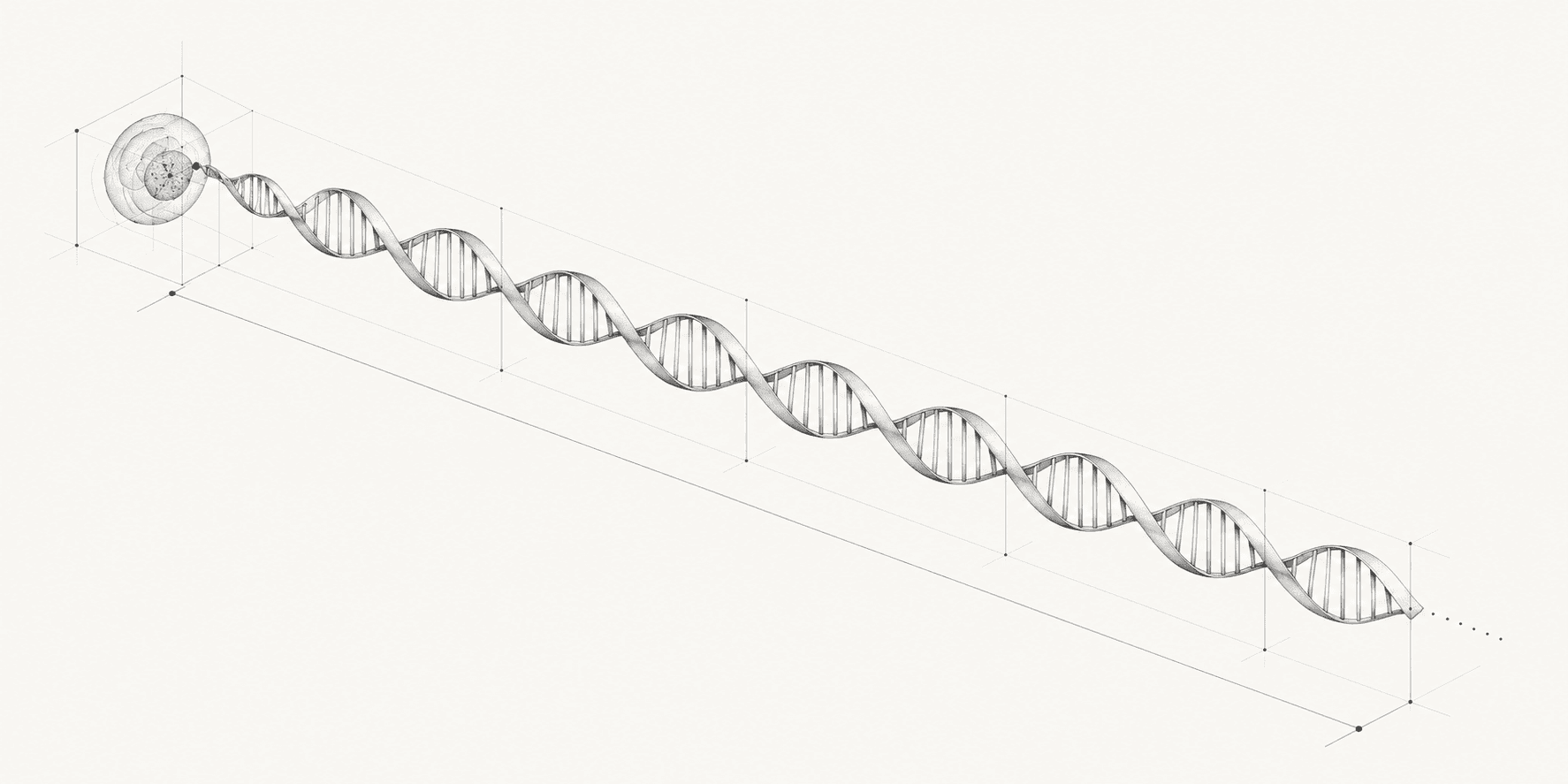
The physical length follows from the spacing between base pairs. In the usual B-form of DNA, adjacent base pairs are separated by approximately 0.34 nanometers along the helix axis.[2] Multiplying this spacing by 6 billion base pairs gives the basis of the familiar two-meter approximation:
This calculation describes extended double-stranded DNA with its packaging removed. Each base pair is counted once, and the result is summed across the chromosomes. Separating and adding the two strands would therefore double-count the length. Before replication, each chromosome contains one continuous double-stranded DNA molecule.[1]
Chromosome lengths vary substantially. Piovesan and colleagues reported 8.14 centimeters for chromosome 1 and 1.53 centimeters for chromosome 21. These values describe the extended DNA molecules, rather than the compact chromosomes visible during cell division.[3]
Precise length estimates also depend on the conversion used. In their 2019 analysis, Piovesan and colleagues assumed 3.4 nm per helical turn and 10.4 base pairs per turn, giving approximately 0.327 nm per base pair.[4] We applied the conventional 0.34 nm spacing to the same sequences and calculated values about 4% higher:
| Reference genome | Published length | Calculated at 0.34 nm per base pair |
|---|---|---|
| 46,XY | 2.05 m | 2.13 m |
| 46,XX | 2.08 m | 2.17 m |
Table 1. Human DNA length under two conversion assumptions. Our comparison uses the study's GRCh38.p10 base-pair counts, approximately 6.27 billion for 46,XY and 6.37 billion for 46,XX. We recalculated the final column from those published counts. Both conversions support an approximate length of two meters; neither establishes an exact value for every individual. The chromosome chart retains the study's original conversion.
[3][4]Within an individual, DNA content changes with cell type and cell-cycle stage. Replication doubles the DNA content of a diploid cell before division, whereas sperm contain a single chromosome set.[5]
| Human cell or cell state | Approximate nuclear DNA length |
|---|---|
| Diploid cell before replication | 2 m |
| Diploid cell after replication, before division | 4 m |
| Sperm | 1 m |
| Egg after completing meiosis II | 1 m |
| Mature red blood cell or platelet | None |
Table 2. Nuclear DNA length by cell type and stage. Human eggs normally complete meiosis II after fertilization, so their DNA content must be described with reference to this stage. [5] Mature red blood cells and platelets lack nuclei. Their numerical abundance makes this distinction particularly important when extending the calculation from a cell to the body.
[6]DNA size in nanometers: length versus width
B-form DNA has a diameter of approximately 2 nanometers. Its length, in contrast, depends on the number of base pairs along the helix.[2] The two-nanometer diameter and the two-meter cellular total therefore describe different dimensions at different scales.
For a known sequence, multiplying the base-pair count by 0.34 gives an approximate extended length in nanometers. The resulting conversions span several orders of magnitude:
| DNA amount | Extended length at 0.34 nm per base pair |
|---|---|
| 100 base pairs | 34 nm |
| 1,000 base pairs (1 kb) | 340 nm, or 0.34 micrometers |
| 1 million base pairs (1 Mb) | 0.34 mm |
| 3 billion base pairs | 1.02 m |
| 6 billion base pairs | 2.04 m |
Table 3. DNA sequence length converted to physical length. We calculated extended DNA lengths using 0.34 nanometers per base pair.
The rounded two-meter cellular total is equivalent to 2 billion nanometers. These lengths describe the molecules in an extended state; they do not measure the space occupied by DNA within a nucleus. Similarly, genome size expressed in base pairs is a sequence count that requires a structural assumption to convert into a physical length. Differences in sequence content underlie the wide variation among the largest and smallest genomes.
DNA packaging brings these molecular and cellular scales together. Approximately 146 base pairs wrap around a histone core to form a nucleosome. Further folding of the DNA-protein complex produces chromatin, allowing meters of DNA to occupy a nucleus only a few micrometers across.[1] Compaction changes the spatial arrangement of the molecule without changing its base-pair count.
How long is DNA in the whole human body?
We combined published cell-count and genome-length estimates to calculate approximately 14 billion kilometers, or 9 billion miles, of nuclear DNA for a 70-kilogram reference male. Our calculation assumes about 7 trillion nucleated cells, each with one diploid nucleus containing 2.05 meters of DNA.[3][6]
The cell count is the main source of variation between such estimates. Hatton and colleagues' 2023 census reported approximately 36 trillion cells in the reference body, including about 29 trillion red blood cells and platelets. Excluding these nonnucleated cells leaves the study's estimate of approximately 7 trillion nucleated cells.[6] Applying a diploid DNA length to all 36 trillion cells would substantially overestimate nuclear DNA content.
We combined the nucleated-cell count with the 2019 study's reference 46,XY DNA length as follows:
We rounded the result to approximately 14 billion kilometers to reflect the uncertainty in the cell count. This is our synthesis of two published estimates, not a whole-body DNA measurement reported by either study. For scale, the unrounded value corresponds to approximately 96 Earth–Sun distances, or 48 round trips.[7]
Comparing our estimate with published totals shows the influence of the cell-count assumption:
| Estimate | Basis |
|---|---|
| 6.2 billion km | Piovesan et al. (2019): about 3 trillion nucleated cells, with a mean diploid DNA length of 2.0662 m. |
| About 14 billion km | Our calculation combines the 2023 estimate of about 7 trillion nucleated cells with 2.05 m per nucleus. |
| 42 billion miles, or about 67.6 billion km | NIGMS (2024): the total is stated without the underlying cell-count calculation. |
Table 4. Estimates of nuclear DNA length in the human body. The difference between the first two values follows primarily from the number of nucleated cells included. The NIGMS explainer provides insufficient methodological detail to reconcile its larger total with these calculations.
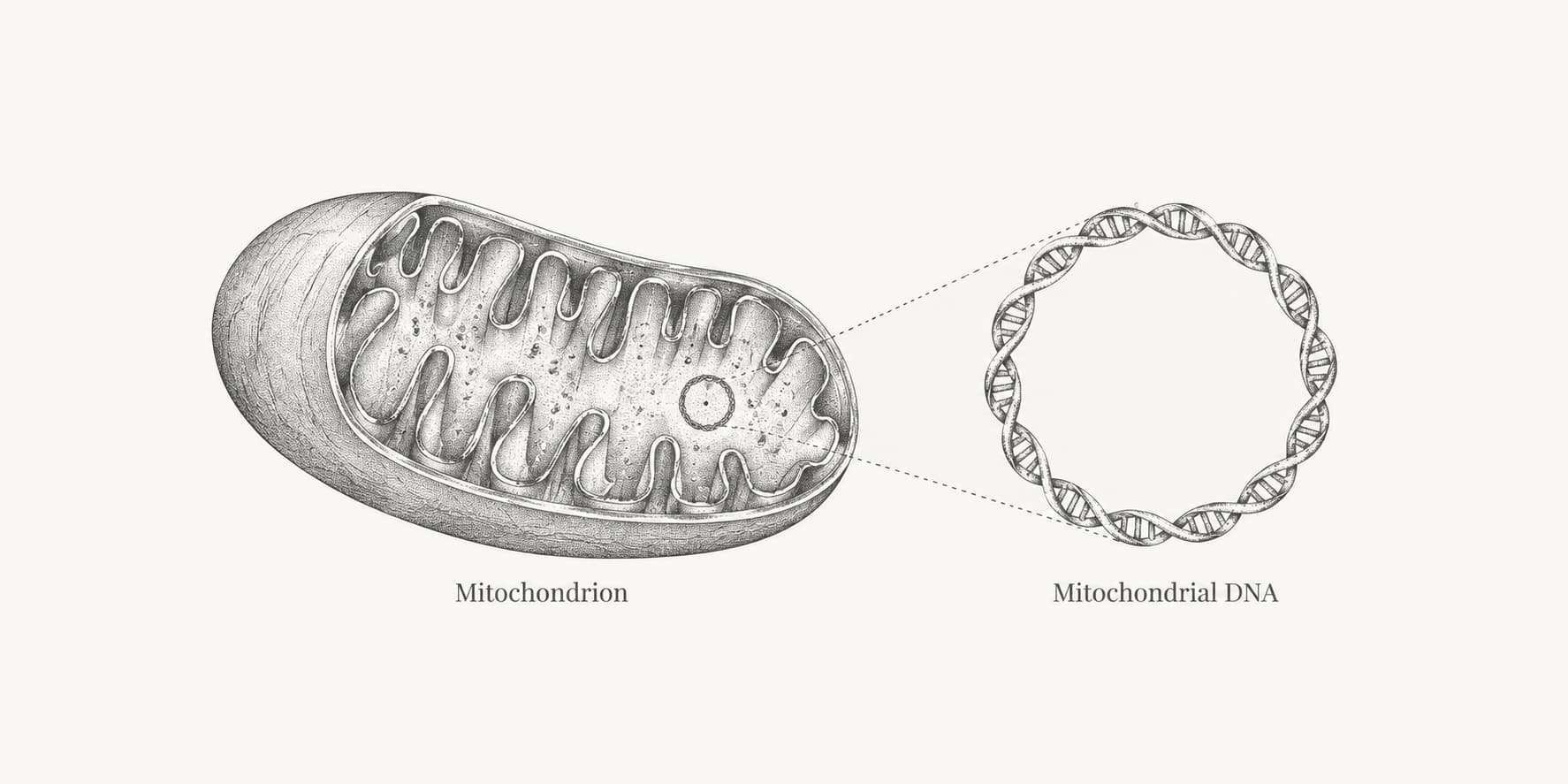
[3][6][8]A single DNA length per cell remains a simplification. Some cells contain multiple nuclei or additional chromosome copies, whereas others are haploid. A more complete estimate would account for DNA content by cell type, together with variation in body size and tissue composition.[6] Our calculation also excludes mitochondrial DNA, whose copy number varies among tissues.[3]
At 2.05 meters per diploid nucleus, a difference of one trillion nuclei changes the total by 2.05 billion kilometers. Whole-body DNA length is therefore best interpreted as an estimate conditional on a defined cell population, rather than a fixed property shared by all humans.
How much does the DNA in a human body weigh?
Using the same simplified cell population as our length estimate, we calculated about 45 grams of nuclear DNA for a 70-kilogram reference male. We combined Hatton and colleagues' estimate of 7 trillion nucleated cells with Piovesan and colleagues' calculated mass of 6.41 picograms per 46,XY diploid nucleus. One picogram is one trillionth of a gram, so 7 trillion nuclei multiplied by 6.41 picograms per nucleus gives 44.87 grams, rounded to about 45 grams.[6][3] This is our estimate from published inputs, not a measured whole-body total.
The calculation assumes one unreplicated diploid nucleus per nucleated cell. It excludes nuclear DNA from mature red blood cells and platelets, which lack nuclei, and does not include mitochondrial or microbial DNA. Multinucleated cells, extra chromosome copies, and cells that have replicated their DNA change the total.[3][5][6] The human genome size guide explains the reference-based DNA mass per nucleus; body-wide mass additionally depends on which cells and nuclei are counted.