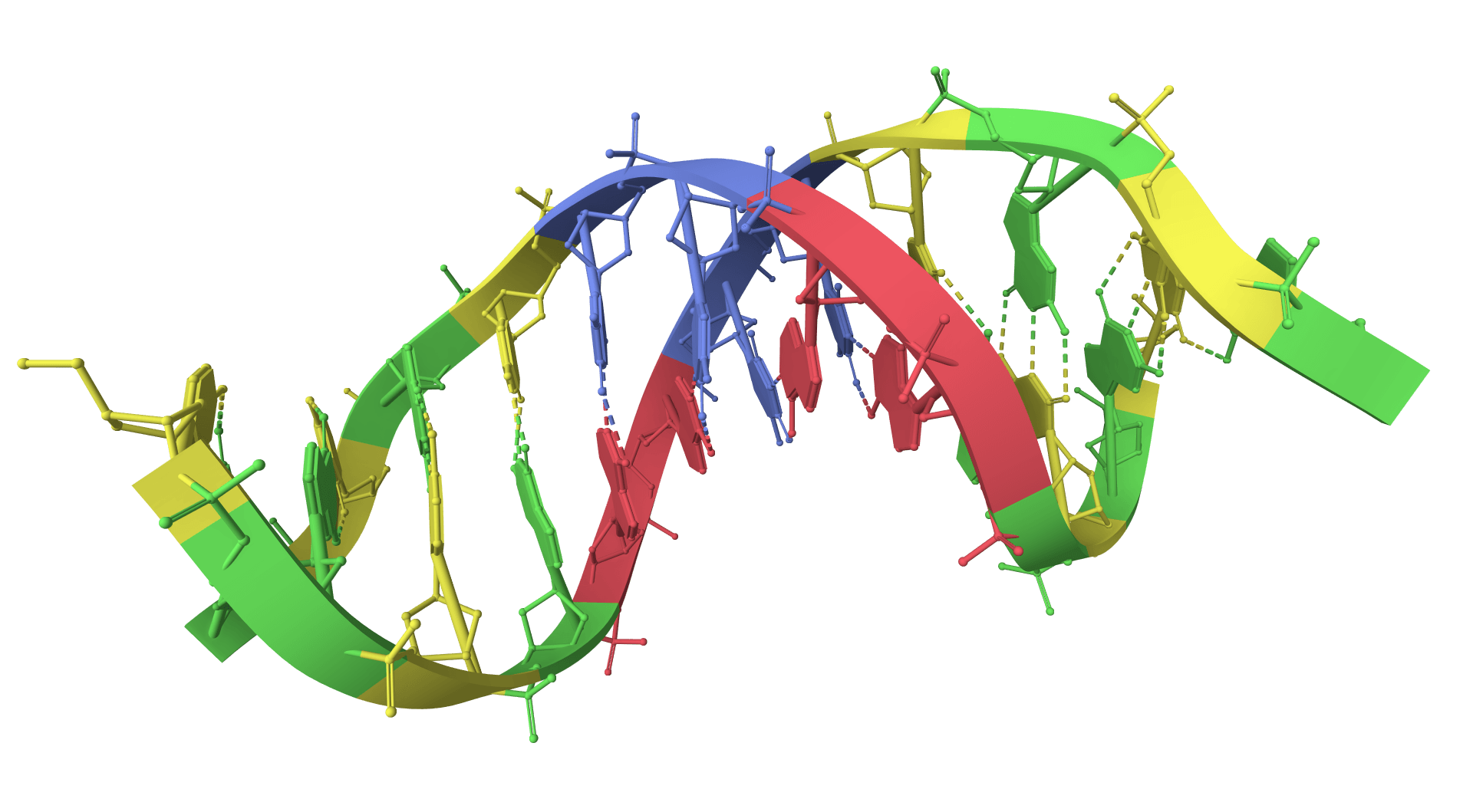
Calculate GC content, AT content, GC/AT skew, melting temperature, and CpG islands for DNA or RNA, with a sliding-window GC plot. Learn more
Input
What is GC content?
GC content is the percentage of guanine (G) and cytosine (C) bases in a nucleic acid sequence. It relates to sequence stability, gene density, and how a sequence behaves in molecular biology experiments.
GC base pairs form three hydrogen bonds compared to two for AT/AU pairs, so GC-rich regions are more thermally stable. This affects DNA melting temperature, PCR primer design, and sequencing success rates.
How is GC content calculated?
GC content is calculated by dividing the sum of guanine and cytosine bases by the total number of nucleotides, then multiplying by 100:
For RNA sequences, uracil (U) replaces thymine (T) in the denominator:
Ambiguous bases like N are excluded from both the numerator and denominator to ensure accurate calculations.
How does our GC content calculator work?
The calculator identifies each sequence as DNA, RNA, or Unknown based on nucleotide content:
| Type | Condition |
|---|---|
| DNA | Contains thymine (T) but no uracil (U) |
| RNA | Contains uracil (U) but no thymine (T) |
| Unknown | Contains neither, or contains both |
Input sequences are cleaned before analysis. Whitespace, numbers, and newlines are removed. Ambiguous bases (N and other IUPAC degenerate codes such as R, Y, S, W) are excluded from both the numerator and denominator of every percentage, so GC% and AT% always sum to 100%. Characters that are not valid nucleotide codes are counted separately and reported in a warning.
Paste sequences or upload a file in FASTA format. The calculator accepts single sequences or multi-FASTA files, and .txt, .fasta, .fa, .fas, and .seq extensions. Results are shown per sequence and as a combined total across all sequences.
Understanding the results
The calculator provides nucleotide statistics for each sequence and a combined total:
| Metric | Description |
|---|---|
| Length (bp) | Count of unambiguous A, T, U, G, and C bases |
| GC% | Percentage of G and C bases |
| AT% | Percentage of A and T/U bases |
| GC skew | (G − C) / (G + C), a strand-bias indicator |
| AT skew | (A − T) / (A + T) |
| Tm | Estimated melting temperature in °C |
| CpG count | Number of 5'-CG-3' dinucleotides |
| CpG obs/exp | Observed-to-expected CpG ratio, used for island prediction |
| Base counts | Raw count for A, T, U, G, C |
GC and AT skew
Skew measures the imbalance between complementary bases on a single strand. GC skew is calculated as (G − C) / (G + C) and AT skew as (A − T) / (A + T). Values range from −1 to +1, where 0 means the two bases occur equally. Strand-specific skew shifts near replication origins and termini, so skew is often used to locate these features in bacterial genomes.
Melting temperature
The calculator reports an estimated melting temperature (Tm) for each sequence. Sequences shorter than 14 bases use the Wallace rule (Tm = 2(A+T) + 4(G+C)); longer sequences use the basic GC formula (Tm = 64.9 + 41 × (G+C − 16.4) / N). These are quick approximations and do not account for salt concentration or nearest-neighbor thermodynamics. For precise PCR design, use Primer3 to design primers with salt-corrected melting temperatures.
Sliding-window GC plot
Open any sequence to see GC content plotted along its length using a sliding window. The window size scales with sequence length, and the dashed line marks the overall GC content. This reveals GC-rich and AT-rich regions that a single average would hide, such as promoters, isochores, and CpG islands.
Related tools
To work with the same sequences in other ways, use Reverse complement to generate the complementary strand, DNA to RNA to transcribe a DNA sequence, and RNAfold to predict secondary structure, where GC content drives stability.
Interpreting GC content
GC content varies widely across organisms and genomic regions:
| GC Range | Characteristics |
|---|---|
| < 30% | AT-rich; common in some bacteria and intergenic regions |
| 30-50% | Typical for most eukaryotic genomes (human average: 41%) |
| 50-60% | GC-rich; often associated with gene-dense regions |
| > 60% | High GC; can cause sequencing difficulties |
For PCR primers, optimal GC content is 40-60%, with 50-55% preferred for balanced annealing temperatures.
CpG islands
A CpG island is a GC-rich DNA region where the CpG dinucleotide frequency is significantly higher than the surrounding genome. These regions are defined as being at least 200 bp long, with GC content ≥50% and a CpG observed-to-expected ratio >0.6.
CpG islands are often associated with promoter regions and play important roles in gene regulation. The calculator flags any sequence that meets these criteria as a predicted CpG island, using the Gardiner-Garden and Frommer observed-to-expected ratio. This is a whole-sequence test, so a long sequence with a localized island may not be flagged; use the sliding-window plot to spot GC-rich stretches within it.
Frequently asked questions
How much GC content is best?
Optimal GC content depends on the application. Most eukaryotic genomes range from 30-50%, with humans averaging 41%. For PCR primers, 40-60% GC is recommended to ensure proper annealing. Coding regions typically have higher GC content than intergenic sequences. There is no universal ideal, since appropriate GC content varies by organism, genomic region, and experimental context.
What is considered high GC content?
Sequences with GC content above 60% are generally considered high. These GC-rich regions form stronger secondary structures due to three hydrogen bonds per GC pair versus two for AT pairs. High GC content is common in promoter regions, CpG islands, and certain bacterial genomes like Streptomyces (over 70%). Such regions can pose challenges for PCR amplification and DNA sequencing.
Is high or low GC content better?
Neither is inherently better, since each has distinct properties. High GC content increases thermal stability and melting temperature, which helps thermostable primers but complicates sequencing. Low GC (AT-rich) sequences denature more easily and may form fewer secondary structures. The right balance depends on your application: primer design favors 40-60%, while genomic studies must account for natural variation across organisms.
Related tools
CpG Island Finder
Identify CpG islands in DNA sequences using the Gardiner-Garden and Frommer criteria. Analyze GC content, CpG density, and observed/expected ratios.
Oligo analyzer
Analyze unmodified DNA oligos with Primer3 thermodynamic Tm, hairpin, self-dimer, heterodimer, physical, and OD260 calculations.
DockQ
Assess docking model quality by comparing predicted complexes against native references. DockQ v2.1.3 supports protein, nucleic-acid, and supported small-molecule interfaces with native metrics.
IPC 2.0 (isoelectric point calculator)
Isoelectric Point Calculator 2.0 - Predict protein/peptide isoelectric point (pI) using 18+ validated pKa scales, SVR models, and deep learning. Supports proteins, peptides, and comprehensive analysis.
Carbon
Carbon is a DNA language model for generation, scoring, and sequence comparison using the native Hugging Face Carbon model family.
ORF Finder
Find open reading frames in DNA with the native NCBI ORFfinder search, translations, coordinates, and output files.
Aggrescan3D
Static-mode Aggrescan3D analysis for per-residue aggregation propensity from a single protein structure.
Protein charge plot
Plot net charge vs pH for protein sequences. Visualize how protein charge changes across pH 0-14 and identify the isoelectric point (pI) where the net charge crosses zero.
FindPept
Match experimental peptide masses against theoretical digest fragments of a protein sequence. Identify peptides from mass spectrometry data by peptide mass fingerprinting.
Hydropathy plot
Generate Kyte-Doolittle hydropathy plots to visualize hydrophobic and hydrophilic regions along protein sequences. Identify transmembrane domains and surface-exposed regions.