What is the largest protein?
PKZILLA-1 is the largest known single-chain protein, with 45,212 amino acids and a reported mass of 4.7 MDa. Titin is the largest human protein.
TL;DR
- PKZILLA-1, from the golden alga Prymnesium parvum, is the largest known single-chain protein: 45,212 amino acids and a reported mass of 4.7 MDa.
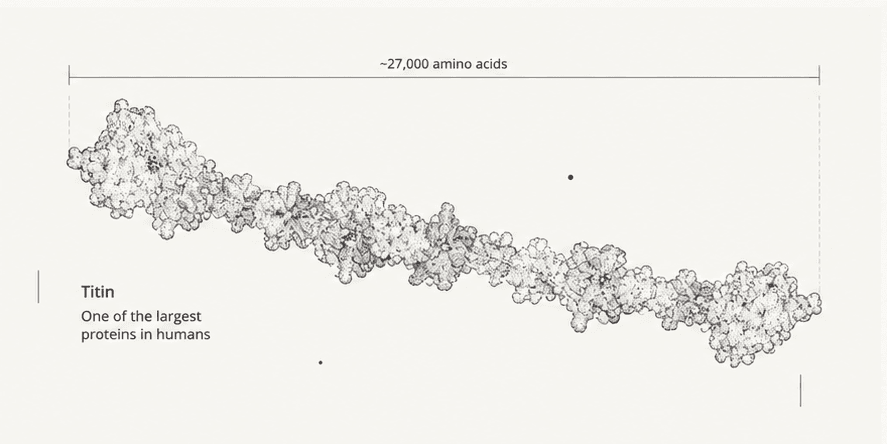
- Titin is the largest human protein. Its canonical UniProt sequence contains 34,350 amino acids; other splice forms have different lengths.
- Von Willebrand factor is the largest plasma protein when assembled multimers are counted. Its reported circulating mass range is about 500 to 20,000 kDa.
The largest known single-chain protein is PKZILLA-1, an enzyme from the golden alga Prymnesium parvum. Its reported sequence contains 45,212 amino acids, with a mass of about 4.7 megadaltons. The discovery, published in 2024, displaced the muscle protein titin as the largest known individual protein chain.
Titin remains the largest protein in the human body. Larger masses are possible when many chains join into an assembly, as happens with von Willebrand factor in blood plasma. Comparing these records requires specifying whether size means the length of one chain or the mass of the assembled molecule.
What is the largest protein?
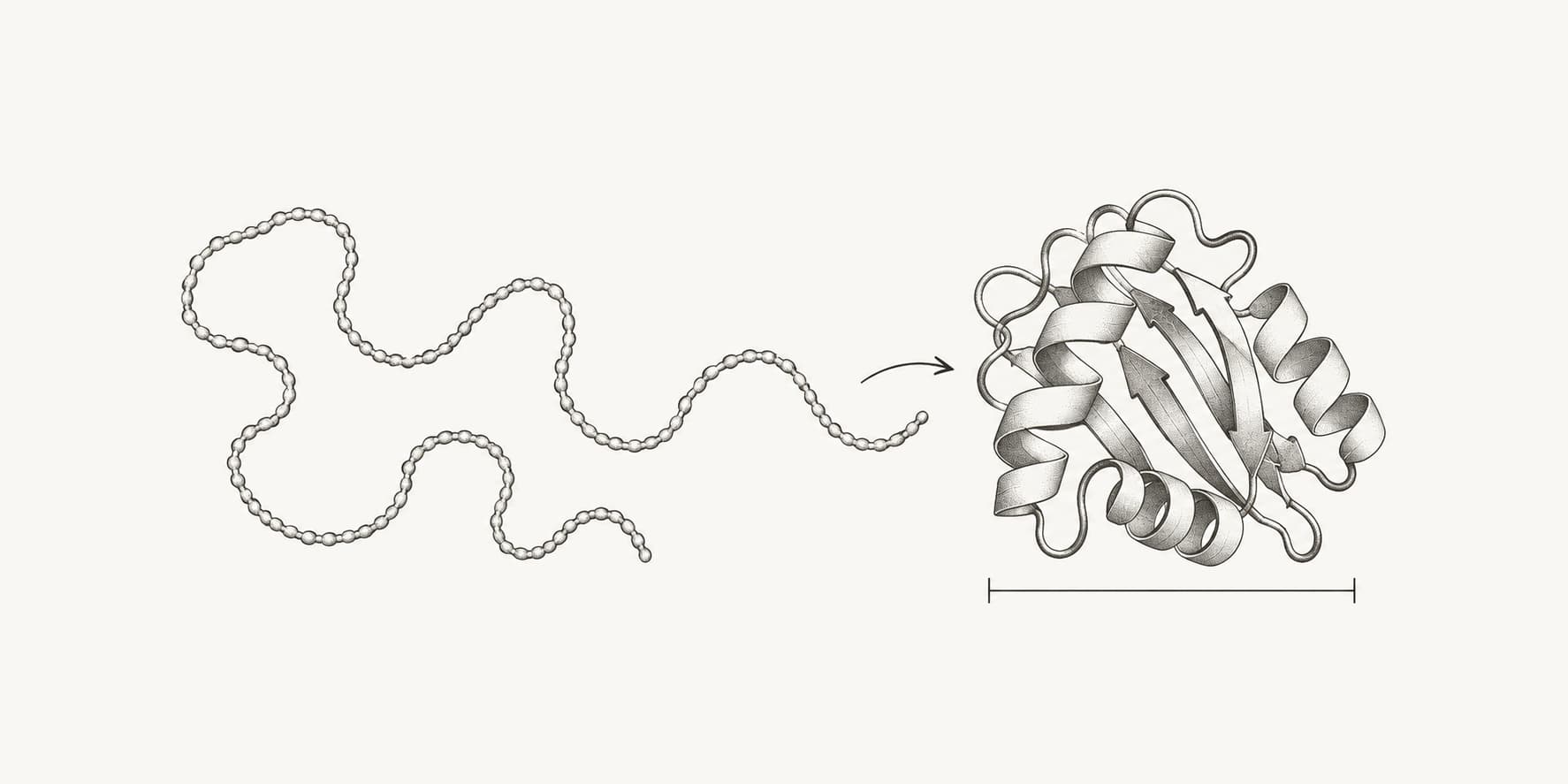
PKZILLA-1 holds the reported single-chain size record, with 45,212 amino acid residues and a mass of 4.7 MDa in the 2024 discovery paper. A residue is one amino acid incorporated into a protein chain; one megadalton (MDa) equals one million daltons (Da).[1][2]
PKZILLA-1 is a polyketide synthase, an enzyme involved in constructing a complex carbon-based molecule. Its many catalytic regions work as successive stations in a chemical assembly line. Together with PKZILLA-2, it helps build the backbone of prymnesins, toxins associated with golden-algal blooms and fish kills.[1][2]
UniProt lists a calculated sequence mass of 4,760,909 Da, or approximately 4.76 MDa, for PKZILLA-1. This is a database calculation from the annotated sequence, distinct from the paper's reported 4.7-MDa figure. The following comparison uses the same database definition for each protein.[3]
| Protein and sequence | Organism | Amino acids per chain | Calculated sequence mass |
|---|---|---|---|
| PKZILLA-1, A0AB34IYJ6 | Golden alga, P. parvum | 45,212 | 4,760,909 Da |
| Titin, canonical Q8WZ42-1 | Human | 34,350 | 3,816,030 Da |
| Dystrophin, canonical P11532 | Human | 3,685 | 426,778 Da |
| Von Willebrand factor precursor, P04275 | Human | 2,813 | 309,265 Da |
These are selected comparisons, not a ranking of the four largest proteins. Lengths and masses are reported by UniProt records accessed on September 19, 2026. The values describe the displayed sequences before processing or chemical additions; they are not measurements of intact circulating proteins.[3][4][5][6]
The evidence for PKZILLA-1 combines a reconstructed gene model, RNA sequencing, and detection of protein fragments by mass spectrometry. Fallon and colleagues identified 43 peptides matching PKZILLA-1. This supports protein expression, but does not amount to sequencing every residue of an isolated intact molecule.[1] Its UniProt entry is unreviewed and carries a caution that the sequence comes from a preliminary whole-genome shotgun record. The record supports a traceable sequence comparison, while the discovery paper provides the experimental context.[3]
Is titin the largest protein in the human body?
Titin is the largest human protein chain. The canonical human sequence in UniProt contains 34,350 amino acids, with a calculated mass of 3,816,030 Da, or about 3.82 MDa.[4][7]
Titin, also called connectin, helps organize striated muscle and gives it elasticity. It spans from the Z-disc to the M-line, across half of a sarcomere, the repeating contractile unit of muscle. Folded domains and flexible regions allow this long chain to accommodate stretching while maintaining the organization of the muscle filaments.[4][7]
There is no single sequence length that describes every titin molecule. Alternative splicing produces different versions, or isoforms, from the same gene. UniProt describes 13 isoforms and notes that the full-length protein may reach 38,138 residues. That upper figure is an annotation note, not the length of the displayed 34,350-residue canonical sequence.[4]
This distinction explains why references give different titin sizes. A comparison should name the species and isoform, and keep its residue count paired with the mass of that same sequence. Neither the canonical sequence nor the larger form noted by UniProt exceeds the reported length of PKZILLA-1.[3][4]
Is dystrophin the largest protein?
Dystrophin is not the largest human protein. Its canonical UniProt sequence contains 3,685 amino acids and has a calculated mass of 426,778 Da, substantially smaller than titin.[5]
The likely source of confusion is the size of its gene, DMD. NCBI's RefSeq summary describes a genomic span of more than 2 million base pairs. This measures the DNA region occupied by the gene, including intervening regions that are removed during RNA processing. It does not mean that all of those bases encode the final protein.[8] Gene length, protein sequence length, and protein mass answer different questions.
What is the largest protein in blood plasma?
Von Willebrand factor (VWF) is the largest plasma protein when its assembled multimers are counted. A widely cited review reports circulating forms ranging from about 500 to 20,000 kDa, equivalent to 0.5 to 20 MDa. A multimer contains multiple protein subunits, and the range reflects variation in how many subunits are joined together.[9]
Those masses cannot be compared directly with the single-chain record without stating the difference. The VWF precursor in UniProt contains 2,813 residues, but processing removes its signal peptide and propeptide. The mature VWF chain occupies residues 764 through 2,813 in the record. The precursor's calculated mass of 309,265 Da therefore does not describe the mature, chemically modified subunit circulating in plasma.[6]
The chart combines Furlan's reported VWF multimer range, the 340-kDa fibrinogen mass described by NCBI Bookshelf, and UniProt's calculated VWF precursor mass. Fibrinogen is itself a six-chain glycoprotein, so it is neither the largest plasma assembly nor an appropriate example of a single-chain size record.[9][10][6]
For comparisons of protein size, identify the molecular form first. Sequence length counts residues in one specified chain; molecular mass also depends on processing, chemical modifications, and whether multiple chains are included. Naming those boundaries makes the apparently conflicting records for PKZILLA-1, titin, and plasma VWF consistent.
Size also does not establish which protein is the most complex. That comparison would need a separate measure, such as the number of folded domains, distinct subunits, or catalytic activities. The largest amino acid, meanwhile, concerns the mass of a building block rather than the length of a complete protein.
Is titin the largest enzyme in the human body?
Titin's size does not establish it as the largest active human enzyme. Although titin contains a kinase-like domain, Bogomolovas and colleagues found that vertebrate titin kinase is an inactive pseudokinase: it resembles a protein kinase but lacks the tested catalytic activity. Their experiments instead supported a role as a scaffold that recruits other proteins to the muscle sarcomere.[11] Calling titin the largest human protein is therefore different from demonstrating a largest-enzyme record.
If complete enzyme assemblies are counted, the human pyruvate dehydrogenase complex provides a well-characterized large example, with a reported mass of about 9.5 MDa. It combines multiple copies of three catalytic components to convert pyruvate into acetyl-CoA.[12] This is the mass of a multienzyme assembly, not one protein chain. It illustrates why a largest-human-enzyme comparison must specify both demonstrated catalytic activity and whether the measurement includes one chain or an entire complex; these examples do not establish an exhaustive ranking.