How much DNA do cousins share?
First cousins share 12.5% of their autosomal DNA by descent on average. The expected share falls to 3.125% for second cousins and 0.781% for third cousins.
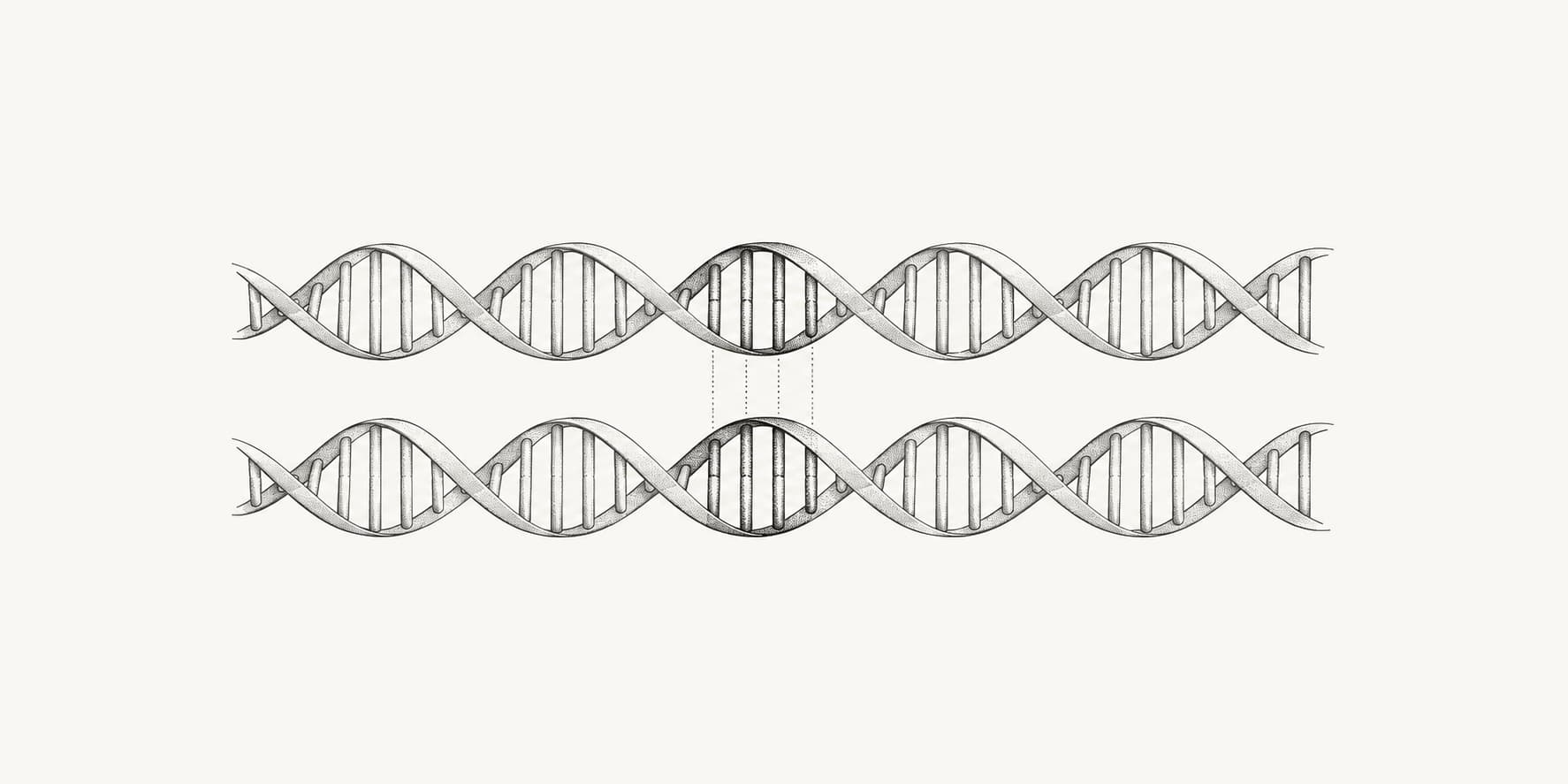
First cousins share 12.5% of their autosomal DNA by descent on average. Second cousins average 3.125%, while third cousins average 0.781%.
These are expected values, not fixed results. Recombination shuffles DNA in every generation, so two confirmed cousins can share more or less than the average.
How much DNA do cousins share?
The expected autosomal DNA share is 12.5% for first cousins, 6.25% for first cousins once removed, 3.125% for second cousins, and 0.781% for third cousins.[1]
Each step down the family tree halves the expected amount inherited from the shared ancestors. First cousins descend from the same grandparents. Second cousins share great-grandparents, and third cousins share great-great-grandparents.
Consumer tests often report shared DNA in centimorgans (cM), a measure based on the probability of recombination rather than physical DNA length. The Shared cM Project collected nearly 60,000 submissions for known relationships and retained 55,418 records after curation and outlier removal.[2]
| Relationship | Expected share | Observed average | Trimmed observed range |
|---|---|---|---|
| First cousin | 12.5% | 866 cM | 396-1,397 cM |
| First cousin once removed | 6.25% | 433 cM | 102-980 cM |
| Second cousin | 3.125% | 229 cM | 41-592 cM |
| Second cousin once removed | 1.563% | 122 cM | 14-353 cM |
| Third cousin | 0.781% | 73 cM | 0-234 cM |
The observed values come from the Shared cM Project. It removed 0.5% of submissions at each end of every relationship distribution; for relationships as distant as third cousins, it set the minimum to 0 cM and calculated the average only among pairs with detectable shared DNA.[2]
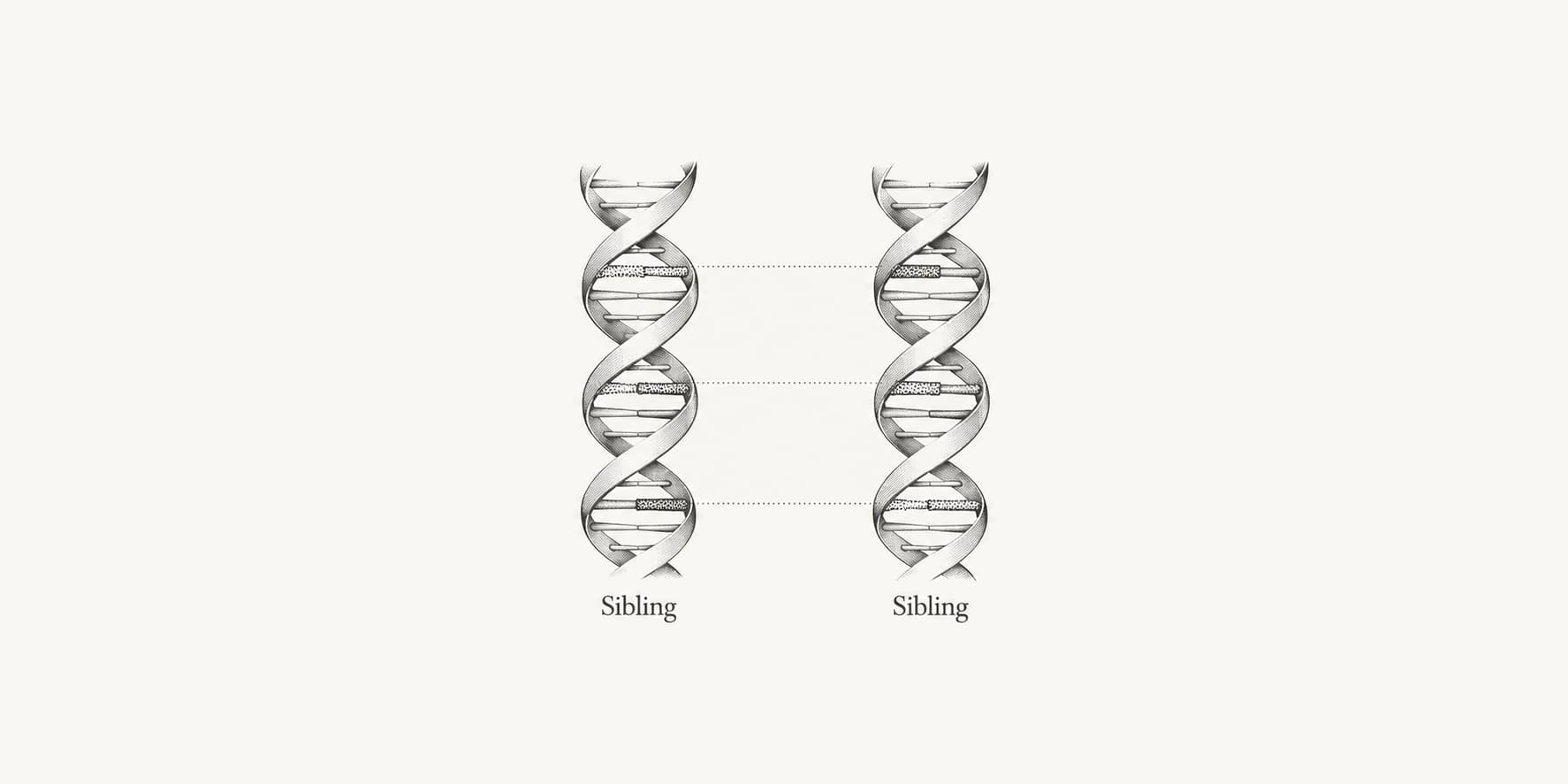
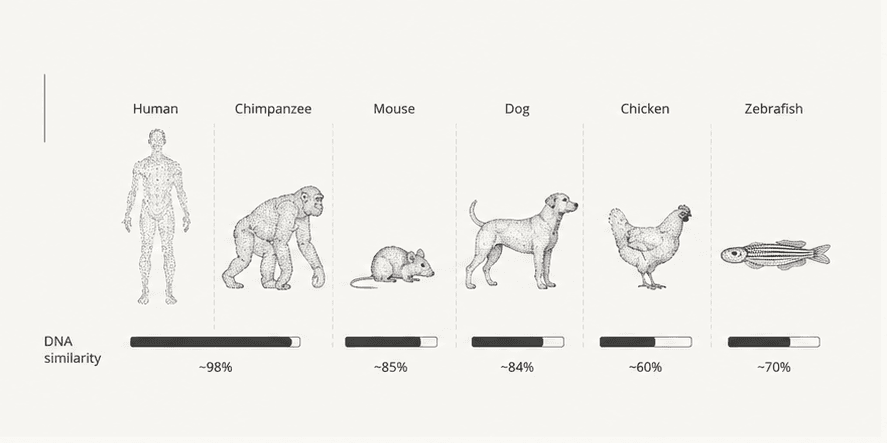
The expected percentages describe DNA inherited from recent common ancestors. They differ from the roughly 50% shared by full siblings and from ordinary sequence similarity between any two people.
How much DNA do first cousins share?
First cousins share 12.5% of their autosomal DNA by descent on average, equivalent to about 850 cM under the standard inheritance model.[1][2]
The Shared cM Project found an observed average of 866 cM across 3,337 first-cousin pairs, with a trimmed range of 396 to 1,397 cM. 23andMe reports a broader expected range of 8% to 22% for the category that includes first cousins and other relationships at the same genealogical distance.[2][3]
First cousins share a pair of grandparents. Along the path from one cousin to the other, each grandparent's DNA passes through four parent-to-child transmissions. Each shared grandparent therefore contributes an expected (1/2)4, or 1/16; the two grandparents together contribute 1/8, or 12.5%.
The actual result varies because eggs and sperm receive recombinant mixtures of chromosome copies rather than exact quarters from each grandparent.[4] A result above or below 12.5% can therefore fit a genuine first-cousin relationship.
How much DNA do second cousins share?
Second cousins share 3.125% of their autosomal DNA by descent on average, equivalent to about 213 cM under the standard inheritance model.[1][2]
The Shared cM Project observed an average of 229 cM across 4,172 second-cousin pairs, with a trimmed range of 41 to 592 cM. 23andMe reports an average of 3.4% and an expected range of 1.1% to 6.3%.[2][3]
Second cousins share a pair of great-grandparents. Two more parent-to-child transmissions separate them than first cousins, so their expected shared fraction is one-quarter as large: 3.125% instead of 12.5%.
The ranges for different relationships overlap. A shared total of 400 cM, for example, can fit a low-sharing first cousin once removed or a high-sharing second cousin. A centimorgan total narrows the possibilities, but ages, family trees, shared matches, and the number and location of segments help identify the relationship.[2][3]
Can cousins share no DNA?
First and second cousins are expected to share at least one inherited autosomal segment, but more distant cousins can share no detectable DNA from their common ancestors.[1]
A 2026 study simulated 100,000 pairs for each cousin relationship using sex-specific genetic maps and crossover interference. All simulated first and second cousins shared at least one identical-by-descent segment. Among third cousins, 98.5% shared at least one segment, leaving about 1.5% with none.[1]
Detection also depends on the testing company's minimum segment length and matching algorithm. Short segments are harder to distinguish from noise, so two genealogical cousins can be related even when a consumer test shows no match.
The percentages here do not mean that first cousins have only 12.5% of their DNA letters in common. A sequence aligner such as MUMmer4 compares base-level similarity and differences, while cousin matching looks for long chromosome segments inherited from the same recent ancestors. Those are different measurements.