How much DNA do humans share with pigs?
Shared genes, aligned DNA, and why pig organs still need editing

Matic Broz, PhD12 min
Humans do not share 98% of their DNA with pigs. Less than half of the human genome, 48.5%, can be lined up with the pig genome at all. Where human protein-coding DNA does line up, 86.7% of the letters match, and the typical protein encoded by a shared gene is 89.1% identical between the two species. For comparison, the same measurement gives 99.3% for chimpanzees and 86.9% for mice.[1]
Each of those numbers answers a different question, which is why figures quoted for pigs range from about 50% to 98%. We measured all of them from one database release, Ensembl 116, with the same human genes and counting rules used in our comparison of humans with 21 other animals. Pigs come out as typical mammals: much further from us than any ape, a little closer than rodents.
How much DNA do humans share with pigs?
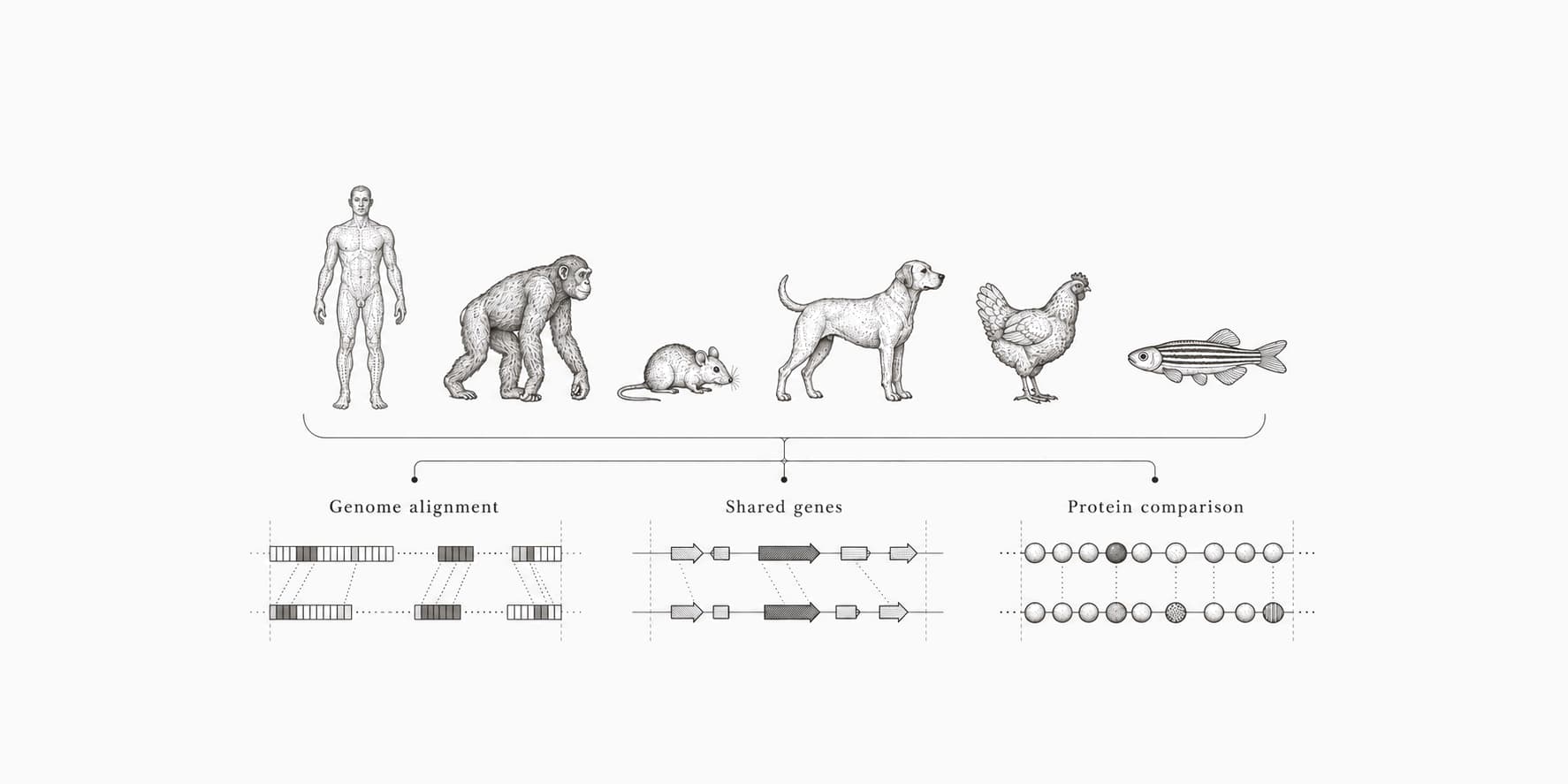
The answer depends on whether you count whole genomes, genes, or the letters inside genes. Table 1 gives five measurements for the pig, all from the human side, so each percentage is a share of human DNA or human genes.[1][3]
| Measure | What is counted | Pig |
|---|---|---|
| Genome aligned | Share of the human genome inside the human–pig alignment | 48.5% |
| Coding-DNA identity | Identical letters among human coding-exon bases aligned to pig | 86.7% |
| Shared genes | Human protein-coding genes with at least one pig ortholog | 87.5% (Ensembl), 85.6% (OMA) |
| One-to-one genes | Human genes with exactly one pig counterpart and no duplicates | 80.6% |
| Protein identity | Median identity of the proteins encoded by one-to-one orthologs | 89.1% (80.5–95.0%) |
Genome alignment is the closest thing to a whole-DNA comparison. Ensembl aligns the two genomes with LASTZ and keeps the best pig match for each human region.[2] The half that fails to align is mostly non-coding DNA, which drifts freely once the lineages separate. Protein-coding DNA is held in place by selection: 94.6% of human coding-exon bases align to pig, and 86.7% of those aligned letters are identical.
The gene measures count orthologs, genes in two species that descend from one gene in their common ancestor. For 87.5% of human protein-coding genes, Ensembl finds a pig ortholog. OMA, which infers orthologs by a different method, finds one for 85.6%.[3] A shared gene can still differ at many positions, so the count of shared genes says nothing about how similar each one is.
Protein identity fills that gap. For the 16,216 human genes with a single pig counterpart, half of the pig proteins are between 80.5% and 95.0% identical to the human protein. Only 324 of them, 2.0%, are identical along their whole length. The analysis files, including the summary and script, record every value here.
The pig genome itself is smaller than ours. The current reference assembly, Sscrofa11.1 from a Duroc sow, holds 2.50 billion bases on 38 chromosomes, against the 3.1 billion bases of the human genome.[5][1]
Where does the 98% pig figure come from?
We could not find a source for it. The 2012 pig genome paper compared pig genes with those of other mammals to study gene evolution and pig domestication, not to measure overall identity with humans.[4] The number appears to be a mix-up with the chimpanzee comparison, in which about 98.8% of directly aligned human and chimpanzee DNA letters match.[17]
The figure also persists because pigs really are similar to us in body size, organ anatomy, and physiology. That similarity is why pigs are used in medicine, but it is not a DNA percentage. The genetic distance between humans and pigs is about the same as between humans and dogs, horses, or cows, each with a median protein identity between 88.7% and 89.3% in the same Ensembl release.[1]
Is human DNA closer to pigs or apes?
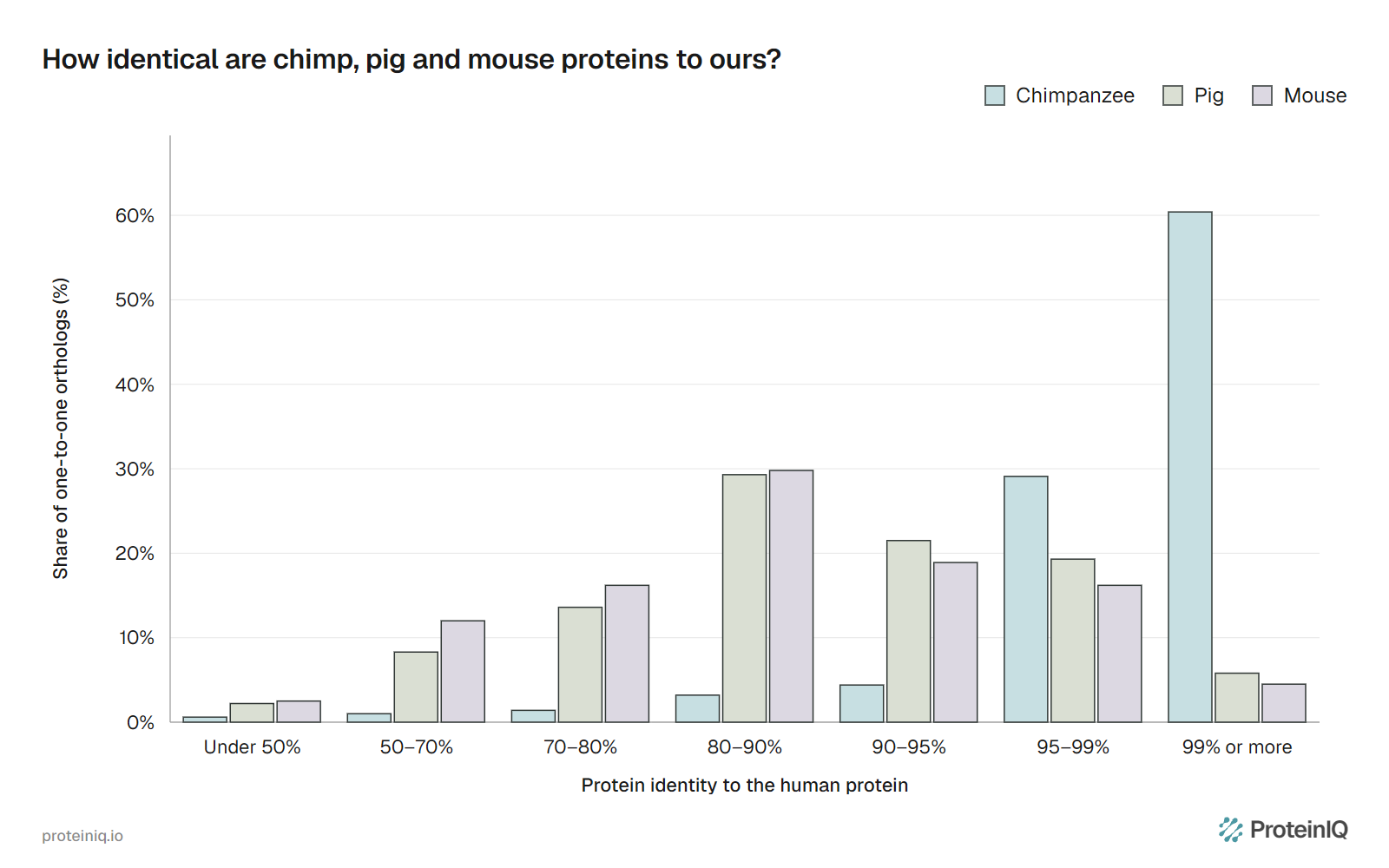
Apes, by a wide margin. Humans and chimpanzees last shared an ancestor about 6.5 million years ago; humans and pigs about 89.5 million years ago, according to the median across studies compiled by TimeTree.[6] The proteins show that distance. The typical chimpanzee protein is 99.3% identical to the human one, and 60.4% of chimpanzee one-to-one orthologs reach at least 99%, against 5.8% for pigs (Figure 1).
We also compared the two species gene by gene. Of 15,053 human genes with a one-to-one ortholog in both, the chimpanzee protein is closer to the human protein for 92.5%, the pig protein for 5.5%, and 2.0% are tied. Even the rhesus macaque, a monkey that separated from our lineage about 29 million years ago, beats the pig for 89.5% of genes.[1][6]
The few genes where the pig wins mostly reflect annotation, not biology. Insulin is an example. Ensembl's chimpanzee insulin protein matches only 59.1% of the human one because of how the chimpanzee gene is annotated, while the pig precursor matches 85.5%. The hormones themselves are almost the same in both species, as the section on medical models below shows.[1]
Coding DNA tells the same story as proteins. Among human coding-exon bases aligned to the other genome, 99.0% are identical in chimpanzees, 96.6% in macaques, and 86.7% in pigs.[1]
Are pigs closer to humans than mice are?
By sequence, yes, even though the pig lineage split from ours first. TimeTree places the human–pig divergence at about 89.5 million years ago and the human–mouse divergence at about 83.5 million.[6] Rodents are the closer relatives, yet on every sequence measure in Table 2 the pig is more similar to us.
| Measure | Pig | Mouse |
|---|---|---|
| Last common ancestor with humans | 89.5 million years ago | 83.5 million years ago |
| Human genome aligned | 48.5% | 32.5% |
| Coding-DNA identity | 86.7% | 83.1% |
| Median protein identity | 89.1% | 86.9% |
| Genes where this species' protein is closer to human | 71.4% | 25.1% |
| Human genes with any ortholog | 87.5% | 87.9% |
The explanation is speed. The mouse genome study found about twice as many neutral substitutions on the mouse lineage as on the human lineage since the two split.[7] Mouse DNA has simply changed faster, with short generations a commonly proposed reason, so mice have drifted further from the common ancestor than pigs have despite being more closely related to us.
Shared-gene counts barely separate the two, and they carry an extra caveat for pigs. A 2025 USDA study assembled pig genes by hand and found assembly or annotation errors in 41 to 53% of the 6,135 genes it checked across three recent pig builds. With the corrected gene set, when a human gene was missing from either the pig or the mouse genome, it was five times more likely to be present in the pig.[8]
Why are pigs used for organ transplants?
Pig organs are the right size and work the right way, but pig DNA is not similar enough for the human immune system to accept them. Clinical pig donors therefore carry targeted edits. The donor of a pig kidney transplanted into a living patient in 2024 carried 69 genomic edits, and each class of edit addresses a specific mismatch between the two genomes.[9][11]
The first mismatch is sugar. Pig cells display three glycans, α-Gal, Neu5Gc and Sd(a), made by the enzymes encoded by GGTA1, CMAH and B4GALNT2 and its relative B4GALNT2L. In humans, GGTA1 and CMAH decayed into pseudogenes long ago, so our immune system treats α-Gal and Neu5Gc as foreign and carries antibodies against them. Knocking out the pig genes removes these targets.[9]
The second is a set of regulators on the surface of blood vessels. Anand and colleagues found that pig complement regulators did a poor job of stopping human complement on pig cells, that pig thrombomodulin and its partner receptor EPCR could not activate human protein C, and that pig CD47 did not engage the human SIRPα receptor that tells immune cells not to attack.[9] The donor pig therefore carries seven human genes.
Our protein comparison shows how far the pig versions have drifted. Four of the seven are among the least conserved eighth of all pig–human one-to-one orthologs, and the complement regulator CD46 has no one-to-one pig counterpart at all (Table 3).[1]
| Human transgene | Role | Pig protein identity | Orthologs less conserved |
|---|---|---|---|
| CD55 | Limits complement activation | 46.5% | 1.7% |
| CD46 | Limits complement activation | No one-to-one ortholog | – |
| EPCR (PROCR) | Presents protein C for activation, limiting clotting | 66.8% | 8.1% |
| Thrombomodulin (THBD) | Turns thrombin into a protein C activator | 70.1% | 10.6% |
| CD47 | Signals "do not eat me" to macrophages | 72.5% | 12.7% |
| HMOX1 | Reduces oxidative injury and inflammation | 82.3% | 29.3% |
| TNFAIP3 | Dampens inflammation and cell death | 88.9% | 49.0% |
The sequence ranking matches what Anand and colleagues saw in the laboratory: the pig proteins that failed with human partners are the ones that have drifted furthest from ours. HMOX1 and TNFAIP3, the two typical genes in the table, were added for a different reason, to make the organ more resistant to inflammation and cell death after transplant.[9]
The third class of edit has no human counterpart. The Yucatan pig genome used for this donor carried 59 copies of porcine endogenous retroviruses, viral DNA inherited in every pig cell. Niu and colleagues showed in 2017 that these viruses can infect human cells, and that all copies can be inactivated with CRISPR–Cas9.[12] The 69-edit donor carries inactivating edits in all 59.[9]
These edits are now being tested in people. In 2022, a man in Maryland lived 60 days after receiving a heart from a pig with 10 edits.[10] In 2024, a 62-year-old man at Massachusetts General Hospital received a kidney from the 69-edit pig; it worked at once and he no longer needed dialysis. He died on day 52 of a cardiac cause, and his autopsy found no evident rejection of the kidney.[11]
Why are pigs used as models of human disease?
The same anatomical and physiological match makes pigs useful for studying human disease, testing devices and drugs, and training surgeons. Lunney and colleagues list similarities in organ size and structure, physiology, immunology, and genome among the reasons.[13] Sequence similarity alone would favor monkeys; pigs win on the whole animal, at a size and cost that primates cannot match.
Cystic fibrosis shows the difference. Mice lacking the CFTR gene do not develop the characteristic abnormalities of the human disease in the pancreas, lung, intestine and liver. Newborn pigs lacking CFTR developed intestinal obstruction, pancreatic destruction and liver lesions like those of newborn humans with cystic fibrosis, and within months they developed the airway infection and inflammation typical of the human lung disease.[14][15]
The proteins fit that pattern. Pig CFTR is 92.4% identical to the human protein, above the pig median, against 78.5% for the mouse protein.[1] Sequence alone does not make a disease model, and airway anatomy and gland structure matter at least as much, but the pig carries a closer copy of the protein at the center of the disease.
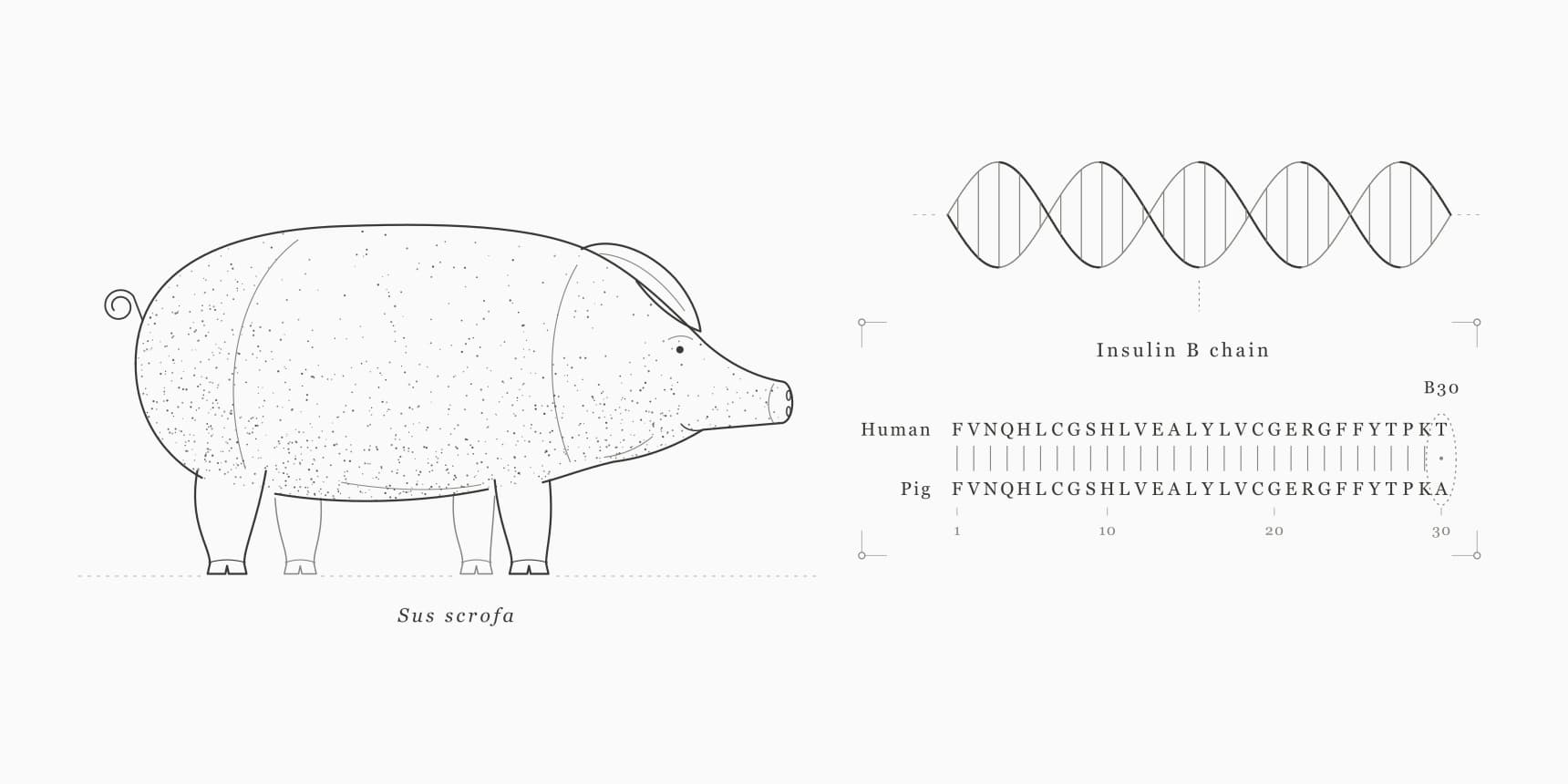
Insulin is the oldest example. Mature pig and human insulin differ at a single position of their 51 amino acids, the last residue of the B chain, which is alanine in pigs and threonine in humans. In 1979, chemists turned pig insulin into human insulin by using an enzyme to swap that one residue.[16]
The rest of the insulin gene has changed more. The full precursor, including the signal peptide and the C-peptide removed during maturation, is 85.5% identical, because the parts cut away during maturation are free to change.[1]
Comparing pig and human sequences yourself
Any single protein can be compared directly. UniProt download retrieves the human and pig sequences of a gene, BLAST finds the closest match for a pig protein among human proteins, and Clustal Omega aligns several species at once for a multiple sequence alignment.
The identity you get will vary with the isoforms you pick and with whether gaps count as differences, which is why the Ensembl values above use one canonical protein per gene and count gaps against the human length.
Whole-genome questions need a whole-genome alignment. MUMmer4 aligns two assemblies and reports aligned blocks and coverage, the same kind of measurement as the 48.5% above, although Ensembl used a different aligner. Pigs sit in the middle of a longer series: near-identity with chimpanzees, a steady decline through other animals, and for bananas, matching DNA letters that add up to only 0.08% of the human genome.