How many chromosomes do different species have?
Dogs have 78 chromosomes, cats have 38, humans have 46, and chimpanzees have 48. Meaningful comparisons depend on the cell type and number of chromosome sets.
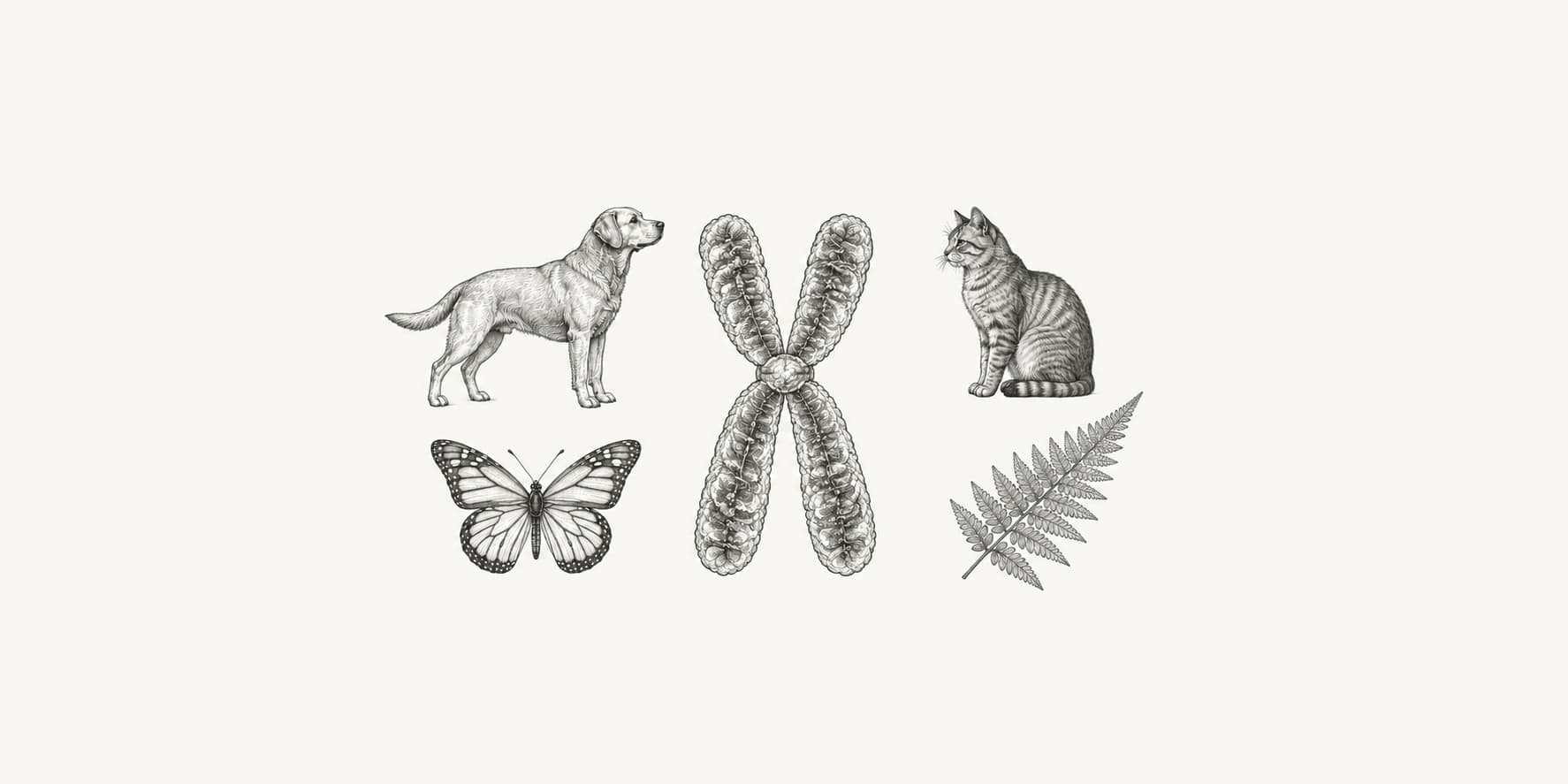
Dogs usually have 78 chromosomes in a diploid body-cell nucleus, cats have 38, horses have 64, and humans have 46. These are totals, corresponding to 39, 19, 32, and 23 pairs, respectively. Chimpanzees have 48 chromosomes, or 24 pairs.
A chromosome count describes how DNA is divided among chromosomes. It does not measure the amount of DNA, the number of genes, or an organism's complexity. Comparisons also depend on what is being counted: a diploid nucleus, a reproductive cell, or a specialized nucleus can give very different answers for the same species.
How many chromosomes do different species have?
The usual diploid counts range from 8 in the fruit fly to 78 in the dog among the familiar animals listed below. These are reference chromosome complements, also called karyotypes, rather than a guarantee that every individual or cell has the same count.[1]
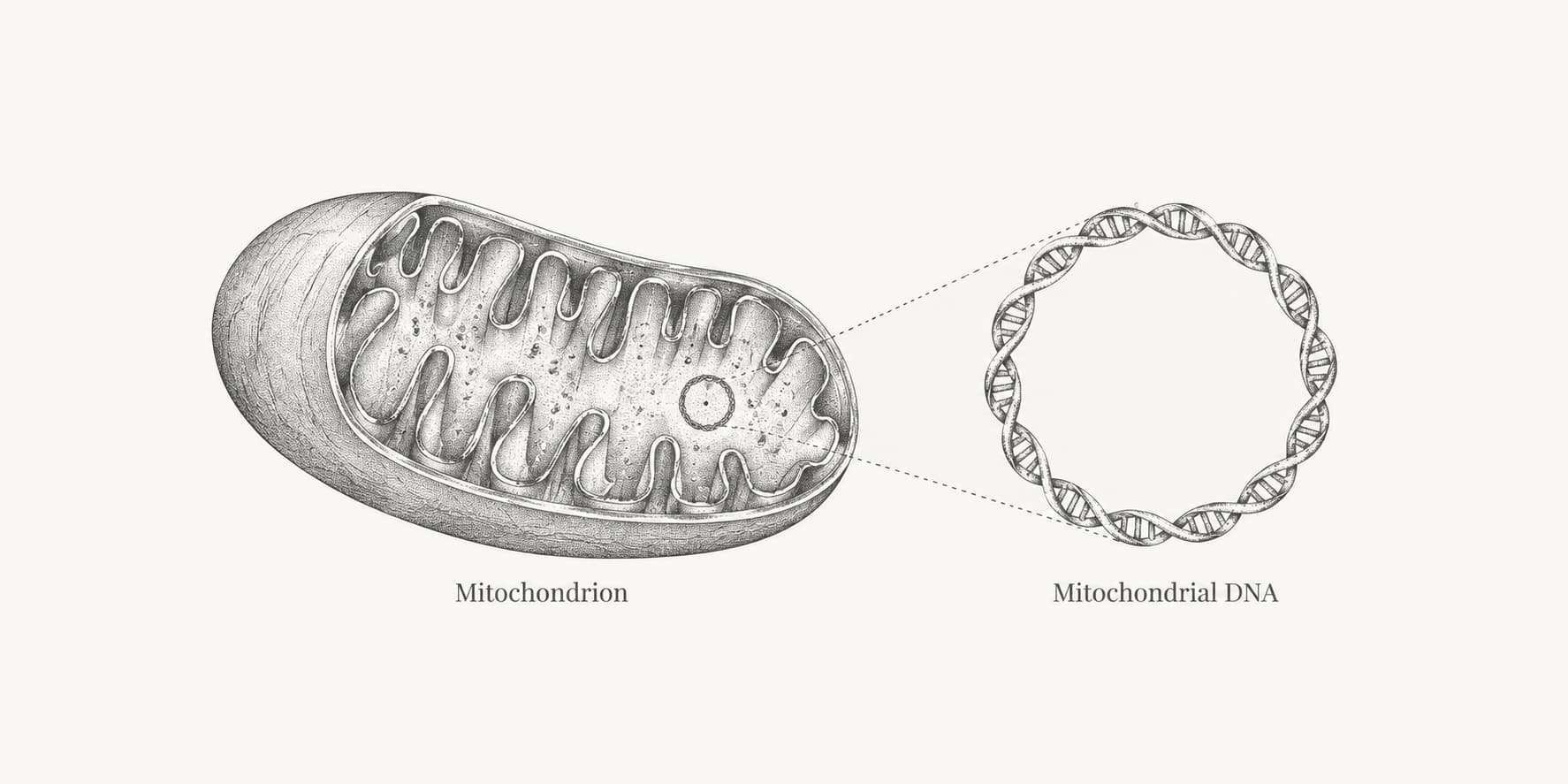
Diploid means two chromosome sets, usually one inherited from each parent, and is written as 2n. A haploid cell has one set, written as n. For example, a typical human diploid nucleus has 46 chromosomes, while an egg or sperm has 23. The counts here refer to nuclear chromosomes and exclude mitochondrial DNA.[2]
| Species | Usual diploid count (2n) | Pairs, including sex chromosomes | Count source |
|---|---|---|---|
| Human (Homo sapiens) | 46 | 23 | ACC |
| Dog (Canis lupus familiaris) | 78 | 39 | ACC: Canis lupus |
| Cat (Felis catus) | 38 | 19 | ACC |
| Horse (Equus caballus) | 64 | 32 | ACC |
| Chimpanzee (Pan troglodytes) | 48 | 24 | ACC |
| Cow (Bos taurus) | 60 | 30 | ACC |
| Chicken (Gallus gallus) | 78 | 39 | Chicken genome consortium |
| House mouse (Mus musculus) | 40 | 20 | ACC |
| Gray wolf (Canis lupus) | 78 | 39 | ACC |
| Fruit fly (Drosophila melanogaster) | 8 | 4 | ACC |
| Domestic pig (Sus scrofa) | 38 | 19 | ACC |
| Rabbit (Oryctolagus cuniculus) | 44 | 22 | ACC |
| Brown rat (Rattus norvegicus) | 42 | 21 | ACC |
The mammal and fruit-fly values are drawn from the Animal Chromosome Count Database (ACC), using its March 24, 2021 release. For chicken, the original genome paper explicitly reports 2n = 78 and supplies the count used here.[1][3]
The pairs column includes the sex chromosomes, even when the two members differ. Humans usually have XX or XY; chickens have ZZ in males and ZW in females. Thus, 39 pairs in a chicken means 38 pairs of autosomes, the non-sex chromosomes, plus the sex chromosomes.[2][3]
Some species need a life-cycle or cultivation qualifier rather than a single number:
| Organism or form | Nuclear chromosome count | How to interpret it | Count source |
|---|---|---|---|
| Honey bee (Apis mellifera) | Usually 32 in females; 16 in males | Diploid females have 16 pairs; ordinary haploid males have one set | ACC |
| Wild diploid banana (Musa acuminata) | 22 | Two sets of 11 chromosomes | Cheung and Town |
| Triploid Cavendish banana | 33 | Three sets of 11; not a whole number of pairs | Huang and colleagues |
| Baker's yeast (Saccharomyces cerevisiae) | 16 haploid; 32 diploid | Both states occur in its sexual life cycle | Jelenić and colleagues |
Sources: ACC for honey bees; Cheung and Town's Musa study and Huang and colleagues' Cavendish genome study for bananas; and the yeast ploidy study for S. cerevisiae.[1][4][5][6]
These distinctions explain many apparently conflicting answers. “Bananas have 22 chromosomes” and “bananas have 33 chromosomes” can both be correct for different plants. Likewise, a count of 16 for yeast describes a haploid state, not its diploid state. Variation also occurs within animal species: the ACC records multiple counts for house mice and Sus scrofa, which includes wild boar as well as domestic pigs.[1][5][6]
How unusual are humans' 46 chromosomes?
In our comparison of 465 mammal species with matching counts across two published compilations, the median diploid count was 44. Humans' 46 chromosomes exceeded the counts of 290 species, or 62.4% of this sample. Another 13 species, including humans, had exactly 46. These results describe our selected sample, not the proportion of all mammals with fewer chromosomes than humans.
We compared the 2021 ACC release with Table S1 from Blackmon and colleagues' 2019 study. The latter reports female haploid counts, including sex chromosomes, which we doubled to obtain female diploid totals. We retained species with one distinct ACC diploid count that agreed with this total, excluding conflicting explicit haploid entries. Of 663 matching species names, 465 met those criteria.[14][15]
The most frequent exact count was also 44, shared by 62 species. Familiar mammals occupy quite different positions within the distribution:
| Reference species | Diploid count | Species below | Share below | Species tied |
|---|---|---|---|---|
| Cat | 38 | 128 | 27.5% | 56 |
| Human | 46 | 290 | 62.4% | 13 |
| Horse | 64 | 417 | 89.7% | 7 |
| Dog / gray wolf | 78 | 458 | 98.5% | 2 |
We calculated these comparisons from the included records. “Fewer” excludes ties; the final column includes the reference species itself. Dogs and gray wolves are represented by one Canis lupus entry, not counted separately.
Selection matters because a single species can have multiple recorded counts, and a database can contain errors. For example, the ACC file records 5 for the serotine bat, Eptesicus serotinus, while a primary study reports 2n = 50. We did not automatically add presumed missing zeros or replace ambiguous records with a preferred value.[15][16]
We also repeated the calculation with broader inclusion rules. Ignoring five conflicting ACC haploid entries gave 470 species and a median of 44. Allowing multiple ACC diploid counts when one agreed with Blackmon's value gave 591 species and a median of 42; 61.9% fell below 46 in both cases. Using all 1,060 Blackmon records without the ACC screen gave a median of 42, with 59.4% below 46. These alternatives show sensitivity to source selection; they are not corrected datasets or confidence intervals.
The compilations may share underlying literature, so agreement does not provide independent biological verification. Our sample also omits unmatched names and many variable records, and we have not checked every included species against its original cytogenetic study. Readers can inspect the complete species audit and counts (CSV), calculated results (JSON), methods and input downloads, and reproduction script. We completed this analysis on September 19, 2026, using the frozen source versions documented there.
Which animal has the most chromosomes?
The Atlas blue butterfly (Polyommatus atlantica) has the highest recorded chromosome number among non-polyploid animals in a 2025 genome study: 458 chromosomes, described in the paper's title as 229 pairs. The sequenced female has 227 pairs of autosomes plus four sex chromosomes.[7]
This qualification matters. Polyploid organisms carry extra complete chromosome sets, whereas the butterfly's exceptional count reflects extensive chromosome fragmentation. Wright and colleagues traced its small autosomes to the splitting of 24 ancestral autosomes. Its large sex chromosomes followed a different history and did not undergo the same fragmentation.[7]
The often-quoted plant record of approximately 1,440 chromosomes belongs to the adder's tongue fern Ophioglossum reticulatum. Yadav and colleagues cite a historical report of n = 720, corresponding to 2n = 1,440, from a population in India's Shevaroy Hills. This is a reported population count, not a number established for every plant of the species.[8] The Chromosome Counts Database contains several other counts, including 2n = 960 and approximately 1,260; its species page does not directly document the 1,440 figure.[9]
Single-celled ciliates make an unrestricted “most chromosomes” ranking misleading. The somatic macronucleus of Halteria grandinella has approximately 23,000 distinct, mostly gene-sized nanochromosomes. They occur in many copies within a highly polyploid nucleus. The figure counts distinct nanochromosomes in the assembled genome, rather than all chromosome copies in one nucleus, so it is not directly comparable with the animal totals above.[10]
Why do species have different numbers of chromosomes?
Chromosome numbers change through fusion, fission, and changes in the number of complete chromosome sets. Fusion joins chromosomes; fission splits them; whole-genome duplication adds a copy of the entire complement. The first two processes can change the count without a proportional change in DNA content.[11]
Human chromosome 2 provides a well-supported example of fusion. IJdo and colleagues identified oppositely oriented telomeric repeats, sequences normally associated with chromosome ends, inside the chromosome. Their arrangement supports an ancient end-to-end joining of two ancestral ape chromosomes. The fusion accounts for the difference between the usual 46 human chromosomes and the 48 found in chimpanzees.[12]
The Atlas blue butterfly illustrates the opposite process: repeated splitting produced many small chromosomes from a much smaller ancestral set.[7] A high chromosome count therefore need not imply repeated doubling of the genome.
Polyploidy changes the comparison in another way because it increases the number of whole chromosome sets. It is especially important in plant evolution, where duplication and hybridization can generate additional sets. Subsequent losses and rearrangements can obscure that history, so equal chromosome totals need not reflect equal ploidy or the same evolutionary route.[11]
Does having more chromosomes make an organism more complex?
No. Chromosome number, genome size, and gene count describe different properties. Chromosome number counts physical units, genome size counts DNA base pairs, and gene count depends on which functional sequences are identified and annotated. Chromosome fusion or fragmentation can alter the first measure without a corresponding change in the others.[11]
The ciliate Oxytricha trifallax illustrates how strongly DNA packaging can affect a count. Swart and colleagues assembled approximately 16,000 complete nanochromosomes from its somatic macronuclear genome, totaling about 50 million base pairs and encoding approximately 18,500 genes. Most nanochromosomes carry a single gene, and each occurs in many copies. Thousands of distinct chromosomes therefore fit into a relatively small genome.[13]
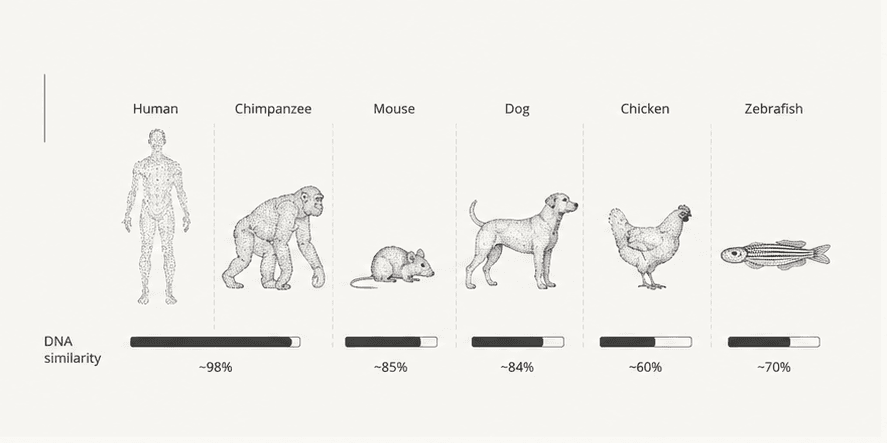
The same distinction applies to sequence comparisons. Human and chimpanzee DNA similarity must be measured from the sequences being compared; the difference of one chromosome pair does not supply a percentage. A karyotype describes the chromosome complement, while sequence alignment addresses which DNA regions correspond and how their bases differ.