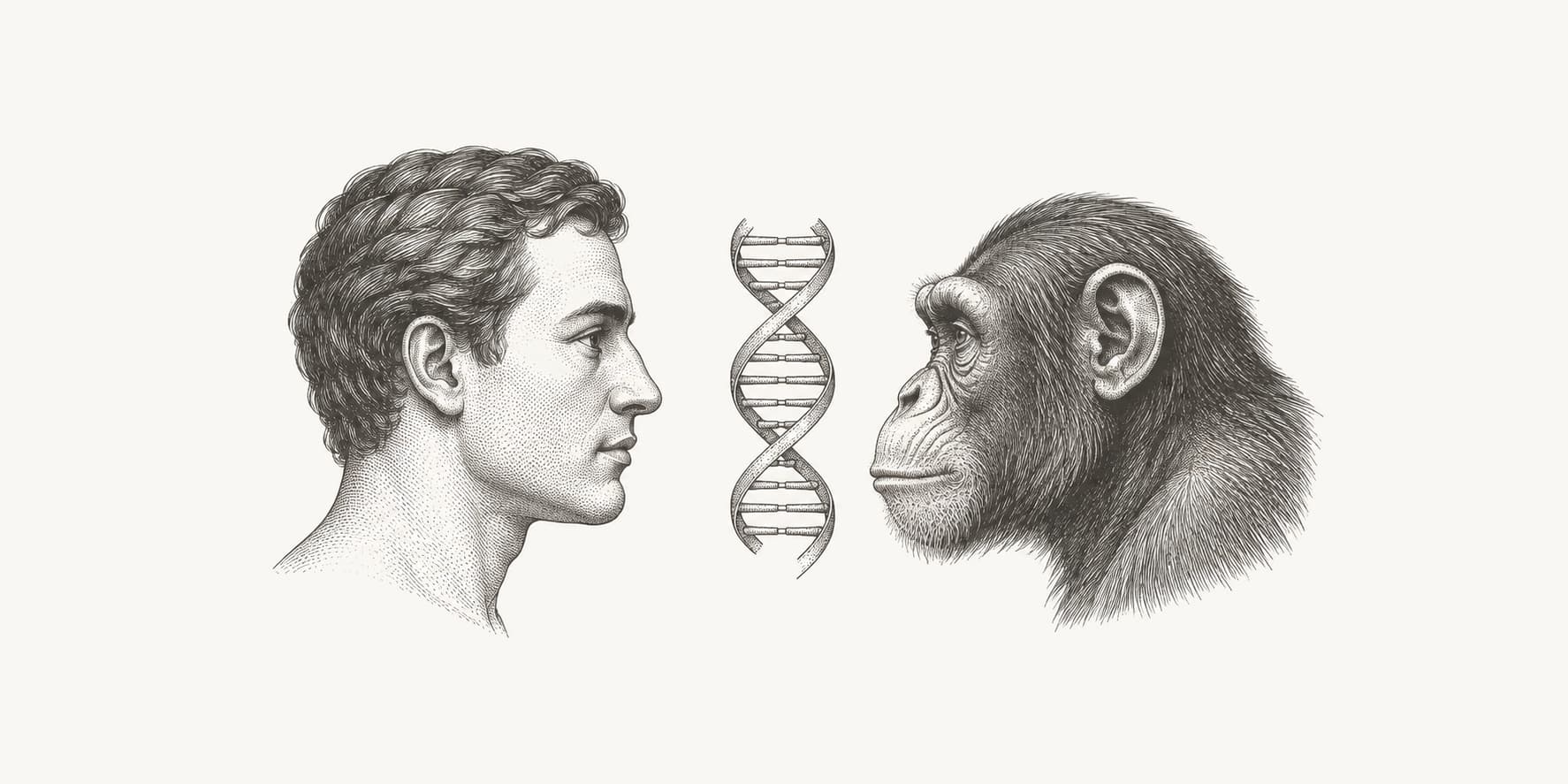
Humans and chimpanzees are often said to share 98.8% of their DNA. That number is real, but it is narrower than it sounds: it refers to single-letter differences in DNA that can be directly lined up between the two genomes.
If you count insertions, deletions, duplications, and difficult repetitive regions, the shared fraction is lower. The best answer is therefore not one percentage, but the percentage plus the method used to calculate it.
How much DNA do humans share with chimps?
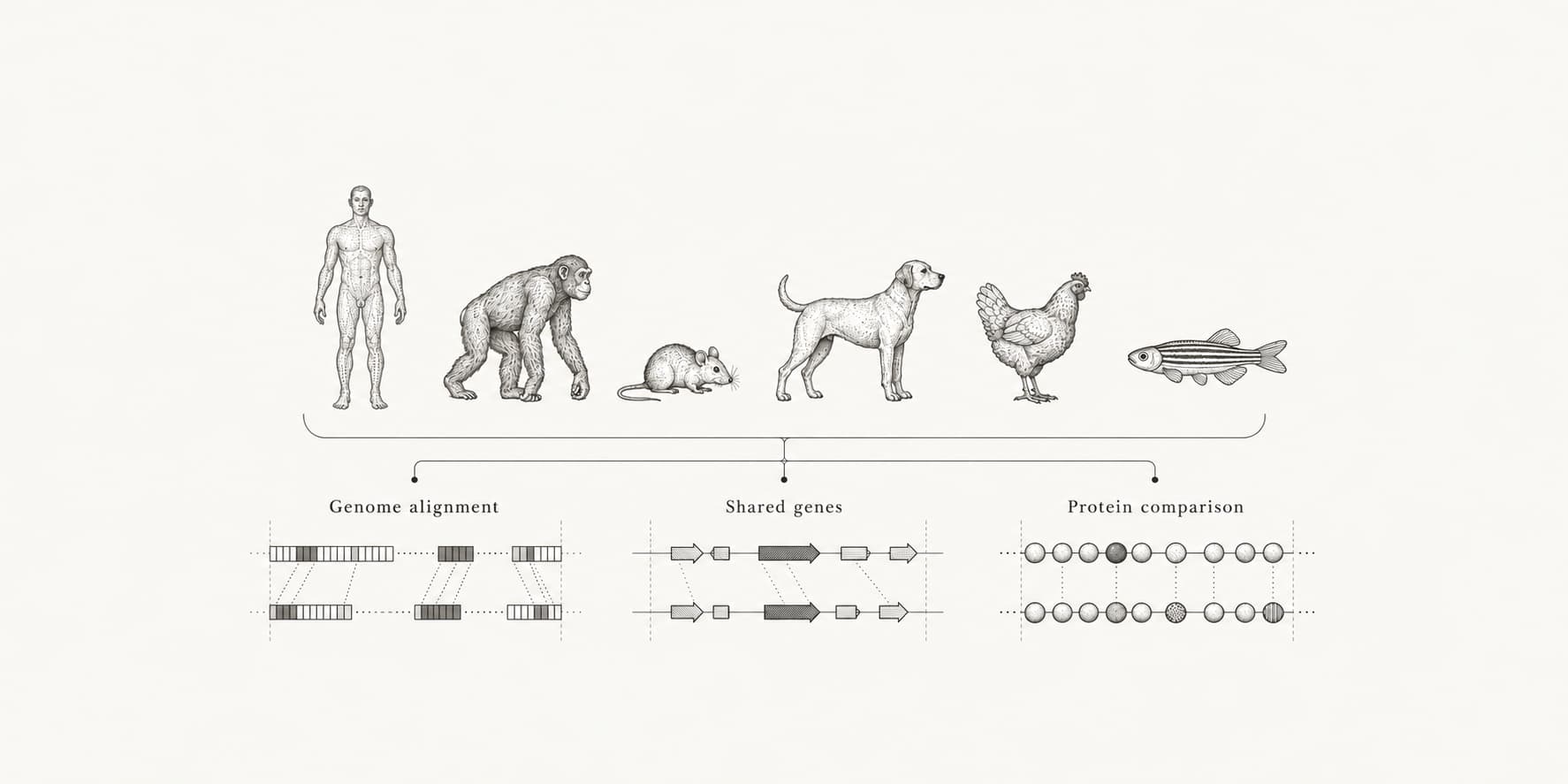
Humans and chimpanzees are about 98.8% identical across DNA bases that can be directly aligned and compared. The 2005 chimpanzee genome paper reported 1.23% mean single-nucleotide divergence between one copy of the human genome and one copy of the chimpanzee genome, which is the source of the familiar 98.8% figure.[1]
That comparison covered about 2.4 billion bases of high-quality aligned sequence. It did not mean that every base, duplicate copy, repeat, insertion, and deletion in both genomes had a one-to-one match.
| Method | Result | Meaning |
|---|---|---|
| Directly aligned DNA letters | 98.8% identical | Comparable sequence only |
| Including insertions and deletions | 96% shared | Classic 2005 genome summary |
| Strict one-to-one assembly matches | About 85% identical | Counts duplicated and unmatched sequence differently |
The first row comes from the 2005 Nature genome comparison. The second row is the NHGRI summary of the same study. The third row refers to the 2025 Nature supplementary table for the 8-way primary Progressive Cactus autosome alignment, where the row labelled chimpanzee reports 84.95% identical one-to-one coverage.[1][2][4]
For most general writing, the clean wording is: humans and chimpanzees are about 98.8% identical across directly comparable DNA sequence. For whole-genome claims, name the method.
How much DNA do humans share with Neanderthals, gorillas, and orangutans?
Across the aligned sequences used in landmark genome studies, humans are about 99.7% identical to Neanderthals, 98.3% to gorillas, and 97% to orangutans. These figures are useful approximations, but they are not whole-genome percentages calculated with one standard method.
| Relative | Reported identity with humans | Comparison basis |
|---|---|---|
| Neanderthal | 99.7% | Genetic variation in a 2010 low-coverage draft genome comparison |
| Chimpanzee | 98.8% | Single-base identity across high-quality aligned sequence |
| Gorilla | 98.25% | Mean divergence across filtered, one-to-one great-ape alignment blocks |
| Orangutan | About 97% | Unique, gap-free sequence aligned to the human reference |
The Neanderthal result came from a draft genome assembled from three ancient individuals and compared with five present-day humans. The analysis used three-way Neanderthal-human-chimpanzee alignments and filtered regions that might be duplicated in humans or chimpanzees. The often-quoted 99.7% is therefore aligned sequence identity, not the percentage of Neanderthal ancestry in a person alive today.[5][6]
The gorilla study measured 1.75% mean nucleotide divergence across 2.01 billion bases of filtered one-to-one orthologous alignment, equivalent to 98.25% identity for those bases. The orangutan project used a different pipeline: it aligned whole-genome shotgun reads to the human reference and estimated divergence only in unique, gap-free sequence, producing the rounded 97% headline.[7][8]
The ordering is clear even though the denominators differ. Neanderthals are closer to present-day humans than any living ape is, chimpanzees are our closest living relatives, gorillas are next, and orangutans split from our lineage earlier. Structural variants, repeats, insertions, deletions, and sequence that cannot be aligned are not represented consistently in these headline percentages.
Why do sources give 98.8%, 96%, or about 85%?
Sources give different percentages because they count different kinds of genetic difference. The 98.8% figure counts single-letter substitutions after the genomes have been aligned. The 96% figure also counts insertion and deletion sequence. The lower complete-assembly figures ask a stricter question: does this base have an exact one-to-one match in the other genome?
These are not contradictions. They are different denominators.
The 2005 Nature paper estimated that human and chimpanzee genomes each contain 40-45 megabases of species-specific euchromatic sequence. Together, those insertion and deletion differences total about 90 megabases, or about 3% of both genomes, on top of the 1.23% single-base substitution difference.[1]
The 2025 complete ape-genome study added many regions that older draft assemblies handled poorly, including centromeres, acrocentric chromosomes, subterminal heterochromatin, segmental duplications, and lineage-specific gene families. Its supplementary tables therefore report lower strict one-to-one identity fractions for some whole-genome-style comparisons than the older aligned-base statistic.[3][4]
The practical rule is simple: 98.8% is the aligned-base answer; 96% is the classic answer when insertions and deletions are included; about 85% is a strict complete-assembly alignment answer for autosomal one-to-one exact matches.
How many DNA differences separate humans and chimps?
The familiar 1.2% difference corresponds to about 35 million single-base differences in the shared, aligned portions of the human and chimpanzee genomes. The same 2005 comparison also reported about 5 million insertion or deletion sites, plus a smaller number of chromosomal rearrangements.[2]
That is why "only 1.2%" can still be biologically large. A human genome copy has roughly 3 billion bases, so one percent is tens of millions of positions.
Most differences do not have obvious functional effects. But the 2005 NHGRI summary estimated that as many as 3 million differences may lie in protein-coding genes or other functional regions.[2] Some of those changes affect proteins directly. Others alter when, where, or how strongly genes are used.
At the protein level, humans and chimps are even more similar than the raw genome sounds. The chimp genome paper reported that about 29% of orthologous proteins are identical, and that the typical human-chimp ortholog differs by only two amino acids, one on each lineage since the common ancestor.[1]
Why are humans and chimps different if their DNA is so similar?
Humans and chimpanzees differ because the important changes are not evenly spread across the genome. Some are single-base changes. Others are insertions, deletions, duplicated gene copies, regulatory changes, and large chromosomal rearrangements.
One visible example is chromosome structure. Human chromosome 2 is the product of a fusion of two ancestral chromosomes that remained separate in chimpanzees as chromosomes 2A and 2B. The 2005 genome comparison also noted at least nine pericentric inversions between human and chimpanzee chromosomes.[1]
Regulation matters too. Two species can carry very similar genes but use them at different times, in different tissues, or at different levels. That is why a small percentage difference in DNA can still affect development, immunity, brain growth, reproduction, and behavior.
The headline number should therefore be read as evidence of close evolutionary relationship, not as evidence that humans and chimps are almost the same organism. The denominator depends on human genome size and on how much non-coding DNA is included in the comparison.