Yes, humans share some DNA with bananas, but far less than the 50% or 60% often quoted. In our analysis of the OMA orthology database, 18.0% of human protein-coding genes have a recognizable banana counterpart. When the proteins encoded by those gene pairs are aligned, they are typically about 40% identical, and the DNA letters that actually match add up to about 2.4 million bases, or 0.08% of the human genome.
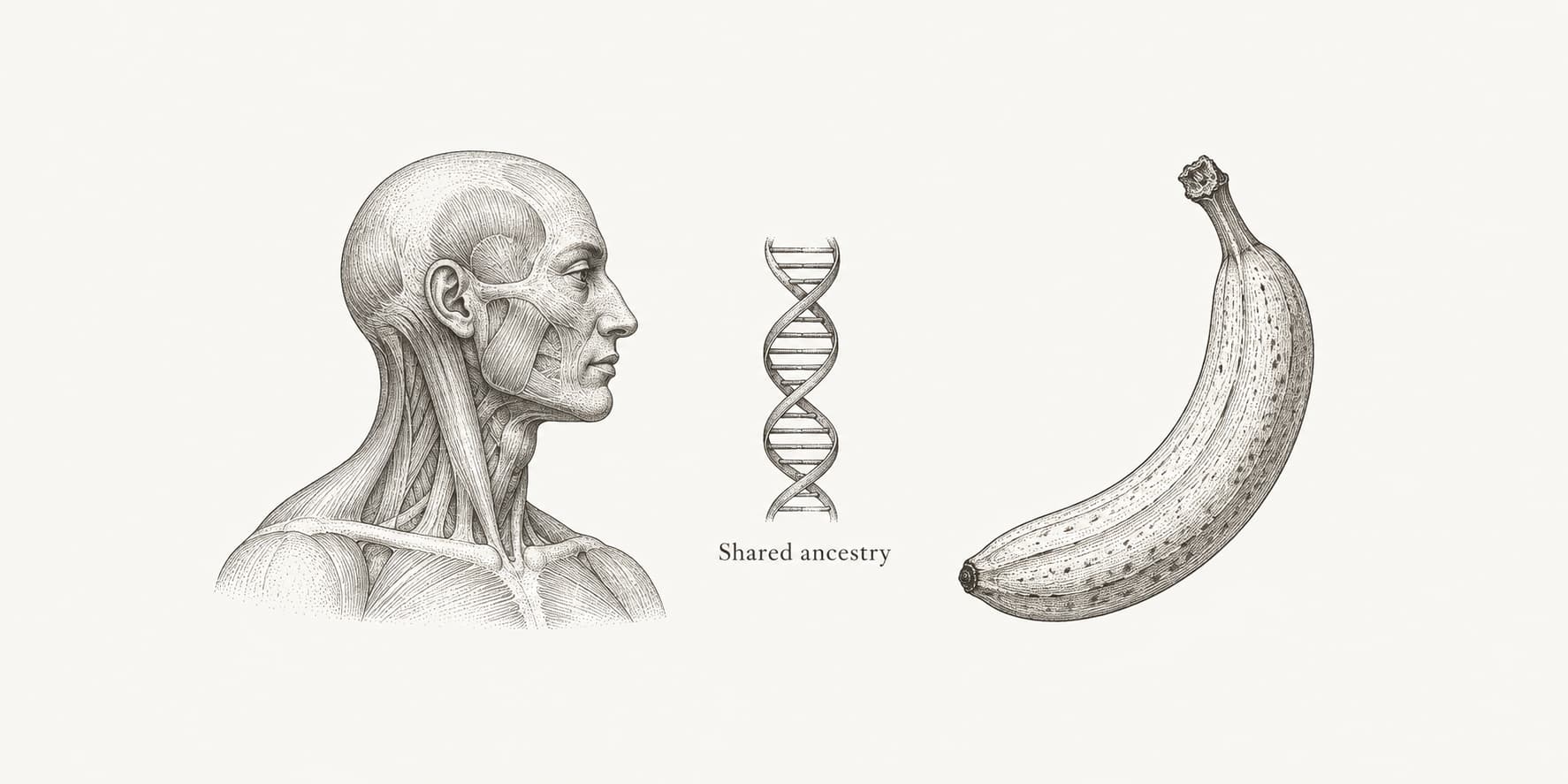
Humans and bananas are related, but distantly. Our last common ancestor lived about 1.5 billion years ago, before the lineages leading to plants and animals separated, so a banana is no closer to us than rice or any other plant. The popular 50% figure comes from a comparison of proteins, not genomes, and has been retold as a statement about DNA.
How much DNA do humans share with bananas?
The answer depends on what is counted: related genes, matching amino acids in their proteins, matching DNA letters in their coding sequence, or the share of the whole genome those letters represent. We measured all four by aligning each human–banana gene pair in OMA (Table 1).[1][2]
The counterparts in question are orthologs: genes in two species that descend from a single gene in their last common ancestor and were separated when that ancestral species split. They differ from paralogs, which arise when a gene is duplicated within a genome. Establishing orthology therefore requires more than finding a similar stretch of sequence.[3] A gene can remain recognizable after most of its sequence has changed, which is why counting related genes and counting matching DNA give such different answers.
| Measure | What is counted | ProteinIQ result |
|---|---|---|
| Shared genes | Human protein-coding genes with at least one banana ortholog | 3,683 of 20,430 genes, or 18.0% |
| Protein identity | Identical amino acids among aligned positions of each human–banana protein pair | 39.9% (33.0–49.8%) |
| Coding-DNA identity | Identical DNA letters among aligned codon positions of the same pairs | 48.4% (44.4–54.2%) |
| Genome share | Identical aligned coding bases as a fraction of the whole human genome | About 2.4 million bases, or 0.08% |
The gene count is the least processed of these numbers. We retrieved OMA's human and banana protein records and its precomputed pairwise orthologs, kept one representative protein per gene (the one OMA marks as the main isoform), and counted each gene with at least one ortholog once. In the reverse direction, 6,193 of 35,012 banana genes, or 17.7%, have a human ortholog. The 13,522 relationships between the two species contain many repeated genes, because a single human gene can have several banana counterparts, so counting relationships instead of genes would overstate the overlap.[2]
The results, saved records, and analysis scripts are published with this article, so every number here can be recalculated without querying a database that changes with each release. The analysis relies on OMA's orthology predictions rather than inferring new ones, and a different method would shift the counts, as the comparison with other species below shows.
Where did the 50% or 60% banana claim come from?
The claim traces to an unpublished comparison run by the National Human Genome Research Institute (NHGRI) for the 2013 Smithsonian video The Animated Genome, which described human and banana DNA as 41% similar. In an interview with HowStuffWorks, geneticist Lawrence Brody explained that his team compared every banana protein with every human protein, kept about 7,000 best matches that were more similar than chance, and found them to be about 40% identical on average. He also said that about 60% of human genes have a recognizable banana counterpart.[5]
Our alignments reproduce the 40% figure. For each of the 3,683 human genes with a banana ortholog, we took the banana counterpart with OMA's highest alignment score and aligned the two proteins with Biopython, using the BLOSUM62 scoring matrix and free end gaps, so that extra tails on either protein do not count against identity.[6] The median pair is 39.9% identical across its aligned positions, and those positions cover a median 93% of the human protein. Half of the pairs fall between 33% and 50% identity.
That 40% reflects real relatedness rather than an artefact of alignment. When we paired the same human proteins with randomly chosen banana proteins that are not their orthologs, the alignment found almost nothing to line up: the median random pair had identical amino acids along only 1.3% of the human protein's length, against 35.9% for true ortholog pairs measured the same way. Brody's number is therefore sound, but it describes the proteins of related genes, not DNA.
The 60% is harder to reconcile. OMA assigns banana orthologs to 18% of human genes, and a 2020 comparison by Natasha Glover found 17–24% depending on the method, whereas 7,000 matches amount to about a third of the roughly 20,000 human protein-coding genes, not 60%.[7][8] A search that keeps every match above a similarity threshold admits distant relatives from large gene families, which orthology methods separate, and this probably explains much of the difference. Because the NHGRI exercise was not published, its method cannot be checked in detail.
| Method | Human genes represented | Human genes with a banana ortholog |
|---|---|---|
| OMA | 20,159 | 17% |
| OrthoInspector | 21,006 | 24% |
| Reciprocal best hits using BLASTP | 20,609 | 17% |
Our current OMA result of 18.0% is close to the 17% OMA gave in 2020, while the banana-side figure rose from 14% to 17.7%.[8] These changes reflect newer genome annotations and database releases, not biological change, and we did not hold those inputs constant to isolate the cause. The Swiss Institute of Bioinformatics summarizes the published range as 17–25% of human genes.[9]
A gene missing from these counts may still have a banana relative too diverged for sequence comparison to detect; profile searches such as HMMER, which compare a sequence with a statistical model of an entire protein family, and structure searches such as Foldseek, which compare folded shapes that change more slowly than sequence, can recover some of these distant relationships.[3]
How much of the DNA actually matches?
Within the 3,683 related gene pairs, 48.4% of aligned coding-DNA letters are identical, and those identical letters add up to about 0.08% of the human genome. Multiplying a gene percentage by a protein identity cannot give this answer, because genes differ in length and genes, amino acids, and DNA letters are different units. We measured it directly instead.
For each ortholog pair, we placed the coding DNA of both genes onto the protein alignment, three letters for each amino acid, and counted identical letters. DNA identity comes out higher than protein identity because two DNA sequences match at about a quarter of their positions by chance, there being only four letters, and because codons for different amino acids often still share one or two letters.
The redundancy of the genetic code, with 64 codons for 20 amino acids, works in the opposite direction for conserved proteins. Histone H4 is 98.1% identical between humans and bananas as a protein, yet only about 80% of its coding DNA letters match, because many changes at the third letter of a codon leave the amino acid unchanged. Across all related genes, more than half of the DNA letters differ.
Scaling up to the genome requires only the lengths involved. The 20,430 human protein-coding genes in OMA contain 34.1 million bases of coding sequence in their main isoforms, about 1.1% of the genome. This is somewhat below NHGRI's approximate 1.5% for the exome, which also counts alternative exons.[10] The 3,683 genes with banana orthologs account for 5.4 million of those bases, of which 4.8 million align to banana coding DNA and 2.4 million are identical. Dividing by the length of the complete human genome sequence gives:[4]
This estimate counts only protein-coding genes with an OMA ortholog. Genes that make RNA rather than protein, including the ribosomal RNA genes found in every eukaryote, fall outside it, and a more permissive orthology method would add perhaps a third more genes, judging by the 17–24% range above. It also includes letters that match by chance. None of these adjustments moves the answer out of the range of a fraction of one percent.
Glover reached a similar expectation in 2020 by extrapolating from animal comparisons, because no human–banana whole-genome alignment was available to measure it directly.[7] Such an alignment, made with a tool such as MUMmer that finds matching stretches between whole genomes, would test directly whether any DNA outside genes remains recognizable after 1.5 billion years.
Do other plants share as many genes with humans as bananas?
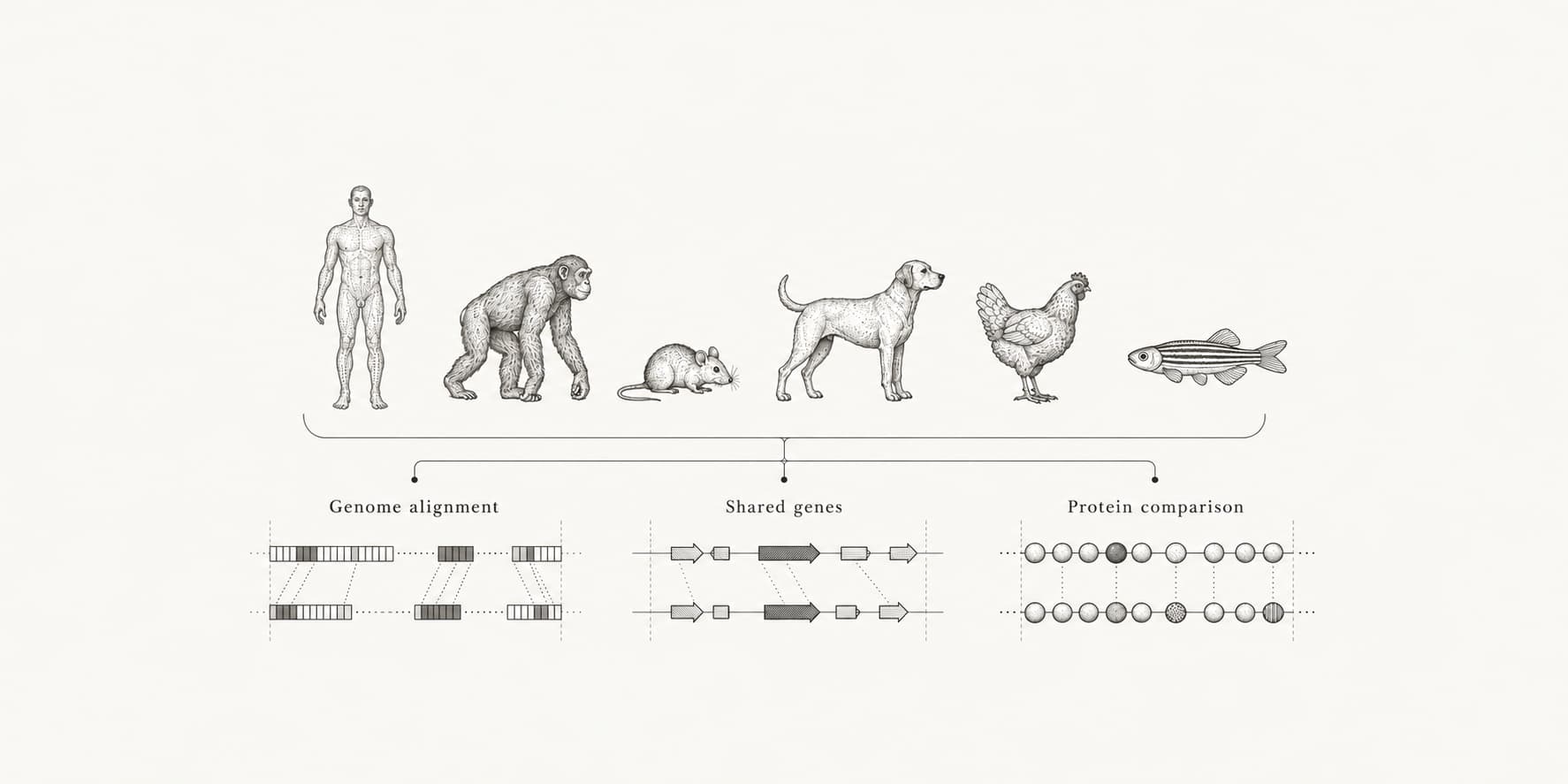
Bananas are not unusual. Thale cress (Arabidopsis thaliana), the standard laboratory plant, has OMA orthologs for 18.2% of human genes, and rice for 16.5%, almost the same as banana's 18.0%. We counted human genes with orthologs in ten other species using the same OMA release and counting rule, which puts banana in context.[1][2]
The share falls with evolutionary distance, from 91.2% for chimpanzees to 60.4% for zebrafish and about a quarter for fruit flies and nematode worms. Plants sit below all animals. Humans and plants last shared an ancestor about 1.5 billion years ago; TimeTree, which combines published molecular-clock studies, gives a median of 1,455 million years across ten studies.[11] Every flowering plant is equally distant from us, which is why banana, thale cress, and rice give similar answers.
Yeasts break the pattern. Fungi are closer relatives of animals than plants are, having separated from our lineage about 1.2 billion years ago, yet baker's yeast has orthologs for only 11.1% of human genes and fission yeast for 12.6%.[11] Yeast genomes are small, with about 5,100 proteins in OMA's fission yeast set and 6,600 in its baker's yeast set, against 35,000 banana genes, so they cannot supply counterparts for as many human genes.[12] The number of shared genes depends on genome content as well as on relatedness.
| Species | Last common ancestor with humans | OMA | Ensembl |
|---|---|---|---|
| Chimpanzee | 6 million years ago | 91.2% | – |
| Mouse | 84 million years ago | 88.6% | 90.5% |
| Chicken | 319 million years ago | 66.2% | 73.7% |
| Zebrafish | 435 million years ago | 60.4% | 78.2% |
| Fruit fly | 721 million years ago | 26.7% | 56.2% |
| Nematode worm | 721 million years ago | 24.1% | 52.8% |
| Baker's yeast | 1,218 million years ago | 11.1% | 24.8% |
| Fission yeast | 1,218 million years ago | 12.6% | 26.2% |
| Thale cress | 1,455 million years ago | 18.2% | 35.5% |
| Rice | 1,455 million years ago | 16.5% | 34.8% |
| Banana | 1,455 million years ago | 18.0% | – |
The comparison also shows how much the method matters. For every distant species, Ensembl's pan-taxonomic comparison assigns orthologs to about twice as many human genes as OMA does, which we found in our comparison of humans with other animals.[13] The two resources infer orthologs differently: Ensembl from gene trees built for whole gene families, and OMA from pairwise comparisons that it then checks for consistency across genomes.[13][3]
The two agree more closely on the strictest category, one-to-one orthologs: Ensembl finds them for 6.9% of human genes in thale cress and rice, and in our banana analysis the best OMA counterpart is one-to-one for 1,236 human genes, or 6.0%. A statement that humans share 18% or 35% of their genes with plants is therefore only complete with the method attached.
Why do humans share genes with bananas?
Humans and bananas inherited part of the same cellular machinery from a common ancestor that lived about 1.5 billion years ago. Both are eukaryotes, organisms whose cells keep their DNA in a nucleus, and both still use many of the proteins that this ancestor used to package DNA, build other proteins, and move material within the cell.[11][9]
The most conserved genes in our analysis make this concrete. Histone H4, one of the proteins around which DNA is wound in every nucleosome, is 98.1% identical between humans and bananas, differing at only 2 of its 103 positions. Ubiquitin, a small tag that marks proteins for recycling, is 95.6% identical, and the skeleton-forming proteins actin and tubulin are 85–90% identical.
Among larger proteins, PRPF8, the central component of the machinery that splices RNA, is 83.4% identical along its 2,335 amino acids. The Swiss Institute of Bioinformatics likewise lists gene expression, lipid metabolism, and RNA splicing among the functions of shared genes.[9]
| Human protein | Role in the cell | Length (amino acids) | Identity with banana |
|---|---|---|---|
| Histone H4 | Packages DNA in nucleosomes | 103 | 98.1% |
| Histone H3 | Packages DNA in nucleosomes | 136 | 97.1% |
| Ubiquitin B | Tags proteins for degradation | 229 | 95.6% |
| Calmodulin | Senses calcium signals | 149 | 89.9% |
| Actin, gamma 1 | Forms cytoskeletal filaments | 375 | 89.9% |
| Tubulin, beta 4B | Forms microtubules | 445 | 87.2% |
| PRPF8 | Core of the spliceosome, which splices RNA | 2,335 | 83.4% |
These proteins are the exception. Only 190 of the 3,683 pairs, about 5%, are at least 70% identical over the human protein's length, while 408 pairs, 11%, are less than 25% identical. The typical shared gene is recognizably related but has changed at more than half of its amino acids. Shared ancestry also does not guarantee shared function: related genes can be duplicated, lost, or adapted to new roles in each lineage.[3]
How many genes does a banana have?
The current reference genome of the wild banana Musa acuminata contains 36,979 annotated genes on 11 chromosomes, which together hold 468.8 million base pairs of assembled sequence. The genome as a whole is estimated at 523 million base pairs.[14] This assembly, known as DH-Pahang version 4, is the one OMA uses; after keeping one protein per gene, OMA's banana set contains 35,012 protein-coding genes.
The banana genome is about a sixth the size of the human genome, yet it contains more protein-coding genes. The first draft genome, published in 2012, reported 36,542 gene models and traced part of this abundance to three rounds of whole-genome duplication in the banana lineage.[15] Duplication helps explain why a single human gene can match several banana genes, and why gene counts and genome sizes are poor guides to how complex an organism is.
Taken together, the banana comparison is a lesson in units. Counted as genes, humans and bananas share about 18%; counted as the amino acids of those genes' proteins, about 40% match; counted as letters of DNA, about 0.08% of the human genome matches. The 50% claim blends the first two numbers and relabels them as the third. For animals, where much more of the genome can be compared directly, see how much DNA humans share with other species and with chimpanzees.