How many RNA polymerases do eukaryotes have?
Eukaryotes have three canonical nuclear RNA polymerases. Land plants have two more, while humans encode 16 DNA polymerases and E. coli encodes five.
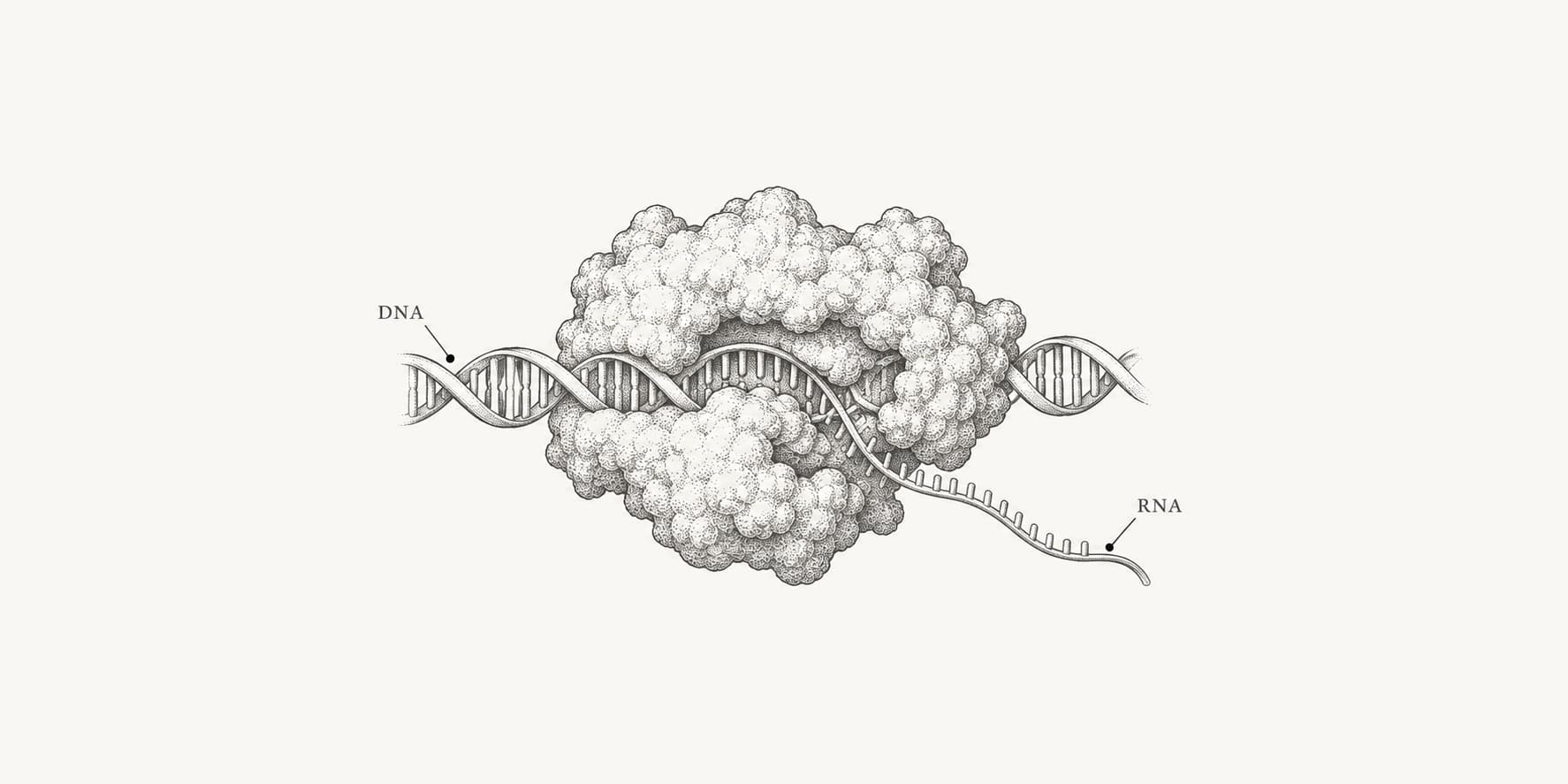
Eukaryotes have three canonical nuclear RNA polymerases: RNA polymerase I, II, and III. Land plants have two additional nuclear enzymes, Pol IV and Pol V, so they have five.
Bacteria and archaea each use one cellular RNA polymerase system. DNA polymerase counts are less uniform: humans encode 16, budding yeast has eight, and Escherichia coli has five.
These numbers count distinct polymerase types, not the number of enzyme molecules inside a cell.
How many RNA polymerases do eukaryotes have?
Eukaryotes have three canonical nuclear RNA polymerases: Pol I, Pol II, and Pol III.[1]
The three enzymes divide nuclear transcription by the RNA they make. Pol I produces the large ribosomal RNA precursor. Pol II transcribes protein-coding genes into messenger RNA and makes many non-coding RNAs. Pol III produces transfer RNAs, 5S ribosomal RNA, and other short RNAs. A DNA-to-RNA conversion represents the same base-pairing step, without the cellular machinery that selects and regulates genes.
In budding yeast, Pol I, II, and III contain 14, 12, and 17 subunits, respectively.[3] These are three enzyme complexes, not 43 separate polymerases.
Land plants are the main exception to the three-polymerase answer. They also have Pol IV and Pol V, specialized descendants of Pol II that produce non-coding RNAs involved in RNA-directed DNA methylation and transposon silencing.[2] Plant nuclei therefore have five established DNA-dependent RNA polymerases.
Mitochondria use a separate RNA polymerase, and plant chloroplasts have additional transcription machinery. The standard answer of three refers specifically to the canonical enzymes that transcribe nuclear genes.
The chart compares the main cellular or nuclear DNA-dependent RNA polymerase systems. It excludes organellar polymerases and RNA-dependent RNA polymerases.[1][2][4]
How many DNA polymerases do eukaryotes have?
Eukaryotes do not have one universal DNA polymerase count: humans encode 16, while budding yeast has eight.[5][6]
Only three human DNA polymerases do most nuclear genome replication. Pol α makes and extends the initial primer, Pol ε copies most of the leading strand, and Pol δ copies the lagging strand as short Okazaki fragments.[5] The remaining polymerases have specialized roles in DNA repair, lesion bypass, immune-cell DNA rearrangement, or mitochondrial DNA replication.
Older textbook lists of three or five eukaryotic DNA polymerases usually cover the principal replication enzymes known at the time, not every recognized DNA-template-dependent polymerase. A typical human cell copies its nuclear DNA in about eight hours because many replication forks work at once. The 16 polymerases do not all copy the chromosomes in parallel.
The comparison uses identified DNA-template-dependent polymerases in each model species. The counts are five in E. coli, eight in Saccharomyces cerevisiae, and 16 in humans.[5][6]
How many RNA polymerases do prokaryotes have?
Bacteria and archaea each use one type of cellular RNA polymerase to transcribe their genes.[4]
Bacterial and archaeal enzymes differ despite sharing a count of one. A bacterial RNA polymerase core contains five subunits, counting two copies of the α subunit. Different sigma factors can attach to that core and direct it to different promoters, but they do not create additional RNA polymerase families.
Archaeal RNA polymerase is larger and structurally closer to eukaryotic Pol II. Depending on the species and whether split subunits are counted separately, it contains about 11 to 13 subunits. It still forms one general RNA polymerase system that transcribes messenger RNA, ribosomal RNA, transfer RNA, and other cellular RNAs.[4]
Both “how many RNA polymerases do archaea have?” and “how many RNA polymerases do prokaryotes have?” have the same concise answer: one. The count refers to enzyme type, not subunits, accessory factors, or the many polymerase molecules active in a growing cell.
How many DNA polymerases do prokaryotes and bacteria have?
Prokaryotes do not share one DNA polymerase count. E. coli has five, some bacteria have only two, and archaeal lineages use different combinations of Pol B and Pol D enzymes.[6][7][8]
The five E. coli enzymes are Pol I, II, III, IV, and V. Pol III is the main chromosome-replicating enzyme. Pol I processes the RNA primers left between Okazaki fragments, while Pol II, IV, and V mainly support repair or DNA-damage tolerance.[6] This five-polymerase set is a property of the model bacterium, not a rule for every bacterium.
For example, Helicobacter pylori has been reported to possess two DNA polymerases.[7] Archaea differ more sharply from bacteria: many species use Pol D for chromosome replication and Pol B for other tasks, while crenarchaea lack Pol D and can encode several Pol B enzymes.[8]
The number of DNA polymerases in bacteria is species-dependent. Five is appropriate for E. coli; it should not be generalized to every bacterium or to all prokaryotes.