How long does DNA replication take?
Human cells typically copy their nuclear DNA in about 8 hours. An individual human replication fork moves at roughly 1 to 2 kilobases per minute, while E. coli forks move hundreds of base pairs per second.
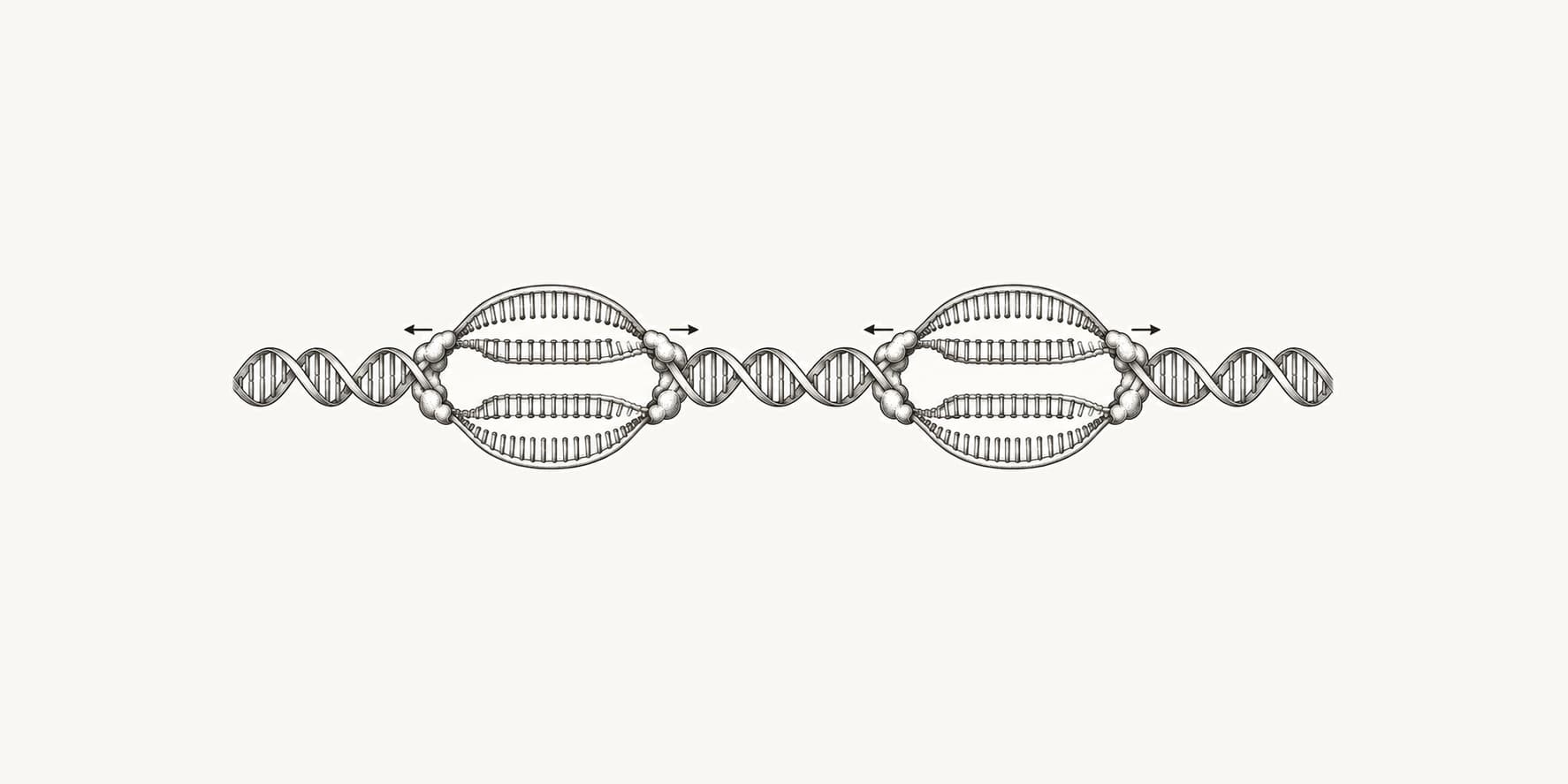
Human DNA replication takes about 8 hours in a typical proliferating cell. During S phase, the cell copies roughly 6.4 billion base pairs of diploid nuclear DNA. It finishes within hours because thousands of replication forks work across the chromosomes in parallel.
The exact time varies with cell type, developmental stage, and replication stress. Bacteria copy much smaller genomes with faster forks, so their chromosome replication is usually measured in minutes.
How long does DNA replication take in humans?
Human nuclear DNA is usually replicated in about 7 to 8 hours during the synthesis, or S, phase of the cell cycle.[1]
That is the time needed to copy the cell's full complement of nuclear DNA, not the working time of one polymerase. A typical diploid cell contains about 2 meters of DNA, or 6.3 to 6.4 billion base pairs distributed across 46 chromosomes.
Different chromosome regions start at different times during S phase. Early-replicating regions tend to be more accessible, while some compact regions copy later. Cell type and chromatin state therefore affect the schedule even when the human genome size is nearly the same.[1][5]
DNA replication is also different from DNA sequencing. A cell copies its own chromosomes before division; a sequencing workflow reads DNA extracted from a sample. Modern human genome sequencing can produce data within hours, but the similar timescale comes from different machinery and a different process.
How fast does DNA replicate?
An individual human replication fork usually moves at roughly 1 to 2 kilobases per minute, equivalent to about 17 to 33 base pairs per second.[2]
In one single-molecule study, forks in primary human keratinocytes averaged 1.46 kb/min, or 24.3 bp/s. Forks in a keratinocyte-derived cancer cell line averaged 1.67 kb/min, or 27.8 bp/s. Individual measurements varied widely, so the mean is more useful than a single universal speed.[2]
The chart converts the reported human and yeast rates from kilobases per minute to base pairs per second. The human values are 1.46 and 1.67 kb/min, budding yeast averages 1.6 kb/min, and the recent in vivo E. coli estimate is about 600 bp/s.[2][3][4]
DNA polymerase speed and replication fork speed are related but not identical. A cellular fork is a moving complex that includes helicase, polymerases, sliding clamps, primase, and other proteins. DNA damage, nucleotide supply, chromatin, and cell state can slow or stall the whole complex. Fork speed therefore cannot be calculated from genome length or GC content alone.
How long does DNA replication take in bacteria?
E. coli chromosome replication is commonly summarized as about 40 minutes, although live-cell measurements have reported 55 to 65 minutes under the conditions tested.[4][6]
The classic 40-minute value is the bacterial C period, the interval from initiation to completion of chromosome replication. Cell Biology by the Numbers derives a similar lower-bound estimate from a roughly 5-million-base-pair genome copied by two opposing forks.[4][6]
More recent fluorescent measurements gave an average in vivo fork rate of about 600 bp/s and total replication times of 55 to 65 minutes. Growth conditions and measurement methods matter, so 40 minutes and 55 to 65 minutes describe different experimental frames rather than one exact constant.[4]
E. coli can divide about every 20 minutes in ideal laboratory conditions, faster than it can finish one chromosome. It does this by starting a new round of replication before the previous round ends, creating overlapping rounds with multiple forks.[4][6]
How do replication forks copy the human genome so quickly?
Human cells finish DNA replication in hours because tens of thousands of origins can launch pairs of forks at different times across the genome.[5][7]
An older textbook estimate places about 30,000 replication origins across the human genome, spaced roughly 50 to 300 kb apart. Current reviews use the more cautious description “tens of thousands” because origin selection varies among cells and only a subset of licensed origins fires in any one S phase.[5][7]
At the measured primary-cell mean of 1.46 kb/min, two forks would need about 4.2 years to copy 6.4 billion base pairs. This hypothetical calculation treats the DNA as one continuous template, although human nuclear DNA is split across 46 chromosomes:
Real cells distribute the work across many chromosomes and many origins. Each fired origin normally produces two forks moving in opposite directions. Nearby forks eventually meet, completing the intervening DNA, while licensed origins that did not fire can remain available as backups if replication slows or stalls.[7]