Whole-genome sequencing can generate a person's genome data in hours to about a day. The full result takes longer: specialized research workflows have returned findings on the same day, while a current consumer service reports a turnaround of about three to four weeks.
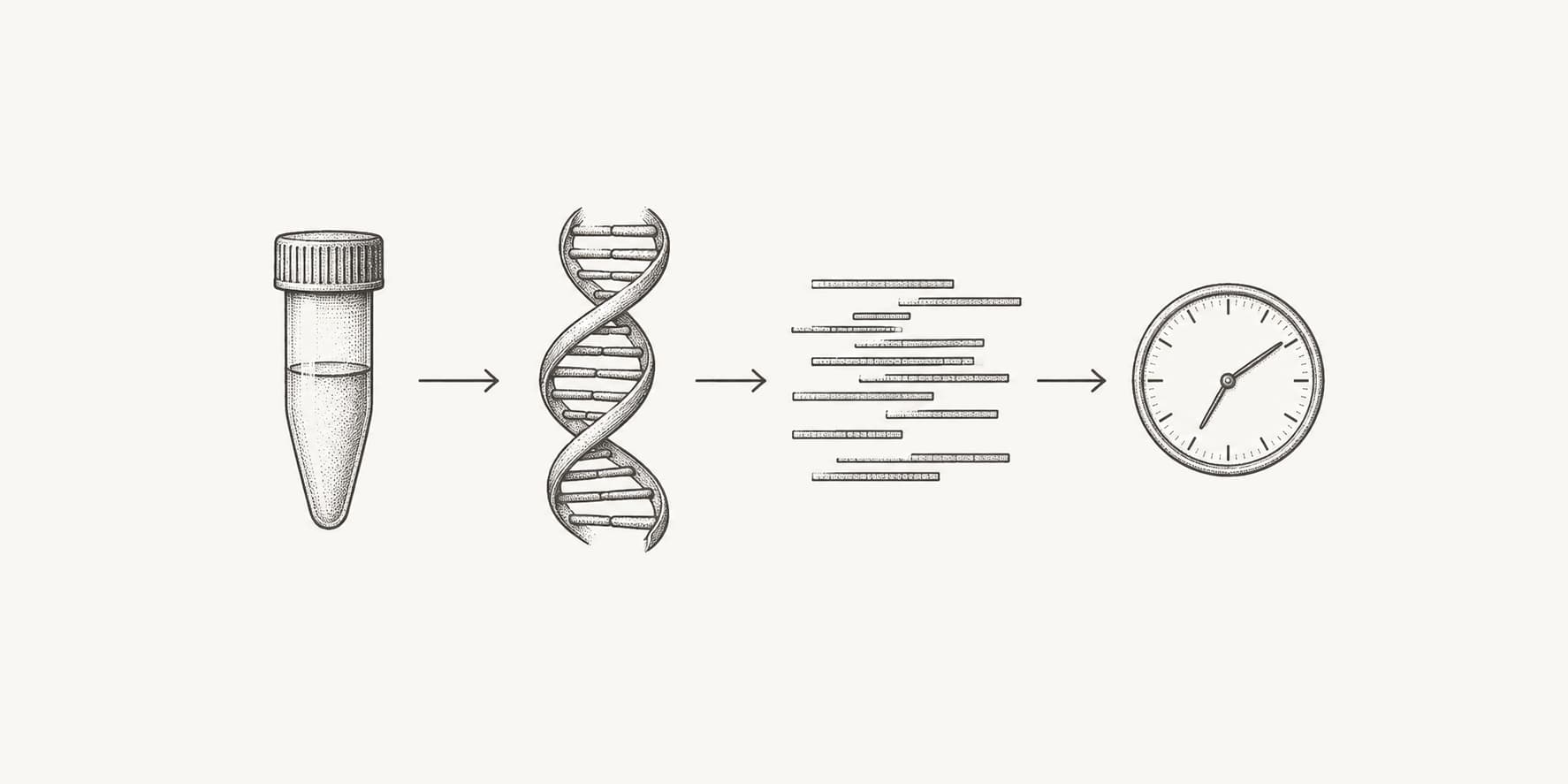
The difference is what the clock includes. A sequencing run reads DNA. A usable result may also require sample preparation, quality control, variant calling, interpretation, and reporting.
How long does whole-genome sequencing take?
A human whole genome can be sequenced in hours to about a day, while sample-to-result times range from the same day in specialized research workflows to several weeks in consumer testing.
| Setting | What is timed | Time |
|---|---|---|
| Rapid long-read WGS | 30x genome plus variant and methylation analysis | 13–16 hours sequencing; about 24 hours sample to analysis |
| Same-day research study, 2025 | Genomic DNA to variants and interpreted report | Mean 4h 4m to variants; fastest report 6h 47m |
| Ultrarapid nanopore study, 2022 | Blood sample to initial genetic diagnosis | Fastest diagnosis 7h 18m |
| MyHeritage consumer test | Sample arrival at the laboratory to results | About 3–4 weeks |
Sources: Oxford Nanopore's rapid human-genome workflow, the 2025 Wojcik et al. research study, the 2022 Gorzynski et al. study, current MyHeritage help pages, and the National Human Genome Research Institute's Human Genome Project timeline.[1][2][3][4][5][6]
These timings describe different products. The Oxford Nanopore workflow uses three flow cells to produce more than 30x coverage in 13 to 16 hours, followed by variant and methylation analysis within a 24-hour sample-to-answer workflow.[1] MyHeritage uses low-pass 2x sequencing for genealogy, so its three-to-four-week report should not be compared with a 30x research or medical genome on speed alone.[4][5]
Why do whole-genome sequencing results take longer than the machine run?
Whole-genome sequencing results take longer because extracting DNA, preparing the library, checking quality, analyzing variants, interpreting findings, and producing a report happen outside the sequencing run.
Batching also changes turnaround. A high-throughput laboratory may wait for enough samples to fill a run, even when the instrument itself can read a genome quickly. Clinical review can add more time because a specialist must decide which variants are relevant and whether the evidence supports a diagnosis.
Coverage and purpose matter too. Low-pass sequencing reads each position only a few times and can be sufficient for genealogy with statistical imputation. Research and medical workflows commonly use deeper coverage and more extensive analysis, which increases both processing time and sequencing cost.[1][4]
Can a human genome be sequenced in one day?
Yes. Specialized research teams have produced variants and interpreted whole-genome results within one day, but these records do not describe routine clinical turnaround.
In a 2025 neonatal intensive-care research study, the mean time from genomic DNA to variants was 4 hours 4 minutes. The fastest time from sample receipt to an interpreted report was 6 hours 47 minutes.[2]
The researchers stated that these reports were generated in a research setting and were not used for clinical diagnosis. In a separate 2022 nanopore study, the shortest time from a blood sample arriving at the laboratory to an initial genetic diagnosis was 7 hours 18 minutes.[3]
These studies show what is technically possible when speed is the main constraint. Routine services must also manage staffing, batching, confirmation, clinical governance, and reporting at scale.
How long did it take to sequence the first human genome?
The first public human reference genome took about 13 years: the Human Genome Project ran from 1990 to 2003 and produced a sequence covering more than 90% of the genome.
That reference was a patchwork from anonymous donors, not one person's complete genome. About 70% of the original sequence came from one individual, while the remaining 30% came from 19 others.[6]
The first named individual's diploid genome was published in 2007. The study assembled J. Craig Venter's genome from about 32 million DNA fragments at approximately 7.5x coverage.[7]
The comparison with today's turnaround is not exact. The Human Genome Project had to develop sequencing methods and build the first reference, while modern whole-genome sequencing aligns a person's reads against an established human genome.