58 E. coli statistics [2026]
A curated, source-checked list of E. coli statistics for the K-12 MG1655 genome, gene and protein counts, cell size, growth, public databases, and foodborne illness.
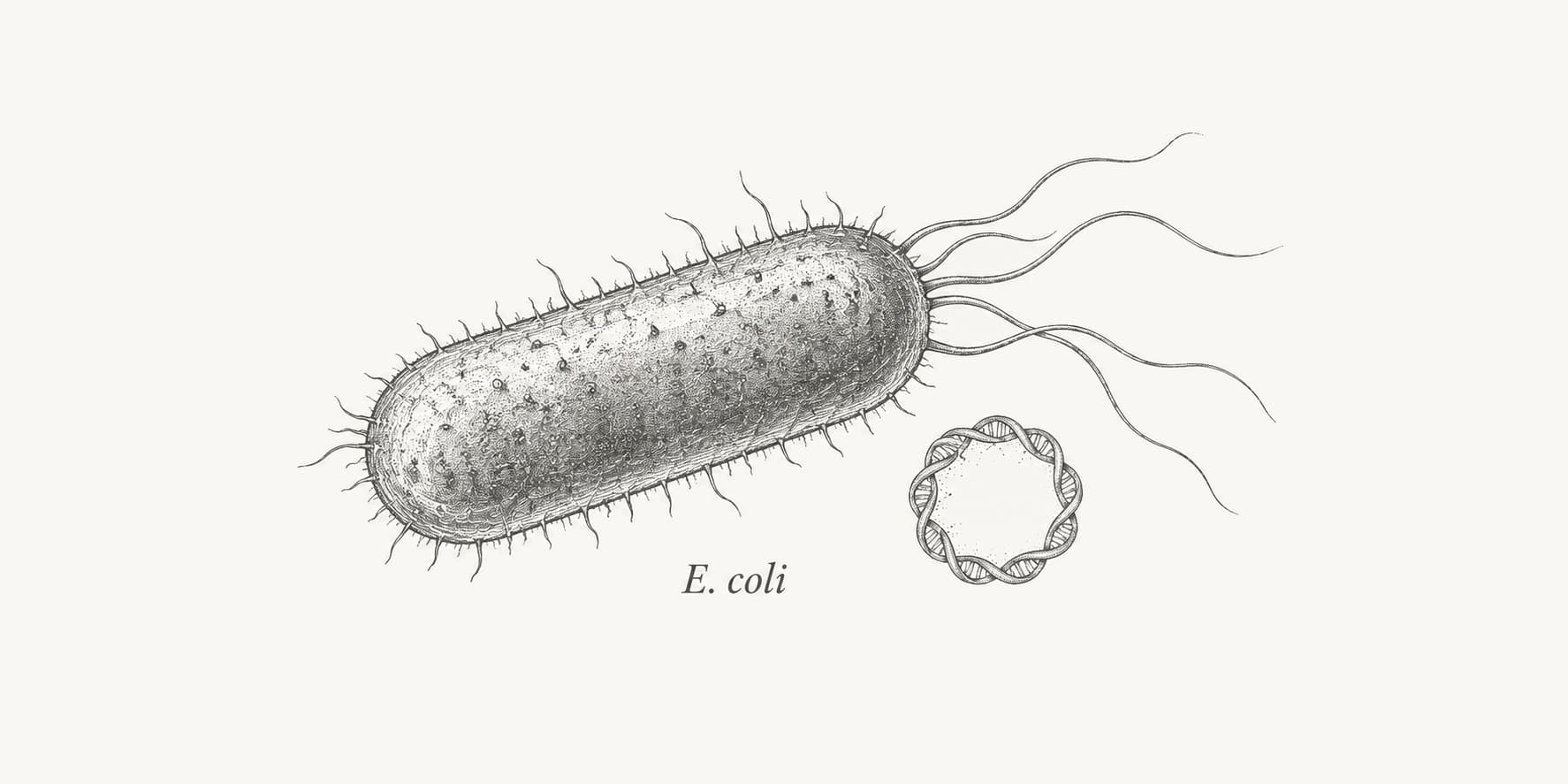
Curious about E. coli by the numbers? This page collects source-checked statistics for the laboratory reference strain, the species as represented in public databases, and the pathogenic groups that matter for public health.
The headline values below focus on Escherichia coli K-12 MG1655 when the statistic is genomic, cell-biological, or a protein count. Public-health figures use CDC categories, because a harmless gut isolate, an outbreak STEC isolate, and a laboratory K-12 strain should not be collapsed into one number.
Top E. coli statistics
The fastest way to summarize E. coli is to separate the K-12 MG1655 reference strain from the broader species and from pathogenic surveillance categories. These are the headline numbers most readers need before going deeper.
The citations point to the databases, CDC pages, or journal tables behind each statistic.
- The reference E. coli K-12 MG1655 chromosome is 4,641,652 bp of circular DNA in RefSeq record NC_000913.3.[1]
- NCBI Datasets lists the K-12 MG1655 assembly GCA_000005845.2 / GCF_000005845.2 as 4,641,652 bp, 1 contig, 51% GC, and a complete genome.[2]
- The current NCBI annotation for that assembly lists 4,651 total genes, including 4,290 protein-coding genes, 215 non-coding genes, and 145 pseudogenes.[2]
- UniProt proteome UP000000625 lists 4,403 proteins for E. coli strain K-12 MG1655, modified December 5, 2025.[3]
- EcoCyc v29.6 reports 4,543 genes, 4,313 protein genes, 229 RNA genes, and 145 pseudogenes for K-12 MG1655.[4]
- A typical E. coli cell is about 1 um in diameter, 2 um long, 1 um^3 in volume, and 1 pg in mass.[7]
- E. coli can divide in about 20 minutes under ideal laboratory conditions, while chromosome replication takes about 40 minutes.[8]
- A fast-growing E. coli cell can contain about 72,000 ribosomes.[9]
- An E. coli cell contains roughly 2 million to 4 million protein molecules per 1 um^3 cell volume.[11]
- NCBI Datasets returned 469,981 genome assembly reports for taxon 562, Escherichia coli, when queried on June 30, 2026.[2]
- CDC's 2025 foodborne-illness update estimated 357,000 domestically acquired foodborne STEC illnesses, 3,150 hospitalizations, and 66 deaths in the United States in 2019.[17][18]
How many genes does E. coli have?
E. coli K-12 MG1655 has 4,651 annotated genes, including 4,290 protein-coding genes, in the current NCBI assembly record.[2] Other strains can have different gene counts, so there is no single number for the species as a whole.
Gene counts are less fixed than chromosome length because databases count related but non-identical objects: assembly annotations, curated EcoCyc genes, UniProt proteins, and historical genome-paper annotations.
- The RefSeq accession for the K-12 MG1655 reference chromosome is NC_000913.3, and NCBI identifies it as genomic DNA with circular topology.[1]
- NCBI last updated the NC_000913.3 ESummary record on December 9, 2025.[1]
- The K-12 MG1655 assembly report gives a total sequence length of 4,641,652 bp and GC content of 51%.[2]
- The current NCBI annotation release date for GCA_000005845.2 is November 6, 2024.[2]
- NCBI counts 4,651 total genes, 4,290 protein-coding genes, 215 non-coding genes, and 145 pseudogenes on the K-12 MG1655 assembly.[2]
- EcoCyc reports 4,543 genes for K-12 MG1655, including 4,313 protein genes and 229 RNA genes.[4]
- The original 1997 Science genome paper reported a 4,639,221 bp sequence with 4,288 protein-coding genes.[5]
- The stretched K-12 MG1655 chromosome is about 1.58 mm long, calculated as 4,641,652 bp x 0.34 nm per base pair.[1][6]
- Compared with a typical 2 um E. coli cell length, that fully stretched chromosome is about 790 cell lengths long.[1][7]
Cell size and growth statistics
E. coli cell size and growth rate are condition-dependent. The familiar 1 um by 2 um cell is a useful scale reference, but faster-growing cells can be much larger and richer in biomass.
The growth statistics below mostly come from classic bacterial physiology data summarized by Cell Biology by the Numbers.
- The common reference scale for E. coli is 1 um diameter, 2 um length, 1 um^3 volume, and 1 pg mass.[7]
- Slowly growing E. coli B/r cells around a 100-minute doubling time have a dry mass of about 148 fg per cell.[7]
- Fast-growing E. coli B/r cells around a 24-minute doubling time have a dry mass of about 865 fg per cell.[7]
- The fast-growth dry-mass value is about 5.8 times the slow-growth dry-mass value, which is why one cell-size number should be treated as a reference scale rather than a constant.[7]
- The minimum division time often quoted for E. coli is about 20 minutes in ideal laboratory conditions.[8]
- Copying a roughly 5 Mbp bacterial genome with two replication forks takes about 40 minutes, longer than the fastest E. coli division cycle.[8]
- Fast-growing E. coli handles that timing gap by initiating overlapping rounds of DNA replication before the previous round is finished.[8]
- A recent in vivo replication-rate estimate summarized by Cell Biology by the Numbers is about 600 bp/s.[8]
- Long-term evolution data put the E. coli mutation rate on the order of 10-10 mutations per base pair per replication under the measured conditions.[12]
- For a roughly 5 x 10⁶ bp bacterial genome, 10-10 mutations per base pair per replication corresponds to about 5 x 10⁻⁴ mutations per genome replication in a single lineage.[12]
Molecular biology statistics
Molecular counts in E. coli are easy to confuse because "protein count" can mean a database proteome, a distinct protein species, or physical protein molecules inside one cell.
The most useful pattern is to name the counting level: annotated proteins, molecule copies, ribosomes, transcription speed, translation speed, or curated EcoCyc functional entries.
- UniProt's K-12 MG1655 reference proteome contains 4,403 proteins.[3]
- Cell Biology by the Numbers estimates roughly 2 million to 4 million protein molecules in a 1 um^3 E. coli cell.[11]
- Those two protein statistics count different things: 4,403 is a distinct-protein annotation count, while 2 million to 4 million is a molecule-copy count inside one cell.[3][11]
- A fast-growing E. coli cell at about a 24-minute doubling time can contain about 72,000 ribosomes.[9]
- A slower-growing E. coli cell at about a 100-minute doubling time can contain about 6,800 ribosomes.[9]
- The fast-growth ribosome count is roughly 10.6 times the slow-growth count, making ribosome abundance one of the clearest quantitative signatures of bacterial growth rate.[9]
- E. coli transcription elongation is commonly summarized at about 40-80 nucleotides per second.[10]
- E. coli translation elongation is commonly summarized at about 20 amino acids per second.[10]
- EcoCyc v29.6 reports 2,419 enzymatic reactions, 549 transport reactions, 1,210 protein complexes, and 1,458 enzymes for K-12 MG1655.[4]
- EcoCyc v29.6 also reports 3,767 transcription units, 6,106 transcriptional regulation entries, and 70,767 GO annotations.[4]
Public database statistics
Public database counts are not counts of how many E. coli strains exist in nature. They reflect sequencing effort, outbreak surveillance, food-safety testing, environmental sampling, and database inclusion rules.
That makes them useful for understanding data availability, not for estimating natural diversity.
- NCBI taxon 562 is the species-level taxon for Escherichia coli.[2]
- NCBI Datasets returned 469,981 genome assembly reports for taxon 562 on June 30, 2026.[2]
- The first assembly returned by that NCBI Datasets query is GCA_000005845.2, the K-12 MG1655 reference assembly.[2]
- NCBI reports 99.48% CheckM completeness and 0.15% CheckM contamination for that returned K-12 MG1655 assembly report.[2]
- EcoCyc v29.6 reports 478 pathways for K-12 MG1655.[4]
- EcoCyc v29.6 reports 488 transporters and 3,086 compounds for K-12 MG1655.[4]
- EcoCyc v29.6 reports 46,219 protein features and 441 growth media entries for K-12 MG1655.[4]
- UniProt proteome UP000000625 is the reference proteome record used here for K-12 MG1655 protein counts.[3]
Pathogenic E. coli and public-health statistics
Pathogenic E. coli is not one disease category. CDC separates diarrheagenic groups such as STEC and ETEC because symptoms, surveillance methods, and public-health burden differ by group.
The U.S. burden estimates below use CDC's 2025 Emerging Infectious Diseases update for STEC because it is newer than the older 2011 foodborne burden paper.
- CDC describes most E. coli as harmless, while some strains can cause diarrhea, urinary tract infections, pneumonia, sepsis, and other illnesses.[13]
- CDC lists six diarrheagenic kinds of E. coli: STEC, ETEC, EPEC, EIEC, EAEC, and DAEC.[14]
- CDC describes STEC as the group most commonly heard about in the United States.[14]
- CDC identifies people younger than 5, adults 65 and older, people with weakened immune systems, and international travelers as higher-risk groups for E. coli infection.[13]
- CDC's national STEC surveillance is based on passive reporting of laboratory-confirmed human STEC isolates to the Laboratory-based Enteric Disease Surveillance system.[15]
- CDC's 2025 major-pathogen foodborne-illness update estimated 357,000 domestically acquired foodborne STEC illnesses in the United States in 2019.[17]
- The same estimate includes rounded subgroup estimates of 86,200 illnesses from O157 and 271,000 from non-O157 STEC.[17]
- Non-O157 STEC accounted for about 76% of estimated domestically acquired foodborne STEC illnesses in 2019.[16][17]
- CDC's 2025 update estimated 3,150 domestically acquired foodborne STEC hospitalizations in 2019, with rounded subgroup estimates of 1,730 from O157 and 1,410 from non-O157 STEC.[18]
- CDC's 2025 update estimated 66 domestically acquired foodborne STEC deaths in 2019, with rounded subgroup estimates of 40 from O157 and 25 from non-O157 STEC.[18]
Methodology and citation
The figures above combine direct source values with a small number of explicitly labeled ProteinIQ calculations. Direct values include the NCBI chromosome length, NCBI annotation counts, UniProt protein count, EcoCyc database counts, Cell Biology by the Numbers cell-scale values, CDC pathotype descriptions, and CDC/EID foodborne burden estimates.
Calculated values include the 1.58 mm stretched chromosome length, the 790 cell-length comparison, the dry-mass and ribosome ratios, the per-genome mutation-rate estimate, and the non-O157 STEC illness share.
- The stretched chromosome length uses 4,641,652 bp from NCBI ESummary and 0.34 nm per base pair from D'Onofrio et al.[1][6]
- The public-health section uses CDC's 2025 Emerging Infectious Diseases update for STEC burden because it is newer than the older 2011 foodborne burden paper. It does not treat the 2025 STEC figures as a count for all pathogenic E. coli, because CDC's diarrheagenic categories are broader than STEC.[16]
- When citing this page as a dated statistics source, include the access date because NCBI Datasets, UniProt, EcoCyc, and CDC/EID estimates can change across releases.
ProteinIQ. "58 E. coli statistics [2026]." Updated June 30, 2026. Accessed [your access date]. https://proteiniq.io/guides/e-coli-statistics