How many oligonucleotide drugs are approved?
Antisense, siRNA and aptamer drugs in the US, Europe and Japan

Matic Broz, PhD14 min
On October 20, 2026, the FDA approved bepirovirsen (Hibsago), a short, chemically modified antisense strand that silences the hepatitis B virus in the liver. Seven weeks earlier it had approved zilganersen (Zanvastro), the first treatment for Alexander disease, a rare and usually fatal brain disorder. Both are oligonucleotide drugs: short synthetic stretches of DNA or RNA that act by pairing with a target RNA, or in two cases by folding around a protein.
Bepirovirsen brought the FDA's total to 25 oligonucleotide drugs since 1998, and 21 of them are still sold in the United States. Adding approvals in the European Union and Japan gives 26 different molecules. Published totals range from 6 to 24 because they count different classes on different dates; below are the full list, the rules behind each number and a downloadable dataset.
How many oligonucleotide drugs has the FDA approved?
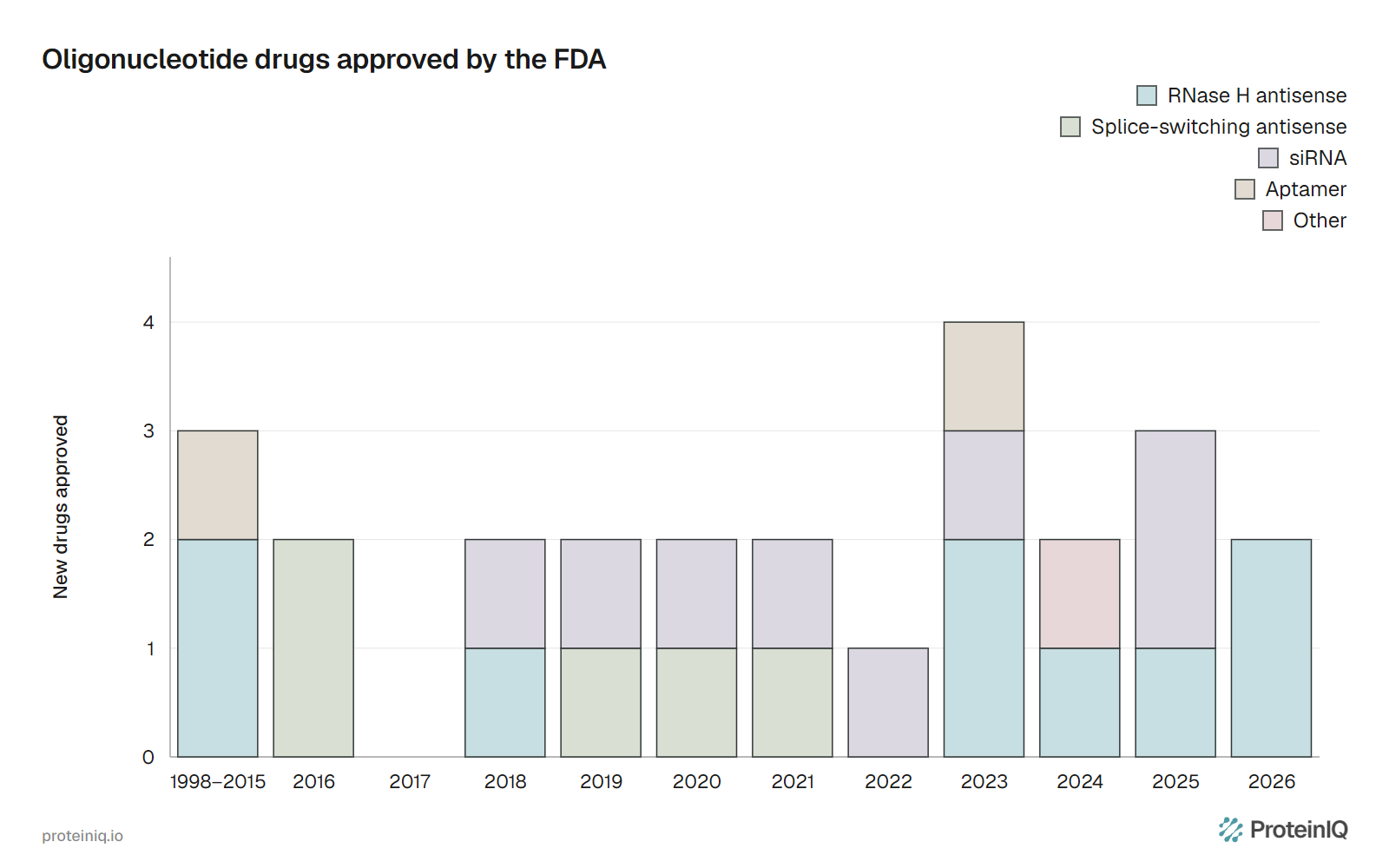
The FDA has approved 25 oligonucleotide drugs as of October 29, 2026: 14 antisense oligonucleotides (ASOs), 8 small interfering RNAs (siRNAs), 2 aptamers and imetelstat, which blocks the RNA template of the enzyme telomerase. Each is counted once, at its first approval, including four that are no longer sold.[1]
An antisense oligonucleotide is a single strand, usually 16 to 30 nucleotides long, whose sequence is the reverse complement of a stretch of its target RNA. An siRNA is a pair of 21 to 23 nucleotide RNA strands that loads into the cell's own RNA interference machinery. Aptamers are the exception: they fold into a shape that binds a protein, the way an antibody would, and their sequence matters only because it sets that shape.
| Drug (brand) | Class | Delivery | Target | First FDA approval | US status | First indication |
|---|---|---|---|---|---|---|
| Fomivirsen (Vitravene) | RNase H antisense | Unconjugated | Cytomegalovirus IE2 | August 1998 | Discontinued | Cytomegalovirus retinitis in AIDS |
| Pegaptanib (Macugen) | Aptamer | PEGylated | VEGF protein | December 2004 | Discontinued | Wet age-related macular degeneration |
| Mipomersen (Kynamro) | RNase H antisense | Unconjugated | APOB | January 2013 | Discontinued | Homozygous familial hypercholesterolemia |
| Eteplirsen (Exondys 51) | Splice-switching antisense | Unconjugated | DMD exon 51 | September 2016 | Marketed | Duchenne muscular dystrophy |
| Nusinersen (Spinraza) | Splice-switching antisense | Unconjugated | SMN2 | December 2016 | Marketed | Spinal muscular atrophy |
| Patisiran (Onpattro) | siRNA | Lipid nanoparticle | TTR | August 2018 | Marketed | Hereditary transthyretin amyloidosis |
| Inotersen (Tegsedi) | RNase H antisense | Unconjugated | TTR | October 2018 | Discontinued | Hereditary transthyretin amyloidosis |
| Givosiran (Givlaari) | siRNA | GalNAc | ALAS1 | November 2019 | Marketed | Acute hepatic porphyria |
| Golodirsen (Vyondys 53) | Splice-switching antisense | Unconjugated | DMD exon 53 | December 2019 | Marketed | Duchenne muscular dystrophy |
| Viltolarsen (Viltepso) | Splice-switching antisense | Unconjugated | DMD exon 53 | August 2020 | Marketed | Duchenne muscular dystrophy |
| Lumasiran (Oxlumo) | siRNA | GalNAc | HAO1 | November 2020 | Marketed | Primary hyperoxaluria type 1 |
| Casimersen (Amondys 45) | Splice-switching antisense | Unconjugated | DMD exon 45 | February 2021 | Marketed | Duchenne muscular dystrophy |
| Inclisiran (Leqvio) | siRNA | GalNAc | PCSK9 | December 2021 | Marketed | High LDL cholesterol |
| Vutrisiran (Amvuttra) | siRNA | GalNAc | TTR | June 2022 | Marketed | Hereditary transthyretin amyloidosis |
| Tofersen (Qalsody) | RNase H antisense | Unconjugated | SOD1 | April 2023 | Marketed | SOD1 amyotrophic lateral sclerosis |
| Avacincaptad pegol (Izervay) | Aptamer | PEGylated | Complement C5 protein | August 2023 | Marketed | Geographic atrophy |
| Nedosiran (Rivfloza) | siRNA | GalNAc | LDHA | September 2023 | Marketed | Primary hyperoxaluria type 1 |
| Eplontersen (Wainua) | RNase H antisense | GalNAc | TTR | December 2023 | Marketed | Hereditary transthyretin amyloidosis |
| Imetelstat (Rytelo) | Other (telomerase inhibitor) | Lipid conjugate | Telomerase RNA template | June 2024 | Marketed | Lower-risk myelodysplastic syndromes |
| Olezarsen (Tryngolza) | RNase H antisense | GalNAc | APOC3 | December 2024 | Marketed | Familial chylomicronemia syndrome |
| Fitusiran (Qfitlia) | siRNA | GalNAc | SERPINC1 (antithrombin) | March 2025 | Marketed | Hemophilia A or B |
| Donidalorsen (Dawnzera) | RNase H antisense | GalNAc | KLKB1 (prekallikrein) | August 2025 | Marketed | Hereditary angioedema |
| Plozasiran (Redemplo) | siRNA | GalNAc | APOC3 | November 2025 | Marketed | Familial chylomicronemia syndrome |
| Zilganersen (Zanvastro) | RNase H antisense | Unconjugated | GFAP | September 2026 | Marketed | Alexander disease |
| Bepirovirsen (Hibsago) | RNase H antisense | Unconjugated | Hepatitis B virus RNAs | October 2026 | Marketed | Chronic hepatitis B |
The list matches the table of nucleic acid drugs kept by Japan's National Institute of Health Sciences, which was last updated on October 21, 2026 and covers approvals in the US, the EU and Japan.[3] Most drugs in it treat rare inherited diseases. Inclisiran, which lowers LDL cholesterol with two injections a year, and bepirovirsen, for chronic hepatitis B, are the main exceptions aimed at common conditions.
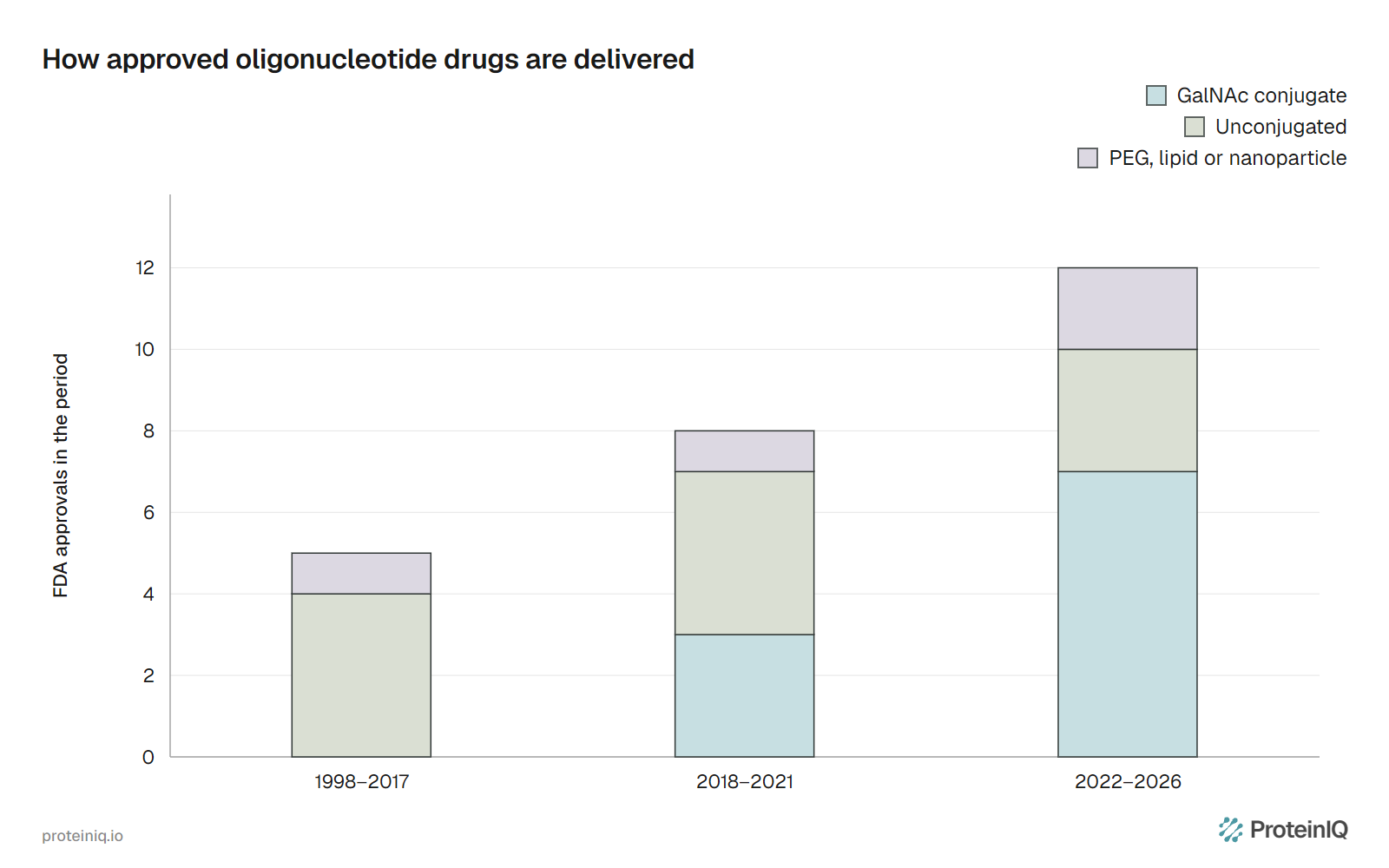
The field took 15 years to reach its third approval. Fomivirsen arrived in 1998, pegaptanib in 2004 and mipomersen in 2013; the other 22 have all been approved since 2016. The FDA approved four in 2023, the most in a single year, and has approved two so far in 2026: zilganersen on September 3 and bepirovirsen on October 20.[4][1]
Why do published oligonucleotide drug counts disagree?
Most published counts are correct for their date and their definition. They differ because the class grows by two or three drugs a year, because some authors count only antisense drugs or only siRNAs, and because one product, defibrotide (Defitelio), is counted by some lists and not by others.
| Count | What it counts |
|---|---|
| 6 | siRNAs approved by the FDA from September 2023 until March 2025, before fitusiran |
| 8 | siRNAs approved by the FDA today |
| 9 | FDA-approved antisense drugs in late 2022, counting defibrotide |
| About 13 | A loose 2025 estimate of all FDA-approved oligonucleotides, which by then numbered 20 by our rules |
| 14 | Antisense oligonucleotides approved by the FDA today, RNase H and splice-switching together |
| 23 | Oligonucleotide drugs approved by the FDA through December 2025 |
| 24 | The 23, plus defibrotide |
| 25 | Oligonucleotide drugs ever approved by the FDA, as of October 29, 2026 |
| 26 | Oligonucleotide drugs approved by the FDA, the EMA or Japan's PMDA |
The siRNA counts are the clearest case of a number going stale. Gavin Traber and Ai-Ming Yu counted six FDA-approved siRNAs in June 2024, which was right until fitusiran was approved in March 2025; plozasiran made it eight that November.[5][1]
Defibrotide explains most counts that run one higher than ours. It is a mixture of DNA fragments, about 50 nucleotides long on average, extracted from pig intestine and approved in 2016 for a liver complication of stem cell transplants. It has no defined sequence and no target RNA, so we list it in the dataset but leave it out of the count.[6]
Danah AlShaer and colleagues include it in their total of 24 FDA-approved oligonucleotides through 2025, and Man Amanat and colleagues include it among nine FDA-approved antisense drugs in 2022, alongside eight true ASOs.[8][6]
Vendor pages are less exact. A Patsnap Synapse article from March 2025 puts the number at "around 13" without listing the drugs, at a time when the FDA had approved 20 by our rules.[7]
How do antisense, siRNA and aptamer drugs work?
The 25 FDA-approved drugs fall into five classes by mechanism, and the class decides much of how a drug is built. Nine are RNase H antisense drugs, five are splice-switching antisense drugs, eight are siRNAs, two are aptamers and one, imetelstat, fits none of these.[1][3]
RNase H antisense drugs bind their target messenger RNA and recruit RNase H1, a cellular enzyme that cuts the RNA strand of an RNA-DNA hybrid. All but fomivirsen are gapmers: a central gap of about ten DNA nucleotides, which RNase H recognizes, flanked by 2′-O-methoxyethyl (2′-MOE) RNA wings that raise binding strength and resist degradation. Every one of them was discovered at Ionis Pharmaceuticals (formerly Isis), from fomivirsen in 1998 to bepirovirsen in 2026.
Splice-switching drugs leave the RNA intact and change how it is spliced. Nusinersen covers a site in the SMN2 pre-mRNA so that cells keep exon 7 and make working SMN protein. The four Duchenne drugs, all phosphorodiamidate morpholino oligomers (PMOs), make the cell skip one exon of the dystrophin gene so that the reading frame is restored around a deletion. Each fits only the patients whose deletion that skip repairs: exon 51 for eteplirsen, 53 for golodirsen and viltolarsen, 45 for casimersen.
siRNAs work through the RNA interference pathway. One strand, the guide, is loaded into the protein Argonaute 2, which then cuts any messenger RNA that matches it, and a single loaded complex can destroy many copies in turn. That catalytic action is why inclisiran needs only two maintenance injections a year and vutrisiran one every three months.
Whatever the class, the drug first has to reach its site on the target. An RNA folds on itself, and a stretch buried in a stable hairpin binds an antisense strand poorly. RNAplfold estimates how likely each position of a long transcript is to be unpaired, RNAplex scans a short strand along that transcript for accessible binding sites, and the Oligo Analyzer checks melting temperature, hairpins and self-dimers for the unmodified DNA version of a candidate sequence.
Why are most new oligonucleotide drugs aimed at the liver?
Ten of the 18 oligonucleotide drugs the FDA has approved since 2019 carry GalNAc, a cluster of N-acetylgalactosamine sugars that binds the asialoglycoprotein receptor on liver cells and pulls the drug inside. Seven of the eight siRNAs use it, and so do three of the Ionis gapmers: eplontersen, olezarsen and donidalorsen.[1][3]
The shift shows in the targets. Fourteen of the 25 FDA-approved drugs act inside liver cells, from PCSK9 and APOC3 for blood lipids to TTR, the protein that misfolds in transthyretin amyloidosis. TTR alone has three approved oligonucleotides still on the US market, patisiran, vutrisiran and eplontersen, and inotersen made four until it was withdrawn.
GalNAc also changed how the drugs are given. Patisiran, the first siRNA, needs an intravenous lipid nanoparticle infusion every three weeks; vutrisiran hits the same TTR gene with a subcutaneous injection every three months. Thirteen of the 25 FDA-approved drugs are injected under the skin.
Outside the liver, delivery is still mostly a matter of putting the drug where it is needed. Nusinersen, tofersen and zilganersen are injected into the spinal fluid, the two aptamers and fomivirsen into the eye, and the four Duchenne PMOs are infused into a vein at doses of 30 mg/kg or more each week to reach enough muscle.
Which oligonucleotide drugs have been withdrawn?
Four of the 25 FDA-approved oligonucleotide drugs are no longer sold in the United States: fomivirsen, pegaptanib, mipomersen and inotersen. All four still count as approved, because the count is of molecules that passed review, not of products on the market today.[1]
Fomivirsen, the first, lost its market as combination antiretroviral therapy made cytomegalovirus retinitis rare in people with AIDS. Its European authorisation was withdrawn in July 2002 for commercial reasons, not safety.[9] Mipomersen, a cholesterol-lowering gapmer, carried a boxed warning for liver toxicity in the US and was refused in the EU in 2013.[10]
Inotersen is the most recent to go. Its maker stopped supplying it in the US on September 27, 2024 because few patients were using it, and it remains authorised in the EU.[11][10] By then vutrisiran and eplontersen treated the same disease with injections every three months or every month, against weekly injections and regular platelet counts for inotersen.
The three Duchenne PMOs from Sarepta and Nippon Shinyaku's viltolarsen are on the market under accelerated approval, granted on increases in dystrophin protein rather than on proven clinical benefit. The EU refused eteplirsen in 2018 and has approved none of the four.[1][10]
How many oligonucleotide drugs are approved in Europe and Japan?
Across the FDA, the European Medicines Agency and Japan's Pharmaceuticals and Medical Devices Agency, 26 oligonucleotide drugs are approved. The European Union has authorised 16, of which 14 are still authorised, and Japan has approved 10.[10][12][13]
| Agency | Approved | Antisense | siRNA | Aptamer | Other | Approved there first |
|---|---|---|---|---|---|---|
| FDA (United States) | 25 | 14 | 8 | 2 | 1 | 20 |
| EMA (European Union) | 16 | 8 | 6 | 1 | 1 | 4 |
| PMDA (Japan) | 10 | 4 | 4 | 2 | 0 | 2 |
| Any of the three | 26 | 15 | 8 | 2 | 1 |
Volanesorsen (Waylivra) is the only one of the 26 that the FDA has not approved. It lowers APOC3 to treat familial chylomicronemia syndrome, a rare inherited cause of extreme triglyceride levels, and received conditional EU authorisation in May 2019 after the FDA had turned it down in August 2018.[10][14] Olezarsen, a GalNAc-conjugated antisense drug against the same gene, has since reached both markets.
Six of the 26 were approved somewhere else first. Inotersen, volanesorsen, lumasiran and inclisiran were authorised in the EU before any US decision, and inclisiran's lead was a full year. Japan was first for viltolarsen, developed by the Japanese company Nippon Shinyaku, in March 2020, and for bepirovirsen, approved on August 24, 2026, almost two months before the FDA.[12][13][15]
Only seven molecules are approved by all three agencies: pegaptanib, nusinersen, patisiran, givosiran, inclisiran, vutrisiran and tofersen. Europe refused mipomersen and eteplirsen, and the application for avacincaptad pegol, which Japan approved in September 2025, was withdrawn in October 2024.[10][12]
Oligonucleotides remain a small class next to antibody-drug conjugates and bispecific antibodies, but they share a pattern with both: approvals cluster in the last decade, and a few platform companies account for most of them. Ionis discovered 11 of the 26 approved molecules and Alnylam 6 of the 8 siRNAs, so the shape of the class follows the chemistry those two companies chose to scale.
Methodology
We listed every oligonucleotide drug approved by the FDA from the Drugs@FDA data files released on October 28, 2026, taking the date of each original application approval and its current marketing status.[1] One date needed correcting: Drugs@FDA records Macugen's original approval as September 17, 2004, but the approval letter acknowledges amendments through December 16, 2004, and the FDA's drug information gives December 17, 2004, which we use.[2]
European authorisations and their status come from the EMA medicines report generated on October 29, 2026, which also records refusals and withdrawn applications.[10] Japanese approvals come from the PMDA's English list of approved drugs from April 2004 to February 2026 and its Japanese list of new drugs approved in fiscal year 2026, which runs to September 16, 2026.[12][13]
We cross-checked the full list against the NIHS table of nucleic acid drugs approved in the US, EU or Japan, updated October 21, 2026, and against the oligonucleotides recorded as approved in ChEMBL 37, which add only defibrotide and an mRNA vaccine.[3]
An oligonucleotide drug here is a chemically synthesised nucleic acid of defined sequence, single- or double-stranded, whose active ingredient is the oligonucleotide itself. Defibrotide is listed as a related product but not counted. mRNA vaccines and medicines, gene therapies, CpG adjuvants inside vaccines and individual antisense drugs made for a single patient under expanded access are out of scope.
Each molecule counts once per agency, at its first approval, whether or not it was later withdrawn, and the worldwide count is the number of molecules approved by at least one of the three agencies.
Class follows mechanism: RNase H antisense (the gapmers and fomivirsen), splice-switching antisense, siRNA, aptamer and other. We put imetelstat in other because it blocks the RNA template inside telomerase rather than a messenger RNA; the NIHS table files it under antisense, which would make 15 antisense drugs at the FDA.[3]
The full dataset lists each drug's sponsor, class, chemistry, delivery, route, target gene, first approval date by the FDA, the EMA and the PMDA, FDA application number, US and EU status and first indication, plus defibrotide. A summary file holds the counts by agency, year, class, delivery and route. The script that builds both checks every FDA date, application number and marketing status against the Drugs@FDA files and every EU date and status against the EMA report.
The data are free to reuse under CC BY 4.0 with credit to ProteinIQ. They were last checked on October 29, 2026, and we recheck them every quarter.