How many antibody-drug conjugates are FDA approved?
A verified list, the counting rules, and why published totals disagree

Matic Broz, PhD12 min
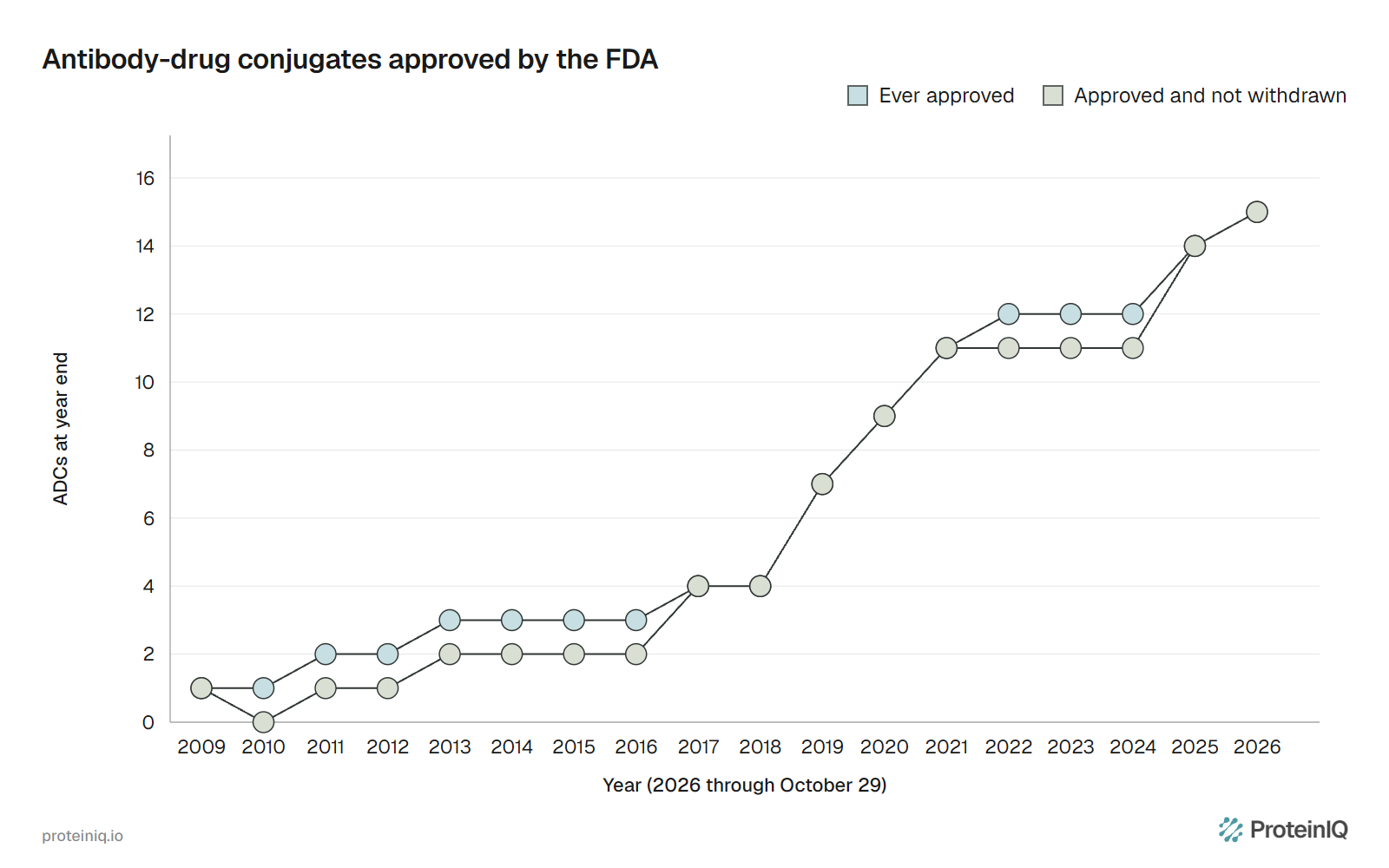
The FDA has approved 15 antibody-drug conjugates (ADCs), and as of October 29, 2026 all 15 hold an active license. Two of them were withdrawn from the US market and later approved again: Mylotarg, first approved in 2000, and Blenrep, first approved in 2020. Counting approvals in the European Union and China as well, 21 different ADCs are approved somewhere in those three markets.
Published counts range from 11 to 23, and most are right by their own rules. Eleven was the number on the US market from late 2022 until Blenrep returned in October 2025. Twenty-three adds a protein-toxin conjugate and a Japan-only product to the worldwide total. Below are the full list, the rules behind each number and a downloadable dataset.
How many ADCs has the FDA approved?
An ADC is a monoclonal antibody chemically linked to a small, highly toxic drug. The antibody finds cells that carry its target, the cell swallows the complex, and the linker releases the drug inside. Fifteen distinct ADCs have reached the US market this way, each counted once even when it was approved twice.[1][2]
The FDA approved pivekimab sunirine (Decnupaz) on May 27, 2026, the only new ADC so far in 2026.[3] No ADC appears among the FDA's later novel approvals or in the October 2026 Purple Book release, which runs to October 27.[4][1]
| ADC (brand) | Target | Payload | Linker | First FDA approval | First indication |
|---|---|---|---|---|---|
| Gemtuzumab ozogamicin (Mylotarg) | CD33 | Calicheamicin | Hydrazone, cleavable | May 2000; again September 2017 | Relapsed acute myeloid leukemia |
| Brentuximab vedotin (Adcetris) | CD30 | MMAE | Valine-citrulline, cleavable | August 2011 | Hodgkin and anaplastic large cell lymphoma |
| Ado-trastuzumab emtansine (Kadcyla) | HER2 | DM1 | Thioether, non-cleavable | February 2013 | HER2-positive metastatic breast cancer |
| Inotuzumab ozogamicin (Besponsa) | CD22 | Calicheamicin | Hydrazone, cleavable | August 2017 | Relapsed B-cell acute lymphoblastic leukemia |
| Polatuzumab vedotin (Polivy) | CD79b | MMAE | Valine-citrulline, cleavable | June 2019 | Relapsed diffuse large B-cell lymphoma |
| Enfortumab vedotin (Padcev) | Nectin-4 | MMAE | Valine-citrulline, cleavable | December 2019 | Advanced urothelial cancer |
| Fam-trastuzumab deruxtecan (Enhertu) | HER2 | DXd | Tetrapeptide, cleavable | December 2019 | HER2-positive metastatic breast cancer |
| Sacituzumab govitecan (Trodelvy) | TROP2 | SN-38 | Hydrolysable CL2A, cleavable | April 2020 | Metastatic triple-negative breast cancer |
| Belantamab mafodotin (Blenrep) | BCMA | MMAF | Maleimidocaproyl, non-cleavable | August 2020; again October 2025 | Relapsed multiple myeloma |
| Loncastuximab tesirine (Zynlonta) | CD19 | PBD dimer | Valine-alanine, cleavable | April 2021 | Relapsed large B-cell lymphoma |
| Tisotumab vedotin (Tivdak) | Tissue factor | MMAE | Valine-citrulline, cleavable | September 2021 | Recurrent or metastatic cervical cancer |
| Mirvetuximab soravtansine (Elahere) | Folate receptor alpha | DM4 | Disulfide, cleavable | November 2022 | Platinum-resistant ovarian cancer |
| Datopotamab deruxtecan (Datroway) | TROP2 | DXd | Tetrapeptide, cleavable | January 2025 | HR-positive, HER2-negative breast cancer |
| Telisotuzumab vedotin (Emrelis) | c-Met | MMAE | Valine-citrulline, cleavable | May 2025 | c-Met-high nonsquamous lung cancer |
| Pivekimab sunirine (Decnupaz) | CD123 | IGN pseudodimer | Peptide, cleavable | May 2026 | Blastic plasmacytoid dendritic cell neoplasm |
Fourteen of the 15 were approved through the end of 2025, the same number of ADCs that William Strohl counts in his annual review of FDA-approved antibodies.[7] The count also matches the ADC row in our Purple Book count of FDA-approved monoclonal antibodies, where ADCs are one format among 159 antibody products.
Every approved ADC so far treats cancer. Eight of the 15 first indications are solid tumors, led by four in breast cancer, and seven are leukemias, lymphomas or myeloma. Most entered as later-line treatments for patients whose disease had come back after standard therapy, then moved earlier in treatment as trials matured.
Small doses of a potent drug also make ADCs some of the most expensive antibodies by weight. Medicare's October 2026 payment limits work out to a median of $146,140 per gram of ADC, more than six times the $22,263 median for conventional antibodies.[8]
Why do published ADC counts disagree?
Most published totals are right by their own rules. They disagree because withdrawn products drop in and out, because some lists add conjugates that carry a protein toxin, a radioactive atom or a light-activated dye instead of a drug, and because "approved" can mean the FDA alone or any major regulator.
| Count | What it counts |
|---|---|
| 11 | ADCs on the US market at the end of 2022, 2023 or 2024, after Blenrep's withdrawal |
| 12 | ADCs ever approved by the FDA at the end of 2022, 2023 or 2024 |
| 14 | ADCs approved by the FDA through December 2025 |
| 15 | ADC molecules ever approved by the FDA, all licensed today |
| 16 | The 15, plus the immunotoxin Lumoxiti, or with Mylotarg's two approvals counted separately |
| 21 | ADC molecules approved by the FDA, the EMA or China's NMPA |
| 23 | The 21, plus Lumoxiti and the Japan-only photoimmunoconjugate Akalux |
The smallest numbers are dated, not wrong. A review written in 2023 or 2024 that reports 11 or 12 approved ADCs gives the US-market and ever-approved counts of its day; three more have been approved since and Blenrep has returned.
Moxetumomab pasudotox (Lumoxiti), approved in 2018 for hairy cell leukemia, explains most counts of 16. It joins an antibody fragment to a fragment of a bacterial toxin as one recombinant protein, so nothing is chemically conjugated and its payload is a protein, not a drug. AstraZeneca withdrew it from the US market in 2023 because few patients received it.[11] We list it in the dataset but leave it out of the ADC count.
The worldwide total of 23 that circulates on vendor pages counts withdrawn products and approvals in Japan.[9] It equals our 21 plus Lumoxiti and cetuximab sarotalocan (Akalux), an antibody carrying a dye that kills cancer cells only when activated by laser light, approved only in Japan in 2020. Radioimmunoconjugates, such as the yttrium-90 antibody ibritumomab tiuxetan (Zevalin), deliver radiation rather than a drug and are left out by every count above.
How do withdrawn and re-approved ADCs count?
A withdrawn ADC still counts as approved. We count each molecule once, at its first approval, so Mylotarg and Blenrep each add one to the total of 15 whatever happened to their licenses later.
Mylotarg shows why the rule matters. The FDA gave it accelerated approval in May 2000 for older patients with relapsed acute myeloid leukemia, and Pfizer withdrew it in October 2010 after the agreed confirmatory trial failed.[2] For the rest of 2010 the United States had no approved ADC at all. Mylotarg came back in September 2017 at a lower dose and under a new license.[1]
Blenrep followed the same path faster. It was the first anti-BCMA therapy for multiple myeloma, approved in August 2020, and GSK began withdrawing it at the FDA's request in November 2022 after the DREAMM-3 confirmatory trial missed its goal.[12] On October 23, 2025, the FDA approved it again, now combined with bortezomib and dexamethasone after at least two earlier lines of treatment.[5]
The Purple Book shows both stories in its records: Blenrep's 2020 license is revoked and a second license is active, while Mylotarg's 2000 approval, made under a new drug application rather than a biologics license, does not appear at all.[1]
Counting the re-approvals separately would give 17 approval events for 15 molecules. That is a count of regulatory decisions, not of medicines.
Which targets and payloads do approved ADCs use?
The 15 FDA-approved ADCs bind 13 different targets. Only HER2 and TROP2 appear twice: HER2 in Kadcyla and Enhertu, TROP2 in Trodelvy and Datroway. Seven targets sit on blood cancers, from CD33 on myeloid leukemia cells to CD123 on the dendritic cell neoplasm treated by Decnupaz.[6]
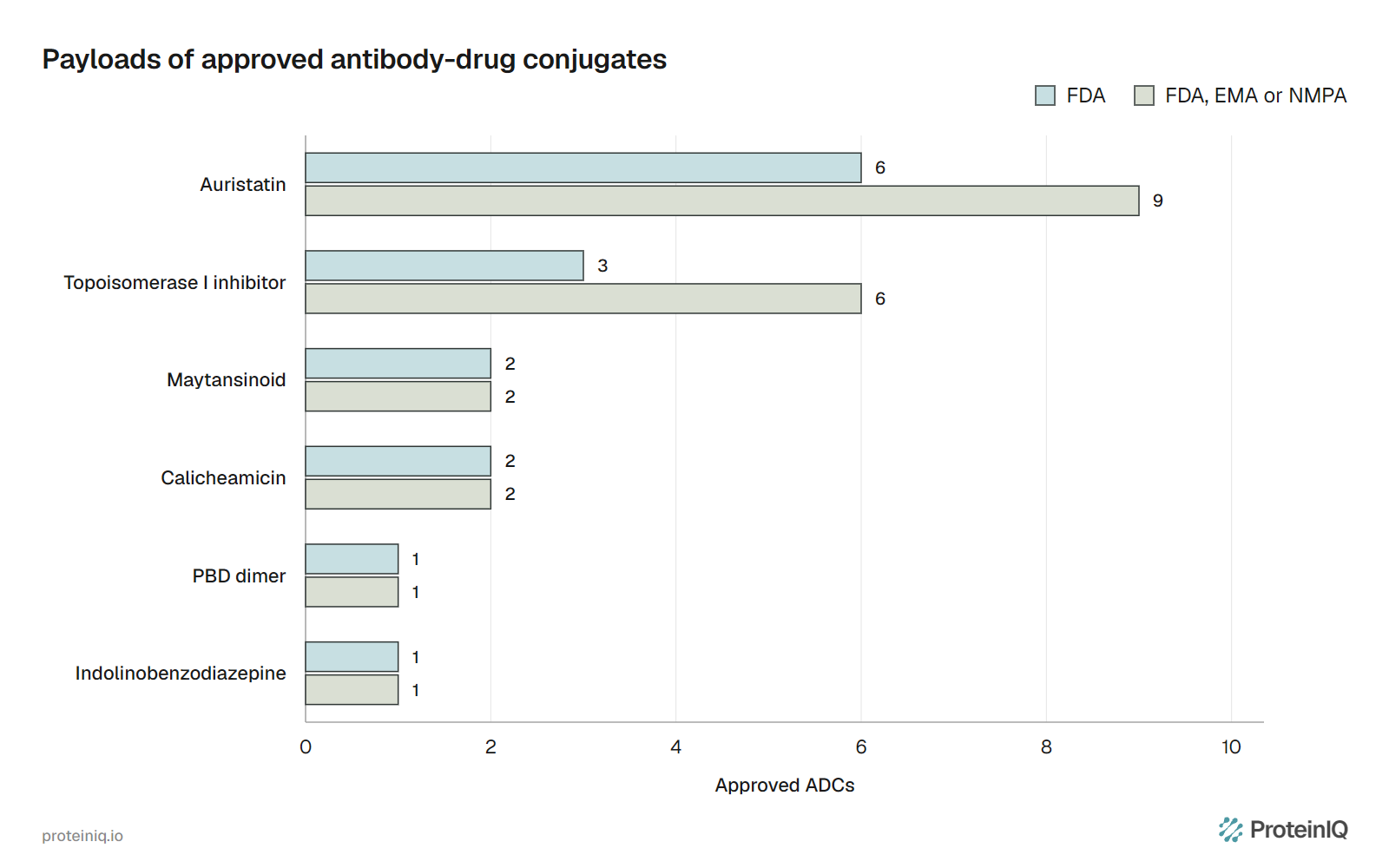
Payloads are less varied. Six of the 15 carry an auristatin, a synthetic version of a sea-hare toxin that stops cell division by blocking microtubules; five of those six use the same one, MMAE. Two carry a maytansinoid, another microtubule blocker. The rest damage DNA directly: three topoisomerase I inhibitors, two calicheamicins, one pyrrolobenzodiazepine (PBD) dimer and one indolinobenzodiazepine (IGN).[6]
The newest approvals lean toward topoisomerase I inhibitors. Enhertu carries about eight molecules of its payload on each antibody, against three or four for most older ADCs, and the released drug can cross into neighboring tumor cells. Datroway and three of the six China-only ADCs use the same payload class.
Linkers have shifted in one direction. Thirteen of the 15 FDA-approved ADCs use a cleavable linker that releases the drug inside the cell, through enzymes, acidity or reduction; only Kadcyla and Blenrep use non-cleavable linkers, which free the drug only when the antibody itself is digested.[6]
Where the drug sits on the antibody is an antibody engineering decision. Conventional chemistry attaches it to exposed lysines or cysteines, which the SASA calculator can rank by solvent exposure on a model from ABodyBuilder3, while site-specific designs build fixed attachment points into the sequence. Hydrophobic payloads also push antibodies toward aggregation, so developability screens such as TAP2 and Aggrescan3D are worth running on the antibody early.
How many ADCs are approved worldwide?
Across the FDA, the European Medicines Agency and China's National Medical Products Administration (NMPA), 21 different ADCs are approved. Thirteen are authorized in the European Union, all of them also approved by the FDA, and six are approved only in China.[10]
Europe has every FDA-approved ADC except the two newest, Emrelis and Decnupaz. Its history has the same twists. The EU refused Mylotarg in 2008 and authorized it in 2018, and Blenrep's conditional authorization expired in February 2024 before a new one was granted in July 2025.[10]
China has become the second source of new ADCs. Its first homegrown ADC, disitamab vedotin, was approved in June 2021, and five more have followed since November 2024, including the first approved bispecific ADC.[13][14][15][16][17]
| ADC | Developer | Target | Payload | First NMPA approval | First indication |
|---|---|---|---|---|---|
| Disitamab vedotin | RemeGen | HER2 | MMAE | June 2021 | HER2-overexpressing gastric cancer |
| Sacituzumab tirumotecan | Kelun-Biotech | TROP2 | Belotecan derivative | November 2024 | Triple-negative breast cancer |
| Trastuzumab rezetecan | Hengrui | HER2 | Exatecan derivative | May 2025 | HER2-mutant non-small cell lung cancer |
| Trastuzumab botidotin | Kelun-Biotech | HER2 | Duostatin-5 (auristatin) | October 2025 | HER2-positive breast cancer |
| Becotatug vedotin | Lepu Biopharma | EGFR | MMAE | October 2025 | Nasopharyngeal carcinoma |
| Izalontamab brengitecan | SystImmune and Bristol Myers Squibb | EGFR and HER3 | Exatecan derivative | June 2026 | Nasopharyngeal carcinoma |
Three of the six target HER2, which brings the number of approved HER2 ADCs across the three regulators to five. Izalontamab brengitecan, approved on June 22, 2026, binds EGFR and HER3 at once, combining the bispecific antibody and ADC formats in one molecule.[17] We found no further first approval of an ADC in China between July and October 2026, but China's approvals are the least certain part of this count.
The pace has picked up everywhere. After Mylotarg in 2000, the FDA approved no other ADC until 2011; it approved eight from 2019 through 2022 and three more since the start of 2025. With six ADCs approved in China alone, the worldwide count already runs well ahead of the FDA's.
Methodology
We listed every ADC molecule approved by the FDA from the FDA Purple Book database download for October 2026, published October 28, 2026, whose latest approval is dated October 27, 2026, and checked it against the FDA's list of novel drug approvals for 2026.[1][4]
Mylotarg's 2000 approval and 2010 withdrawal, which predate the Purple Book record, come from the sponsor's 2017 advisory committee briefing document.[2] Targets, payloads, linkers and first indications come from each product's US prescribing information.[6]
An ADC here is an antibody or antibody fragment chemically linked to a small-molecule drug. Immunotoxins, radioimmunoconjugates and photoimmunoconjugates are recorded as related conjugates but not counted. Conjugates without an antibody, such as peptide-drug conjugates and radioligands like lutetium-177 vipivotide tetraxetan (Pluvicto), are outside the scope. Each molecule counts once, at its first approval, whether or not it was later withdrawn.
The European count comes from the EMA medicines report generated on October 29, 2026, and includes expired and withdrawn authorizations.[10] China-only ADCs come from company announcements, stock exchange filings and the annual mAbs review of antibody approvals. The worldwide count of 21 is the number of distinct ADC molecules approved by at least one of the FDA, the EMA and the NMPA.
The full dataset lists each ADC's sponsor, target, payload, payload class, linker, first approval date, FDA license numbers, US and EU status, and indication at first approval, plus the four related conjugates that are not counted. A summary file holds the counts by year, target, payload class and linker type. The script that builds both checks every FDA date and license status against the Purple Book file and every EU date against the EMA report.
The data are free to reuse under CC BY 4.0 with credit to ProteinIQ. They were last checked on October 29, 2026, and we recheck them every quarter.