What is antibody engineering? Techniques, formats, and computational workflows
Antibody engineering modifies antibody sequences and structures — CDRs, frameworks, and Fc regions — to improve binding, reduce immunogenicity, tune effector functions, and create formats such as bispecific antibodies and ADCs.
TL;DR
- Antibody engineering modifies antibody sequences and structures on purpose: tuning CDRs for binding, reshaping frameworks and Fc regions to lower immunogenicity or change effector function, and reformatting molecules into Fabs, scFvs, nanobodies, bispecifics, and ADCs.
- The field started with hybridoma technology in 1975; chimeric antibodies (1984), CDR grafting (1986), and phage display (1990) turned antibodies from immune products into engineerable proteins.
- More than 200 antibody therapeutics are marketed worldwide, and engineered formats such as bispecifics and ADCs make up a growing share of new approvals.
- Modern antibody engineering pairs wet-lab methods with computational workflows: sequence numbering and germline analysis, structure prediction, antibody-antigen docking, AI-driven CDR design, in silico humanization, and developability screening.
Antibody engineering is the deliberate modification of antibody sequences and structures to give these proteins properties they do not have naturally: higher affinity for a chosen target, lower immunogenicity in patients, tuned effector functions, longer or shorter persistence in blood, and entirely new architectures such as bispecific antibodies, antibody-drug conjugates (ADCs), and single-domain binders. It is the discipline that converted antibodies from serum-derived reagents into the dominant class of biologic drugs — more than 200 antibody therapeutics are now marketed worldwide.[7]
The practice has two layers today. The wet-lab layer builds and screens real molecules: hybridomas, display libraries, B-cell sorting, and expression systems. The computational layer, which has grown rapidly since roughly 2020, designs and prioritizes molecules before they are ever synthesized: numbering and germline analysis, structure prediction, antibody–antigen docking, generative CDR design, in silico humanization, and developability screening. This guide covers both, with emphasis on how the two connect.
How an antibody is built: the parts engineers change
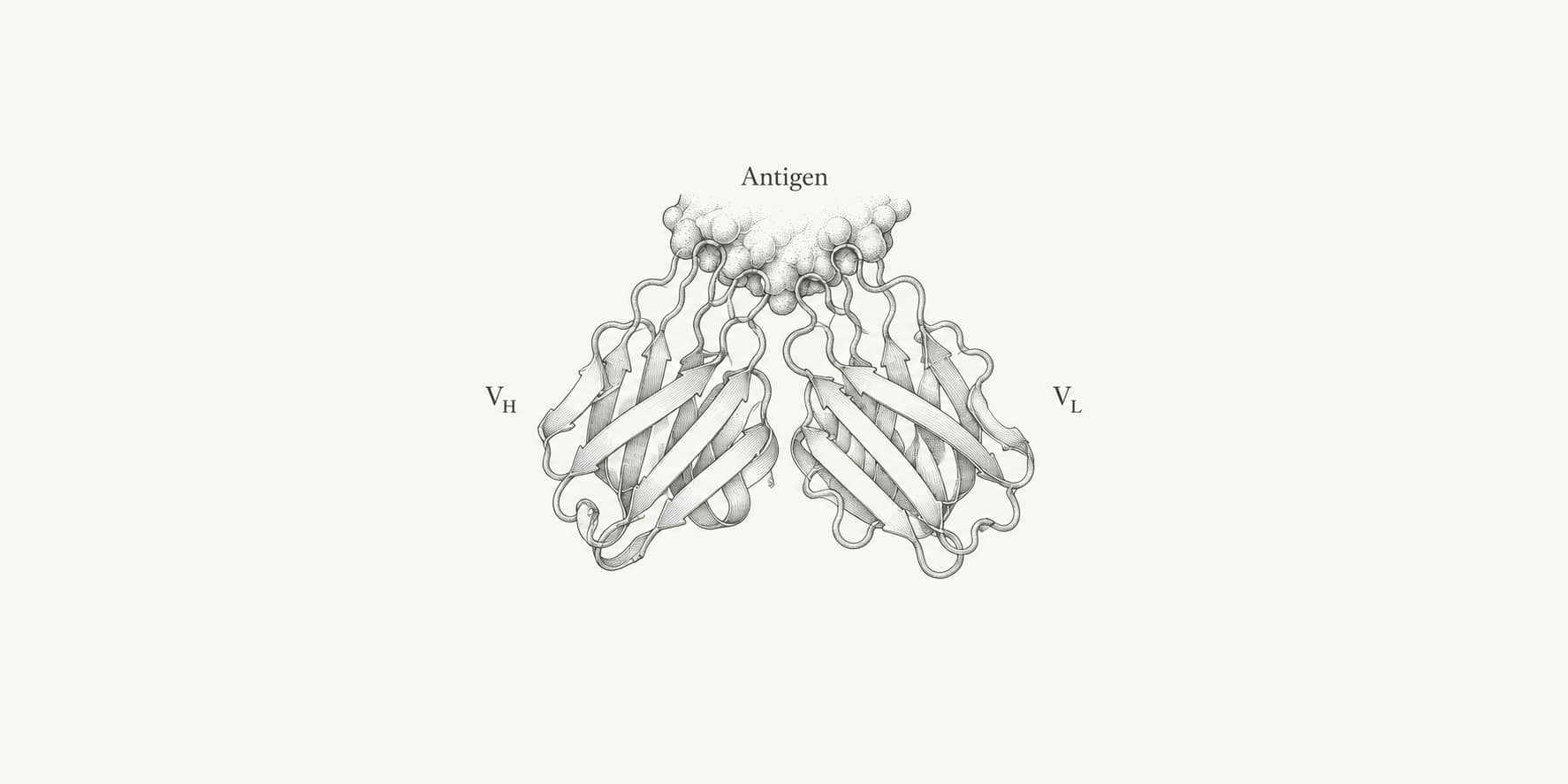
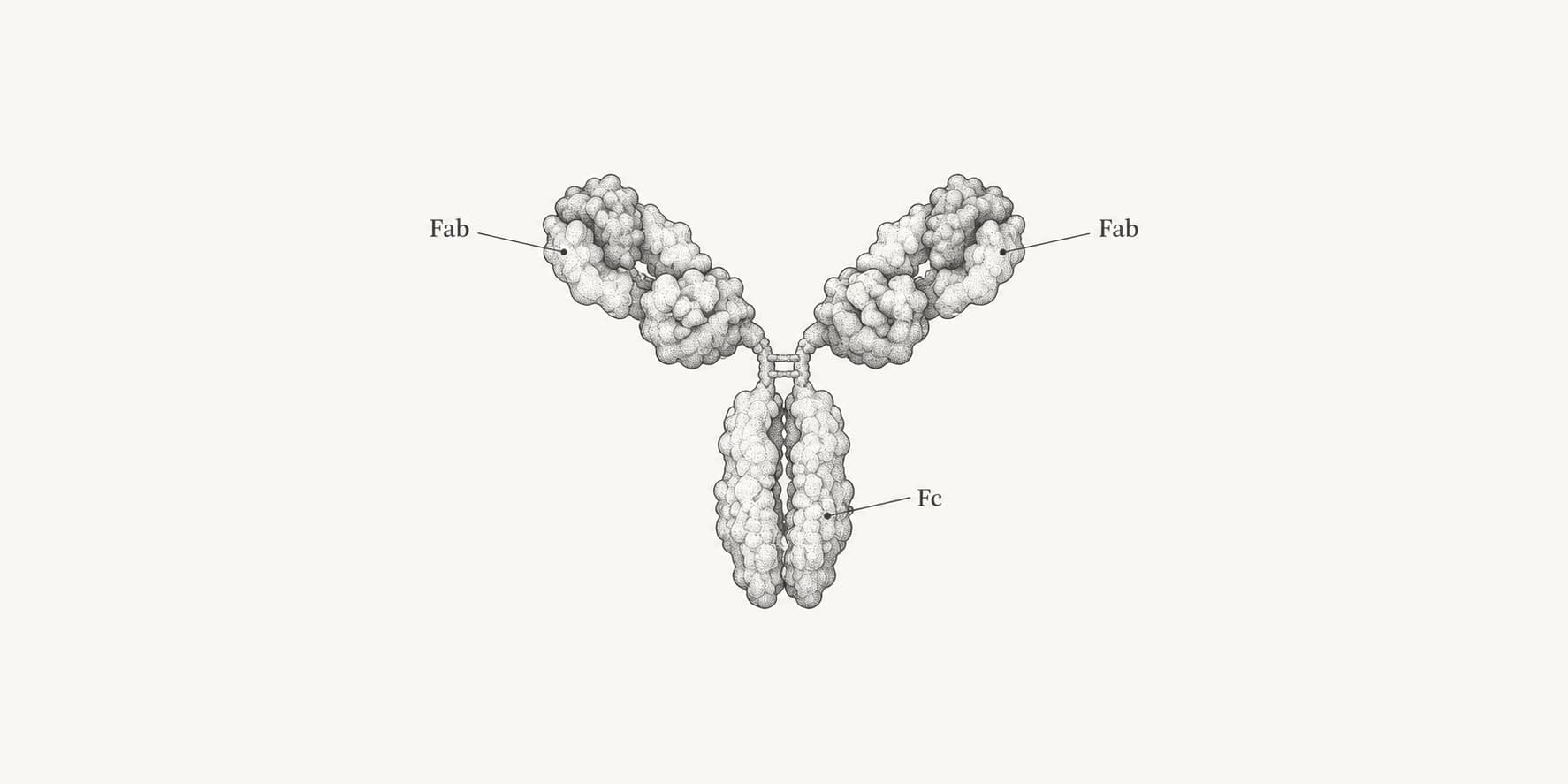
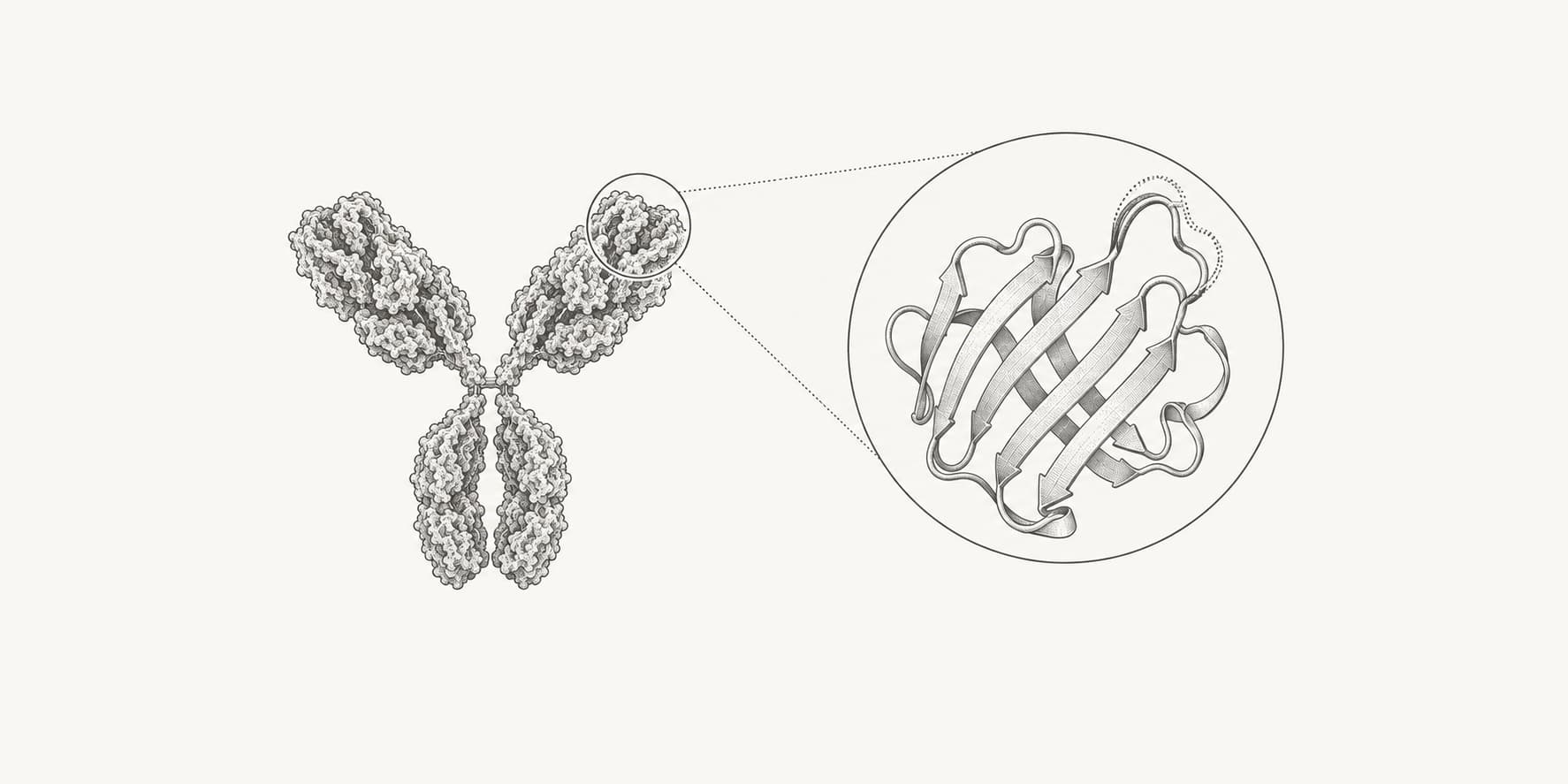
A standard immunoglobulin G (IgG) antibody is a ~150 kDa Y-shaped protein of four chains: two heavy chains and two light chains. Each chain has a variable region at the tip of the arms and a constant region forming the stem and lower arms. The variable regions of one heavy chain (VH) and one light chain (VL) pair to form the antigen-binding site; everything below is the constant region that recruits immune functions. Engineered fragments scale down from there — see our guide to antibody molecular weight for per-format numbers.
Three structural features matter most for engineering:
- CDRs (complementarity-determining regions) — six hypervariable loops (three per chain, usually called H1–H3 and L1–L3) that make most of the physical contact with the antigen. Loop H3 is the most variable and does the largest share of binding in most antibodies.
- Framework regions — the conserved beta-sheet scaffold that holds the CDR loops in position. Mutations here can stabilize the binding site or change its geometry without touching the paratope directly.
- Constant region and Fc — the CH2/CH3 domains that engage Fcγ receptors (FcγR), complement C1q, and the neonatal Fc receptor (FcRn). This is where effector function, half-life, and much of the safety profile are decided.
| Region | Natural role | What engineering targets there |
|---|---|---|
| VH + VL domains | Antigen recognition | Affinity, specificity, cross-reactivity, de novo binding sites |
| Six CDR loops | Direct antigen contact | Affinity maturation, CDR grafting during humanization, epitope focusing |
| Frameworks | Structural scaffold | Stability, correct loop conformations, humanness |
| Hinge | Flexibility between Fab arms | Protease resistance, effector spacing, format switching |
| CH2/CH3 (Fc) | Immune recruitment, recycling | ADCC/CDC tuning, half-life extension or ablation, Fc silencing |
Human antibodies use five heavy-chain classes (IgG, IgM, IgA, IgD, IgE), but therapeutics overwhelmingly use IgG scaffolds because of their long serum half-life and well-characterized manufacturing. Because natural diversity is generated by V(D)J recombination plus somatic hypermutation, every engineered antibody is ultimately a recombination of the same parts catalog: variable domains, constant domains, and linkers.
What antibody engineering sets out to change
Every project reduces to one or more of six goals:
| Goal | Where it acts | Standard approaches |
|---|---|---|
| Binding affinity and specificity | CDRs, VH/VL interface | Affinity maturation, CDR redesign, library selection |
| Low immunogenicity | Variable region, frameworks | Humanization, humanness scoring, germline matching |
| Effector function | Fc, glycans | Fc mutations that raise or silence ADCC/CDC, glycoengineering |
| Pharmacokinetics | Fc–FcRn interface | Half-life extension (e.g., pH-dependent binding mutants) or rapid clearance by design |
| Format and valency | Overall architecture | Fab, scFv, diabody, VHH, bispecific formats, ADC conjugation sites |
| Manufacturability | Whole sequence | Liability removal, stability and solubility screening (developability assessment) |
The order matters in practice. Discovery usually delivers a binder with acceptable affinity; engineering then makes it viable as a drug — human enough not to be rejected, stable enough to manufacture, formatted correctly for its mechanism, and free of sequence liabilities such as unpaired cysteines or deamidation motifs in critical positions.
Core antibody engineering techniques
Humanization
Early monoclonal antibodies were made in mice — Köhler and Milstein's hybridoma technique of fusing antibody-producing cells with myeloma lines made unlimited monoclonal production possible[1], but patients responded to the mouse products as foreign proteins. The historical fixes came in steps: chimeric antibodies replaced mouse constant regions with human ones[2], and CDR grafting went further by transplanting only the six mouse complementarity-determining regions into a human framework[3]. Later refinements — framework back-mutation, surface resurfacing — preserved affinity while making the molecule progressively more human.
Modern humanization is largely computational. Platforms such as BioPhi generate humanized variants using language models trained on observed human repertoires and score "humanness" against those same datasets[10], while tools like Humatch select optimal human acceptor genes and minimize the number of non-human residues retained. These methods turn a weeks-long expert exercise into an afternoon of scoring and ranking — though binding must still be confirmed experimentally for every candidate.
Affinity maturation
Natural affinity maturation happens through somatic hypermutation and selection in germinal centers. Engineered versions introduce diversity deliberately — error-prone PCR, DNA shuffling, chain shuffling, or focused CDR mutagenesis — and then select tighter binders by phage or yeast display[4][5]. Computational affinity maturation predicts which substitutions will improve binding before any library is built, either with structure-based energy calculations or with protein-language-model likelihood scores that rank candidate mutations across whole CDRs. Typical therapeutic candidates sit in the low-nanomolar range, but higher affinity is not always better: very slow off-rates can hurt tissue penetration ("binding-site barrier") and tumor selectivity strategies sometimes aim for moderate affinity on purpose.
Fc engineering
The Fc region decides what the antibody does after it binds. Point-mutation panels can raise FcγRIIIa engagement for stronger NK-cell killing (ADCC), silence Fc entirely for indications where inflammation is harmful, or extend serum half-life through pH-dependent FcRn binding. Glycosylation adds another control layer: afucosylated antibodies bind activating FcγRs substantially more strongly than fucosylated ones. Fc engineering also underlies several approved format families — Fc-fusion proteins, Fc-silent bispecific scaffolds, and fragments such as efgartigimod's Fc fragment that works by saturating FcRn.
Format engineering: fragments, multispecifics, and ADCs
Once binding domains exist, architecture becomes a design variable:
- Fab — complete light chain plus VH–CH1; monovalent, no Fc, ~50 kDa
- scFv — VH and VL joined by a flexible peptide linker; smallest common format that keeps both variable domains
- VHH (nanobody) — camelid single-domain binder, ~15 kDa, accesses clefts and pockets that paired VH/VL cannot
- Diabodies and tandem formats — short linkers force cross-chain pairing, creating compact bispecific architectures
- Bispecific antibodies — two binding specificities in one molecule, spanning IgG-like formats (CrossMab, knobs-into-holes) and fragment-based formats (BiTEs, trispecifics)
- ADCs — antibody plus cytotoxic payload through engineered linker chemistry, increasingly with site-specific conjugation points chosen in the sequence
Format choice trades off size versus half-life, valency versus selectivity, and manufacturability versus mechanism. Fragment formats clear quickly and penetrate tissue well; IgG formats persist for weeks and recruit immunity.
Developability assessment
Developability asks whether a sequence that binds well will also express, fold, stay soluble, avoid aggregation, and survive manufacturing. A landmark survey of clinical-stage antibodies characterized 137 candidates across dozens of biophysical assays and showed that clinical molecules cluster around favorable property ranges[8]. In practice, screening now happens on the sequence before the molecule exists: liability scans (deamidation, isomerization, oxidation, unpaired cysteine, N-glycosylation motifs), polyspecificity predictions, aggregation-prone region detection, and thermodynamic-stability estimates. Candidates that fail early filters get engineered again rather than discovered to fail in process development.
Where engineered antibodies are used
Therapeutics dominate. Oncology uses engineered antibodies for direct tumor blocking (checkpoint inhibitors), delivery (ADCs), and cell redirection (bispecifics that bridge T cells to tumor antigens). Autoimmune and inflammatory disease relies heavily on Fc-engineered molecules that deplete or modulate immune cells, and infectious-disease programs — palivizumab for RSV, the SARS-CoV-2 antibody campaigns — show how fast engineering responds once a target is known[6].
The regulatory footprint keeps expanding: the FDA had approved 169 antibody-based biologics through the end of 2025, including 113 conventional IgGs, 15 bispecifics, and 14 ADCs — see our breakdown of FDA-approved monoclonal antibodies. Diagnostics and research reagents form a second, larger-by-volume market: ELISA pairs, flow-cytometry reagents, and intrabodies all depend on the same engineering toolkit for affinity, epitope tolerance, and format.
Computational antibody engineering workflows
The computational layer did not replace the wet lab — it changed where decisions happen. Instead of building thousands of variants to find the handful worth testing, teams now compute rankings first and synthesize far fewer molecules. A representative end-to-end workflow:
| Stage | Question answered | Typical tools |
|---|---|---|
| Sequence analysis and numbering | Which loops are which? What germline did this come from? Is the pair human-like? | ANARCI, ANARCII, IgBLAST, AbLang-2 |
| Structure prediction | What do the variable domains look like? Where are the CDR loops? | ABodyBuilder3, ImmuneBuilder, Boltz-2 |
| Epitope and paratope prediction | Where on the target should we bind? What surface does our antibody present? | ParaSurf, ScanNet |
| Antibody–antigen docking | How do antibody and antigen engage? Is the pose consistent with data? | HADDOCK3, LightDock, co-folding models |
| De novo design and optimization | What CDR sequences might bind this epitope? Which mutations improve affinity? | RFantibody, DiffAb, IgGM, AntiFold, IgDesign |
| Humanization and humanness | Can this be made human without losing binding? | BioPhi, Humatch |
| Developability screening | Will this sequence manufacture and behave in vivo? | Property and liability calculators, solubility and stability tools |
Numbering is the quiet foundation of everything above. Schemes such as Kabat, Chothia, and IMGT assign each residue in a variable domain a standardized position so that CDR boundaries, mutations, and germline assignments mean the same thing across papers, databases, and pipelines[9]. Every serious antibody workflow starts by running sequences through a numbering tool — ANARCI remains the standard reference implementation, and ANARCII extends coverage to shark VNAR domains and can renumber structures directly.
On the design side, the shift has been decisive. Diffusion-based pipelines such as RFantibody generate antibody variable domains against user-specified epitopes, and the method reported experimentally validated binders designed entirely from a target structure[11]. Structure-prediction cofolding models including Boltz-2 estimate whether designed complexes actually hold together. Language models trained on antibody repertoires — AbLang-2 for sequence likelihood, AntiFold for inverse folding on IMGT-numbered structures — rank mutations by how "antibody-like" and compatible they are. And zero-shot platforms such as Chai-2 have reported double-digit hit rates for antibodies designed against novel targets without prior binders — we cover the benchmarks in our Chai-2 explainer.
For a mapped product view, ProteinIQ's antibody engineering platform organizes these stages into connected workflows — from antibody design and structure prediction through antibody–antigen docking, humanization review, and candidate triage — so each stage hands its outputs to the next instead of living in separate scripts.
Limitations and caveats
Computational antibody engineering is powerful and imperfect. Four caveats keep projects honest:
- Predictions require experimental validation. Every computed structure, pose, affinity delta, and humanness score is a hypothesis until SPR/BLI kinetics, expression data, or functional assays confirm it. Even the strongest de novo pipelines pair designs with display screening and biophysical validation[11].
- Long CDR-H3 loops remain hard. The most important loop is also the least constrained by templates and hardest for predictors; confidence drops sharply for unusual loop lengths and geometries, so treat per-residue confidence metrics as part of the result, not decoration.
- Humanness scores are not immunogenicity verdicts. Repertoire-based humanness correlates with reduced risk, but anti-drug responses depend on the whole molecule, the patient, the dose, and the indication. In silico humanization lowers risk; it does not eliminate it[10].
- Affinity and developability pull against each other. Maturation can introduce aggregation-prone patches, new liabilities, or polyspecificity. Mature candidates need re-screening after every optimization round.
None of these are reasons to skip computation. They are reasons to run computation and experiments as a closed loop, letting each side prune the other's search space.
Antibody engineering tools on ProteinIQ
ProteinIQ runs the established tools for each stage of the workflow above, with the original algorithms and defaults intact:
Sequence analysis and numbering
- ANARCI — canonical antibody/TCR numbering in IMGT, Kabat, Chothia, and other schemes, with germline assignment
- ANARCII — language-model numbering for antibody, TCR, and VNAR sequences, including direct PDB/mmCIF renumbering
- IgBLAST — V/D/J gene assignment, CDR delineation, and rearrangement analysis
- AbLang-2 — antibody language model for residue likelihood scoring and embeddings
Structure prediction and complex modeling
- ABodyBuilder3 — fast paired VH/VL structure prediction with per-residue confidence
- ImmuneBuilder — antibody, nanobody, and TCR structure prediction
- Boltz-2 — cofolding and binding-affinity prediction for complexes
Epitope, paratope, and docking
- ParaSurf and ScanNet — paratope and epitope-region prediction from structure
- HADDOCK3 and LightDock — data-driven and flexible protein–protein docking
Design, optimization, and humanization
- RFantibody — de novo antibody and nanobody binder generation against specified epitopes
- DiffAb, IgGM, and IgDesign — CDR design, affinity maturation, and sequence generation on antibody–antigen complexes
- AntiFold — inverse folding scored on IMGT-numbered variable domains
- BoltzGen and mBER — generative binder design, including nanobody scaffolds
- BioPhi — Sapiens humanization and OASis humanness scoring
- Humatch — human V-gene selection and paired-chain humanization
Ready-to-run multi-tool pipelines — numbering audits, humanization review, developability panels, and de novo nanobody design — are available as workflow templates from the antibody engineering solution page.
Frequently asked questions
What does antibody engineering actually modify?
Primarily amino-acid sequences: CDR loops to change binding, framework residues to fix stability and loop geometry, Fc and hinge residues to retune effector function and half-life, and junction/linker regions to build new formats such as scFvs, bispecifics, and conjugation-ready ADCs. Glycosylation is engineered indirectly through both sequence (mutation of Fc glycan-interacting residues) and production-cell choice.
How is antibody engineering different from antibody discovery?
Discovery finds an initial binder against a target — via immunization, display libraries, or single B cells. Engineering improves and reformats that binder into a viable drug: humanizing, maturing affinity, tuning the Fc, removing liabilities, and switching formats. In practice the boundary blurs, because de novo computational design generates binders and optimizes them in the same pipeline.
Which numbering scheme should I use: Kabat, Chothia, or IMGT?
All three define antibody positions; they disagree mainly at CDR boundary definitions. IMGT is the most widely adopted current standard and aligns well across species; Kabat is the historical default still common in older literature and patent claims; Chothia emphasizes structurally equivalent positions. Pick one scheme per project and state it explicitly — tools like ANARCI output all of them simultaneously.
Can AI really design antibodies from scratch?
Yes, with validation. Diffusion-based systems such as RFantibody have produced experimentally confirmed binders generated purely in silico against specified epitopes, and zero-shot platforms report meaningful hit rates against novel targets. Hit rates and affinities still vary by target class, and every designed molecule still passes through expression, binding measurement, and developability testing before it counts.
Does humanization always preserve binding?
No — that is the core trade-off. Replacing non-human residues with human ones can perturb CDR loop conformations and drop affinity, which is why classical CDR grafting included back-mutations to restore binding. Computational humanization reduces guesswork by scoring many variants, but each top candidate still needs binding confirmation.
What makes an antibody "developable"?
A developable sequence expresses well, folds stably, stays soluble at formulation concentrations, resists aggregation and chemical degradation, shows low polyspecificity, and tolerates manufacturing stresses. These properties correlate with measurable sequence and structure features, which is why developability screening now runs computationally on candidates before any cell line work.