How many bispecific antibodies are approved?
A checked list across the FDA, the EU, China and Japan

Matic Broz, PhD10 min
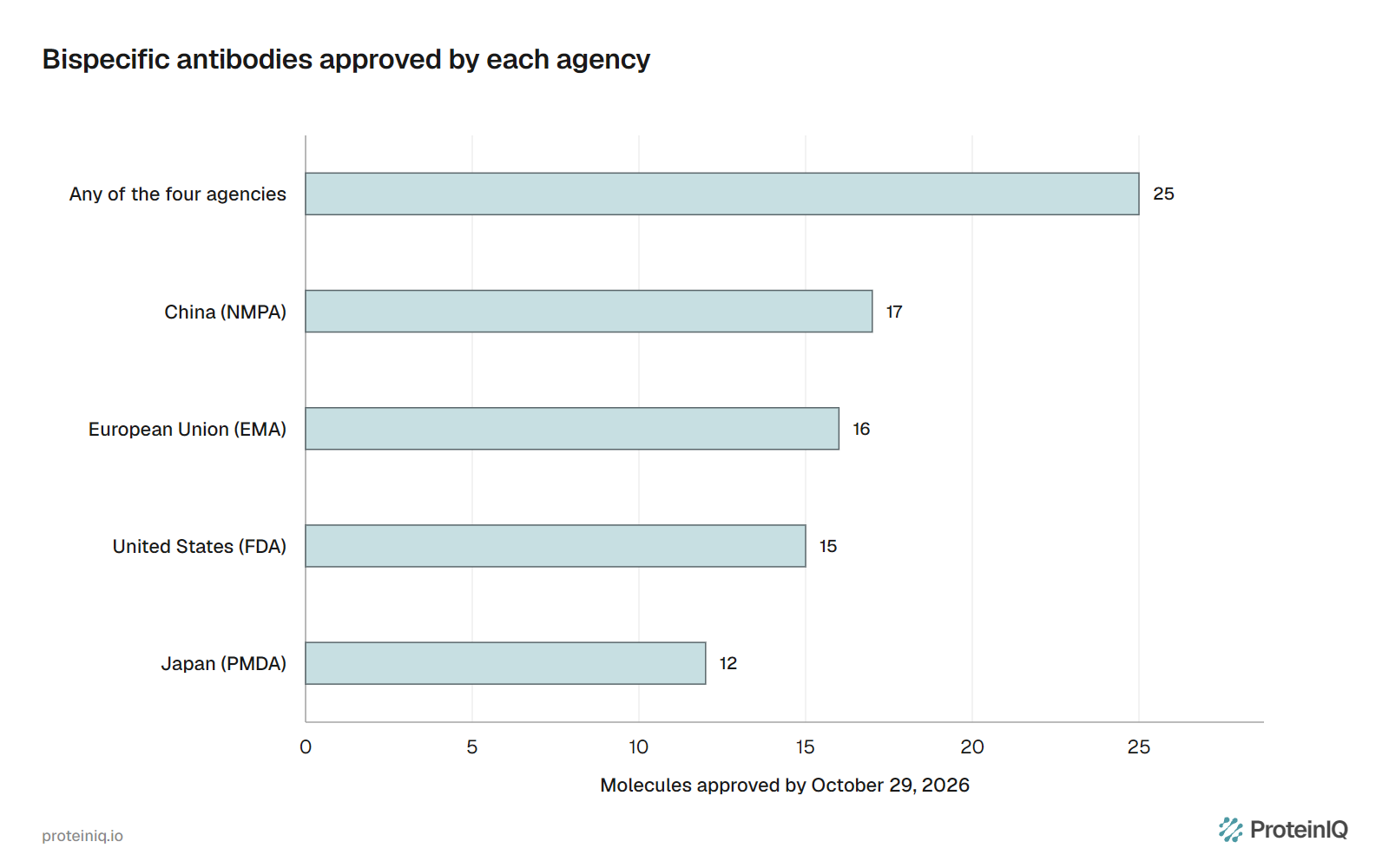
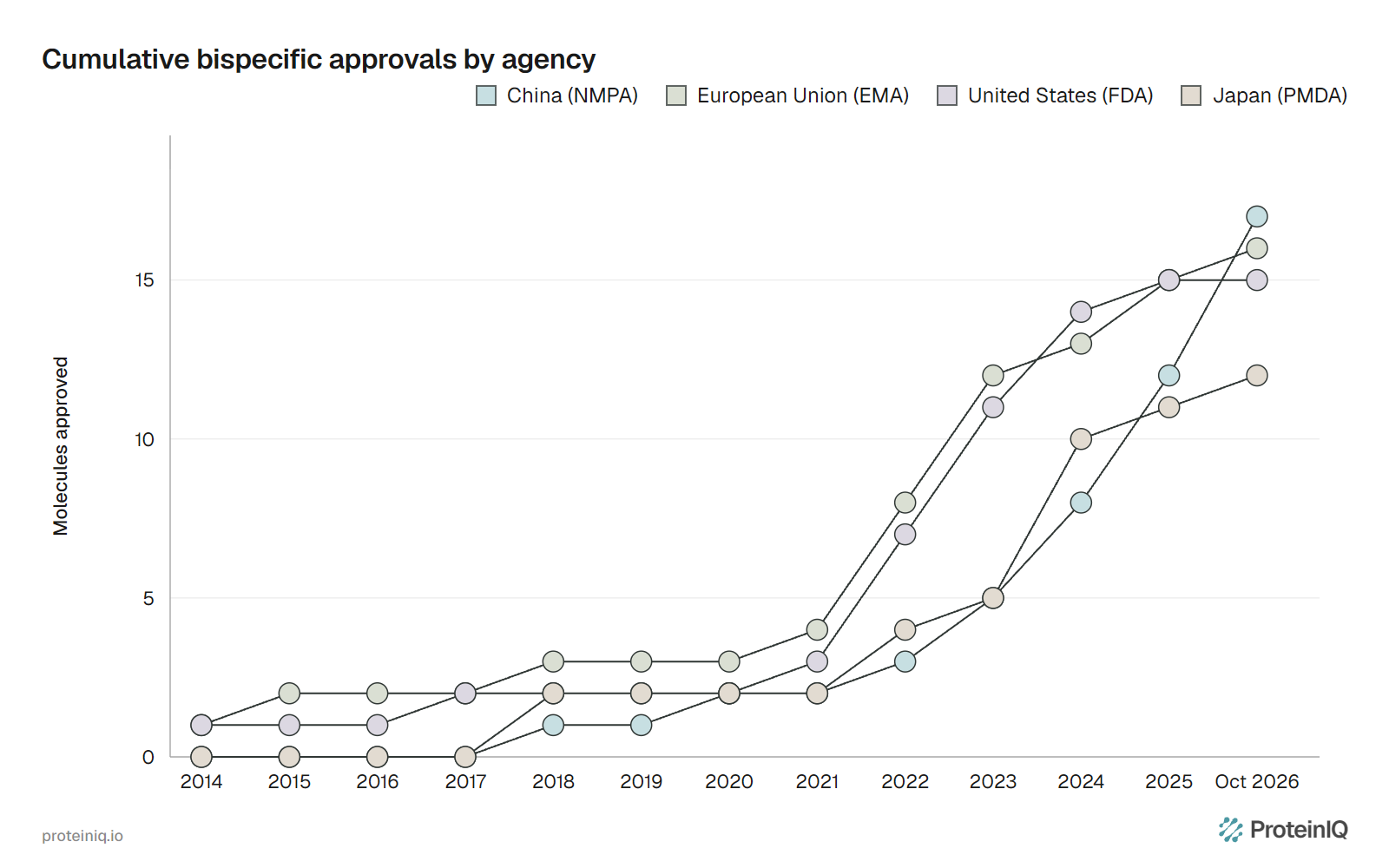
By our count of agency records, 25 bispecific antibodies had been approved by the US Food and Drug Administration (FDA), the European Union, China's National Medical Products Administration (NMPA) or Japan's Pharmaceuticals and Medical Devices Agency (PMDA) by October 29, 2026. The FDA had approved 15 of them, the EU 16, China 17 and Japan 12. Only nine are approved by all four.
Which of those numbers a reader needs depends on where they work. A doctor in Boston can choose from 15 bispecifics and one in Shanghai from 17, and six of the Chinese products are approved nowhere else. Published totals of 12, 15, 19 and 20 are mostly older or narrower versions of the same list.
How many bispecific antibodies are approved worldwide?
A bispecific antibody is a single engineered molecule with two different binding sites, either for two different targets or for two separate sites on one target. Ordinary monoclonal antibodies carry two copies of the same binding site.
The most complete published count comes from a cross-sectional study by Wang and colleagues, who found 20 bispecific antibodies approved by the FDA, the European Medicines Agency (EMA), NMPA and PMDA up to December 31, 2025.[1] We rebuilt that list from agency records and extended it to October 29, 2026. Our table gives exactly 20 molecules through 2025, and five more were approved in 2026.
The agencies overlap far less than their similar totals suggest. Nine molecules hold all four approvals, six of them T-cell engagers plus amivantamab, emicizumab and faricimab. Eleven are approved by only one agency: six in China, two each in the EU and Japan, and one in the United States.
| Molecule | Targets | Format | First approved | FDA | EU | China | Japan |
|---|---|---|---|---|---|---|---|
| Catumaxomab (Removab, Korjuny) | EpCAM × CD3 | IgG-like | April 2009, EU | No | 2009 | No | No |
| Blinatumomab (Blincyto) | CD19 × CD3 | BiTE | December 2014, FDA | 2014 | 2015 | 2020 | 2018 |
| Emicizumab (Hemlibra) | Factor IXa × factor X | IgG-like | November 2017, FDA | 2017 | 2018 | 2018 | 2018 |
| Amivantamab (Rybrevant) | EGFR × MET | IgG-like | May 2021, FDA | 2021 | 2021 | 2025 | 2024 |
| Tebentafusp (Kimmtrak) | gp100 peptide on HLA × CD3 | TCR fusion | January 2022, FDA | 2022 | 2022 | No | No |
| Faricimab (Vabysmo) | VEGF-A × angiopoietin-2 | IgG-like | January 2022, FDA | 2022 | 2022 | 2023 | 2022 |
| Mosunetuzumab (Lunsumio) | CD20 × CD3 | IgG-like | June 2022, EU | 2022 | 2022 | 2024 | 2024 |
| Cadonilimab | PD-1 × CTLA-4 | IgG-like | June 2022, China | No | No | 2022 | No |
| Teclistamab (Tecvayli) | BCMA × CD3 | IgG-like | August 2022, EU | 2022 | 2022 | 2024 | 2024 |
| Ozoralizumab (Nanozora) | TNF × albumin | Nanobody | September 2022, Japan | No | No | No | 2022 |
| Epcoritamab (Epkinly) | CD20 × CD3 | IgG-like | May 2023, FDA | 2023 | 2023 | No | 2023 |
| Glofitamab (Columvi) | CD20 × CD3 | IgG-like | June 2023, FDA | 2023 | 2023 | 2023 | No |
| Talquetamab (Talvey) | GPRC5D × CD3 | IgG-like | August 2023, FDA | 2023 | 2023 | 2025 | 2025 |
| Elranatamab (Elrexfio) | BCMA × CD3 | IgG-like | August 2023, FDA | 2023 | 2023 | 2025 | 2024 |
| Tarlatamab (Imdelltra) | DLL3 × CD3 | BiTE | May 2024, FDA | 2024 | 2026 | 2026 | 2024 |
| Ivonescimab | PD-1 × VEGF-A | IgG-like | May 2024, China | No | No | 2024 | No |
| Odronextamab (Ordspono) | CD20 × CD3 | IgG-like | August 2024, EU | No | 2024 | No | No |
| Zanidatamab (Ziihera) | Two sites on HER2 | IgG-like | November 2024, FDA | 2024 | 2025 | 2025 | No |
| Zenocutuzumab (Bizengri) | HER2 × HER3 | IgG-like | December 2024, FDA | 2024 | No | No | No |
| Linvoseltamab (Lynozyfic) | BCMA × CD3 | IgG-like | April 2025, EU | 2025 | 2025 | No | No |
| Anbenitamab | Two sites on HER2 | IgG-like | May 2026, China | No | No | 2026 | No |
| Izalontamab brengitecan | EGFR × HER3 | Bispecific ADC | June 2026, China | No | No | 2026 | No |
| Silevimig | Two sites on the rabies virus glycoprotein | Not published | June 2026, China | No | No | 2026 | No |
| Velinotamig | BCMA × CD3 | Not published | August 2026, China | No | No | 2026 | No |
| Gefurulimab | Complement C5 × albumin | Nanobody | September 2026, Japan | No | No | No | 2026 |
How many bispecific antibodies are FDA approved?
The FDA had approved 15 bispecific antibodies by October 29, 2026, the same number William Strohl counted at the end of 2025.[11] The latest was linvoseltamab (Lynozyfic) for multiple myeloma on July 2, 2025.[2] No new bispecific appears among the FDA's novel approvals for 2026, which ran to October 20 when we checked.[12]
Ten of the 15 are T-cell engagers, matching Strohl's breakdown.[11] Three more treat solid tumors by blocking growth-factor receptors (amivantamab, zanidatamab and zenocutuzumab), and two treat diseases other than cancer: emicizumab for hemophilia A and faricimab for retinal disease. All 15 are still licensed.[2]
Counting the FDA Purple Book by antibody name gives 14, as in our count of FDA-approved monoclonal antibodies. The difference is tebentafusp (Kimmtrak), approved on January 25, 2022.[3] Its binding arms are a T-cell receptor and an antibody fragment, so its name carries no antibody stem, but it binds two targets in the same way as the other T-cell engagers.
How many are approved in the EU, China and Japan?
The European Commission had authorized 16 bispecific molecules, under 17 authorizations, by October 29, 2026.[4] The extra authorization belongs to catumaxomab, the first bispecific approved anywhere. Its original holder withdrew Removab in June 2017 for commercial reasons, and the same molecule returned as Korjuny in February 2025.[13][14] The newest EU bispecific is tarlatamab, authorized as Imdylltra on May 29, 2026.[4]
The EU often moves first. Five molecules were approved there before any other agency: catumaxomab, mosunetuzumab, teclistamab, odronextamab and linvoseltamab. Catumaxomab and odronextamab have no FDA approval at all. Wang and colleagues found that EU approval of FDA-first bispecifics followed after a median of 82.5 days.[1]
China now has the longest list, 17 molecules. Until 2025 the NMPA mostly approved bispecifics already licensed in the West, a median of 602 days after the FDA, but it also approved two that started in China: cadonilimab in June 2022 and ivonescimab in May 2024.[1][5][6] Four more Chinese firsts followed in 2026, including silevimig for rabies exposure and velinotamig for multiple myeloma.[9][10]
Japan has approved 12, with a median lag of 455 days behind the FDA through 2025.[1] Its list includes two nanobody products found nowhere else: ozoralizumab for rheumatoid arthritis in 2022 and gefurulimab for generalized myasthenia gravis on September 16, 2026.[7][8]
How fast is the number of approved bispecifics growing?
Bispecific approvals were rare for more than a decade. Catumaxomab arrived in 2009, blinatumomab in 2014 and emicizumab in 2017, and the four-agency total stood at four by the end of 2021. Then six new molecules were approved in 2022, four in 2023 and five in 2024.
The pattern changed in the last two years. In 2025 only one new molecule, linvoseltamab, was approved by any of the four agencies, while the existing ones spread to more regions. In 2026 five new molecules arrived, and none started at the FDA or in the EU: four were first approved in China and one in Japan.
Through 2025 the FDA approved 12 of the 20 molecules first, as Wang and colleagues also found; across all 25 the split is FDA 12, China 6, EU 5 and Japan 2.[1]
What kinds of bispecific antibodies are approved?
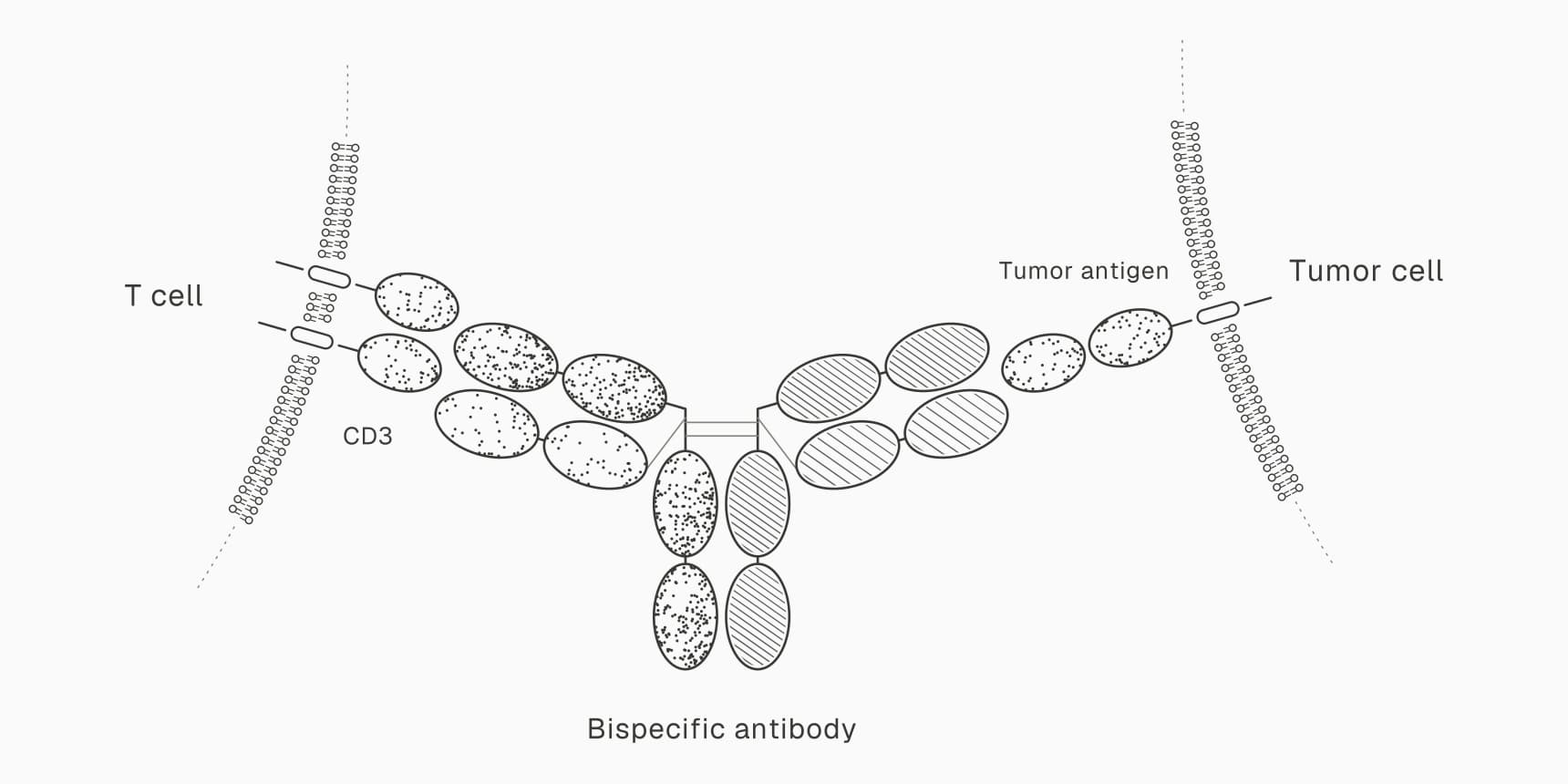
Thirteen of the 25 are T-cell engagers. One arm grabs CD3 on a T cell, the other grabs a marker on a cancer cell, and the bridge makes the T cell kill the cancer cell. Seven more treat cancer in other ways: by blocking two growth signals or two immune checkpoints at once, or, in one case, by carrying a drug into the cancer cell. Five treat other diseases, from hemophilia to rabies.
Most approved bispecifics are built like ordinary IgG antibodies, with the Fab arms and Fc region engineered so that two different arms pair correctly.
Only two follow the BiTE design of two small antibody fragments joined by a linker. Blinatumomab has no Fc and is given as a continuous infusion; tarlatamab adds an Fc so that it lasts longer between doses. No product built on the DART format, two fragments held together by a disulfide bond, has been approved.
| Format | T-cell engagers for cancer | Other cancer | Other diseases | All |
|---|---|---|---|---|
| IgG-like | 9 | 6 | 2 | 17 |
| BiTE | 2 | 0 | 0 | 2 |
| Nanobody | 0 | 0 | 2 | 2 |
| T-cell receptor fusion | 1 | 0 | 0 | 1 |
| Bispecific antibody-drug conjugate | 0 | 1 | 0 | 1 |
| Not published | 1 | 0 | 1 | 2 |
| All formats | 13 | 7 | 5 | 25 |
Each arm of these molecules is still an antibody, nanobody or T-cell receptor domain, so their structures can be modeled from sequence with ImmuneBuilder, which has separate predictors for all three. Designing a new arm against a chosen epitope is the job of tools such as RFantibody, part of the wider antibody design workflow, and the format is then chosen through antibody engineering.
Why do published counts of bispecific antibodies differ?
Published counts differ because they answer different questions. The figure of 20 is the four-agency count through 2025, and 15 is the FDA alone.[1][11] Lower totals come from older lists, and any list that leaves out China or Japan misses the eight molecules approved only there.
Four judgment calls move the total, and we made each one in the open:
- Tebentafusp counts, although its binding arms come from a T-cell receptor and an antibody fragment rather than two antibodies. Strohl and Wang count it too.[11][1]
- Ozoralizumab and gefurulimab count. Their second arm binds albumin to keep the drug in the blood longer rather than to hit a second disease target, but they are bispecific molecules, and Wang counts ozoralizumab.[1]
- Izalontamab brengitecan counts. It is a bispecific antibody that also carries a drug payload, so it also belongs in counts of antibody-drug conjugates.
- Withdrawn approvals count. Catumaxomab counts once, from 2009, although the EU had no authorized product between 2017 and 2025.
Removing the first three groups gives 21 molecules that bind two targets with antibody-derived arms alone. Two products from China are left out entirely: retlirafusp alfa, an antibody fused to a receptor that traps TGF-β, and the PD-1 and CTLA-4 combination iparomlimab and tuvonralimab, which contains two separate antibodies rather than one bispecific molecule. Products that have only a positive opinion from the EMA, such as denecimig for hemophilia A, are not yet counted.[4]
How we built the list
We started from the 20 molecules in Wang and colleagues' study and the FDA bispecifics in our Purple Book antibody dataset, then checked every agency record again on October 29, 2026.[1][2] For FDA approvals after the September 2026 Purple Book release, we checked the novel approvals list and Drugs@FDA.[12] EU dates are the first European Commission decision in the EMA's medicines data, generated on the day we checked.[4]
Japanese dates come from PMDA's approval lists, which run to the September 16, 2026 batch.[7][8] Chinese dates come from NMPA approval notices. Where we could not open an NMPA page, mainly for imported products such as amivantamab and talquetamab and for anbenitamab, we used the company's own announcement and recorded that in the dataset.
Each molecule counts once at each agency, at its first approval for any indication. New indications, subcutaneous versions such as Rybrevant Faspro and Lunsumio Velo, and new brand names do not count again. Approvals by other regulators, such as Health Canada, which approved glofitamab first, are outside the count.
The full dataset gives each molecule's sponsor, targets, format, first indication, dates at each agency, status and the source of each date, and the summary holds every count on this page. Both are free to reuse under CC BY 4.0 with credit to ProteinIQ. We last checked them on October 29, 2026 and plan to recheck them every quarter.
ProteinIQ. "How many bispecific antibodies are approved?" Published October 29, 2026. Accessed [your access date]. https://proteiniq.io/guides/approved-bispecific-antibodies