How many radiopharmaceutical therapies are approved?
The FDA list, the counting rules, and the trial pipeline by isotope

Matic Broz, PhD14 min
Most of what you can read about radioligand therapy says there are two approved drugs, Lutathera and Pluvicto. In September 2026 that stopped being a useful answer. Within one week the FDA approved two more lutetium-177 dotatate products, Curium's Bexlutry and Lantheus's Bravnetsa, both copies of Lutathera, so the same molecule now reaches patients under three brand names.
The broader count is larger. The FDA has approved 11 radiopharmaceutical therapies, medicines whose radioactive atom delivers the treatment rather than an image, starting with radioactive iodine for thyroid disease, which appears in FDA records in 1957. As of October 29, 2026, 6 of those 11 active ingredients are still approved. ClinicalTrials.gov lists 1,041 interventional trials of radiopharmaceutical therapies, and lutetium-177 is the isotope in 363 of them.
How many radiopharmaceutical therapies has the FDA approved?
A radiopharmaceutical therapy pairs a radioactive atom with something that carries it to diseased tissue. The carrier can be a peptide or small molecule that binds a receptor on tumor cells, an antibody, or nothing at all when the element itself goes where it is needed: iodine to the thyroid, radium and strontium to growing bone. We count each active ingredient once, at its first FDA approval, which gives 11 ingredients sold as the 13 products in Table 1.[1]
| Product | Isotope | Carrier and target | First FDA approval | US status | First indication |
|---|---|---|---|---|---|
| Sodium iodide I-131 (Iodotope, Hicon and generics) | Iodine-131, beta | Iodide ion; thyroid sodium-iodide symporter | May 1957 | Approved | Hyperthyroidism and thyroid carcinoma |
| Sodium phosphate P-32 (Phosphotope) | Phosphorus-32, beta | Phosphate ion; bone and marrow | May 1957 | Discontinued | Polycythemia vera, leukemias, bone metastases |
| Chromic phosphate P-32 (Phosphocol P32) | Phosphorus-32, beta | Colloid; pleural and peritoneal surfaces | September 1974 | Discontinued | Malignant pleural and peritoneal effusions |
| Strontium chloride Sr-89 (Metastron) | Strontium-89, beta | Calcium analogue; bone metastases | June 1993 | Approved | Pain from bone metastases |
| Samarium Sm-153 lexidronam (Quadramet) | Samarium-153, beta | Phosphonate; bone metastases | March 1997 | Discontinued | Pain from osteoblastic bone metastases |
| Yttrium Y-90 ibritumomab tiuxetan (Zevalin) | Yttrium-90, beta | Antibody; CD20 | February 2002 | Approved | Relapsed or refractory low-grade B-cell lymphoma |
| Iodine I-131 tositumomab (Bexxar) | Iodine-131, beta | Antibody; CD20 | June 2003 | License revoked | Rituximab-refractory follicular lymphoma |
| Radium Ra-223 dichloride (Xofigo) | Radium-223, alpha | Calcium mimetic; bone metastases | May 2013 | Approved | Castration-resistant prostate cancer in bone |
| Lutetium Lu-177 dotatate (Lutathera) | Lutetium-177, beta | Peptide; SSTR2 | January 2018 | Approved | Somatostatin receptor-positive GEP neuroendocrine tumors |
| Iobenguane I-131 (Azedra) | Iodine-131, beta | Small molecule; norepinephrine transporter | July 2018 | Discontinued | Pheochromocytoma and paraganglioma |
| Lutetium Lu-177 vipivotide tetraxetan (Pluvicto) | Lutetium-177, beta | Small molecule; PSMA | March 2022 | Approved | PSMA-positive metastatic castration-resistant prostate cancer |
| Lutetium Lu-177 dotatate (Bexlutry) | Lutetium-177, beta | Peptide; SSTR2 | September 2026 | Approved | Same as Lutathera, adults only |
| Lutetium Lu-177 dotatate (Bravnetsa) | Lutetium-177, beta | Peptide; SSTR2 | September 2026 | Approved | Same as Lutathera, adults only |
The list falls into four families. Two phosphorus-32 products and sodium iodide are simple radioactive ions or colloids. Strontium-89, samarium-153 and radium-223 settle in bone where metastases are remodeling it. Zevalin and Bexxar are radioimmunotherapies, antibodies that carry the isotope to the CD20 protein on lymphoma cells, close relatives of the antibody-drug conjugates that carry a toxin instead. The last family, radioligand therapy, uses a small molecule or peptide that binds a receptor on the tumor: Lutathera, Azedra and Pluvicto, plus the two Lutathera copies.
Bexlutry and Bravnetsa took different routes to the same molecule. Curium's Bexlutry was approved on September 14, 2026 under its own new drug application, supported by data showing that it behaves like Lutathera.[1][3] Lantheus's Bravnetsa, developed as PNT2003, was approved on September 21, 2026 as a generic, after a tentative approval earlier in the year waited out a patent stay.[1][4]
Neither label includes the pediatric use that Lutathera gained in April 2024. Bravnetsa is not the first generic radiopharmaceutical, though: a generic strontium-89 was approved in 2003 and a generic sodium iodide I-131 in 2020.[1]
Which radiopharmaceutical therapies are still on the market?
Five of the 11 have left the US market. The two phosphorus-32 products and Quadramet are listed as discontinued in Drugs@FDA.[1] Bexxar's license is marked voluntarily revoked in the Purple Book; GlaxoSmithKline stopped selling it on February 20, 2014, citing use it called extremely limited.[5][6] Neither of the two exits with a stated reason was about safety.
Azedra is the recent exit. Lantheus announced in August 2023 that low demand and fixed costs made the drug untenable, and kept making doses only so that patients already on treatment could finish.[7] No Azedra was manufactured after March 1, 2024, when Lantheus transferred the plant that made it.[8] Drugs@FDA now lists it as discontinued, which takes the number of radioligand therapies ever approved from three molecules back to two on the market.[1]
The products that remain have been gaining patients rather than losing them. Pluvicto was first approved in March 2022 for prostate cancer that had already progressed after hormone therapy and chemotherapy. In March 2025 the FDA allowed it before chemotherapy, and on July 31, 2026 it approved Pluvicto with an androgen receptor pathway inhibitor in metastatic prostate cancer that is still sensitive to hormone therapy, based on the PSMAddition trial.[1][2]
The next candidate stalled. ITM's lutetium-177 edotreotide (ITM-11), another somatostatin receptor ligand for neuroendocrine tumors, received a complete response letter on August 7, 2026. The FDA cited manufacturing and a third-party facility, not the clinical data, and ITM plans to resubmit.[9]
Why do counts of approved radioligand therapies disagree?
Counts from two to six circulate in market reports and news coverage, and most are defensible. They differ in whether they count molecules or products, whether withdrawn drugs stay in, and whether "radioligand" means only receptor-targeted small molecules and peptides or every radioactive medicine. Table 2 lines the rules up against the same list.
| Count | What it includes |
|---|---|
| 2 | Radioligand molecules on the market: lutetium-177 dotatate and lutetium-177 vipivotide tetraxetan |
| 3 | Radioligand molecules ever approved, adding iobenguane I-131 (Azedra) |
| 4 | Radioligand products on the market: Lutathera, Pluvicto, Bexlutry and Bravnetsa |
| 6 | Therapeutic radiopharmaceutical ingredients approved today, adding sodium iodide I-131, strontium-89, Zevalin and Xofigo |
| 11 | Therapeutic radiopharmaceutical ingredients ever approved by the FDA |
A count of four or five that names Lutathera, Pluvicto, Xofigo and Zevalin, sometimes with Azedra, is the most common in industry writing. It mixes the families: Xofigo has no targeting molecule at all, and Zevalin is an antibody. That list is a fair answer to "which radiopharmaceuticals treat cancer and are known by brand name," but it is not a count of radioligands.
Only two receptors carry an approved radioligand so far. Lutathera and its copies bind somatostatin receptor 2 (SSTR2), which neuroendocrine tumors overexpress, and Pluvicto binds prostate-specific membrane antigen (PSMA).
Both are among the drug targets of ordinary medicines too: octreotide binds SSTR2 without any isotope attached. The ligand half of a radioligand is conventional peptide and small-molecule design, so new PSMA or SSTR2 binders are often screened by docking against the receptor structure, for example with AutoDock Vina, before anyone attaches a chelator and an isotope.
How do European approvals differ?
The European Medicines Agency lists four centrally authorized radiopharmaceutical therapies: Xofigo, Lutathera, Pluvicto and Quadramet.[10] Lutathera reached Europe first, authorized on September 26, 2017, four months before its FDA approval. Quadramet, discontinued in the United States, is still authorized in the EU. Zevalin's EU authorization lapsed on January 4, 2024, Bexxar and Azedra were never authorized, and an application for iodine-131 omburtamab (Omblastys) for neuroblastoma was refused.
The EMA also authorizes something the FDA list has no equivalent for: radiopharmaceutical precursors. Five lutetium-177 chloride products and one yttrium-90 chloride product are approved only for radiolabeling a carrier molecule, not for injection on their own.[10] They are not therapies and we do not count them. Older agents such as sodium iodide I-131 and strontium-89 do not appear in the central EMA register at all, because European countries license them nationally.
How many radiopharmaceutical therapies are in clinical trials?
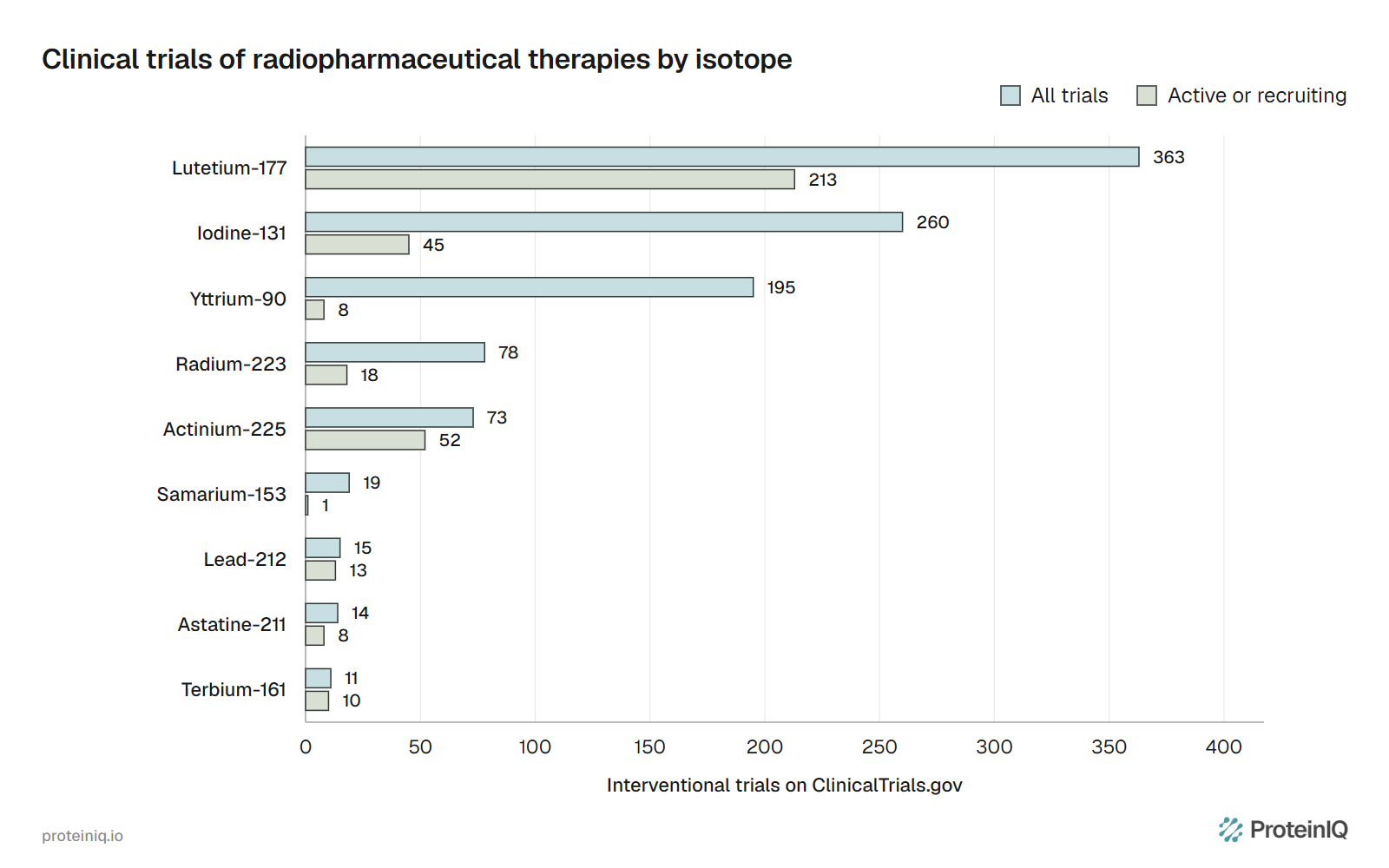
ClinicalTrials.gov lists 1,041 interventional trials of therapeutic radiopharmaceuticals, and 362 of them were recruiting, about to recruit or still running on October 29, 2026.[11] We counted trials by the isotope in the study treatment, so a trial that uses a gallium-68 PET scan to select patients for lutetium-177 therapy counts only under lutetium-177.
The totals reward old isotopes, the active counts show where the field is going. Iodine-131 and yttrium-90 built up their trial records over decades of thyroid treatment and lymphoma antibodies, but only 45 and 8 of their trials are active now. Lutetium-177 has 213 active trials, more than every other isotope combined. Actinium-225, lead-212 and terbium-161 have small totals and nearly all of their trials are still open, which is what a new field looks like.
Isotope choice is mostly a question of range. Beta particles from lutetium-177 travel a mean of 0.62 mm in tissue, enough to hit tumor cells that the ligand missed, while alpha particles from actinium-225 or radium-223 stop within 0.05 to 0.08 mm, a few cell widths, and deposit far more energy along the way.[12] Alpha emitters suit small tumor deposits and patients whose cancer has outgrown beta therapy, but they are scarcer: actinium-225 is still sold by the millicurie.
| Isotope | Emission | Mean range in tissue | Half-life | Trials | Active trials |
|---|---|---|---|---|---|
| Lutetium-177 | Beta | 0.62 mm | 6.6 days | 363 | 213 |
| Iodine-131 | Beta | 0.8 mm | 8.0 days | 260 | 45 |
| Yttrium-90 | Beta | 5.3 mm | 64.1 hours | 195 | 8 |
| Radium-223 | Alpha | 0.05 to 0.08 mm | 11.4 days | 78 | 18 |
| Actinium-225 | Alpha | 0.05 to 0.08 mm | 10.0 days | 73 | 52 |
| Samarium-153 | Beta | 0.4 mm | 46.5 hours | 19 | 1 |
| Lead-212 | Beta, then alpha | Under 0.1 mm, then 0.05 mm | 10.6 hours | 15 | 13 |
| Astatine-211 | Alpha | 0.05 mm | 7.2 hours | 14 | 8 |
| Terbium-161 | Beta and Auger electrons | Not listed | Not listed | 11 | 10 |
Smaller programs use rhenium-188 (8 trials), strontium-89 (9), rhenium-186 (6), holmium-166 (6), copper-67 (4), radium-224 and phosphorus-32 (3 each) and bismuth-213 (2). Thorium-227, scandium-47 and erbium-169 have no therapy trial that met our rules.[11]
How fast is the radiopharmaceutical pipeline growing?
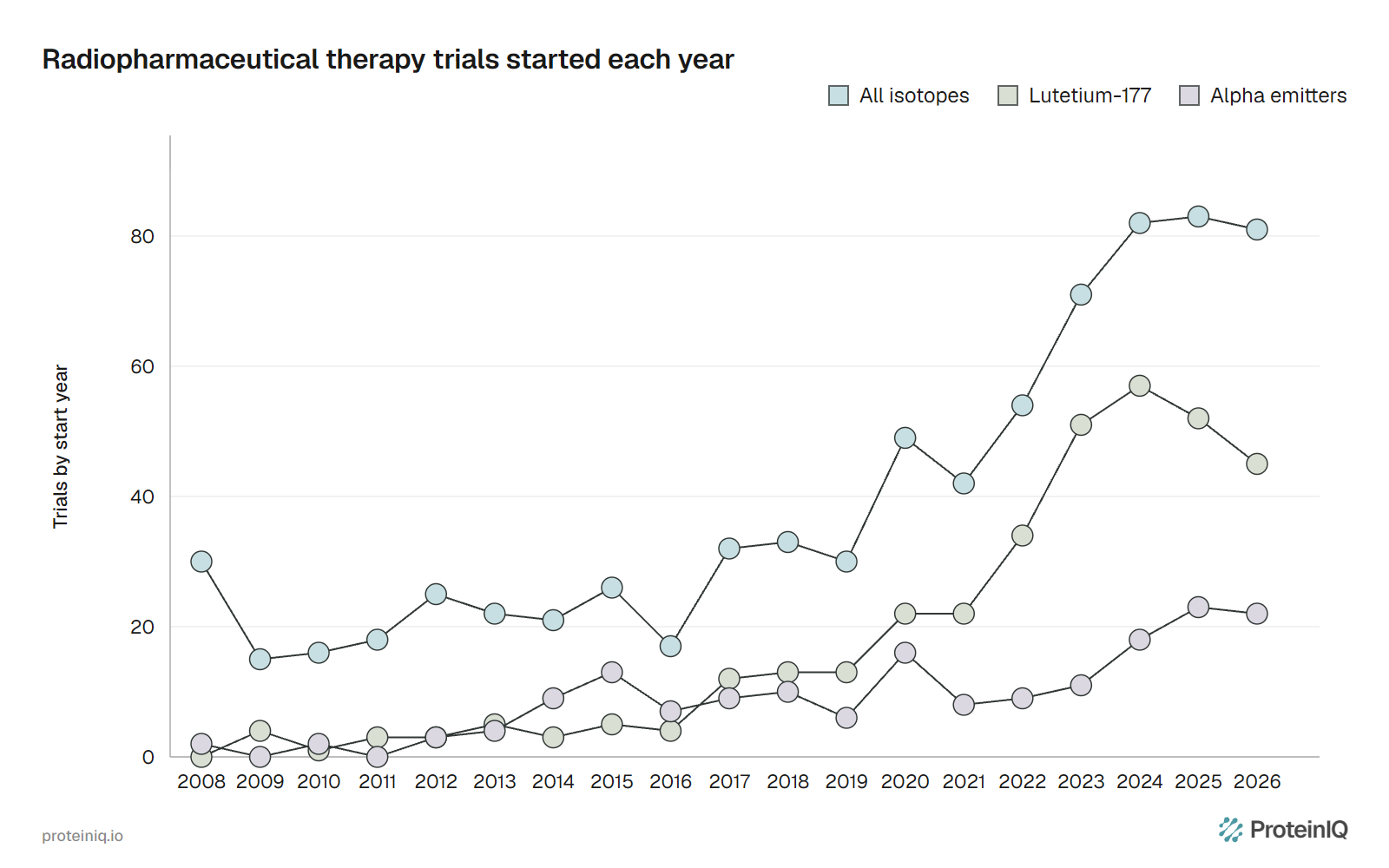
Radiopharmaceutical therapy has had two waves of trials. The first, from 2000 to 2008, produced 244 trials, mostly yttrium-90 and iodine-131 antibodies in lymphoma around the Zevalin and Bexxar approvals. Starts then fell to 15 to 26 a year for most of the next decade. The second wave began after Lutathera's approval: 49 trials started in 2020, and between 71 and 83 a year from 2023 to 2026.[11]
The second wave belongs to lutetium-177. Of the 371 trials that started or are due to start from 2022 to 2026, 239 use it, and at least 99 of those name PSMA in the title or intervention, while at least 50 name a somatostatin receptor ligand. Alpha emitters appear in 83 of the 371. Industry leads 142 of them, and academic centers most of the rest.[11]
Late-stage work is concentrated in the same places. Of the 42 active phase 3 or phase 2/3 trials, 27 involve lutetium-177, some only as the comparator, and they include new PSMA-targeted agents such as Telix's antibody TLX591 and FutureChem's ludotadipep. Three involve actinium-225, among them RayzeBio's RYZ101 for neuroendocrine tumors and Novartis's AAA817 for prostate cancer. Ten are iodine-131 trials: half ask how much radioiodine thyroid cancer patients need, and half test iodine-131 drugs such as the antibody apamistamab and Cellectar's iopofosine.[11]
Nothing in these numbers predicts approvals. Most of the 362 active trials are phase 1 or 2, and a radiopharmaceutical faces the same odds of failure as any other drug, plus a supply chain that has to deliver a decaying product on time. ITM-11, a lutetium-177 drug with positive phase 3 data, was held up in 2026 by manufacturing rather than efficacy.[9]
Methodology
We listed every therapeutic radiopharmaceutical in the Drugs@FDA data files released on October 29, 2026, by searching active ingredients for radioactive isotopes and reading each product's indication. Approval dates are the original application approvals in the same files, and status is each application's marketing status.[1] The two antibody products, Zevalin and Bexxar, were checked in the Purple Book download for October 2026.[5]
A therapeutic radiopharmaceutical here is a medicine whose radioactive atom delivers the treatment dose inside the body. Imaging agents are excluded, including gallium-68 and fluorine-18 PET tracers and diagnostic iodine-131 products such as iobenguane sulfate I-131 and iodinated I-131 albumin. Radioactive medical devices are excluded too: yttrium-90 glass and resin microspheres and iodine-125 seeds are regulated as devices, not drugs. Each active ingredient counts once, at its first approval. EU dates come from the EMA medicines report generated on October 29, 2026.[10]
The trial count used the ClinicalTrials.gov API v2, data timestamp October 29, 2026.[11] We searched the intervention field of interventional studies with 12 broad queries covering lutetium, actinium, lead-212, terbium, copper-67, iodine-131, yttrium, radium, samarium, strontium, rhenium, holmium, astatine, bismuth, thorium, phosphorus-32, scandium and erbium, which returned 2,049 candidate trials. A script then tagged isotopes in each intervention's name, other names and description with patterns such as 177Lu, Lu-177, lutetium-177 and brand names.
Three rules removed trials that do not test a radiopharmaceutical therapy. Interventions that mention microspheres, radioembolization, seeds or similar devices count as device trials, which removed 205 trials, 165 of them with yttrium-90. Trials with a diagnostic or screening primary purpose were dropped (35). Trials whose only isotope mention was in the title were read by hand: 41 were kept and 33, such as drug trials in radioiodine-refractory thyroid cancer, were not. A random sample of 50 counted trials, read by hand, contained no false positives.
The count has known limits. It covers ClinicalTrials.gov only, so trials registered solely in national registries, including many in China, are missing. Iodine-131 includes radioiodine for benign thyroid disease, and comparator arms count, so a trial testing a new drug against Pluvicto counts under lutetium-177. Start years after 2026 and trials without a start date are in the trial list but not in Figure 2.
The list of approved therapies gives each product's isotope, emission, carrier, target, FDA application, first approval, status, first and later indications and EU status, with a summary file. The trial list has every counted trial with its isotopes, phase, start date, status and sponsor, alongside counts by isotope and phase, by start year and a trial summary with the exact queries.
The scripts that build both datasets are scripts/build-radiopharmaceutical-approvals-dataset.py, which checks every FDA and EU date and status against the regulator files, and scripts/count-radiopharmaceutical-therapy-trials.py. The data are free to reuse under CC BY 4.0 with credit to ProteinIQ. They were last checked on October 29, 2026, and we recheck them every quarter.