How many drug targets are there?
An original count from the curated mechanisms of approved drugs

Matic Broz, PhD13 min
Approved drugs act on about 800 molecular targets. In ChEMBL 37, the May 2026 release of the curated drug and bioactivity database run by EMBL-EBI, we counted 809 distinct efficacy targets behind 2,205 approved drugs. Of those, 611 are human, 179 belong to bacteria, viruses, fungi and parasites, and 19 are molecules with no organism, such as iron for chelating drugs or the anticoagulant dabigatran, which its antidote idarucizumab binds.
The spread is uneven. The glucocorticoid receptor alone carries 65 approved drugs, while 285 human targets have exactly one. Most of the targets also come from a handful of protein families, which is why the share of drugs that act on GPCRs has become one of the most quoted and most disputed numbers in pharmacology.
How many drug targets are there?
The count depends on what you call a target. We took every ChEMBL parent molecule with an approved status and a therapeutic use, 2,511 drugs in all, and kept the targets that ChEMBL curators mark as responsible for the drug's effect. That gave 809 targets for the 2,205 drugs with a known one.[1]
ChEMBL records a mechanism against the most specific target its evidence supports. Metoprolol acts on one protein, the beta-1 adrenergic receptor. Benzodiazepines act on the GABA-A receptor, which ChEMBL treats as one target although the channel is built from several subunits. Olanzapine is mapped partly to "D2-like dopamine receptors", a family target covering several receptor genes.[1]
| Target kind | Human | Pathogen or parasite | No organism | All |
|---|---|---|---|---|
| Single protein | 428 | 103 | 0 | 531 |
| Protein complex | 58 | 34 | 0 | 92 |
| Protein family or group | 73 | 7 | 0 | 80 |
| Protein-protein interaction | 2 | 0 | 0 | 2 |
| Non-protein target (DNA, RNA, lipid, metal and others) | 50 | 35 | 19 | 104 |
| All targets | 611 | 179 | 19 | 809 |
Counted as ChEMBL targets, approved drugs reach 561 human proteins or protein assemblies. Expanded to the individual human proteins behind every complex and family, the same targets cover 984 distinct UniProt entries. Neither figure is wrong; one counts what a drug binds as a unit, the other every gene product involved. The single-protein targets alone come to 428.
Of the 179 targets outside humans, 88 are bacterial, 45 viral, 26 belong to parasites such as Plasmodium and lice, and 20 to fungi. They are the targets of 390 drugs that act only on a pathogen: 324 small molecules such as antibiotics, antivirals and antifungals, 34 vaccines and 12 antibodies.
How the count compares with published estimates
Published counts land between our two human figures, because each team draws the unit in a different place. The best-known one, from Santos and colleagues, curated 893 targets for 1,578 FDA-approved drugs, 667 of them human proteins, using data retrieved in June 2015.[2] Overington, one of its authors, had counted 324 targets in 2006.[2]
| Study | Drugs covered | All targets | Human protein targets |
|---|---|---|---|
| Overington and colleagues (2006), as restated by Santos | FDA-approved drugs | 324 | Not given |
| Santos and colleagues (2017) | 1,578 FDA-approved drugs, data from June 2015 | 893 | 667 |
| DrugCentral 2023 | Human drugs approved to March 31, 2022 | 927 | 704 |
| Halip and colleagues (2026) | 1,702 drugs | 686 | Not given in abstract |
| ProteinIQ, ChEMBL 37 (2026) | 2,205 approved therapeutic drugs | 809 | 561 targets, 984 proteins |
DrugCentral, one of the three databases merged in the Santos map, listed 927 efficacy targets in 2023, 704 of them human proteins and 222 in infectious agents.[3] A 2026 review by the same researchers puts the current total at 686 biomolecules modulated by 1,702 drugs.[4]
Our count includes more drugs because ChEMBL treats a drug as approved when a source of approved-drug information lists it, such as the FDA, the European Medicines Agency or the WHO's ATC classification.[5] Many older European drugs, such as betahistine and domperidone, were never approved in the US.
Which target classes do approved drugs act on?
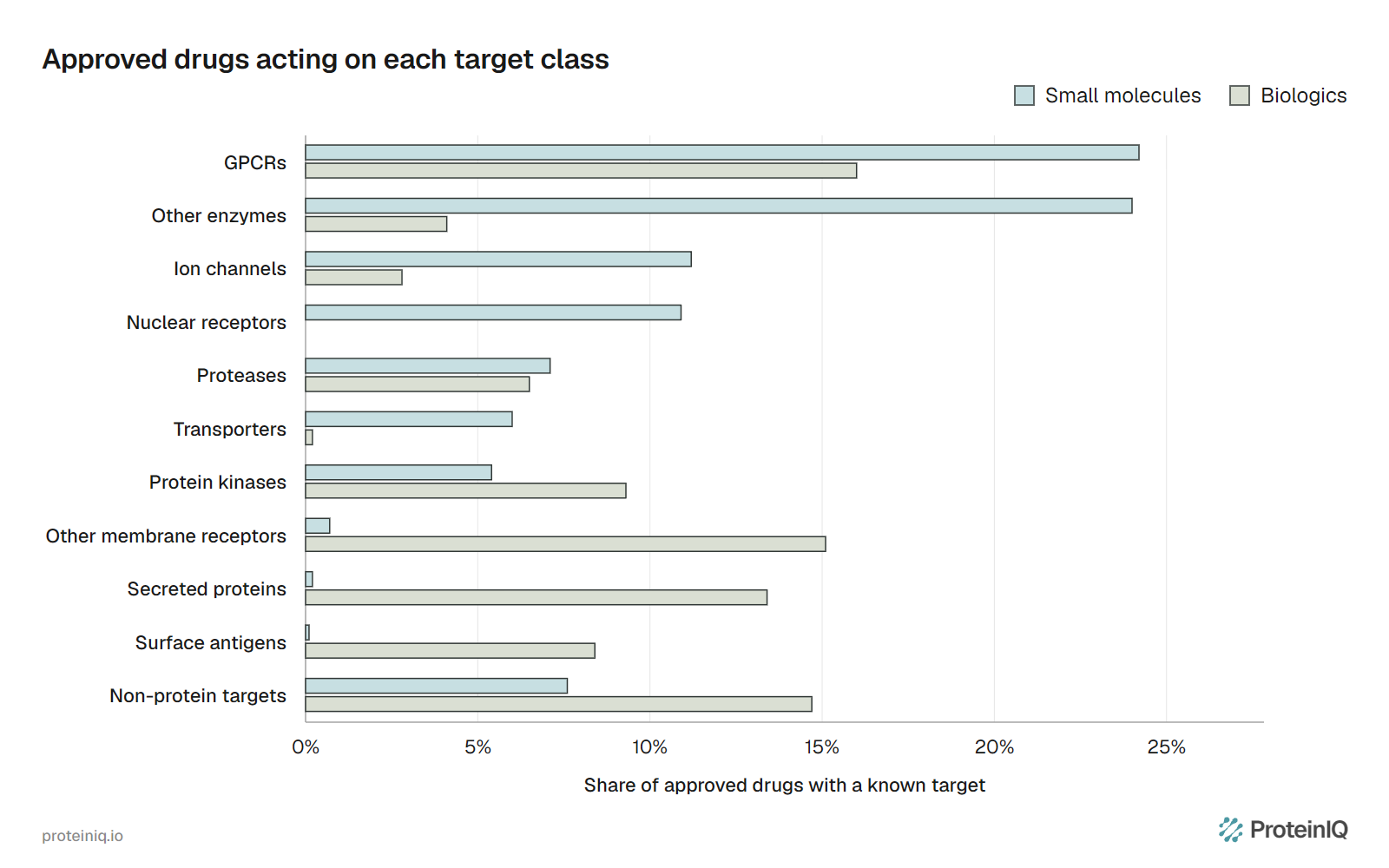
GPCRs are the largest single class: 110 human GPCR targets carry 484 approved drugs, 22% of the drugs with a known target. Enzymes outside the kinase and protease families come second with 19%, and the other well-known families follow well behind: ion channels at 9%, nuclear receptors at 8% and protein kinases at 6%.
Small molecules and biologics divide the work almost cleanly. Small molecules dominate ion channels, nuclear receptors and transporters, where a binding pocket inside the membrane or the cell suits a compact, drug-like molecule.
Biologics act on what sits outside the cell: cytokine and growth factor receptors, secreted proteins such as TNF and the interleukins, and surface antigens such as CD19. None of the 463 biologics acts on a nuclear receptor, and only 3 on a transporter or epigenetic regulator.
GPCRs are the one large class both modalities share, but not through antibodies. Of the 74 biologics on GPCRs, 71 are peptides and proteins, most of them modelled on natural hormones, such as semaglutide on the GLP-1 receptor and octreotide on somatostatin receptors. Only three antibodies act on a GPCR: erenumab, mogamulizumab and talquetamab.
| Target class | Human targets | Small molecules | Biologics | All drugs |
|---|---|---|---|---|
| GPCRs | 110 | 24.2% | 16.0% | 22.0% |
| Ion channels | 50 | 11.2% | 2.8% | 9.1% |
| Protein kinases | 82 | 5.4% | 9.3% | 6.0% |
| Nuclear receptors | 18 | 10.9% | 0% | 8.4% |
| Proteases | 29 | 7.1% | 6.5% | 7.0% |
| Other enzymes | 116 | 24.0% | 4.1% | 19.0% |
| Transporters | 21 | 6.0% | 0.2% | 4.6% |
| Epigenetic regulators | 10 | 0.5% | 0.4% | 0.5% |
| Other membrane receptors | 32 | 0.7% | 15.1% | 3.7% |
| Other transcription factors | 3 | 0.2% | 0% | 0.1% |
| Secreted proteins | 33 | 0.2% | 13.4% | 3.6% |
| Surface antigens | 9 | 0.1% | 8.4% | 1.9% |
| Other or unclassified proteins | 38 | 4.7% | 13.8% | 6.9% |
| Targets spanning two classes | 10 | 1.6% | 0.4% | 1.3% |
| Non-protein targets | 50 | 7.6% | 14.7% | 10.2% |
| All human targets | 611 |
The table also shows how differently classes are used. Nuclear receptors are few, 18 human targets, but they carry 181 small-molecule drugs, because steroids, retinoids and thyroid hormones were optimized against the same receptors for decades. Kinases are the reverse: 82 human targets with only 133 drugs between them, since 86 of the 90 small-molecule kinase drugs were first approved in 2001 or later, and many kinases still have only one or two.
Santos and colleagues reported that GPCRs, ion channels, kinases and nuclear receptors make up 44% of human protein targets and account for 70% of small-molecule drugs.[2] In our count the same four classes make up 43% of human targets and act on 51% of small molecules with a known target, a gap that the next section largely explains.
What percentage of drugs target GPCRs?
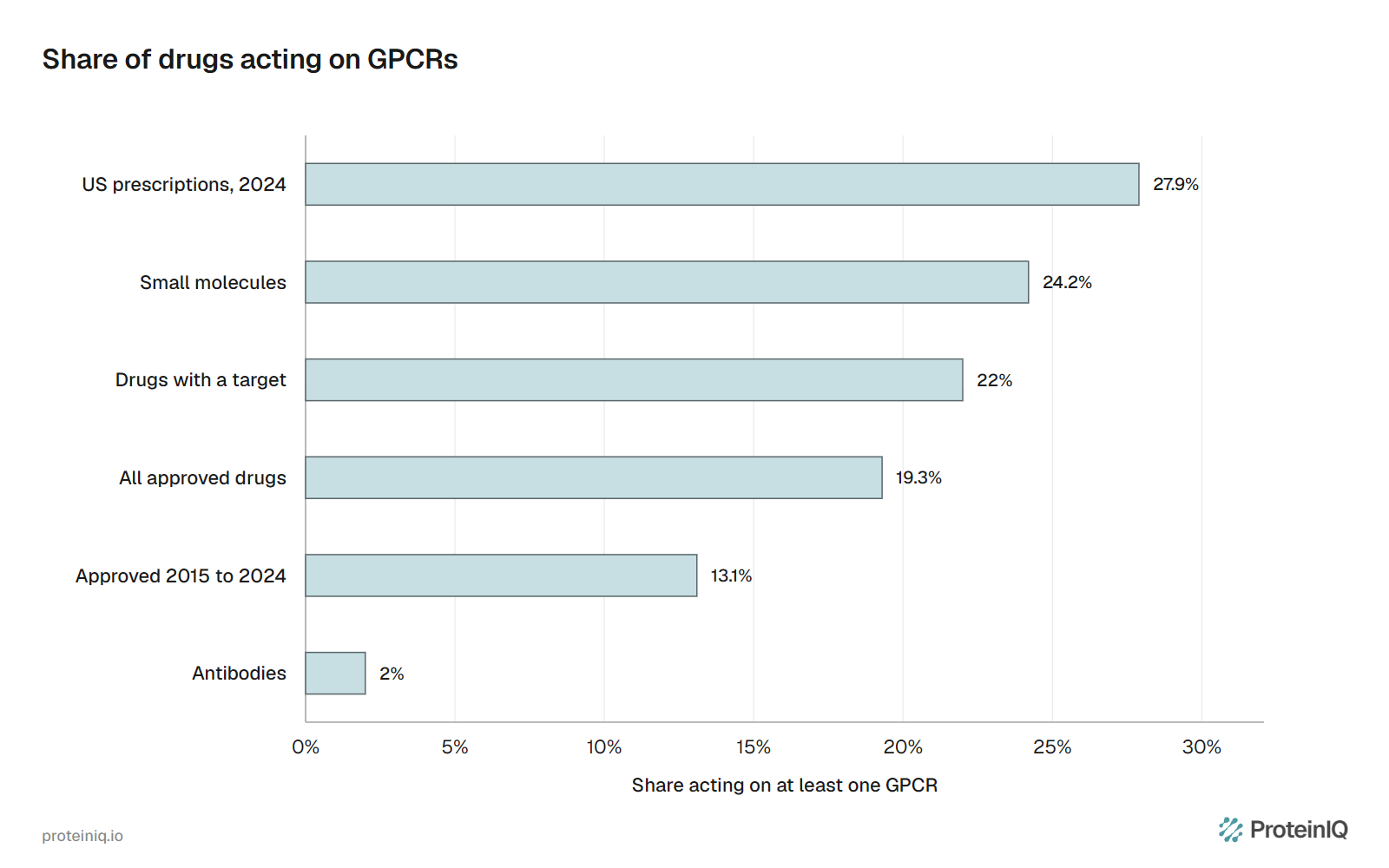
About a fifth to a third, depending on the denominator. In our count, 22% of approved drugs with a known target act on at least one GPCR, and 19% of all approved drugs do. The figure most often repeated, 34%, comes from Hauser and colleagues, who counted 475 drugs at 108 GPCRs, "~34% of all drugs approved by the US Food and Drug Administration".[6] A 2025 analysis by Schröer and Seifert arrived at 19% and argued that 30% is too high.[7]
The numerator barely moves between studies. Hauser counted 475 GPCR drugs, Sriram and Insel about 700 at the generous end, Lorente and colleagues 516 in 2025, and we count 484.[6][8][9] What changes is the denominator. Hauser's 475 drugs at 34% imply a list of about 1,400 FDA drugs; ChEMBL's 2,205 drugs from several regulators give 22%; a list of recent approvals gives much less.
| Source | Population counted | GPCR share |
|---|---|---|
| Santos and colleagues (2017) | FDA small-molecule drugs to June 2015, rhodopsin-like GPCRs only | 33% |
| Hauser and colleagues (2017) | FDA-approved drugs, July 2017 | 34% |
| Sriram and Insel (2018) | About 1,950 FDA and EMA drugs, November 2017 | 25% to 36% |
| Lorente and colleagues (2025) | Approved drugs | 36% |
| Schröer and Seifert (2025) | 1,110 new active substances approved in Germany, 1987 to 2023 | 19% |
| Schröer and Seifert (2025) | FDA novel approvals, 2018 to 2023 | 14.5% |
| ProteinIQ, ChEMBL 37 | 1,664 small molecules with a known target | 24.2% |
| ProteinIQ, ChEMBL 37 | 2,205 drugs with a known target | 22.0% |
| ProteinIQ, ChEMBL 37 | 2,511 approved therapeutic drugs | 19.3% |
| ProteinIQ, ChEMBL 37 | 464 drugs first approved 2015 to 2024 with a known target | 13.1% |
| ProteinIQ, ChEMBL 37 and ClinCalc | Top 300 US products by prescriptions, 2024 | 27.9% |
Time explains most of the 19%. GPCR drugs made up 29% of the drugs first approved in the 1970s and in the 1980s, then 19% in the 1990s, 23% in the 2000s, 17% in the 2010s and 12% from 2020 to 2024. Schröer and Seifert counted German approvals from 1987 onwards, one primary target each, so they measured the newer, less GPCR-heavy part of the pharmacopoeia.[7] Hauser and Santos counted every FDA drug ever approved, old antihistamines and beta blockers included.
Prescriptions tilt the other way. Weighting the 300 most prescribed US products of 2024 by their prescription counts, 27.9% of 2.66 billion prescriptions were for a product with a GPCR-acting ingredient, from albuterol and losartan to metoprolol, cetirizine and semaglutide.[10] The old GPCR drugs are cheap, generic and taken daily, so they weigh more in a pharmacy than in a list of molecules. None of these figures is the true one; each answers a different question.
How fast is the number of drug targets growing?
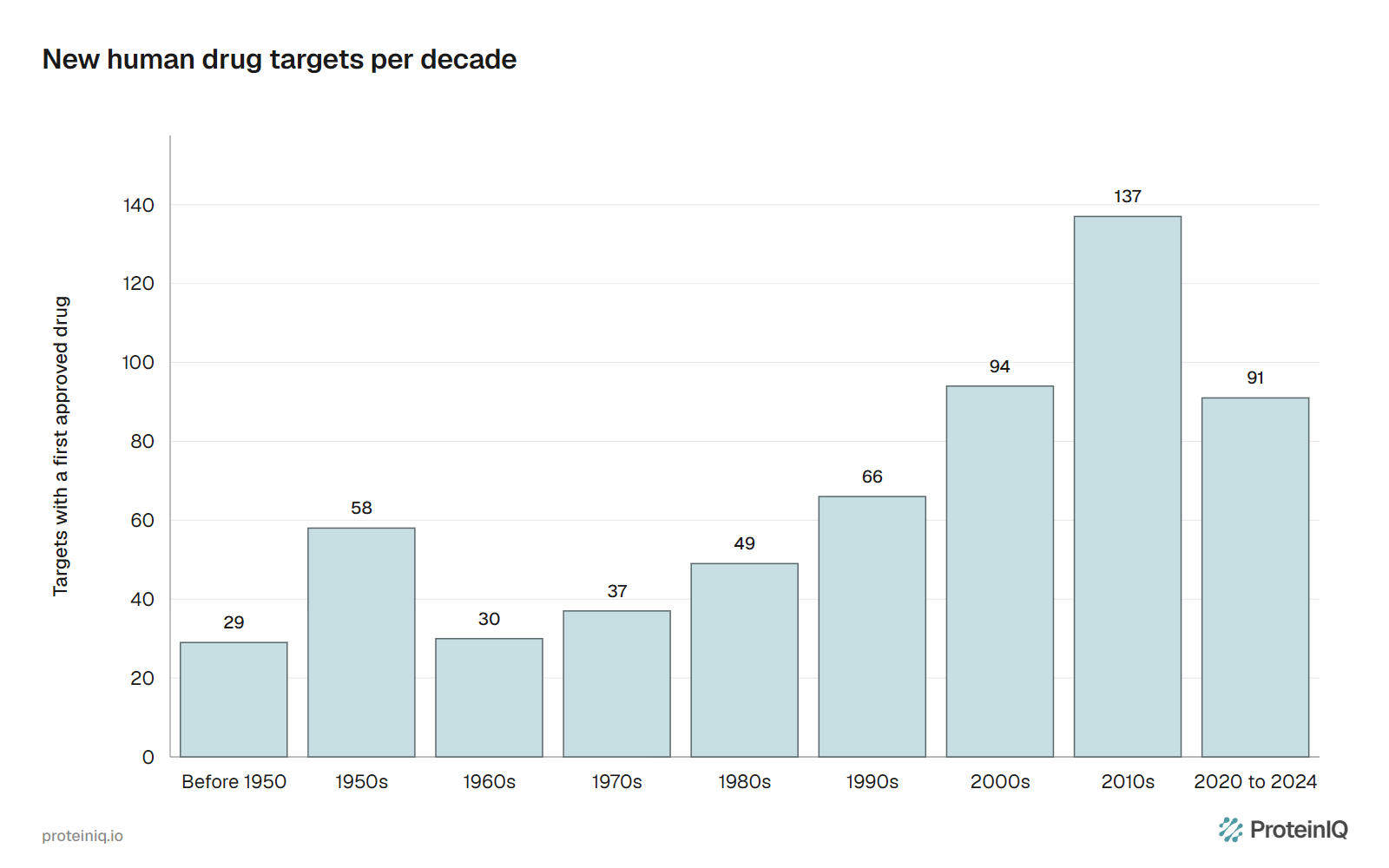
Faster than ever. Drugs first approved in the 2010s introduced 137 human targets that no earlier approved drug had reached, more than any previous decade. From 2020 to 2024, the latest years with approval dates in ChEMBL 37, another 91 arrived, about 18 a year.[1]
The new targets come from different families than the old ones. Of the 228 human targets first reached since 2010, 47 are protein kinases and only 27 are GPCRs; before 2010, GPCRs outnumbered kinases 78 to 34. Antibodies added secreted proteins and surface antigens, and oligonucleotides added RNA targets such as transthyretin mRNA.
Even so, approved drugs reach only a small part of the genome. Roughly 4,500 human genes are thought to be druggable, against about 600 human targets with an approved drug today.
For a protein outside that list, the work starts from structure: predicting a model with AlphaFold 2 when no experimental one exists, finding cavities with fpocket, then docking candidate compounds with AutoDock Vina. Inverse virtual screening runs the other way, docking one compound against many targets to suggest which it acts on.
How we counted drug targets in ChEMBL
We queried the ChEMBL REST API on October 29, 2026, which served release ChEMBL_37 of May 1, 2026.[1] An approved drug is a parent molecule with max_phase 4, after folding salts into their parent, and with ChEMBL's therapeutic flag set. That keeps 2,511 of 2,996 approved parents and removes mostly contrast agents, radiotracers and other non-therapeutic products; 150 of the 2,511 are flagged as withdrawn and stay in.
ChEMBL curators record each drug's mechanism of action and its target from drug labels and the literature, and flag the interactions thought to produce the clinical effect.[11] We kept those efficacy mechanisms with a named target. Of the 2,421 drugs with a mechanism record, 216 have no assigned target, among them surfactants, many vaccines and drugs whose mechanism ChEMBL lists as unknown. That leaves 2,205 drugs with 2,846 drug-target links, a median of one target per drug.
Target classes come from ChEMBL's protein classification of each target's components. GPCRs are every receptor under ChEMBL's G protein-coupled receptor branches; kinases are its protein kinase branch, which includes receptor tyrosine kinases such as HER2 and the insulin receptor. A complex or family gets a class when its classified members agree, otherwise it counts as spanning two classes. Biologics are ChEMBL's antibody, antibody-drug conjugate, protein, enzyme, vaccine, cell and gene therapy types; peptides such as semaglutide sit in the protein type.
ChEMBL's classification has quirks that carry into the counts. CD20, the target of rituximab, is classified as an ion channel, and bacterial penicillin-binding proteins, the targets of 55 antibiotics, sit under proteases. First-approval years are missing for 215 drugs, mostly older drugs approved outside the US, so 20 human targets have no date in Figure 3. Prescription shares use ClinCalc's 2024 list, built from the Medical Expenditure Panel Survey, with each product's ingredients matched to ChEMBL by name.[10]
The analysis script reruns every number on this page against the current ChEMBL release, using only the Python standard library. The drug-target links (gzipped CSV), target list (CSV), class summary (CSV), provenance and filters (JSON) and license notes hold the results. The script downloads ClinCalc's list itself, and we publish only the prescription shares computed from it.
Because ChEMBL is licensed CC BY-SA 3.0, the data files are shared under the same license with credit to ChEMBL and ProteinIQ. We last checked them on October 29, 2026 and plan to refresh them with each ChEMBL release.