How many druggable genes are there?
About 4,500 human genes are considered druggable, but approved medicines act through only about 700 human protein targets.
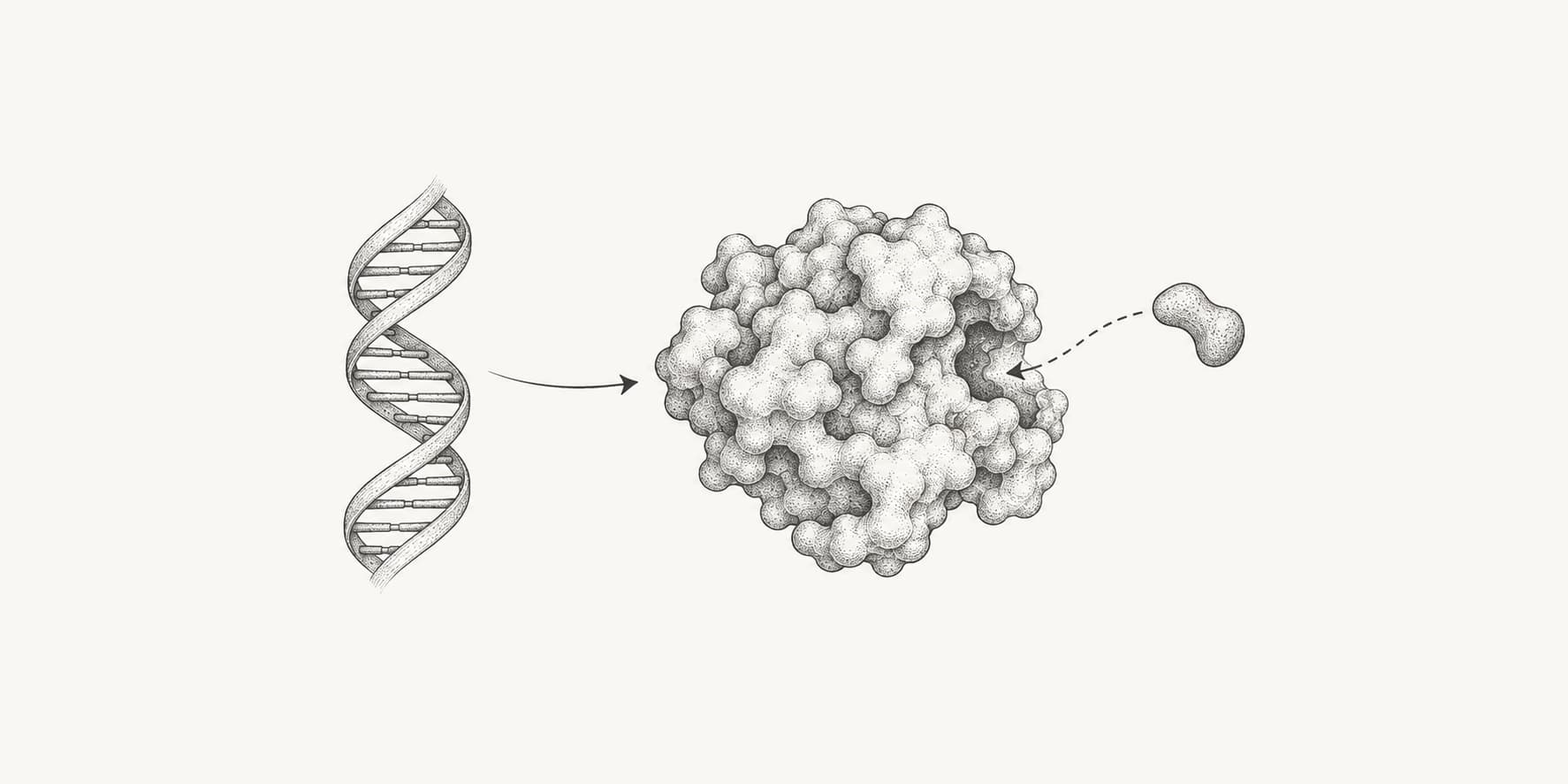
About 4,500 of roughly 20,000 human protein-coding genes are considered druggable. A major analysis classified 4,479 genes this way, equal to 22% of the genome annotation it used.
Approved medicines act through only about 700 human protein targets. Most of the druggable genome has yet to produce an approved treatment.
How many druggable genes are there?
A 2017 analysis classified 4,479 human genes as drugged or druggable, equal to 22% of the 20,300 protein-coding genes in the genome annotation it used.[1]
The study divided those genes into three tiers. Tier 1 contained 1,427 targets of approved drugs or clinical-stage candidates. Tier 2 contained 682 genes with potent drug-like binders or close similarity to approved targets. Tier 3 contained 2,370 genes, including secreted and extracellular proteins and members of established druggable families.[1]
The rounded answer is still about 4,500. A 2024 review from the National Institutes of Health used that figure, while the NIH program page gives the more conservative rounded estimate of approximately 4,000.[4][5]
How many drug targets are there?
Approved drugs act through about 700 human protein targets, far fewer than the roughly 4,500 proteins considered druggable.
A comprehensive map identified 667 human protein efficacy targets for 1,578 FDA-approved drugs. The same analysis counted 893 targets after adding pathogen proteins and non-protein biomolecules such as DNA and RNA.[2]
DrugCentral reported 709 Tclin proteins in 2023. Tclin is its category for human proteins involved in the known mechanism of action of an approved drug.[7] Both sources therefore support about 700 as the rounded answer.
An efficacy target is the molecule responsible for a drug's therapeutic effect. The count excludes other proteins the drug binds, enzymes that metabolize it, and genes whose expression changes after treatment.
The 667 human targets included 549 targets of small-molecule drugs and 146 targets of biologics; some proteins appeared in both groups. Four established families, GPCRs, ion channels, kinases, and nuclear receptors, made up 44% of human protein targets and mediated the effects of 70% of small-molecule drugs in the dataset.[2]
The chart compares the protein-coding gene set and druggable-genome estimate from the 2017 Finan analysis with the approved human protein efficacy targets mapped by Santos and colleagues.[1][2]
How many GPCRs, kinases, ion channels, proteases, and transcription factors are there?
Common reference counts are about 800 human GPCRs, 518 putative protein kinase genes, 332 genes in the HGNC ion-channel group, 641 protease genes, and 1,639 likely sequence-specific transcription factors.[8][9][10][11][12]
| Human target class | Published count | What the source counted |
|---|---|---|
| GPCRs | Approximately 800 | Unique proteins encoded by the human GPCR gene family |
| Protein kinases | 518 | Putative protein kinase genes in the canonical human kinome |
| Ion channels | 332 | Genes in the HGNC ion-channel group and its subgroups |
| Proteases | 641 | Genes classified as human proteases |
| Transcription factors | 1,639 | Likely sequence-specific DNA-binding transcription factors |
The GPCR, kinase, ion-channel, protease, and transcription-factor figures come from separate family catalogues with their own inclusion rules.[8][9][10][11][12] They are total family counts. They do not measure how many members are druggable or already addressed by approved drugs.
In the Santos map, ChEMBL classifications assigned 12% of 667 human protein efficacy targets to rhodopsin-like GPCRs, 19% to ion channels, and 10% to protein kinases.[2] The denominator is the set of targets for drugs approved through June 2015. It does not show the share of each complete gene family that has been drugged. The same summary did not report matching protease or transcription-factor percentages, so those classes cannot be compared on that denominator.
Why do estimates of the druggable genome differ?
Estimates differ because researchers draw the boundary around “druggable” in different places and use different genome annotations, drug types, and evidence thresholds.
The original druggable-genome work started with 399 known molecular targets, identified 130 related protein families, and expanded those families to 3,051 proteins. A 2005 update produced a list of 2,917 druggable genes.[3]
The later 4,479-gene estimate was broader. It added targets of drugs licensed after 2005, clinical-stage candidates, proteins with measured small-molecule binding, and extracellular proteins that antibodies or other biologics could reach.[1]
Druggability describes whether a protein can be modulated by a suitable molecule. Safe and effective disease treatment is a separate test. A protein may contain a binding pocket yet have no useful role in disease, or changing its activity may cause unacceptable side effects. Antibodies, targeted protein degradation, RNA medicines, and other modalities can also reach targets that older small-molecule definitions excluded.
For a known structure, fpocket can identify possible ligand-binding cavities. In molecular docking, AutoDock Vina tests how candidate compounds might fit. These methods address physical tractability. Disease biology, safety, and clinical evidence determine whether changing the target will benefit patients.
How are researchers illuminating the druggable genome?
The Illuminating the Druggable Genome program focused on understudied proteins from three target-rich families: non-olfactory GPCRs, ion channels, and protein kinases.[5]
The program developed data, assays, chemical tools, and the Pharos knowledge portal to make sparsely studied targets easier to investigate. Its premise was the gap between thousands of potentially druggable proteins and the few hundred already reached by medicines.[4]
The Drug-Gene Interaction Database, or DGIdb, serves a related purpose. It combines drug, gene, and interaction records from many sources so researchers can search a gene list for known compounds and druggable-gene categories. DGIdb 5.0 introduced a GraphQL interface and aggregated content from 44 sources.[6]
These resources help researchers move from a genomic result to testable target and compound hypotheses. Structural evidence, genetics, disease biology, safety, and clinical validation then determine whether a druggable protein becomes a successful drug target.