Drug discovery statistics [2026]
FDA approved 46 novel drugs in 2025. The same pipeline produced 88 US biosimilar approvals and 50 licensed cellular and gene therapy products by July 2026.
Drug discovery produces few approvals from a long and expensive pipeline. FDA approved 46 novel drugs in 2025. Large studies put the chance of approval after entering Phase 1 at 7.9% to 13.8%.
Approval totals depend on the product class and counting rule. By July 2026, FDA listed 88 biosimilars and 50 licensed cellular and gene therapy products.
How many novel drugs does the FDA approve each year?
FDA approved 46 novel drugs in 2025. Across the five years from 2021 through 2025, the annual count ranged from 37 to 55 and averaged 47.6 approvals.[1]
| Year | FDA novel drug approvals |
|---|---|
| 2021 | 50 |
| 2022 | 37 |
| 2023 | 55 |
| 2024 | 50 |
| 2025 | 46 |
The 2025 total comprised 34 new molecular entities and 12 new therapeutic biologics. It does not include most generics, biosimilars, or new indications for medicines already on the market.[1]
This is why annual novel approvals are much lower than the total number of FDA-approved drugs. The two figures count different units.
What percentage of drug candidates reach FDA approval?
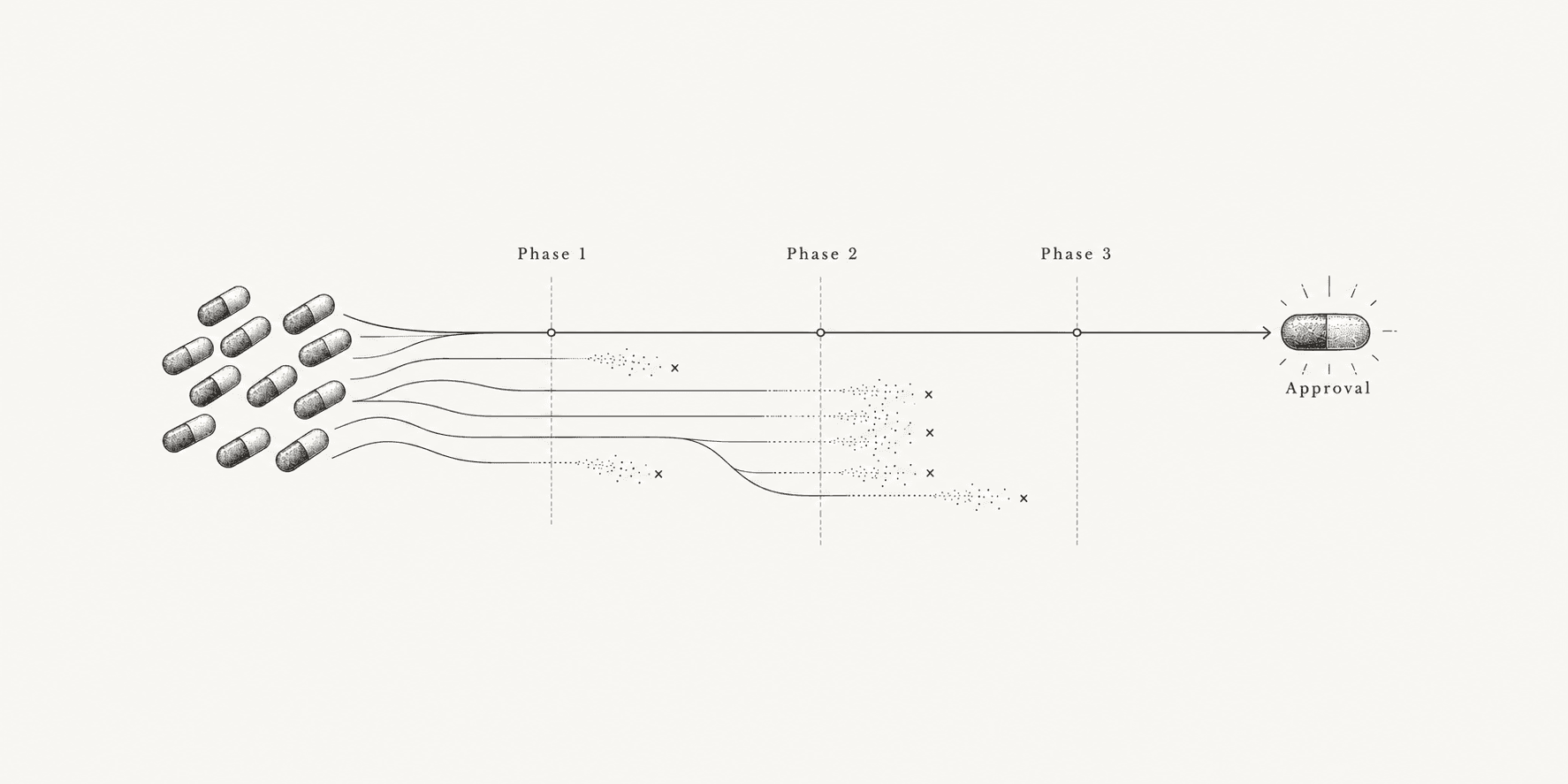
Large studies estimate that 7.9% to 13.8% of drug programs entering Phase 1 eventually reach approval. The difference reflects the years studied, the databases used, and whether researchers tracked individual compounds or drug-indication programs.[2][3]
The BIO benchmark followed drug-indication programs from 2011 through 2020 and reported a 7.9% Phase 1-to-approval likelihood. Wong, Siah, and Lo analyzed more than 21,000 compounds in trial data from 2000 through 2015 and estimated a 13.8% likelihood.[2][3]
Both studies support the same conclusion: most clinical programs fail. The clinical failure rate is highest in Phase 2, after initial safety testing but before the largest confirmatory studies.
How much does it cost to develop a drug?
A 2024 economic model estimated a mean capitalized cost of USD 879.3 million per approved drug, including failed candidates and the cost of capital. The estimate was USD 172.7 million for direct spending and USD 515.8 million after failed programs were included.[4]
The capitalized estimate varied from USD 378.7 million for anti-infective drugs to USD 1.76 billion for pain and anesthesia products. These figures were reported in 2018 US dollars and cover nonclinical work through postmarketing studies.[4]
Published development cost estimates differ because they use different samples and cost boundaries. Early molecular docking and ADMET prediction can help teams reject weak candidates before expensive experiments, but these screens do not remove the cost of clinical failures.
How many biosimilars are approved in the US and Europe?
As of July 27, 2026, FDA had approved 88 biosimilars in the United States. A March 2026 review of EMA records counted 150 biosimilars approved for use in Europe, compared with 168 EMA recommendations.[5][7]
The US total is a count of rows in FDA's product table. ProteinIQ grouped those rows by approval year: 18 biosimilars were approved in 2024, another 18 in 2025, and seven from January through July 27, 2026.[5]
Europe approved its first biosimilar in 2006, nine years before the United States. EMA uses a centralized scientific review, after which the European Commission issues the marketing authorization.[6]
The European figures answer different questions. The 168 figure counts positive EMA recommendations, while the 150 figure removes products that were withdrawn, refused, or no longer authorized for use. EMA recommended 41 biosimilars in 2025 alone, its highest annual total.[7][8]
How many cell and gene therapies are FDA approved?
As of July 1, 2026, FDA's official list contained 50 licensed cellular and gene therapy products. FDA does not publish separate gene-therapy and cell-therapy subtotals on that page, and some products belong to both categories.[9]
The combined list includes gene-modified cell therapies such as CAR T-cell products, in vivo gene therapies, cord-blood products, and other cellular therapies. Calling all 50 “gene therapies” or all 50 “cell therapies” would therefore overstate either category.
This classification problem matters when comparing years or countries. A source that excludes cord-blood products, for example, will report a lower total even when it uses the same approval date.
How many AAV gene therapies are FDA approved?
ProteinIQ counted nine FDA-licensed AAV-based gene therapy products as of July 2026. The count consists of seven products approved through 2024, plus Itvisma in November 2025 and Otarmeni in April 2026.[9][10][11][12]
| Approval year | AAV-based product |
|---|---|
| 2017 | Luxturna |
| 2019 | Zolgensma |
| 2022 | Hemgenix |
| 2023 | Elevidys; Roctavian |
| 2024 | Beqvez; Kebilidi |
| 2025 | Itvisma |
| 2026 | Otarmeni |
This is a product count, not a count of unique AAV capsids or diseases. It also counts licensed products even if a manufacturer later limits or stops commercial sales.
How many CRISPR therapies are approved or in clinical trials?
ProteinIQ found one FDA-approved CRISPR therapy as of July 2026: Casgevy. FDA approved it in December 2023 as the first treatment to use CRISPR/Cas9 genome editing, and it remains on FDA's current cellular and gene therapy list.[9][13]
A 2025 peer-reviewed review identified 69 active CRISPR clinical trials and six completed studies. That is a dated literature count, not a live total from ClinicalTrials.gov.[14]
Broader gene-editing trackers can report higher numbers because they include other editing systems, more trial statuses, or preclinical programs. Counts should state the search date, registry, statuses, and technologies included.
ProteinIQ. "Drug discovery statistics [2026]." Published July 30, 2026. Accessed [your access date]. https://proteiniq.io/guides/drug-discovery-statistics