PROTACs and molecular glue degraders in clinical trials
A tracker of every targeted protein degrader dosed in people

Matic Broz, PhD13 min
Vepdegestrant became the first approved PROTAC on May 1, 2026, when the FDA cleared it for breast cancer driven by a mutated estrogen receptor. Fifteen weeks later iberdomide became the first approved molecular glue that was developed as a degrader rather than discovered to be one. Neither drug blocks its target the way an inhibitor does. Each makes the cell destroy it.
By our count, 102 targeted protein degraders had been dosed in human trials by October 29, 2026: 54 PROTACs, 28 molecular glue degraders, 7 degraders of other kinds and 13 that their sponsors call degraders without saying which kind. Of these, 73 are still in development. Published counts run from 12 to "over 40" because they count different things, so below are the full list, the counting rules and a downloadable dataset.
How many PROTACs are in clinical trials?
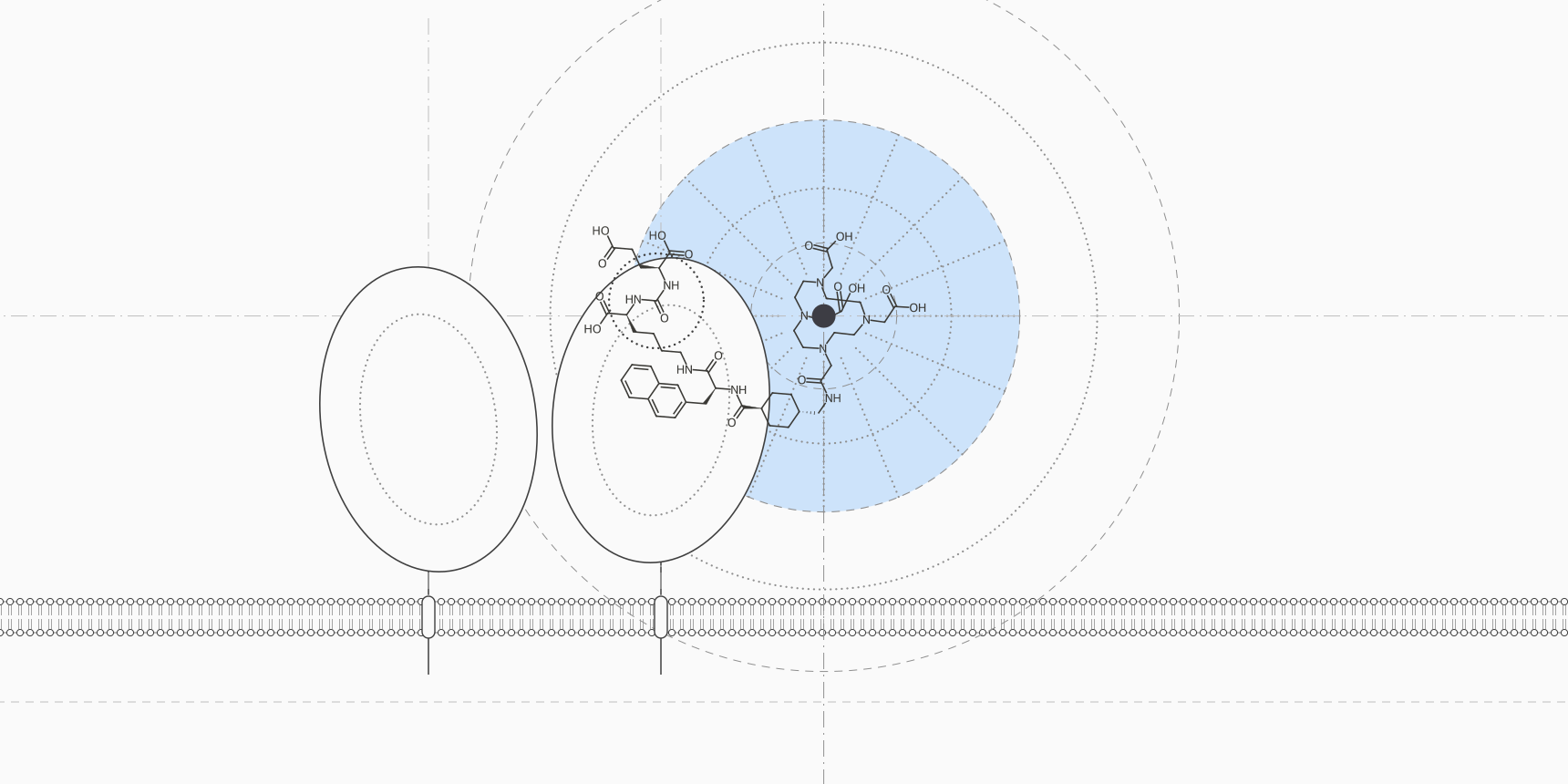
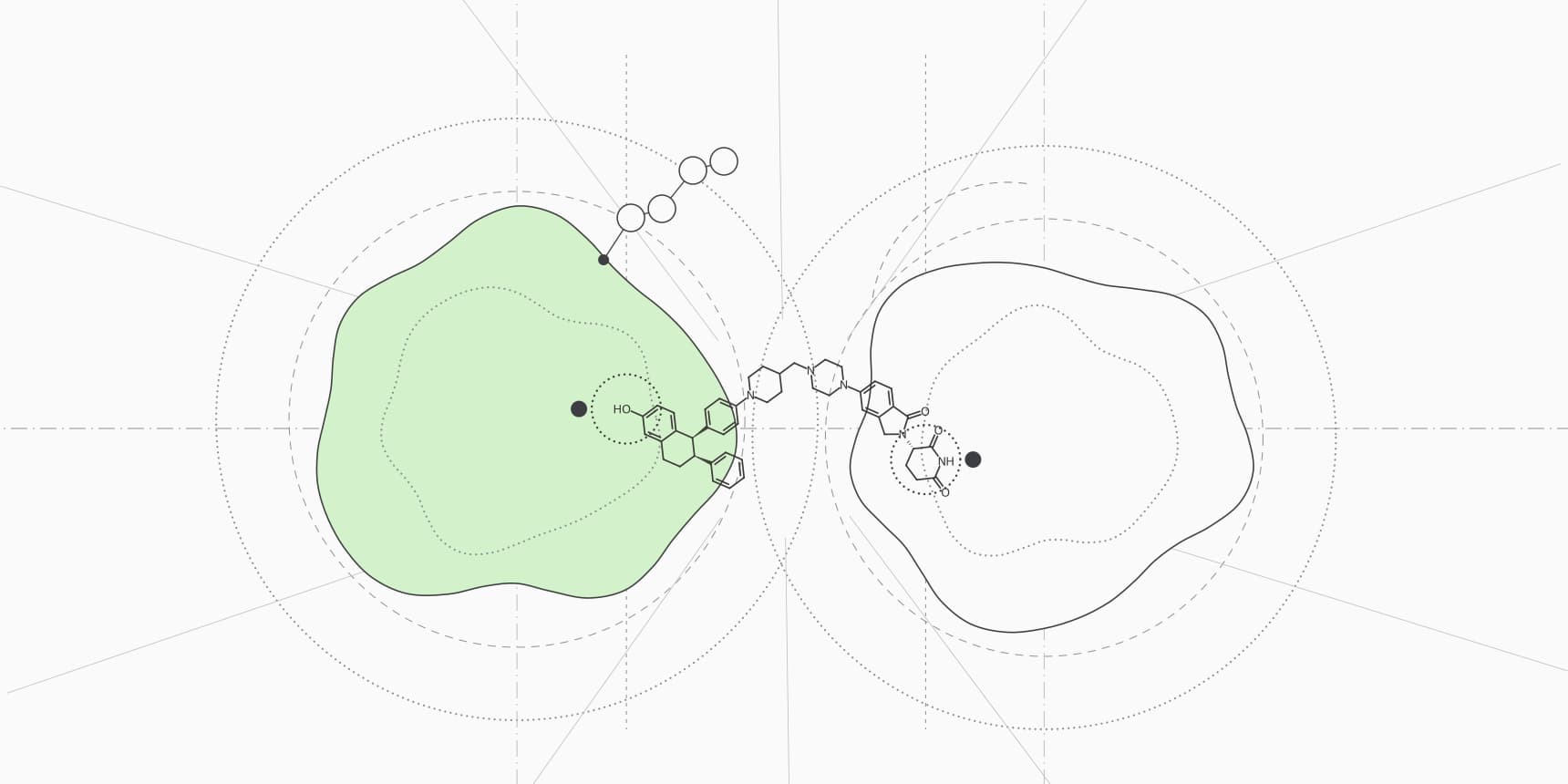
A PROTAC (proteolysis targeting chimera) is two drug-like pieces joined by a linker. One end binds the target protein and the other binds an E3 ubiquitin ligase, an enzyme that tags proteins for disposal. Held side by side, the ligase marks the target with ubiquitin and the proteasome breaks it down. One PROTAC molecule can repeat the cycle many times, and the target needs no active site, only a surface that a ligand can grip.
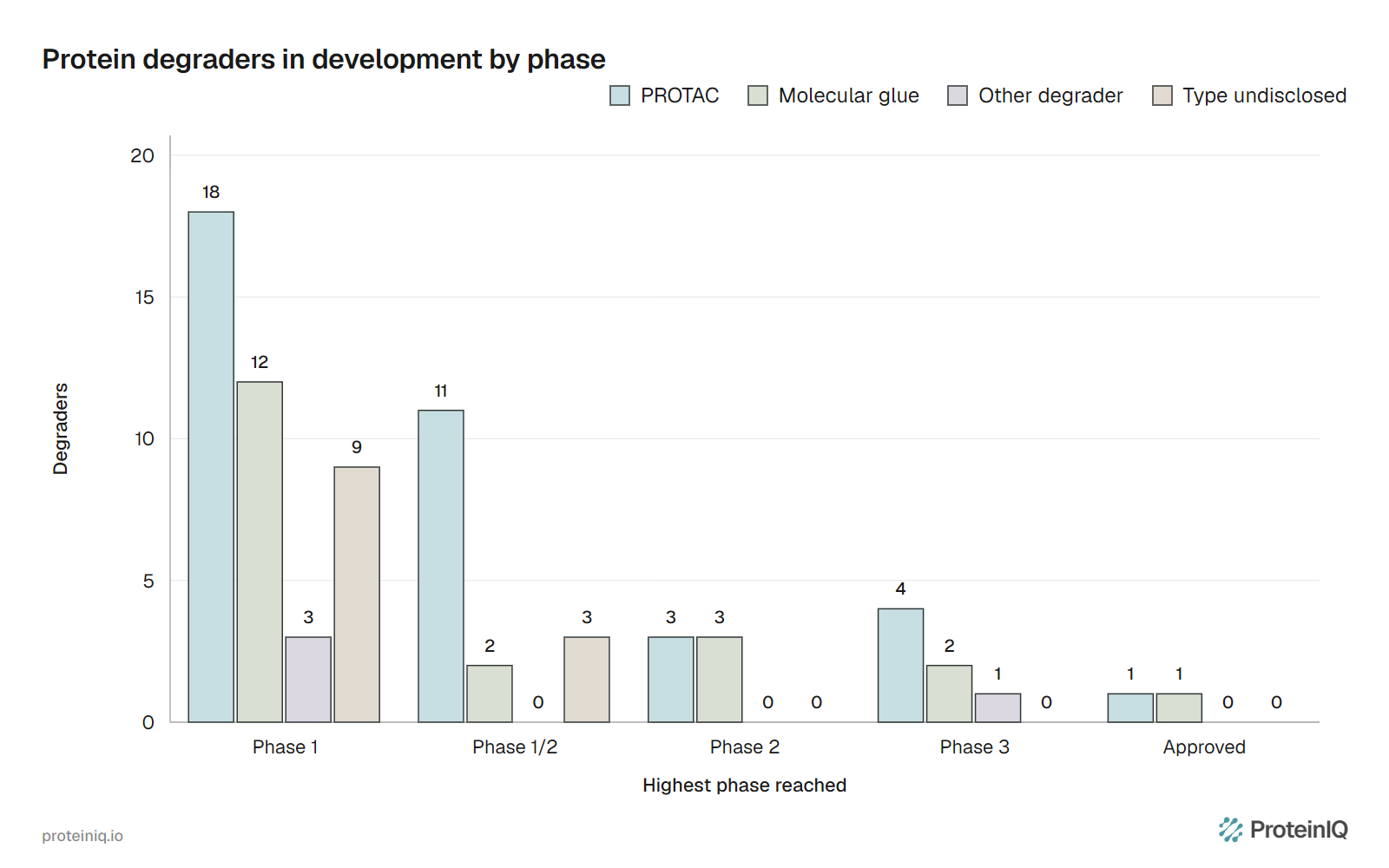
Fifty-four PROTACs have entered human trials since Arvinas dosed the first, bavdegalutamide, in March 2019, and 37 of them are still in development.[1][2] Most are early. Eighteen of the 37 have only reached Phase 1 and 11 more are in combined Phase 1/2 trials, while three are in Phase 2, four in Phase 3 and one is approved.
Size is the price of the design. Vepdegestrant weighs 723.9 Da, far past the 500 Da limit of Lipinski's rule of five, and yet it is taken as a daily tablet.[3] Almost every clinical PROTAC sits in that space beyond the rule, which is one reason chemists treat oral exposure as the first problem to solve, and why ADMET predictors trained on conventional drugs are least reliable for them.
The four PROTACs in Phase 3 attack three proteins. Bexobrutideg and tacabrutideg both degrade BTK, the kinase that ibrutinib blocks in leukemia, and both are being compared head to head with the newer BTK inhibitor pirtobrutinib.[4][1] BMS-986365 degrades the androgen receptor in prostate cancer. Setidegrasib, an intravenous PROTAC that recruits the VHL ligase, is the first degrader of mutant KRAS to reach Phase 3, in pancreatic cancer.[5]
| Degrader | Type | Sponsor | Target | E3 ligase | Stage |
|---|---|---|---|---|---|
| Vepdegestrant (Veppanu) | PROTAC | Arvinas, Pfizer | Estrogen receptor | CRBN | FDA approved, May 2026 |
| Iberdomide (Zenbexus) | Molecular glue | Bristol Myers Squibb | IKZF1 and IKZF3 | CRBN | FDA accelerated approval, August 2026 |
| Mezigdomide | Molecular glue | Bristol Myers Squibb | IKZF1 and IKZF3 | CRBN | Under FDA review, decision due May 2027 |
| Golcadomide | Molecular glue | Bristol Myers Squibb | IKZF1 and IKZF3 | CRBN | Phase 3, large B-cell lymphoma |
| BMS-986365 | PROTAC | Bristol Myers Squibb | Androgen receptor | CRBN | Phase 3, prostate cancer |
| Tacabrutideg (BGB-16673) | PROTAC | BeOne Medicines | BTK | CRBN | Phase 3, chronic lymphocytic leukemia |
| Bexobrutideg (NX-5948) | PROTAC | Nurix Therapeutics | BTK | CRBN | Phase 3, chronic lymphocytic leukemia |
| Setidegrasib (ASP3082) | PROTAC | Astellas | KRAS G12D | VHL | Phase 3, pancreatic cancer |
| BHV-1300 | Extracellular degrader | Biohaven | IgG antibodies | None (ASGPR) | Phase 3, Graves' disease |
Fifteen PROTACs have been dropped. The reasons say a lot about where the approach is still fragile. C4 Therapeutics stopped CFT8634 because deep degradation of BRD9 did not shrink tumors, and Foghorn's BRD9 degrader FHD-609 was halted after a patient developed a dangerous heart-rhythm change.[10][11] Other drops were replacements. Sanofi ended the IRAK4 degrader KT-474 after two Phase 2 trials in favour of a successor, KT-485, which entered its first trial in May 2026.[12]
Molecular glue degraders in clinical trials
A molecular glue is a single small molecule that changes the surface of an E3 ligase so it grabs a protein it would normally ignore. There is no linker and no second ligand, so glues are smaller than PROTACs: iberdomide weighs 449.5 Da against vepdegestrant's 723.9 Da.[13] The catch is discovery. A glue's partner protein cannot be designed in advance as easily as a PROTAC's, so many were found by screening.
The first glues were found by accident. Thalidomide, lenalidomide and pomalidomide were in use for years before researchers showed that they bind the ligase cereblon (CRBN) and make it destroy the transcription factors IKZF1 and IKZF3.[14][15] The anticancer sulfonamide indisulam turned out to work the same way through a different ligase, DCAF15.[16] Our dataset lists these drugs for reference but does not count them, because none was developed as a degrader.
Counting only glues designed or optimized to degrade a protein, 28 have entered human trials and 20 are still in development. Bristol Myers Squibb's cereblon E3 ligase modulators (CELMoDs) lead the field. Iberdomide won accelerated approval for multiple myeloma on August 13, 2026.[7] The FDA accepted mezigdomide's application in July and set a decision date of May 13, 2027, and golcadomide is in Phase 3 for lymphoma.[8]
Newer glues reach well beyond the IKZF proteins. Monte Rosa's MRT-6160 degrades VAV1, a signalling protein in immune cells, and entered a Phase 2 trial in Sjögren's disease under Novartis in August 2026.[17] Others in early trials remove GSPT1, NEK7, WEE1, ALK, ARNT, HuR, RBM39 and c-Myc, a transcription factor long treated as undruggable. Twenty-two of the 28 glues recruit cereblon, the ligase that thalidomide revealed.
Other kinds of degrader
Seven degraders in our count are neither PROTACs nor small-molecule glues. Three are degrader-antibody conjugates from Orum Therapeutics: an antibody delivers a GSPT1 glue into cancer cells that carry its target, in the way an antibody-drug conjugate delivers a toxin. The first, ORM-5029, was stopped after a patient died, and Bristol Myers Squibb ended its CD33-directed partner program, ORM-6151, in September 2026.[18]
Three more work outside the cell, where the ubiquitin system cannot reach. Biohaven's BHV-1300 binds circulating IgG antibodies at one end and a liver receptor, ASGPR, at the other, so the liver swallows and digests them. It entered Phase 3 in Graves' disease in June 2026, and its sibling BHV-1400 clears a disease-causing form of IgA.[9] EpiBiologics' EPI-326 uses a bispecific antibody to pull EGFR into lysosomes. The seventh, Ranok's RNK05047, recruits the chaperone HSP90 instead of an E3 ligase.
The boundary matters for counting. Halda's HLD-0915 is often listed with degraders, but it holds the androgen receptor next to an essential protein to kill the cell rather than destroying the receptor, so we exclude it.[19] We also leave out drugs that inhibit a protein and happen to speed up its breakdown, such as the oral estrogen receptor degraders (SERDs) and Ensem's PI3Kα inhibitor ETX-636.
Which E3 ligases and targets do degraders use?
Cereblon dominates. Of the 53 degraders whose E3 ligase is public, 47 use CRBN, three use VHL and three use other ligases (DCAF15, DCAF16 and CHIP). The other 45 degraders have no ligase named in public, among them most Chinese PROTACs and Kymera's immunology programs. Even if a few of them recruit something new, the clinic so far relies on a handful of ligases.
| E3 ligase | PROTACs | Molecular glues | Other | Type undisclosed | All |
|---|---|---|---|---|---|
| CRBN | 22 | 22 | 3 | 0 | 47 |
| VHL | 3 | 0 | 0 | 0 | 3 |
| DCAF15, DCAF16 or CHIP | 0 | 3 | 0 | 0 | 3 |
| None (lysosome or chaperone) | 0 | 0 | 4 | 0 | 4 |
| Not disclosed | 29 | 3 | 0 | 13 | 45 |
| All | 54 | 28 | 7 | 13 | 102 |
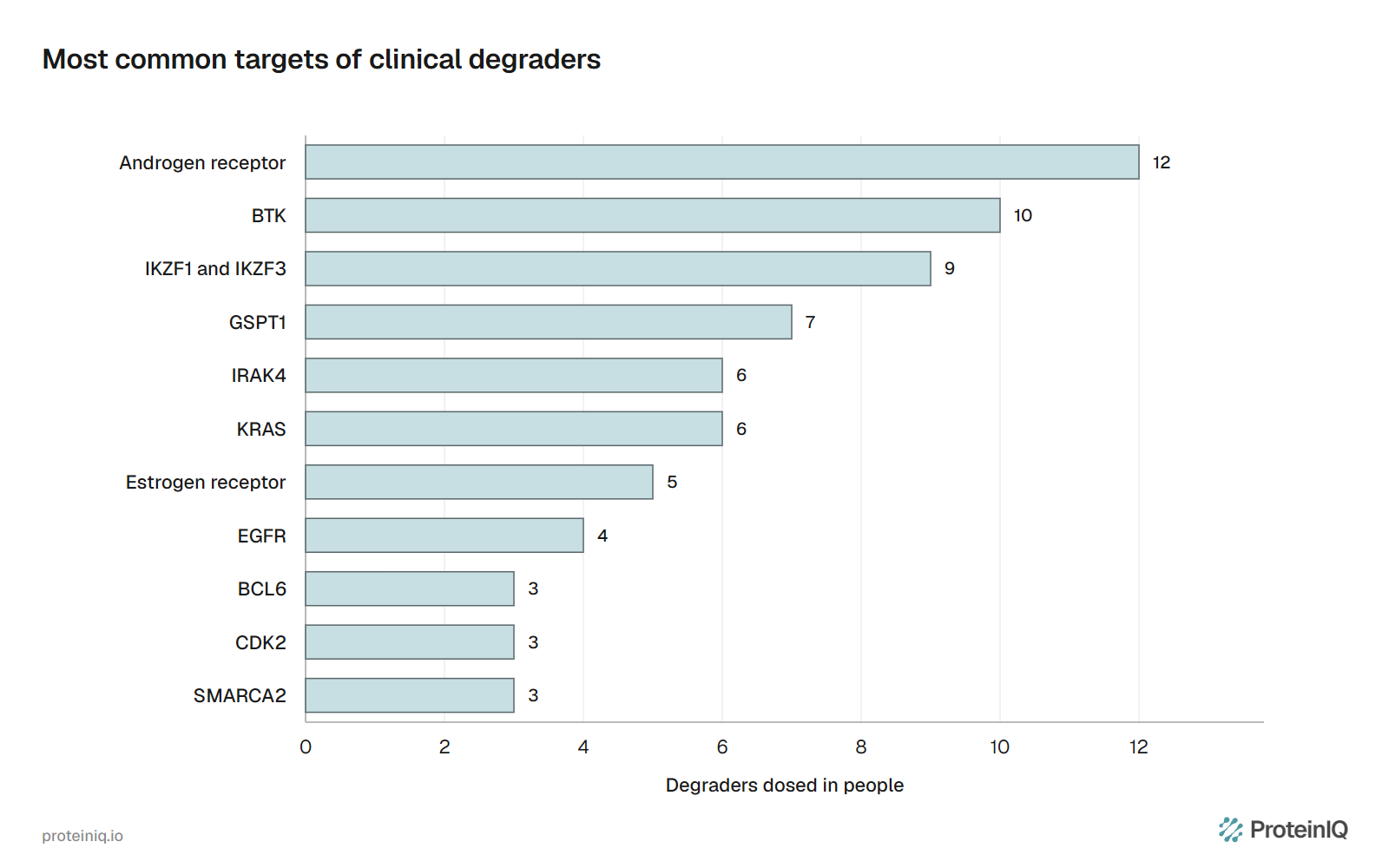
The targets are just as concentrated. The androgen receptor is the most common, with 12 degraders, followed by BTK with 10 and the IKZF1 and IKZF3 pair with nine. Most of these proteins already had approved inhibitors, and degraders were brought in to beat resistance mutations that stop those inhibitors from binding. A degrader only needs to hold its target long enough for tagging, so a mutation that weakens binding does not always stop it.
Cancer still accounts for 83 of the 102. The first degrader for an immune disease, KT-474, entered trials in 2021, and immunology and inflammation now count 14 degraders aimed at IRAK4, STAT6, IRF5, VAV1, NEK7, IKZF1 and IKZF3 and circulating antibodies. Two Arvinas PROTACs, against LRRK2 in Parkinson's disease and the expanded androgen receptor of spinal and bulbar muscular atrophy, are the only brain programs.
Whether a PROTAC works depends less on how tightly each end binds than on the three-part complex it forms with the target and the ligase. Co-folding models such as Boltz-2 and Chai-1 take several protein chains and a small molecule in one job, so they can propose such a ternary complex for a design. Their predictions for these flexible assemblies are less reliable than for one protein and one ligand, which AutoDock Vina can dock into a single binding pocket.
How fast are degraders entering the clinic?
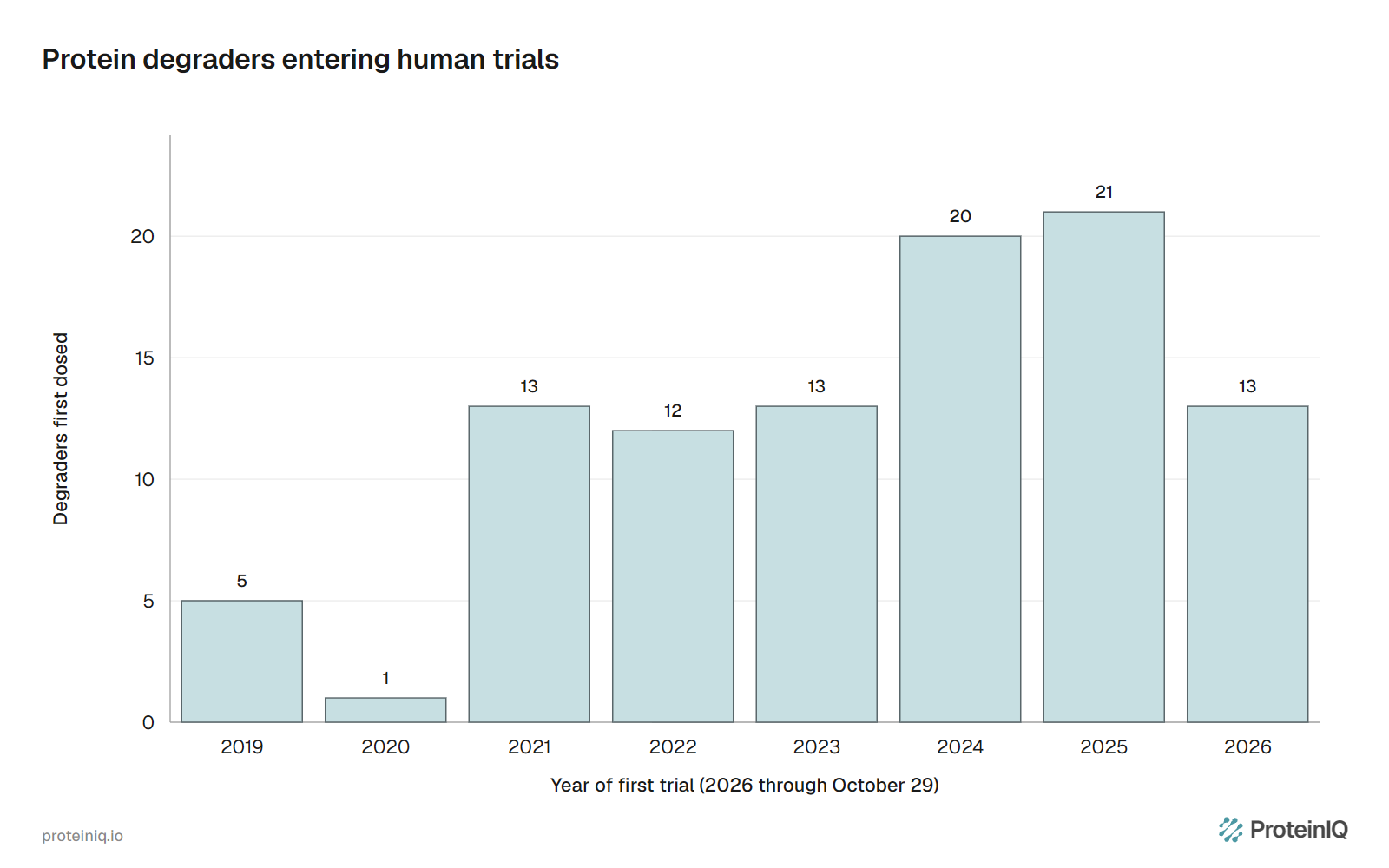
About four times as fast as when PROTACs arrived. Five degraders were first dosed in 2019, the year the first PROTACs entered trials, then 12 or 13 a year from 2021 to 2023 and 20 or more in each of 2024 and 2025. Thirteen more had started by the end of October 2026. Before 2019, only four designed degraders had reached people, all cereblon modulators from Celgene, now part of Bristol Myers Squibb.
The newest entrants also show who is doing the work. Large companies that once licensed degraders from biotechs now run trials of their own, among them AstraZeneca, Astellas, Bristol Myers Squibb, Gilead, Novartis and Sanofi. Chinese companies such as Hengrui, Haisco, Chia Tai Tianqing, Qilu and Huadong account for a growing share, and several of their degraders appear only in Chinese registries or company filings.
Why published PROTAC counts disagree
Every published count is right by its own rules. They differ in whether they count molecules or trials, whether they include glues, whether discontinued programs stay in, and when they were taken. Chirnomas, Hornberger and Crews counted 18 degraders in cancer trials at the start of 2023.[2] GlobalData counted 14 oncology PROTACs in the clinic around the same time, and 39 PROTAC trials a year later.[20][21]
| Count | Source and date | What it counts |
|---|---|---|
| 12 | CAS, November 2024 | PROTACs in Phase 1 (six) and Phase 2 (six) |
| 14 | GlobalData, February 2023 | Oncology PROTACs from companies in clinical stages |
| 18 | Chirnomas et al., February 2023 | Degraders in Phase 1 or 1/2 cancer trials, plus one in Phase 3 |
| 39 | GlobalData, June 2024 | Phase 1 to 3 trials of PROTACs, not molecules |
| Over 40 (52 listed) | Biochempeg, May 2025 | PROTACs in trials, including some that had stopped; no glues |
| 123 | Cai et al., 2025 | PROTAC clinical trials registered from 2004 to 2024, not molecules |
| 54 (37 active) | ProteinIQ, October 2026 | PROTACs ever dosed in people; active excludes 15 dropped and 2 unclear |
| 102 (73 active) | ProteinIQ, October 2026 | All degraders ever dosed: PROTACs, glues, other and undisclosed |
Counting trials instead of molecules inflates the total fast: vepdegestrant alone has more than 20 trials on ClinicalTrials.gov, many of them small studies of food effects and drug interactions.[1] Counting molecules but keeping dropped ones gives a number that never falls. The 13 degraders whose sponsors have not said whether they are PROTACs or glues add one more uncertainty: depending on how they are classified, the PROTAC total lies between 54 and 67.
How we built the tracker
We searched the ClinicalTrials.gov API on October 29, 2026 for degrader terms and for about 130 named candidates, then checked each candidate against company pipelines, press releases, financial filings and conference abstracts.[1] A degrader counts when it was designed or optimized to remove its target protein and at least one trial of it had actually started dosing people. A registered trial that was not yet recruiting does not count, and nine such degraders are listed in the dataset as not counted.
We split degraders into four types. PROTACs are two-ended molecules that join a target ligand to an E3 ligase ligand, including the ones Bristol Myers Squibb calls ligand-directed degraders. Molecular glues are single small molecules that create a new contact between a ligase and a target. Other degraders use antibodies, the lysosome or a chaperone. The undisclosed group is everything the sponsor has called a degrader without saying which kind.
Status is our reading of the most recent evidence. Active means a trial is running or the sponsor lists the program as in development. Discontinued means the sponsor ended development, or paused it until a partner is found with no trial running. Unclear means no trial update or company news for about two years, which applies to seven degraders. The first-in-human year is the actual start year of the earliest trial.
The full dataset gives each degrader's sponsor, type, E3 ligase, target, therapeutic area, highest phase, regulatory status, development status, first-in-human year, trial IDs and the source for each row. The summary holds every count on this page.
Both files are free to reuse under CC BY 4.0 with credit to ProteinIQ. We last checked them on October 29, 2026 and will refresh them every quarter, since in 2025 a new degrader entered the clinic every two to three weeks.
Seven years after the first PROTAC entered a trial, the field has its first two approvals, one of each main type, and more than 70 degraders still moving through the clinic. Most of them still recruit cereblon and still chase targets that inhibitors already reach. The next test is whether degraders can do what inhibitors cannot, in the brain, in autoimmune disease and against proteins without a pocket.