Lipinski's rule of five
What the four limits mean, where they came from and how often approved drugs break them

Matic Broz, PhD14 min
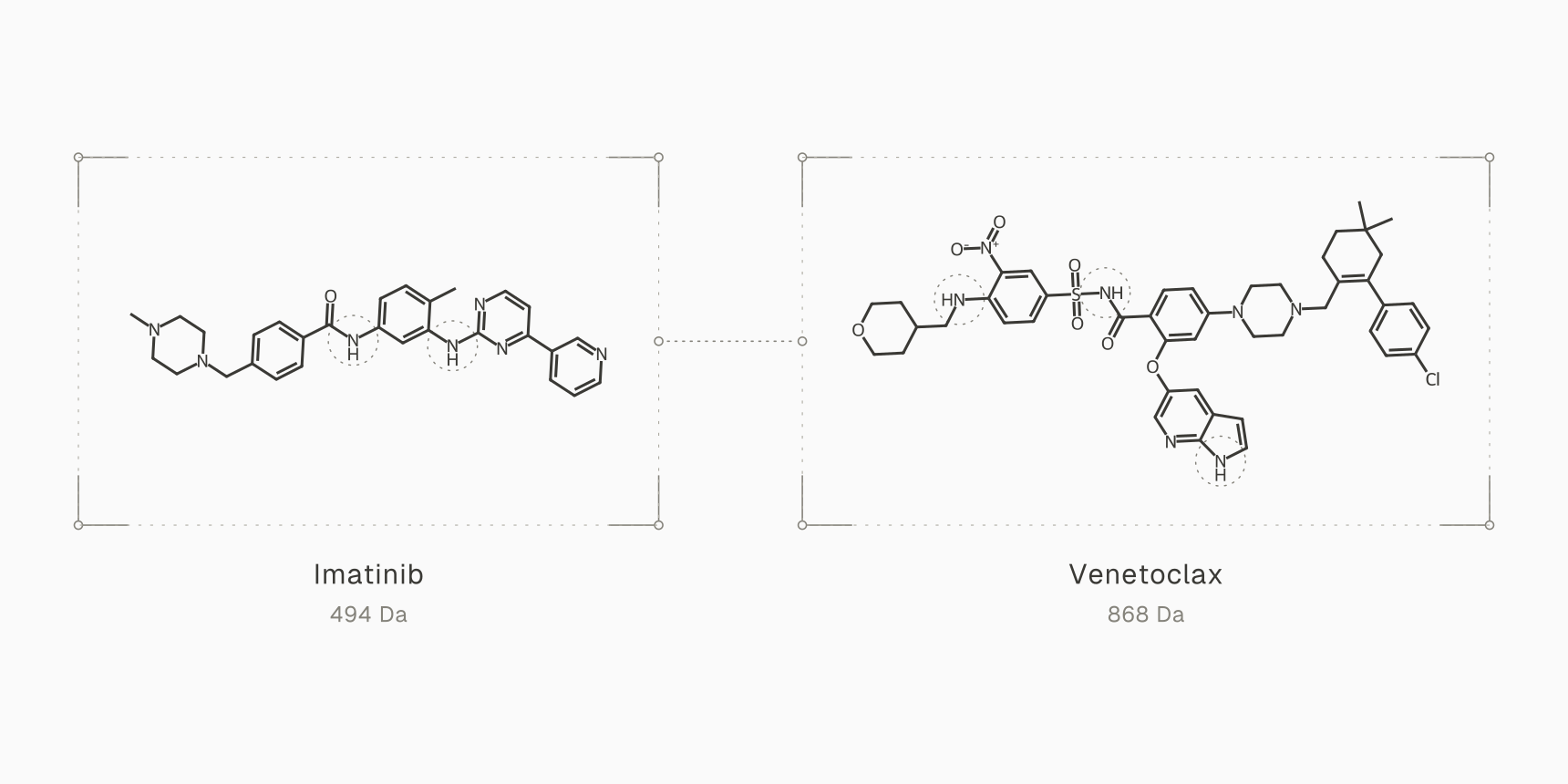
Venetoclax, a leukemia drug taken as a tablet, weighs 868 daltons, has a calculated logP of 8.7 and carries 14 nitrogen and oxygen atoms. By the yardstick most medicinal chemists learn first, it should have been a poor bet for an oral drug. Imatinib, a tablet for chronic myeloid leukemia, sits just inside every limit at 494 daltons. Both are approved, and the difference between them is what Lipinski's rule of five measures.
The rule says poor absorption or permeation is more likely when a compound breaks two or more of four limits: a molecular weight above 500 Da, a calculated logP above 5, more than 5 hydrogen-bond donors and more than 10 hydrogen-bond acceptors. We checked all 2,104 approved small-molecule drugs in ChEMBL 37 against these limits. 72% pass all four, 14% break one and 13% break two or more.
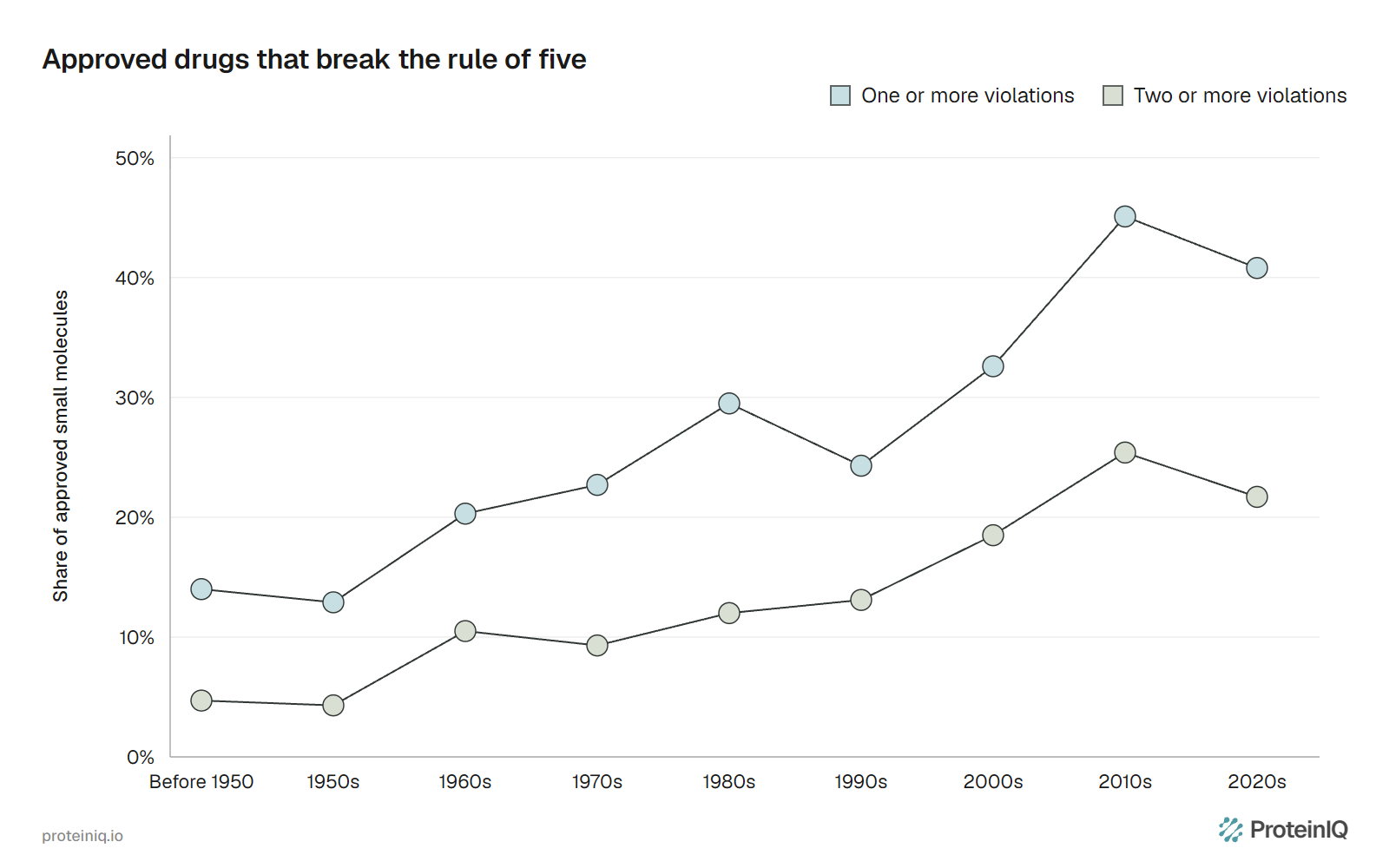
Among drugs with an oral product, 12% break two or more, and the share has grown from fewer than one in twenty drugs first approved before 1960 to one in four in the 2010s. You can run the same check on any structure with the Lipinski's rule of 5 calculator.
What is Lipinski's rule of five?
Christopher Lipinski and his colleagues at Pfizer published the rule in 1997 to warn chemists early when a compound was unlikely to be absorbed after swallowing.[1] In their words, poor absorption or permeation is more likely when there are more than 5 hydrogen-bond donors, more than 10 acceptors, a molecular weight over 500 and a calculated logP over 5, or a Moriguchi logP over 4.15.[2] It is called the rule of five because every limit is a multiple of five.
The limits were not derived from absorption experiments. Lipinski's team analyzed 2,245 compounds from the World Drug Index, a catalogue of drugs and development candidates, and set each limit near the 90th percentile of that collection.[1][3] The rule therefore describes where most drug candidates of the early 1990s sat, and it flags compounds that sit outside on more than one count.
| Property | Limit | What it stands for | Approved drugs over the limit |
|---|---|---|---|
| Molecular weight | 500 Da | Size, which slows diffusion through membranes | 16.4% |
| Calculated logP | 5 | Lipophilicity, which hurts solubility when too high | 12.8% |
| Hydrogen-bond donors | 5 | OH and NH groups that must shed water to enter a membrane | 6.0% |
| Hydrogen-bond acceptors | 10 | N and O atoms, a second measure of polarity | 10.3% |
Each limit stands for one physical obstacle. LogP is the logarithm of how a compound divides between octanol and water, so a logP of 5 means 100,000 times more in the oily phase; such molecules dissolve poorly in the gut. Donors and acceptors measure how strongly a molecule holds on to water, which it has to give up to cross the fatty interior of a cell membrane. Size slows that crossing too.
Two details are easy to miss. The rule is an alert, not a pass mark: one violation is allowed, and the warning applies from two. Lipinski also stated that it holds only for compounds that are not carried across membranes by active transporters, and natural products are set aside as well.[5] A drug that breaks the rule and is still absorbed is often using one of those carriers.
How many approved drugs break the rule of five?
We counted 2,104 approved small-molecule drugs in ChEMBL release 37, the European Bioinformatics Institute's curated database of drugs and bioactive molecules.[4] Each drug is one parent compound, so a salt such as atorvastatin calcium counts once as atorvastatin. Of these, 1,521 (72.3%) pass all four limits, 302 (14.4%) break exactly one and 281 (13.4%) break two or more. Only 89 drugs break three or all four.
| Group | Drugs | No violations | One violation | Two or more |
|---|---|---|---|---|
| All approved small molecules | 2,104 | 72.3% | 14.4% | 13.4% |
| With an oral product | 1,238 | 74.9% | 13.3% | 11.8% |
| Injected or applied to the skin or eye only | 545 | 62.4% | 16.7% | 20.9% |
The route makes the difference the rule predicts. Drugs given only by injection or applied to the body surface trigger the alert almost twice as often as oral drugs, 20.9% against 11.8%, because they never have to cross the gut wall. Molecular weight is the limit broken most often, by 345 drugs, followed by cLogP with 270.
The answer also depends on how donors and acceptors are counted. Lipinski counted every nitrogen and oxygen atom as an acceptor, which is what we report above. Many software tools, ChEMBL included, count only atoms that can actually accept a hydrogen bond, so an amide nitrogen does not count. With those definitions the share with two or more violations falls from 13.4% to 11.2%, and the share with at least one from 27.7% to 25.7%.
Why published figures range from 8% to 38%
Ask how many approved drugs break the rule of five and you can find answers from under a tenth to more than a third. Most of that spread comes from three choices: whether one violation counts or only two, whether the denominator is all drugs or oral drugs only, and which years of approvals are included. When we repeat each analysis on our data with the same choices, the answers line up.
| Study | Drugs analyzed | Measure | Published | ProteinIQ, same window |
|---|---|---|---|---|
| Benet et al. 2016 | 852 oral drugs | Two or more violations | 7.9% | 11.8% (1,238 oral drugs) |
| Benet et al. 2016 | Oral drugs approved up to 1997 | Two or more violations | 5.6% | 6.5% |
| Benet et al. 2016 | Oral drugs approved after 1997 | Two or more violations | 15.7% | 19.4% |
| Pirie et al. 2024 | 371 FDA oral drugs, 2000 to 2022 | Two or more violations | 17% | 16.8% with RDKit donor and acceptor counts |
| Reese et al. 2024 | FDA oral drugs, 2011 to 2022 | Deviate from the rule | About 38% | 45.0% with one or more violations |
The low figures come from all oral drugs ever approved, a population dominated by the small molecules of the 1950s to 1980s. Benet and colleagues found 67 of 852 oral drugs, 7.9%, with two or more violations.[5] The high figures come from recent approvals counted at one violation. Reese and colleagues found that about 38% of FDA-approved oral drugs from 2011 to 2022 deviate from the original criteria, and about 53% from extended versions of the rule.[6]
In between, Pirie and colleagues counted 64 of 371 FDA oral drugs approved from 2000 to 2022, or 17%, with two or more violations.[3] Over the same years and with the same RDKit counts, we get 16.8%. Our oral shares run a few points above Benet's in both eras, which may reflect ChEMBL's inclusion of drugs approved outside the US. The direction is the same in every comparison: drugs approved after the rule was published break it about three times as often as drugs approved before.
Drugs have grown larger since 1997
The rule did not stop drugs from growing. Among small molecules first approved before 1960, 8 of 183, or 4.4%, trigger Lipinski's alert. The share passes 10% in the 1960s, reaches 18.5% in the 2000s and peaks at 25.4% in the 2010s. Drugs first approved from 2020 to 2024 are close behind at 21.7%.
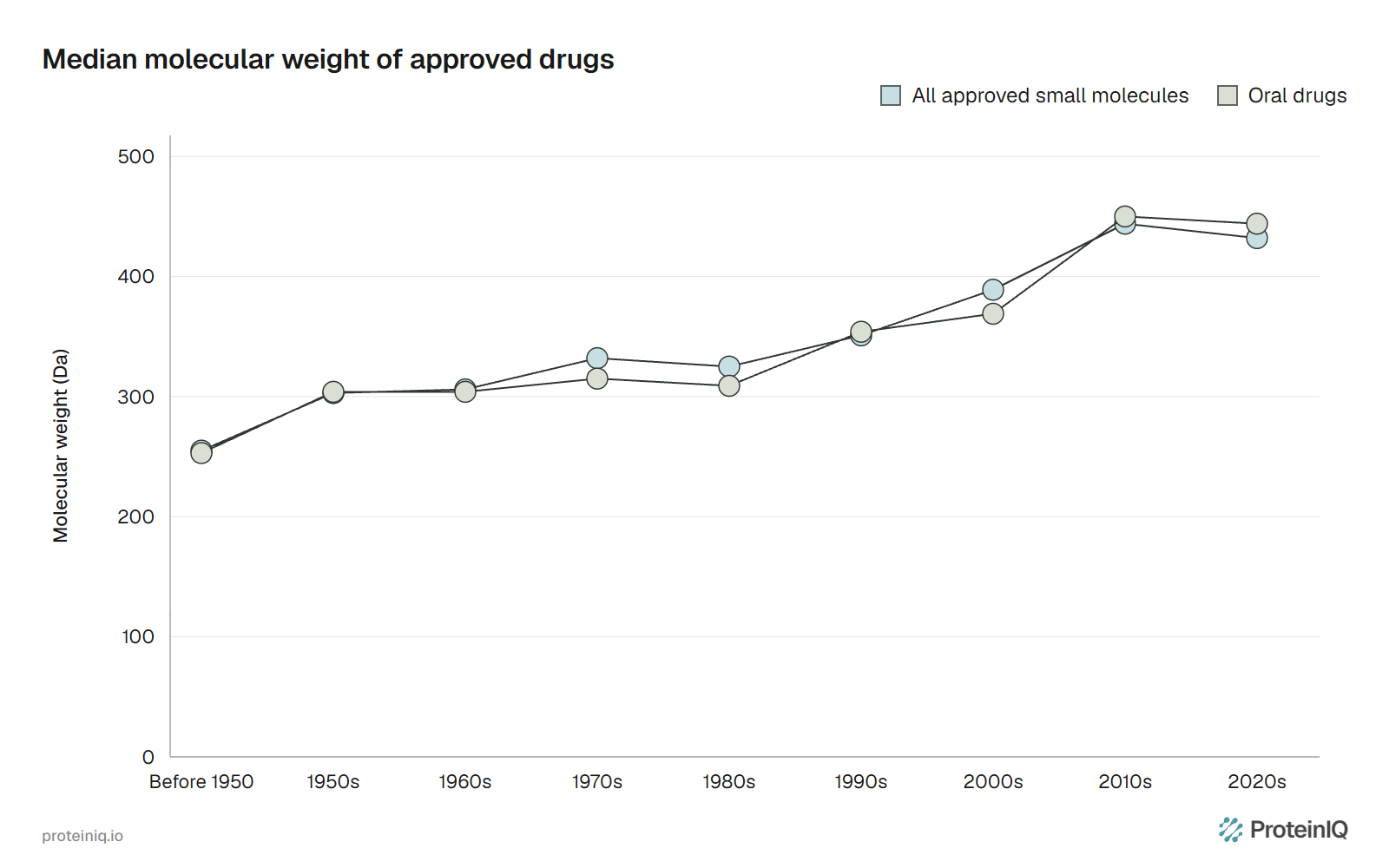
Size drives most of the change. The median molecular weight of approved drugs rose from 351 Da in the 1990s to 444 Da in the 2010s, and the share above 500 Da doubled from 14.8% to 31.7%. Oral drugs followed the same path, to a median of 450 Da in the 2010s. Lipophilicity rose less, with the median cLogP moving from 2.7 to 3.6.
Shultz reached the same conclusion by comparing oral drugs approved before and after the rule was published. Molecular weight and acceptor counts rose over two decades while cLogP and donor counts stayed about constant, which he took as evidence against molecular weight being a drug-like property at all.[7]
His analysis covered the 409 small molecules the FDA had approved since 1997, and in both 2016 and 2017 their average molecular weight was above 500 Da.[8] Pirie and colleagues estimate that a rule built from the 90th percentile of recent oral drugs would set the limit at 589 Da.[3]
Which drugs break the rule most often
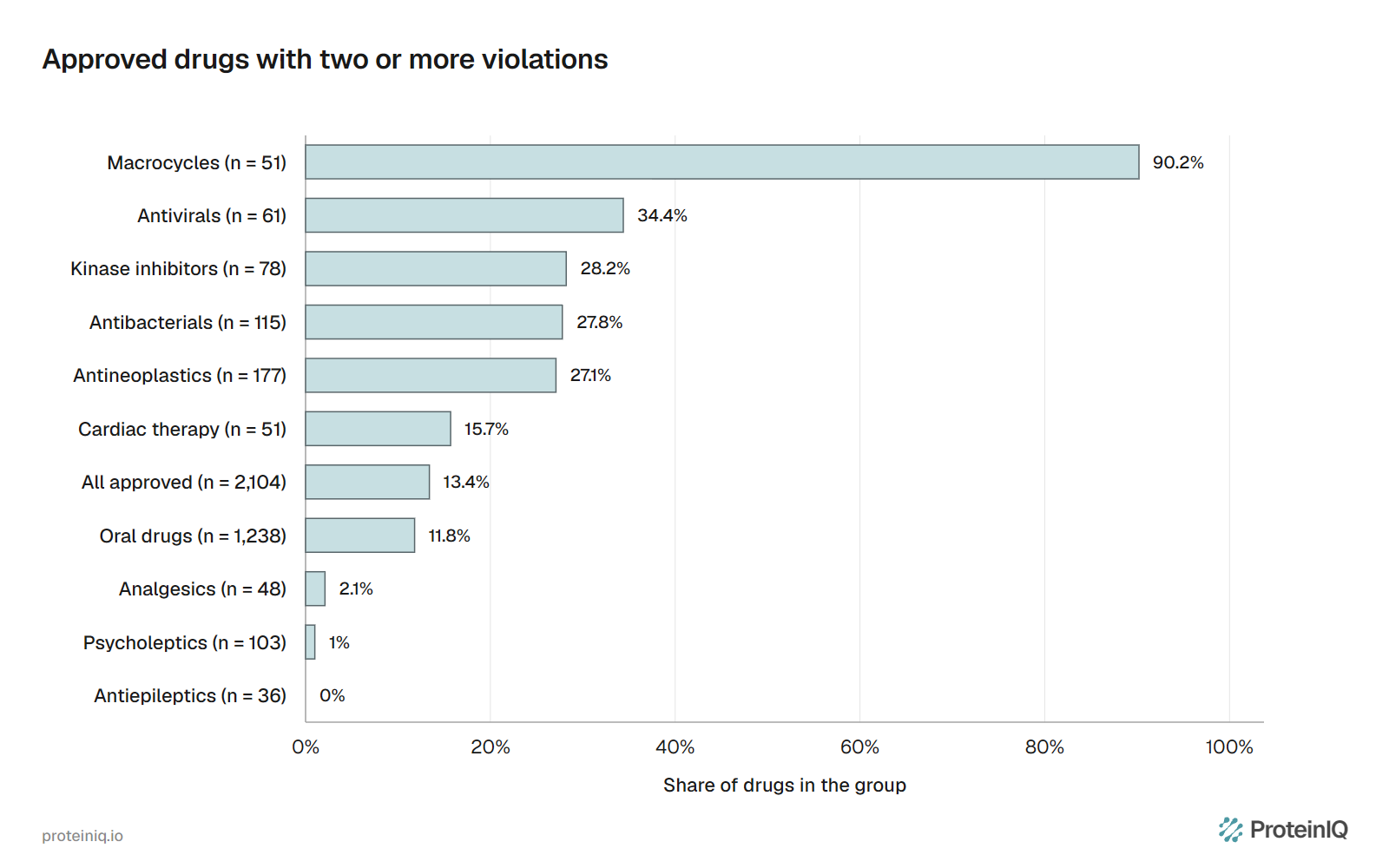
The violations are concentrated in a few kinds of drugs. Nine in ten approved macrocycles, drugs built around a ring of 12 or more atoms, trigger the alert. Antivirals, kinase inhibitors, antibacterials and cancer drugs each do so at least twice as often as the average drug, while drugs acting on the brain almost never do.
Macrocycles are mostly natural products and their derivatives, such as the macrolide antibiotics erythromycin and azithromycin, and the immunosuppressants sirolimus and tacrolimus. Benet and colleagues found that most drugs with two or more violations are natural products or derived from them, a group Lipinski had set aside from the start.[5] Their large rings can fold so that polar groups bond to each other instead of to water, which helps them cross membranes despite their size.[9]
Antivirals are the next largest group. The hepatitis C drugs ledipasvir, daclatasvir and velpatasvir weigh 739 to 889 Da and are all taken as tablets. Benet and colleagues counted 16 of 21 HIV protease inhibitors and hepatitis C drugs with two or more violations.[5] Kinase inhibitors such as lapatinib and nilotinib break it on size and lipophilicity together, each weighing more than 500 Da with a cLogP above 6.
At the other end, only 1 of 103 psycholeptics and none of the 36 antiepileptics or 71 psychoanaleptics trigger the alert. Drugs that act in the brain must also cross the blood-brain barrier, a tighter filter than the gut, so they stay small and moderately lipophilic.
Some oral drugs break the rule because they are not meant to be absorbed at all. Oral vancomycin treats infections inside the gut, and recent drugs such as tenapanor, odevixibat and maralixibat act on transporters in the intestine. Pirie and colleagues removed such drugs before analyzing oral approvals; our counts keep them, since ChEMBL records them as oral.[3]
Beyond the rule of five
Once enough approved drugs broke the rule, chemists began to treat the space past it as a design target rather than a dead end. Doak and colleagues surveyed oral drugs and clinical candidates above 500 Da and concluded that oral drugs are found far beyond the rule of five. Intramolecular hydrogen bonds, macrocyclization, dose and formulation can each rescue bioavailability, and natural products and peptide-derived designs are the main sources of such drugs.[9]
Other descriptors explain some of the exceptions. Veber and colleagues measured oral bioavailability in rats for more than 1,100 drug candidates and found that molecular weight above 500 did not by itself separate poor from acceptable compounds. Ten or fewer rotatable bonds and a polar surface area of 140 Ų or less predicted good bioavailability better.[10] In our data, 86% of oral drugs pass Veber's rule, but only 31% of the oral drugs that trigger Lipinski's alert do.
The rule also has a limit in the other direction: passing it says little about whether a molecule is a drug. Benet and colleagues note that more than 82% of a filtered set of ordinary chemicals from a commercial catalogue also pass.[5] The rule screens for oral absorption, not for activity, safety or a good starting point.
The rule of five has outlived the drugs it was fitted to. Its limits describe the candidates of the early 1990s, and a quarter of the drugs approved in the 2010s sit outside them, most in classes where the reason is known: macrocycles that fold, antivirals, kinase inhibitors, and drugs that act in the gut or are injected. What it still captures is the price of size and polarity for a molecule that must cross the gut wall, which is why most oral drugs and nearly all drugs for the brain remain inside it.
How to use the rule of five today
Treat a violation as a question to answer rather than a reason to discard a molecule. A compound with one violation is within the rule as Lipinski wrote it. With two or more, check whether the drug will be injected, whether it acts in the gut, or whether it belongs to a class known to break the rule, such as macrocycles. For an oral program, check polar surface area and flexibility as well.
For a single structure or a library, the Lipinski's rule of 5 calculator reports molecular weight, logP, donors, acceptors and the violation count from SMILES. Earlier in a project, the lead-likeness filter applies tighter limits suited to screening hits, which tend to grow during optimization. Structural alerts are a separate question: the PAINS filter and Brenk filter flag groups that cause false assay signals or toxicity, whatever a molecule's size.
For a fuller property profile, molecular descriptors calculates polar surface area, rotatable bonds and dozens of other descriptors, and ADMET-AI predicts absorption, metabolism and toxicity endpoints directly. In virtual screening, these filters usually run before docking to remove compounds that would fail for reasons unrelated to the target.
How we counted
We took every molecule with max_phase 4 in ChEMBL 37, released on May 1, 2026, and read through the ChEMBL web services on October 29, 2026.[4] ChEMBL uses that phase for compounds approved in at least one jurisdiction it tracks, so the set is larger than the FDA's list of novel drugs.
Salts and hydrates were merged into their parent compound. We kept small molecules and structurally defined peptides and oligosaccharides up to 900 Da, and removed biologics, metal-containing and inorganic compounds, mixtures and parents without a single defined structure.
This is the same population of 2,104 drugs as our approved drug library. It leaves out large cyclic peptides such as cyclosporine and mixtures such as ivermectin, both oral drugs that break the rule. We recalculated every property with RDKit 2025.03.5 rather than using ChEMBL's stored violation counts, which are missing for 27 of these drugs, 22 of them above 500 Da.
Oral status is ChEMBL's oral route flag on the parent or any of its salts, and the decade is that of ChEMBL's first approval year, recorded for 1,805 drugs up to 2024. The per-drug table (CSV), summary of every figure (JSON), methods and definitions and analysis script reproduce all of our numbers.
Because ChEMBL is licensed CC BY-SA 3.0, the data files are shared under the same license with credit to ChEMBL and ProteinIQ. We last checked them on October 29, 2026.