How long do clinical trials take?
A single clinical trial usually lasts from several months to several years. Among trials completed in 2024, the median was 408 days in Phase 1, 1,146 days in Phase 2, and 994 days in Phase 3.
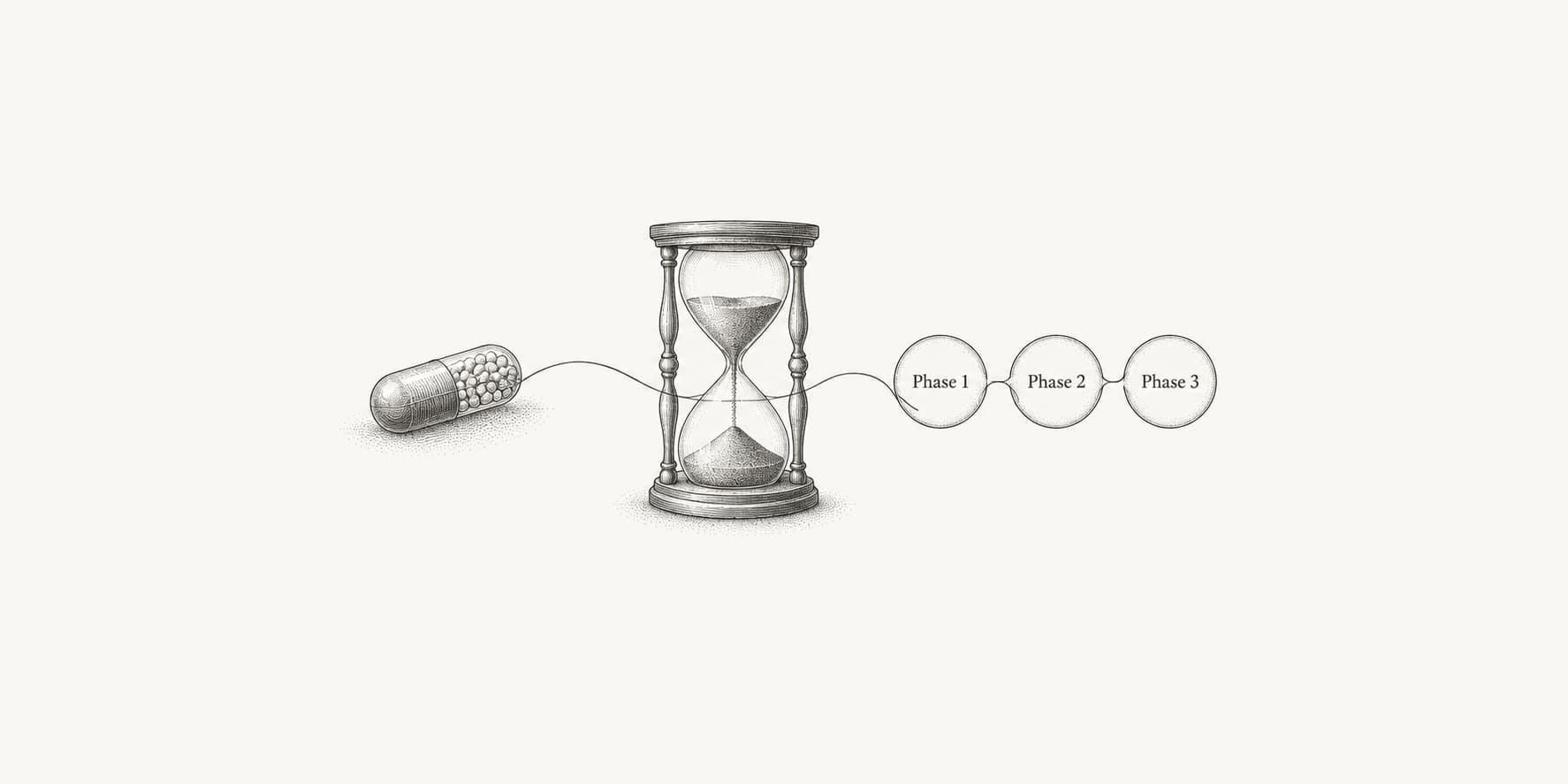
A single clinical trial usually lasts from several months to several years. A full clinical development program takes longer because a drug normally passes through multiple trials before approval.
Among trials completed in 2024, the median start-to-completion time was 408 days for Phase 1, 1,146 days for Phase 2, and 994 days for Phase 3.
How long do clinical trials take?
A single clinical trial can take months or years, while the complete clinical development program for a successful new drug typically takes about eight years.
ClinicalTrials.gov data processed by Our World in Data show that trials completed in 2024 had median durations of 408 days in Phase 1, 1,146 days in Phase 2, 994 days in Phase 3, and 703 days in Phase 4.[1]
These figures measure the time from a trial's start date to its study completion date. They describe individual completed trials, not the time needed to move one drug through every phase.
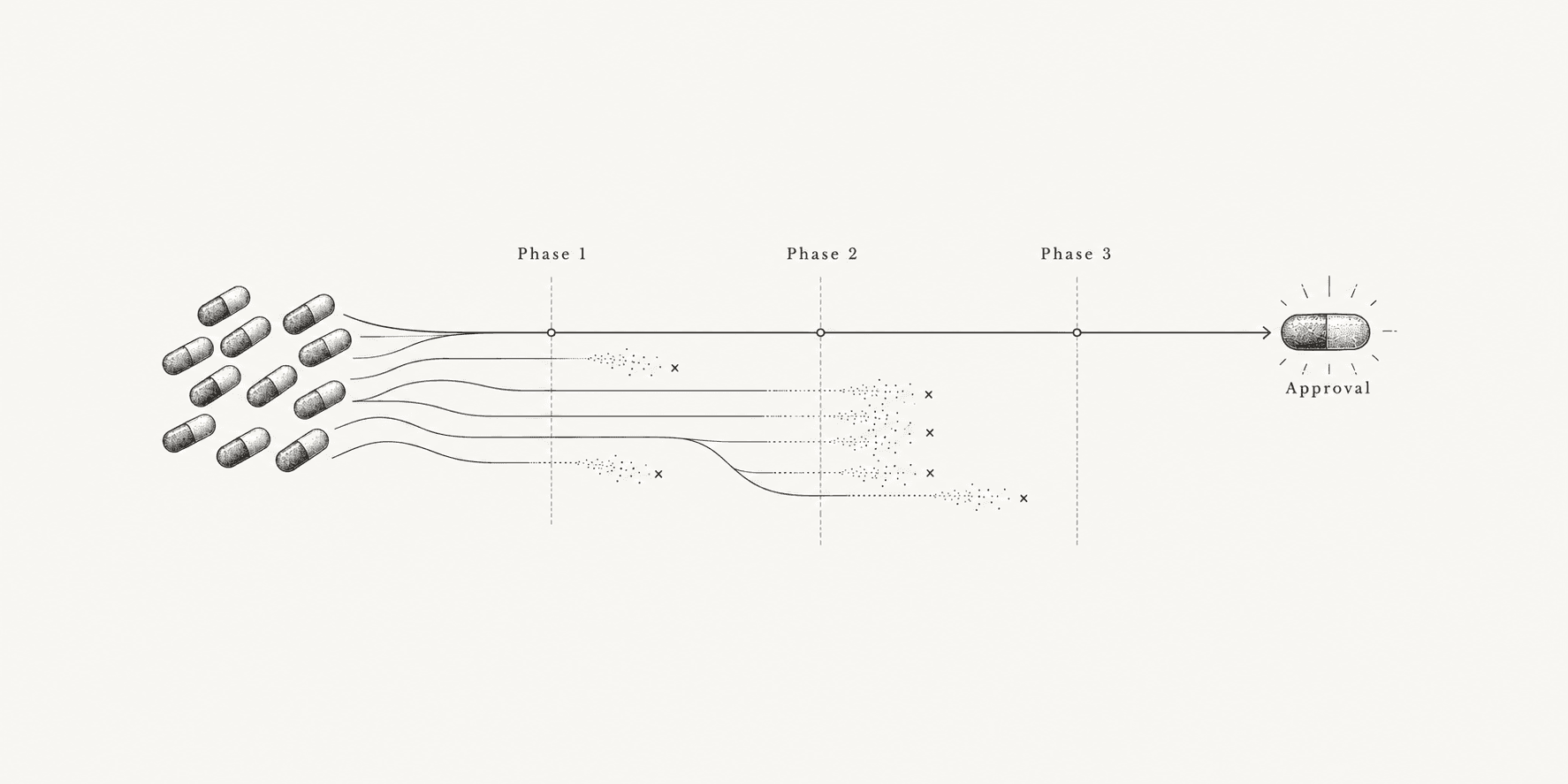
For innovative drugs approved by the FDA from 2010 to 2020, the median clinical development time from the first human study to marketing authorization was 8.3 years.[3] That estimate includes only successful programs. Most candidates do not reach approval, as the failure rates show.
Preclinical research is outside this clock because it happens before testing begins in people. Target discovery, laboratory experiments, animal studies, and early screens such as ADMET prediction belong to the longer drug development timeline.
The chart uses completed interventional studies with a valid start date, completion date, and phase in ClinicalTrials.gov. The medians are grouped by the year in which each study was completed.[1]
How long does a Phase 1 clinical trial take?
A Phase 1 clinical trial usually takes several months, although the median among Phase 1 trials completed in 2024 was 408 days, or about 13 months.[1][2]
FDA describes Phase 1 as the first small human study, usually involving 20 to 100 healthy volunteers or patients. Its main purpose is to assess safety, dosage, and how the drug behaves in the body.[2]
The two figures use different frames. The registry measures the full interval from study start to completion, while FDA gives a short public summary of the phase. A brief dosing period can sit inside a longer study with enrollment and follow-up.
How long does a Phase 2 clinical trial take?
A Phase 2 clinical trial typically takes several months to two years, according to FDA. In the 2024 completed-trial data, the median was 1,146 days, or about 3.1 years.[1][2]
Phase 2 studies usually enroll up to several hundred people with the condition being treated. They test whether the treatment appears to work, continue safety monitoring, and help researchers choose the design and dose for Phase 3.[2]
The two figures are not estimates of the same population. FDA gives a general phase range. The ClinicalTrials.gov median covers all qualifying completed interventional studies in that phase, including studies with long enrollment or follow-up periods.
How long does a Phase 3 clinical trial take?
A Phase 3 clinical trial usually takes one to four years. The median among Phase 3 trials completed in 2024 was 994 days, or about 2.7 years.[1][2]
Phase 3 studies commonly enroll 300 to 3,000 participants. They are designed to confirm treatment benefit and collect more safety data, including adverse reactions that smaller studies may not detect.[2]
Larger enrollment does not automatically make every Phase 3 trial longer than every Phase 2 trial. The endpoint matters. A study measuring survival, disease progression, or a rare event may need more follow-up than one measuring a faster clinical response.
Why do some clinical trials take longer than others?
Clinical trials take longer when researchers need more participants, slower outcomes, or longer follow-up.
A 2025 analysis of 86,838 trials found that phase, target enrollment, therapeutic area, sponsor type, and trial region were among the factors most closely associated with duration.[4] Oncology trials can be especially long when outcomes depend on disease progression or survival rather than an immediate laboratory measurement.
The protocol sets the endpoint, visit schedule, sample size, and follow-up period before the study begins. Recruitment delays extend the calendar, while rare diseases can require many sites to find enough eligible participants. Some phases overlap, so adding the duration of Phase 1, Phase 2, and Phase 3 does not always reproduce the total program length.
Do vaccine and medical-device trials take the same time?
No fixed timeline applies to every vaccine or medical device. Vaccine studies generally use the same three pre-approval phases as drug studies, while medical-device studies follow a different framework.
FDA says vaccine development has no predetermined timeline. Vaccine phases may run sequentially or overlap, and Phase 3 generally includes thousands of people to measure effectiveness and less common side effects.[5] Faster vaccine development can come from overlapping work, adaptive designs, earlier manufacturing investment, or existing knowledge of the pathogen. It does not require omitting the clinical phases.
Medical devices are not neatly divided into drug-style Phase 1, 2, and 3 trials. FDA describes exploratory studies, pivotal studies that support safety and effectiveness, and postmarket studies. Not every device goes through all three stages.[6] The duration therefore depends on the device, its risk, the endpoint, and the evidence required for its regulatory pathway.