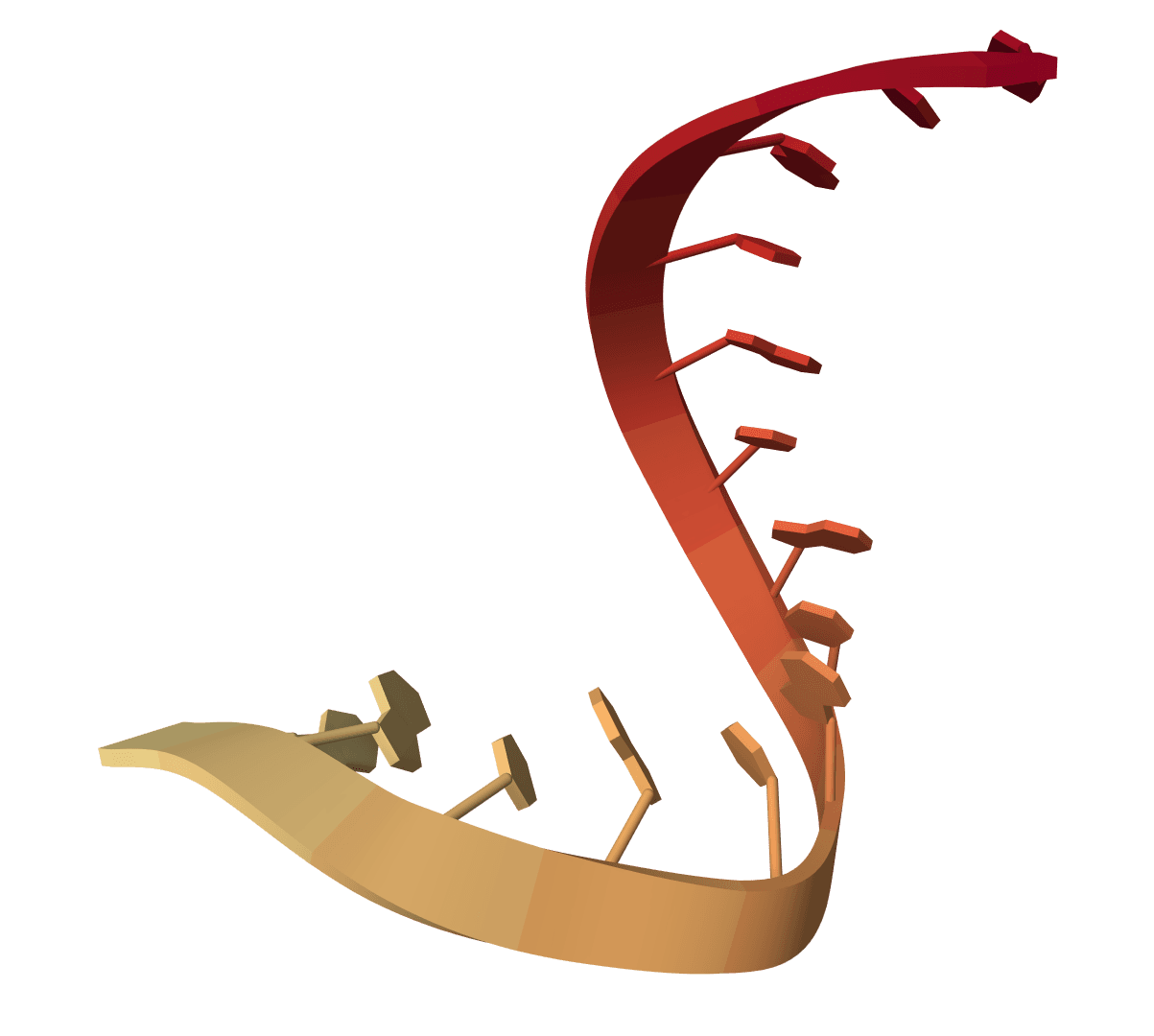
Calculate local RNA base-pair probabilities. Learn more
Input
What is RNAplfold?
RNAplfold is a local RNA secondary-structure program in the ViennaRNA Package. Rather than choosing one structure for an entire transcript, it calculates average base-pair and unpaired-region probabilities across overlapping sequence windows. The result is an accessibility profile, useful when a long RNA contains local regulatory elements, antisense target sites, or short regions whose availability matters more than its full-length fold.
Local folding avoids treating distant regions of a large transcript as though they must fold together. A base pair is considered only within the selected maximum span, and its probability is averaged across the windows that contain it. RNAplfold therefore describes a thermodynamic ensemble of local, nested secondary structures. It does not predict pseudoknots, tertiary contacts, protein binding, or cellular RNA remodeling.
The unpaired probabilities are particularly useful for assessing whether a contiguous stretch may be available to bind another RNA, an oligonucleotide, or a protein. For a global minimum-free-energy structure instead, use RNAfold. For a discrete list of locally stable stem-loops, use RNALfold.
How to use RNAplfold online
ProteinIQ runs RNAplfold on an RNA sequence provided as FASTA, plain text, or an uploaded text file. Select the local window, maximum pairing span, and largest unpaired region of interest, then receive per-position local accessibility values and the native ViennaRNA output files. Optional opening-energy and RNAplex-compatible output modes are available for accessibility-focused workflows.
Input
| Input | Description |
|---|---|
RNA Sequences | RNA in FASTA or plain-sequence form. Paste text or upload .fasta, .fa, or .txt. FASTA headers are retained as sequence identifiers in the results. A submitted FASTA record may contain multiple sequences, which RNAplfold processes independently. |
RNA sequences are expected to use standard nucleotide notation. The ViennaRNA engine accepts T by converting it to U under its standard input handling. Each record represents one strand. RNAplfold measures intramolecular local folding, not hybridization between separate strands.
Settings
| Setting | Description |
|---|---|
Window size | Width of the overlapping folding windows, from 20 to 200 nt, default 70. Pair and accessibility probabilities are averaged over windows of this size. Choose a window at least as large as the local feature under study. |
Maximum span | Largest permitted separation between paired nucleotides, from 10 to 200 nt, default 70. A pair (i, j) is excluded when j - i exceeds this value. It cannot exceed the effective window size for a sequence. |
Unpaired region length | Largest contiguous unpaired interval to calculate, from 1 to 50 nt, default 31. RNAplfold computes probabilities for regions of every length from 1 nt through this value. |
Cutoff | Minimum average base-pair probability reported in the native dot plot, default 0.01. It does not act as an accessibility threshold for the _lunp table. |
Opening energies | Writes the native opening-energy-oriented profile (_openen) instead of the standard unpaired-probability profile (_lunp). The ViennaRNA manual defines these values as logarithmic probability transforms, not literal mean energies required to unfold a site. |
RNAplex output mode | Creates the additional local-accessibility files used by RNAplex for target-search workflows. Off by default. |
Temperature (°C) | Temperature used to rescale the thermodynamic energy parameters, from 0 to 100 °C, default 37. It should reflect the experimental or biological condition being modeled. |
For short input sequences, ProteinIQ reduces a requested window, span, or unpaired length when necessary so no setting exceeds the sequence or its effective local span. This keeps the job valid, but it also means a short transcript cannot yield a 31 nt accessibility interval.
Results
The default table is parsed from the native _lunp file. It contains one row per nucleotide position, with each value describing the probability that an interval ending at that position is entirely unpaired.
| Column | Meaning |
|---|---|
Sequence ID | FASTA identifier or generated sequence name. |
Position | One-based rightmost position of the reported interval. For a 5 nt value at position 20, the interval is positions 16 through 20. |
P(unpaired 1nt) | Probability that the nucleotide at Position is unpaired in the local folding ensemble. |
P(unpaired 5nt) through P(unpaired 31nt) | Probability that the corresponding contiguous interval ending at Position is entirely unpaired. Columns appear where the chosen Unpaired region length produces them. |
When Opening energies is enabled, the table uses the corresponding Opening energy (n nt) columns parsed from _openen. These transformed values are most useful when a downstream workflow expects ViennaRNA accessibility output. They should not be interpreted as independently measured unfolding free energies.
The Files tab preserves the native artifacts for inspection or reuse:
_lunp: plain-text matrix of unpaired-region probabilities in the standard mode._openen: opening-energy-oriented accessibility matrix when that mode is selected._dp.ps: PostScript dot plot of local base-pair probabilities above the selected cutoff.- Additional RNAplex-oriented files when
RNAplex output modeis selected.
How RNAplfold works
RNAplfold uses a partition-function calculation with the ViennaRNA nearest-neighbor energy model. Instead of retaining a single lowest-energy structure, the partition function sums the Boltzmann weights of the possible local secondary structures, producing a probability for each permitted base pair and for each unpaired interval.
The calculation is repeated conceptually across overlapping windows. A pair or unpaired segment can appear in more than one window, so RNAplfold averages its probability across the windows that contain it. With sequence length and window size , the algorithm uses memory and time. Keeping modest makes it suitable for scanning long transcripts while retaining sensitivity to local structures.
Changing Window size and Maximum span changes the question being asked. A 70 nt window asks which interactions are supported by nearby sequence context; a larger setting permits more distant local partners. It does not make RNAplfold a global-folding method. If long-range structure is the hypothesis, compare the relevant region with a global RNA secondary-structure prediction.
Interpreting local accessibility
High P(unpaired n nt) identifies a region that is frequently unpaired across the local thermodynamic ensemble. It is a stronger condition as n increases: a site may have a high one-nucleotide accessibility yet a low probability that all 20 nucleotides around it are simultaneously open. Match Unpaired region length to the footprint that needs to bind, such as the length of an oligonucleotide seed or an RNA interaction segment.
Low accessibility can arise because the local ensemble supports a stable stem, but it is not direct evidence that a protein or another RNA cannot bind. Ionic conditions, ligands, RNA-binding proteins, chemical modifications, co-transcriptional folding, and tertiary structure are outside the standard calculation. For an interaction score that explicitly combines hybridization with the cost of exposing an interaction site, use RNAup.
RNAplfold probabilities are comparable only when the temperature, window, span, and energy model are held constant. Comparing raw probabilities across settings can mistake a change in modeling assumptions for a biological change in accessibility.
Related tools
RNAdos
RNAdos calculates density-of-states summaries for RNA sequences, reporting representative structures and state counts across energy bands.
RNAeval
RNAeval calculates the free energy of an RNA secondary structure for a given sequence. Evaluates if a proposed structure is thermodynamically favorable.
RNAfold
RNAfold predicts RNA secondary structure using minimum free energy (MFE) algorithms and optionally returns partition-function ensemble metrics when explicitly enabled.
RNALfold
RNALfold reports locally stable RNA secondary structures within a sliding window and returns their start and end positions on the input sequence.
RNAsubopt
RNAsubopt enumerates all RNA secondary structures within a specified energy range above the minimum free energy (MFE). Useful for exploring the structural ensemble and identifying alternative conformations.
ViennaRNA
ViennaRNA supports a curated set of ViennaRNA 2.7.2 workflows for RNA folding, density-of-states analysis, interaction prediction, local accessibility, plotting, inverse folding, and structure analysis.
RNAcofold
RNAcofold predicts the joint secondary structure of two interacting RNA molecules and optionally reports partition-function and concentration-dependent equilibrium metrics.
RNAdistance
RNAdistance compares RNA secondary structures using the selected native ViennaRNA distance representation and comparison mode.
RNAduplex
RNAduplex computes the hybridization structure between two RNA sequences. Predicts the optimal duplex formation and binding energy.
RNAplex
RNAplex predicts fast query-target RNA interactions, reporting parsed hit coordinates, structures, and energies.