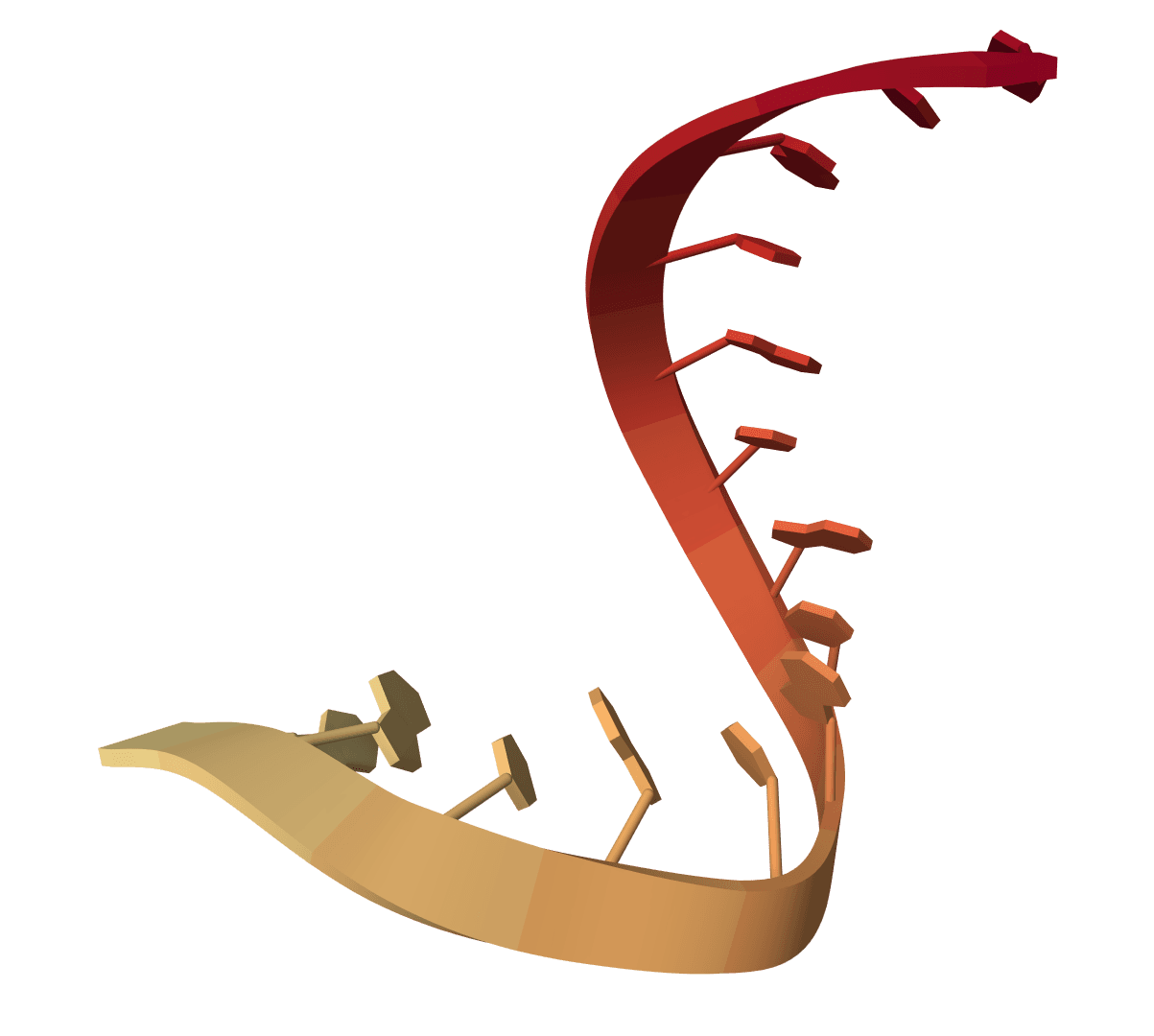
Predict RNA-RNA interactions using accessibility-aware energy scoring. Learn more
Input
What is RNAup?
RNAup predicts RNA-RNA interactions while accounting for the cost of making binding sites accessible. This is the central idea that separates RNAup from simpler interaction tools: before two RNA molecules can hybridize, each must unfold any internal structure that blocks the interaction site. RNAup calculates this "opening energy" for both strands and adds it to the intermolecular binding energy, producing a total energy that reflects the true thermodynamic cost of the interaction.
The total energy reported by RNAup is the sum of three terms:
- Interaction energy: the free energy gained from forming intermolecular base pairs between the two strands
- Opening energy (target): the cost of unfolding the target RNA's internal structure at the binding site
- Opening energy (query): the cost of unfolding the query RNA's internal structure at the binding site
This decomposition makes RNAup particularly valuable for studying interactions where one or both molecules have stable internal folds. A binding site that looks favorable based on intermolecular pairing alone may turn out to be thermodynamically unfavorable once the opening cost is included.
RNAup vs. other interaction tools
| Tool | Considers accessibility | Speed | Best for |
|---|---|---|---|
| RNAduplex | No | Very fast | Initial screening, pre-filtering large sets |
| RNAup | Yes (full calculation) | Moderate | Accurate binding energy with opening costs |
| RNAplex | Yes (precomputed profiles) | Fast | Scanning long targets for interaction sites |
| RNAcofold | Implicit (joint folding) | Moderate | Full dimer structure including intra- and intermolecular pairs |
RNAduplex is a good first pass, but it systematically overestimates binding stability for structured RNAs because it ignores opening costs. RNAup corrects this by computing accessibility from the full ensemble of each strand's internal structures.
How to use RNAup online
RNAup on ProteinIQ takes two RNA sequences (a target and a query), computes accessibility-aware interaction energies using ViennaRNA's RNAup program, and returns interaction coordinates, energy decompositions, and downloadable output files. No local ViennaRNA installation is needed.
Inputs
| Input | Description |
|---|---|
Target RNA | The RNA sequence to scan for binding sites. FASTA or plain nucleotide format. |
Query RNA | The RNA sequence that binds to the target. FASTA or plain nucleotide format. |
Supported file formats: .fasta, .fa, .txt
Settings
Interaction options
| Setting | Type | Default | Description |
|---|---|---|---|
Interaction mode | select | binding-site | Controls the RNAup workflow. The binding-site mode reports optimal interaction sites; the default mode uses RNAup's standard output format. |
Unpaired region length | slider (1-50) | 1 | Maximum length of the unpaired region considered for accessibility (-u flag). Larger values allow RNAup to evaluate longer stretches of unpaired nucleotides as potential binding sites. |
Window size | slider (1-200) | 25 | Size of the sliding window used for accessibility computation (-w flag). Should be at least as large as the unpaired region length. |
Report energy contributions | switch | off | Request contribution-oriented output from RNAup where supported. |
Include both strands | switch | off | Report interaction results for both orientations (5'>3' and 3'>5'). |
Extend 5' | text | default | Optional extension of the interaction region in the 5' direction. |
Extend 3' | text | default | Optional extension of the interaction region in the 3' direction. |
Thermodynamic parameters
| Setting | Type | Default | Description |
|---|---|---|---|
Temperature | slider (0-100) | 37 | Folding temperature in degrees Celsius. |
Salt concentration | text | default | Monovalent salt concentration for the ViennaRNA energy model. |
Initial salt correction | text | default | Initial salt correction parameter. |
Parameter file content | textarea | none | Inline ViennaRNA parameter file content passed via --paramFile. |
Energy model
| Setting | Type | Default | Description |
|---|---|---|---|
Dangling ends | select | 2 (double dangles) | How unpaired nucleotides adjacent to helices contribute to the energy. Options: 0 (ignore), 1 (one side), 2 (both sides), 3 (coaxial stacking). |
Disallow lonely pairs | switch | off | Prohibit helices of length 1 (isolated base pairs). |
Leaving optional text fields blank preserves the native ViennaRNA CLI defaults.
Output
Results table
| Column | Description |
|---|---|
Interaction | Identifier for the interaction pair |
Query ID | Identifier of the query sequence |
Target ID | Identifier of the target sequence |
Query Start / Query End | Nucleotide positions of the interaction on the query strand |
Target Start / Target End | Nucleotide positions of the interaction on the target strand |
Interaction Energy (kcal/mol) | Free energy from intermolecular base pairing alone |
Opening Energy (kcal/mol) | Combined cost of unfolding internal structure on both strands at the interaction site |
Total Energy (kcal/mol) | Sum of interaction energy and opening energy. More negative values indicate more favorable interactions. |
Files
The Files tab provides the raw .out files generated by the RNAup CLI, available for download.
Related tools
RNAduplex
RNAduplex computes the hybridization structure between two RNA sequences. Predicts the optimal duplex formation and binding energy.
RNAplex
RNAplex predicts fast query-target RNA interactions, reporting parsed hit coordinates, structures, and energies.
RNAcofold
RNAcofold predicts the joint secondary structure of two interacting RNA molecules and optionally reports partition-function and concentration-dependent equilibrium metrics.
RNAdistance
RNAdistance compares RNA secondary structures using the selected native ViennaRNA distance representation and comparison mode.
RNAdos
RNAdos calculates density-of-states summaries for RNA sequences, reporting representative structures and state counts across energy bands.
RNAeval
RNAeval calculates the free energy of an RNA secondary structure for a given sequence. Evaluates if a proposed structure is thermodynamically favorable.
RNAfold
RNAfold predicts RNA secondary structure using minimum free energy (MFE) algorithms and optionally returns partition-function ensemble metrics when explicitly enabled.
RNALfold
RNALfold reports locally stable RNA secondary structures within a sliding window and returns their start and end positions on the input sequence.
RNAplfold
RNAplfold computes local base pair probabilities using a sliding window approach. Useful for analyzing accessibility and identifying binding sites in long RNA sequences.
RNAplot
RNAplot renders ViennaRNA secondary-structure plot files from a supplied RNA sequence and dot-bracket structure.