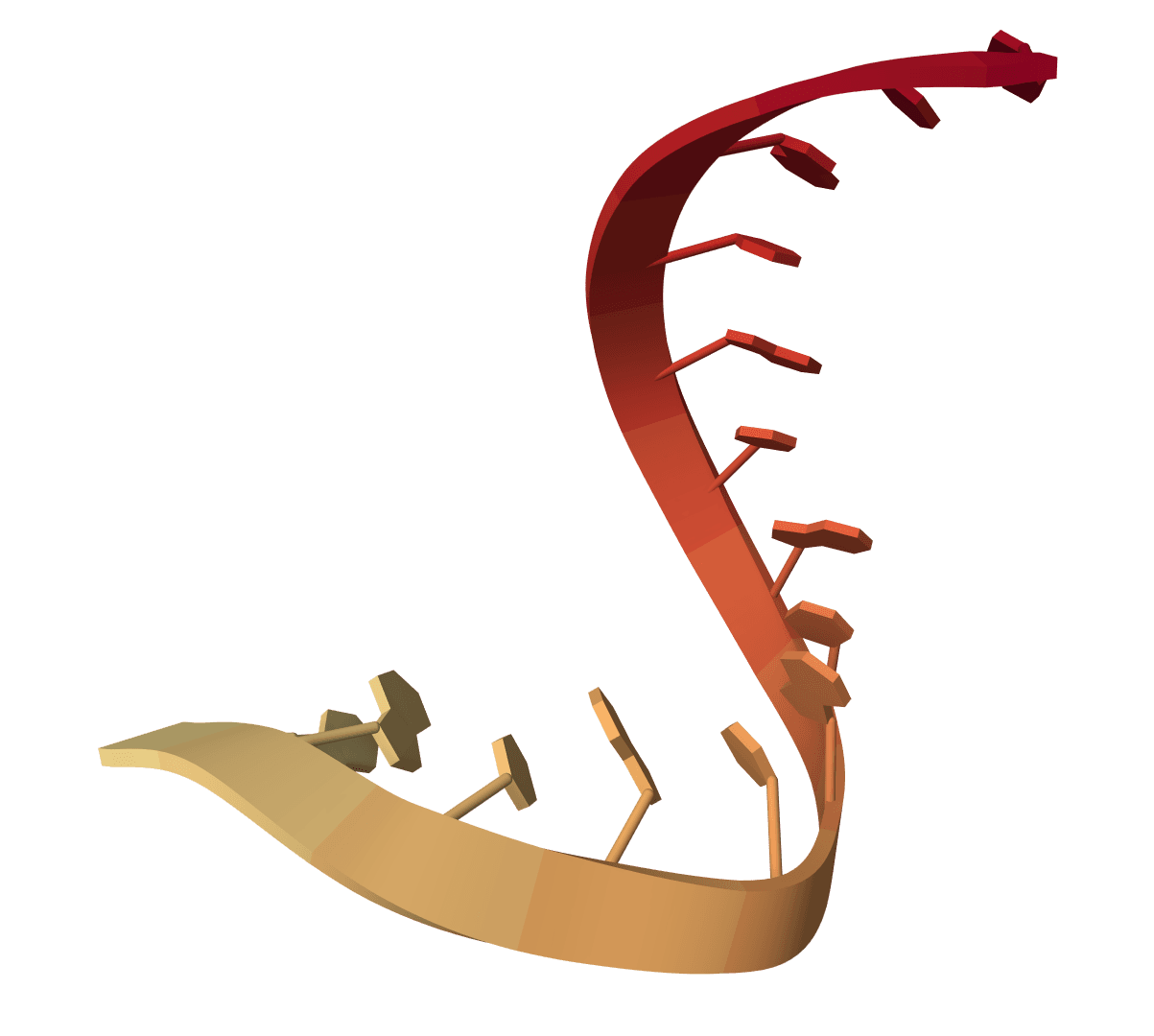
Predict RNA duplex hybridization between two sequences. Learn more
Input
What is RNAduplex?
RNAduplex computes the hybridization structure between two RNA strands by predicting only intermolecular base pairs. Given two RNA sequences, it identifies optimal binding sites and calculates the hybridization free energy.
The program belongs to the ViennaRNA Package and uses the "interaction-only" (IO) approach: it models duplex formation without considering how intramolecular folding within each strand might compete with hybridization. This simplification makes RNAduplex extremely fast, operating at speeds comparable to sequence alignment while providing more information than simple BLAST searches. The tradeoff is that it may overestimate binding stability for sequences with stable internal structures.
When to use RNAduplex
RNAduplex works well for:
- Locating miRNA binding sites on mRNA targets
- Screening for potential RNA-RNA interactions across many sequence pairs
- Initial identification of antisense oligonucleotide targets
- Rapid pre-filtering before more detailed analysis with RNAcofold or RNAup
How to use RNAduplex online
Paste two RNA sequences, set a folding temperature, and RNAduplex returns the optimal intermolecular hybridization structure with binding site coordinates and free energy. Results appear as a spreadsheet row with dot-bracket notation showing exactly which nucleotides pair across the two strands.
Inputs
| Input | Description |
|---|---|
RNA Sequence 1 | First RNA sequence in FASTA format or plain nucleotides |
RNA Sequence 2 | Second RNA sequence to test for hybridization |
Supported file formats: .fasta, .fa, .txt
Settings
| Setting | Description |
|---|---|
Temperature | Folding temperature in degrees Celsius (0-100, default 37). Higher temperatures generally destabilize base pairing. |
Output
Results display in spreadsheet format with the following columns:
| Column | Description |
|---|---|
Interaction | Identifier for the sequence pair |
Seq 1 Length | Length of the first RNA sequence |
Seq 2 Length | Length of the second RNA sequence |
Duplex Structure | Dot-bracket notation showing base pairs, with & separating the two strands |
Energy (kcal/mol) | Hybridization free energy. More negative values indicate stronger binding. |
Start (Seq1) | Starting position of the interaction on sequence 1 |
Start (Seq2) | Starting position of the interaction on sequence 2 |
Interpreting the structure notation
The output uses dot-bracket notation with an ampersand separating the strands:
.(((((.(((...((((((((((.&))))))))))))))))))..indicates unpaired nucleotides(and)indicate paired bases (matching pairs face each other across the&)&marks the boundary between the two sequences
How RNAduplex works
RNAduplex uses dynamic programming to find the minimum free energy (MFE) configuration of intermolecular base pairs. The algorithm considers:
- Watson-Crick and wobble pairs: Standard A-U, G-C, and G-U base pairing
- Stacking energies: Stabilization from consecutive base pairs
- Dangling ends: Energy contributions from unpaired nucleotides adjacent to helices
- Temperature effects: Thermodynamic parameters rescaled to the specified temperature
The calculation deliberately excludes intramolecular structure formation. Each nucleotide can participate in at most one intermolecular base pair, but neither strand folds onto itself during the prediction.
Limitations
Because RNAduplex only considers intermolecular pairs, it does not account for:
- Competition from internal structure: If either RNA has stable intramolecular base pairs, the predicted binding site may be inaccessible
- Structure opening costs: The energy required to unfold existing structure before hybridization can occur
For more accurate predictions that include these effects, follow up RNAduplex hits with RNAcofold (full dimer folding including intramolecular pairs) or RNAup (adds accessibility costs to the calculation).
Related tools
RNAplex
RNAplex predicts fast query-target RNA interactions, reporting parsed hit coordinates, structures, and energies.
RNAup
RNAup predicts accessibility-aware RNA-RNA interactions, reporting opening-energy terms alongside interaction energies and downloadable native output files.
RNAcofold
RNAcofold predicts the joint secondary structure of two interacting RNA molecules and optionally reports partition-function and concentration-dependent equilibrium metrics.
RNAdistance
RNAdistance compares RNA secondary structures using the selected native ViennaRNA distance representation and comparison mode.
RNAdos
RNAdos calculates density-of-states summaries for RNA sequences, reporting representative structures and state counts across energy bands.
RNAeval
RNAeval calculates the free energy of an RNA secondary structure for a given sequence. Evaluates if a proposed structure is thermodynamically favorable.
RNAfold
RNAfold predicts RNA secondary structure using minimum free energy (MFE) algorithms and optionally returns partition-function ensemble metrics when explicitly enabled.
RNALfold
RNALfold reports locally stable RNA secondary structures within a sliding window and returns their start and end positions on the input sequence.
RNAplfold
RNAplfold computes local base pair probabilities using a sliding window approach. Useful for analyzing accessibility and identifying binding sites in long RNA sequences.
RNAplot
RNAplot renders ViennaRNA secondary-structure plot files from a supplied RNA sequence and dot-bracket structure.