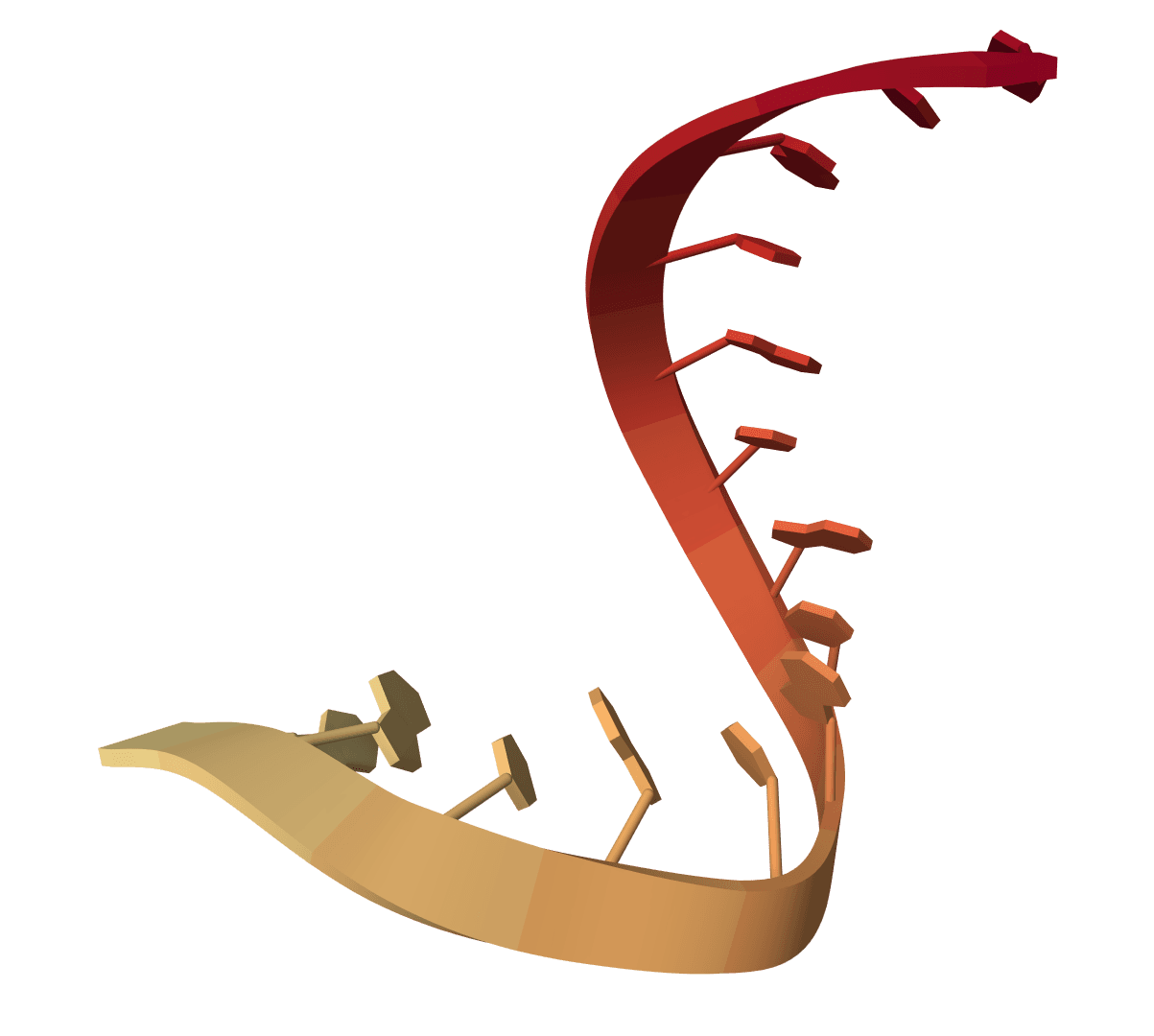
Predict and analyze RNA secondary structures. Learn more
Input
What is ViennaRNA?
The ViennaRNA Package is a collection of thermodynamics-based programs and a C library for predicting, comparing, and designing RNA secondary structures. Its central models assign free energies to RNA secondary structures using nearest-neighbor parameters, then use dynamic programming to find a minimum-free-energy structure, characterize the thermodynamic ensemble, enumerate alternatives, or analyze RNA-RNA interactions.
ProteinIQ runs ViennaRNA 2.7.2 as one workspace with a method selector. This is useful when a project moves beyond a single predicted fold: the same sequence can be folded globally, inspected for local accessibility, evaluated against a supplied dot-bracket structure, or compared with a designed alternative. Predicted secondary structures describe canonical nested base-pairing patterns. Pseudoknots and protein-bound or chemically modified states need methods and experimental evidence suited to those questions.
Available methods
- RNAfold: predicts the minimum free energy, or MFE, secondary structure. An optional partition-function calculation adds ensemble statistics and representative alternative structures.
- RNAsubopt: lists secondary structures within an energy range above the MFE, which helps reveal competing low-energy folds.
- RNALfold: finds locally stable structures within a sliding sequence span rather than forcing one global fold across a long RNA.
- RNAplfold: estimates local base-pairing and unpaired-region accessibility probabilities in a sliding window.
- RNAplot: renders a supplied sequence and dot-bracket structure. It does not predict a structure first.
- RNAcofold and RNAduplex: analyze two RNA strands. RNAcofold folds the joint system, while RNAduplex performs fast hybridization prediction.
- RNAup and RNAplex: predict RNA-RNA interactions with accessibility-aware and fast interaction-search workflows, respectively.
- RNAalifold: predicts a consensus secondary structure from an RNA sequence alignment.
- RNAinverse: searches for sequences that can adopt a supplied target structure.
- RNAeval, RNAdistance, and RNAdos: evaluate a supplied structure's energy, compare two structures, or calculate a density-of-states summary.
How to use ViennaRNA online
ProteinIQ runs ViennaRNA online by pairing the selected analysis method with the RNA sequence, aligned sequences, or dot-bracket structure it requires. Submit one or more FASTA or plain-text RNA sequences for folding and interaction analyses, or supply valid dot-bracket input for structure-based methods. The result is a table of method-specific values plus native reports, plots, and accessibility files when that workflow produces them.
Inputs
| Method family | Required input | Notes |
|---|---|---|
| Global, local, or ensemble folding | RNA Sequences | RNAfold, RNAsubopt, RNALfold, RNAplfold, RNAdos, RNAeval, and RNAinverse start-sequence input accept FASTA or plain text. Most sequence modes accept up to 500 sequences per job. |
| Two-RNA interaction | RNA Sequence 1 and RNA Sequence 2 | RNAcofold, RNAduplex, RNAup, and RNAplex operate on paired strands. The reported order is method-specific, so retain clear sequence IDs. |
| Comparative folding | Aligned RNA Sequences | RNAalifold needs an alignment, not merely several related unaligned sequences. Inputs can be FASTA, Clustal, or text alignment formats. |
| Supplied structure | Target Structure | RNAplot, RNAinverse, and RNAeval use dot-bracket notation such as ((((....)))). RNAeval also needs a sequence of exactly the same length. |
| Structure comparison | Target Structure and Second Structure | RNAdistance compares two valid dot-bracket structures. |
RNA bases should be supplied as RNA sequence text. RNAdos is restricted to sequences of 100 nucleotides or fewer because density-of-states calculations grow rapidly with sequence length. For longer local-accessibility questions, use RNAplfold; for a global MFE prediction, use RNAfold.
Shared settings
| Setting | Default | Effect |
|---|---|---|
Temperature | 37 °C | Sets the temperature used by supported folding and energy calculations. Results at a different temperature should not be compared directly with 37 °C predictions. |
Disallow lonely pairs | Off | Excludes isolated base pairs, reducing the set of allowed structures. This can remove short stems that are otherwise energetically favorable. |
Circular RNA | Off | Treats supported global-folding inputs as circular rather than linear. It is not applied to every method. |
Compute partition function | Off | For RNAfold and supported workflows, calculates thermodynamic-ensemble quantities in addition to the MFE. |
Dangling ends | 2 | Chooses how unpaired bases adjacent to helices contribute to the energy model. 2 uses double dangles; 0 ignores them, 1 allows one-side dangles, and 3 also allows coaxial stacking. |
Leave method-specific fields blank when the native default is appropriate. RNAinverse, RNAdos, RNAup, and RNAplex also accept optional ViennaRNA parameter-file content for supported parameter overrides.
Method-specific settings
| Method | Settings that change the analysis |
|---|---|
| RNAsubopt | Energy range (kcal/mol) sets the energy above the MFE considered for suboptimal structures. Max structures limits rows returned by ProteinIQ after the program generates them. |
| RNALfold | Window size sets the largest sequence span considered for local structures. The effective span cannot exceed the sequence length. |
| RNAplfold | Cutoff filters low-probability entries. RNAplfold window size sets the local context, while RNAplfold unpaired region length controls requested unpaired-region accessibility. Opening energies and RNAplex output mode add accessibility-oriented artifacts. |
| RNAup | RNAup unpaired region length, Interaction window, interaction mode, strand orientation, extensions, and energy-contribution reporting control the accessibility-aware interaction calculation. |
| RNAplex | Interaction length, energy threshold, duplex distance, accessibility scaling, and window length tune the fast query-target search. |
| RNAplot | Plot output format supports eps, svg, gml, xrna, and ssv. |
| RNAcofold | Concentration table enables concentration-dependent equilibrium output for the two-strand system. |
| RNAinverse | Repeat controls native search repetitions. Alphabet constrains allowed bases, and Final scoring mode selects an optional final evaluation mode. |
| RNAdistance | Distance and Compare mode pass the native distance representation and comparison mode. Backtrack output writes the corresponding backtrack file. |
Understanding ViennaRNA results
The Results tab presents the rows that the selected method can parse, while the Files tab retains native text output and generated artifacts. A column that is meaningful for one method is not necessarily populated for another.
| Result | Meaning |
|---|---|
structure | A secondary structure in dot-bracket notation. Matching parentheses represent a base pair; dots represent unpaired nucleotides. |
mfe or energy | Predicted free energy in kcal/mol under the selected model and conditions. More negative structures are favored within the same sequence, model, and settings. Energy values are not a direct measure of biological activity or expression. |
ensemble_free_energy | Free energy of the thermodynamic ensemble when the partition function is enabled. It summarizes the ensemble rather than one structure. |
mfe_frequency | Estimated probability of the MFE structure within the ensemble. A low value indicates that several alternatives contribute appreciably. |
ensemble_diversity | Mean base-pair distance within the ensemble. Higher diversity indicates a less structurally concentrated ensemble. |
centroid_structure | Structure with minimum average base-pair distance to the ensemble. It can be more representative than the single MFE structure when alternatives compete. |
mea_structure and mea_score | Maximum expected accuracy structure and its score, calculated from base-pair probabilities when available. |
For RNAsubopt, read structures together with their energies and the selected energy range. A dense set of alternatives close to the MFE suggests structural heterogeneity rather than a unique fold. RNALfold results identify local motifs and their positions in the sequence. RNAplfold may return accessibility and pairing-probability reports as files; these are often the useful input for interaction analyses rather than a single global structure.
RNAcofold and RNAduplex report structures and interaction energies for paired strands. RNAup separates the energetic cost of making interaction regions accessible from the interaction itself, so its output is more informative when local structure can block binding. RNAplex is designed for a faster search and is a practical first pass for many candidate interactions. RNAalifold returns a consensus structure from the alignment, making alignment quality and homolog selection central to interpretation.
RNAeval is appropriate for scoring a specific proposed structure under the chosen conditions, not for deciding whether that structure is the only plausible fold. RNAdistance quantifies structural dissimilarity using the selected native representation and comparison mode. Its value is only comparable across analyses that use the same options.
How ViennaRNA works
ViennaRNA represents a secondary structure as a set of noncrossing base pairs and scores permitted loop and stacking arrangements with an empirical nearest-neighbor free-energy model. Dynamic programming makes a global optimum tractable without enumerating every possible structure. RNAfold returns the lowest-energy structure from that model; the partition function instead sums over structures to derive base-pair probabilities and ensemble quantities.
The method selector changes the scientific question, not merely the presentation. RNAsubopt explores structures near the optimum. RNALfold and RNAplfold restrict calculations to local windows, which is useful when a long transcript contains independently folding regions or when the availability of a binding site matters. RNAup adds opening-energy terms to RNA-RNA interaction prediction, whereas RNAcofold treats two strands as a joint folding system. RNAinverse reverses the usual direction by starting from a target dot-bracket pattern and searching for compatible sequences.
These are thermodynamic predictions, not direct experimental structure measurements. Ionic conditions, modified bases, protein binding, kinetic folding, long-range tertiary contacts, and pseudoknots can all change real RNA behavior. Use the results to generate and prioritize structural hypotheses, then test consequential predictions with appropriate experiments.
When to use ViennaRNA methods versus alternatives
Choose RNAfold when one global secondary-structure hypothesis and its energy are the goal. Enable the partition function when ensemble ambiguity matters, particularly before interpreting a single MFE structure as definitive. Use RNAsubopt to inspect competing structures and RNAplfold when the question is whether a local segment is likely to be unpaired and accessible.
For two-strand questions, RNAduplex is suited to rapid hybridization prediction. RNAcofold gives a joint dimer folding calculation and can add concentration-dependent equilibrium analysis. RNAup is the stronger choice when opening a locally structured binding site may carry an energetic penalty. RNAplex trades detail for fast query-target screening.
For a direct sequence-to-structure workflow outside the multi-method workspace, RNAfold provides the focused MFE workflow. RNAcofold is the focused two-RNA dimer workflow, and RNAdistance is available when comparing dot-bracket structures is the only task.
Related tools
RNAdos
RNAdos calculates density-of-states summaries for RNA sequences, reporting representative structures and state counts across energy bands.
RNAeval
RNAeval calculates the free energy of an RNA secondary structure for a given sequence. Evaluates if a proposed structure is thermodynamically favorable.
RNAfold
RNAfold predicts RNA secondary structure using minimum free energy (MFE) algorithms and optionally returns partition-function ensemble metrics when explicitly enabled.
RNALfold
RNALfold reports locally stable RNA secondary structures within a sliding window and returns their start and end positions on the input sequence.
RNAplfold
RNAplfold computes local base pair probabilities using a sliding window approach. Useful for analyzing accessibility and identifying binding sites in long RNA sequences.
RNAsubopt
RNAsubopt enumerates all RNA secondary structures within a specified energy range above the minimum free energy (MFE). Useful for exploring the structural ensemble and identifying alternative conformations.
RNAcofold
RNAcofold predicts the joint secondary structure of two interacting RNA molecules and optionally reports partition-function and concentration-dependent equilibrium metrics.
RNAdistance
RNAdistance compares RNA secondary structures using the selected native ViennaRNA distance representation and comparison mode.
RNAduplex
RNAduplex computes the hybridization structure between two RNA sequences. Predicts the optimal duplex formation and binding energy.
RNAplex
RNAplex predicts fast query-target RNA interactions, reporting parsed hit coordinates, structures, and energies.