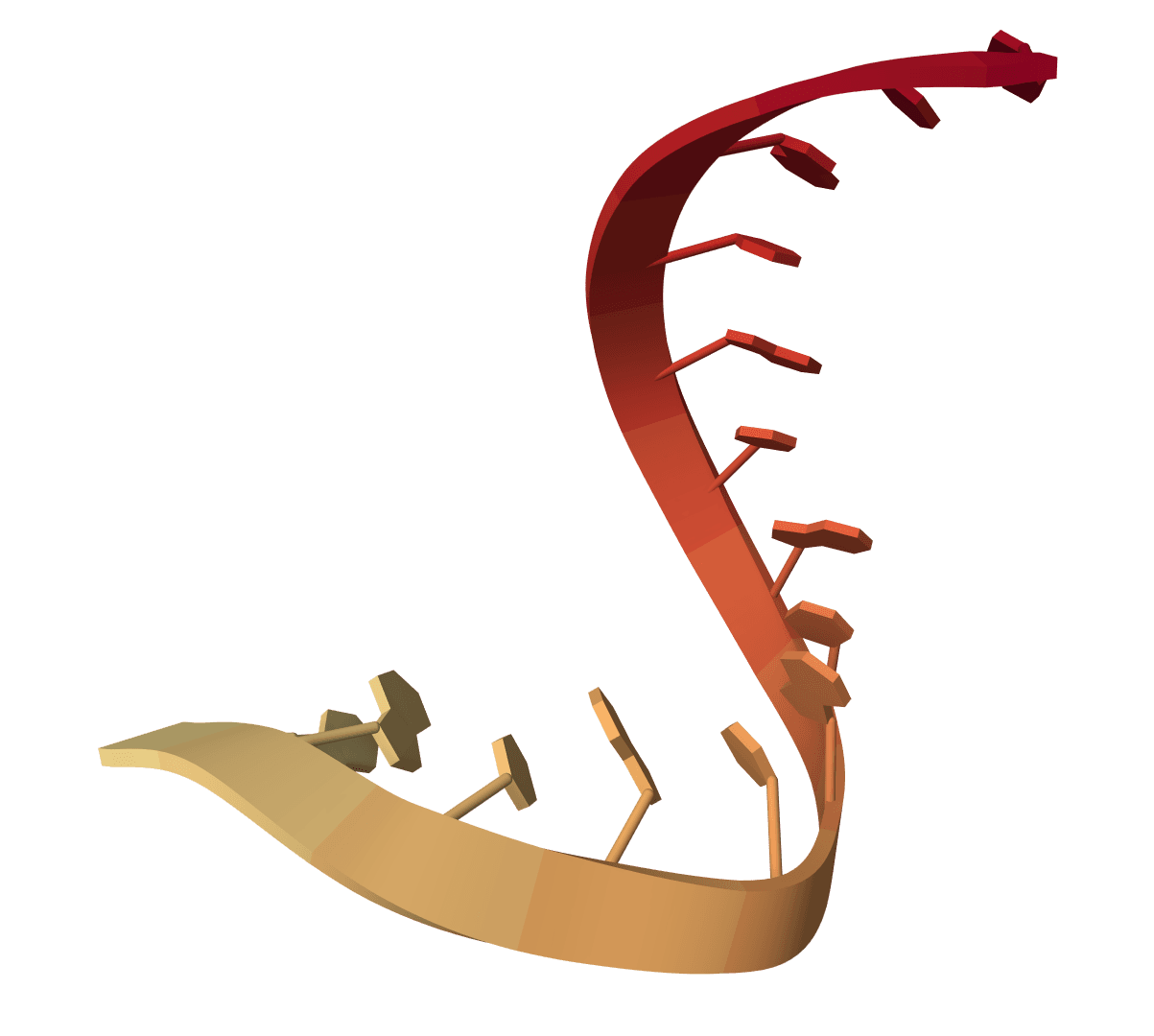
Predict RNA-RNA dimer secondary structures. Learn more
Input
What is RNAcofold?
RNAcofold is a ViennaRNA program for thermodynamic prediction of the secondary structure formed by two RNA molecules. Rather than treating hybridization as an isolated helix, it finds a joint dimer fold in which each strand may form both intramolecular and intermolecular base pairs. The result is useful when an RNA interaction may compete with the internal structure of either partner.
The standard calculation reports the minimum free-energy, or MFE, dimer structure. RNAcofold can also calculate the partition function, which represents the full ensemble of possible secondary structures rather than a single optimum. This adds ensemble free energy, representative structures, and a binding free-energy estimate. Like other standard ViennaRNA secondary-structure methods, it does not model pseudoknots or cellular factors such as RNA-binding proteins and chemical modification.
Where RNAcofold fits
RNAcofold is suited to a focused pairwise question, such as whether an sRNA and a candidate mRNA region can form a stable joint fold, or how an antisense oligonucleotide changes the structure of its target. For a rapid interaction-only screen, RNAduplex is the lighter calculation. When the opening cost of a specific binding site is central to the question, RNAup separates that cost from intermolecular hybridization. RNAfold remains the right starting point for inspecting either RNA by itself.
How to use RNAcofold online
ProteinIQ runs RNAcofold on two supplied RNA sequences, one in each input field, and returns their joint dot-bracket structure with its minimum free energy. Enable the partition function to obtain ensemble and binding metrics, or provide starting concentrations to calculate the equilibrium mixture of monomers and dimers under the selected thermodynamic settings.
Inputs
| Input | Description |
|---|---|
RNA Sequence 1 | First RNA strand, or the first FASTA record set for batch analysis. |
RNA Sequence 2 | Second RNA strand, or the second FASTA record set for batch analysis. |
The tool accepts .fasta, .fa, and .txt inputs. For a single interaction, enter one sequence in each field. For batch analysis, provide multiple FASTA records in either or both fields and choose All combinations or Pair by index. All combinations evaluates every sequence 1 × sequence 2 pairing. Pair by index matches records in FASTA order and requires equal record counts.
Results preserve strand order: the first portion of every dot-bracket structure belongs to sequence 1, and the second belongs to sequence 2.
Folding settings
| Setting | Default | Description |
|---|---|---|
Batch pairing | All combinations | Combines every record across the two RNA sets. Pair by index instead matches the first record with the first, the second with the second, and so on. |
Temperature (°C) | 37 | Temperature used to evaluate the RNA energy model. Changing it can alter both the preferred structure and free energies. |
Disallow lonely pairs | Off | Excludes helices made of a single isolated base pair. Enable it when these short helices should not be considered stable structural features. |
Dangling ends | 2, double dangles | Controls how unpaired nucleotides adjacent to helices contribute to the energy: 0 ignores them, 1 uses one-sided contributions, 2 uses double dangles, and 3 also permits coaxial stacking. |
Compute partition function | Off | Adds ensemble free energy, MFE frequency, ensemble diversity, centroid and MEA structures, and binding free energy. It requires more computation than MFE folding alone. |
Concentration table | Empty | Optional starting concentrations for sequences A and B. Each nonempty line must contain two numeric concentrations in mol/L, separated by whitespace. Supplying a table enables equilibrium calculations for A, B, AA, BB, and AB. |
The concentration calculation uses the same temperature, lonely-pair, and dangling-end choices as the reported fold. A concentration table describes initial monomer concentrations, not a concentration for an already formed RNA complex.
Understanding RNAcofold results
Joint structure and MFE
The main structure row contains the joint dimer structure in dot-bracket notation. An ampersand, &, marks the chain break. Matching parentheses can occur within either side of the separator for intramolecular pairs, or across it for intermolecular pairs.
(((...&...)))Dots are unpaired nucleotides. The MFE (kcal/mol) is the free energy of this single lowest-energy structure. More negative values indicate a more favorable predicted structure under the selected model, but MFE values are comparable only for calculations run with the same conditions and sequence boundaries. They are not experimental binding affinities.
Use the Files tab to download the .dbn file and reuse the two RNA sequences and their joint dot-bracket structure in compatible RNA analysis software.
Partition-function metrics
With Compute partition function enabled, the results table also includes the following fields:
| Result | Meaning |
|---|---|
Ensemble Free Energy (kcal/mol) | Free energy of the full thermodynamic structure ensemble, derived from its partition function. |
MFE Frequency | Estimated probability of the reported MFE structure within the ensemble. A small value means many alternative structures have appreciable probability. |
Ensemble Diversity | Mean base-pair distance between structures in the ensemble. Larger values indicate a more structurally heterogeneous ensemble. |
Delta G Binding (kcal/mol) | Ensemble free energy of the AB dimer minus the free energies of the separate A and B monomers. A negative value favors dimer formation in the model. |
Centroid Structure | The structure with the smallest average base-pair distance to the rest of the ensemble. Centroid Distance reports that average distance and Centroid Energy evaluates this representative structure. |
MEA Structure | Maximum expected accuracy representative structure. MEA Score is its optimization score, while MEA Energy is its thermodynamic energy. |
An MFE structure can be low in energy but have low MFE Frequency if several distinct folds are nearly as favorable. In that case, centroid or MEA structures can give a more stable summary of the predicted ensemble than the MFE result alone.
Concentration rows
When a Concentration table is provided, RNAcofold adds concentration results alongside the structure results. They report the initial A and B concentrations and the equilibrium concentrations of:
AandB: unbound monomersAAandBB: homodimers of the first and second sequencesAB: the heterodimer formed by the two different sequences
Formation depends on the initial amounts of both RNAs as well as the calculated thermodynamics. A favorable Delta G Binding can therefore coexist with little predicted AB when either RNA starts at a low concentration. These equilibrium values are ideal-solution predictions, so they do not account for compartmentalization, degradation, competing transcripts, or protein binding in a cell.
How RNAcofold works
RNAcofold uses dynamic programming with the nearest-neighbor RNA energy model to search pseudoknot-free secondary structures of the combined sequence. The MFE calculation selects the single structure with the lowest model free energy. Partition-function mode sums Boltzmann-weighted contributions across possible structures, enabling base-pair probability based representatives and ensemble thermodynamic quantities.
For dimerization, the calculation distinguishes the AB heterodimer from the A and B monomers. In concentration mode it also evaluates AA and BB homodimers, then uses those free energies with mass conservation to estimate the equilibrium composition. This makes RNAcofold more informative than a pure complementary-helix search, but it still produces a thermodynamic hypothesis rather than evidence that an interaction occurs in vivo.
Choosing an RNA interaction method
| Question | Best starting method | Why |
|---|---|---|
| What is the most favorable intermolecular helix between two RNAs? | RNAduplex | It optimizes an interaction-only duplex and is well suited to fast screening. |
| How does joint folding redistribute intra- and intermolecular base pairs? | RNAcofold | It predicts a full dimer secondary structure. |
| Does access to the site dominate the interaction energy? | RNAup | It explicitly reports the opening-energy contribution for the binding site. |
| Which regions of a long target are likely to be accessible? | RNAplfold | It calculates local pairing probabilities and accessibility profiles. |
Agreement between multiple methods is useful for prioritization, especially for long or structured transcripts. Important candidates still need experimental validation with an assay appropriate to the biological system.
Related tools
RNAdos
RNAdos calculates density-of-states summaries for RNA sequences, reporting representative structures and state counts across energy bands.
RNAduplex
RNAduplex computes the hybridization structure between two RNA sequences. Predicts the optimal duplex formation and binding energy.
RNAeval
RNAeval calculates the free energy of an RNA secondary structure for a given sequence. Evaluates if a proposed structure is thermodynamically favorable.
RNAfold
RNAfold predicts RNA secondary structure using minimum free energy (MFE) algorithms and optionally returns partition-function ensemble metrics when explicitly enabled.
RNALfold
RNALfold reports locally stable RNA secondary structures within a sliding window and returns their start and end positions on the input sequence.
RNAplex
RNAplex predicts fast query-target RNA interactions, reporting parsed hit coordinates, structures, and energies.
RNAplfold
RNAplfold computes local base pair probabilities using a sliding window approach. Useful for analyzing accessibility and identifying binding sites in long RNA sequences.
RNAsubopt
RNAsubopt enumerates all RNA secondary structures within a specified energy range above the minimum free energy (MFE). Useful for exploring the structural ensemble and identifying alternative conformations.
RNAup
RNAup predicts accessibility-aware RNA-RNA interactions, reporting opening-energy terms alongside interaction energies and downloadable native output files.
ViennaRNA
ViennaRNA supports a curated set of ViennaRNA 2.7.2 workflows for RNA folding, density-of-states analysis, interaction prediction, local accessibility, plotting, inverse folding, and structure analysis.