Find locally stable RNA structures in long sequences. Learn more
Input
What is RNALfold?
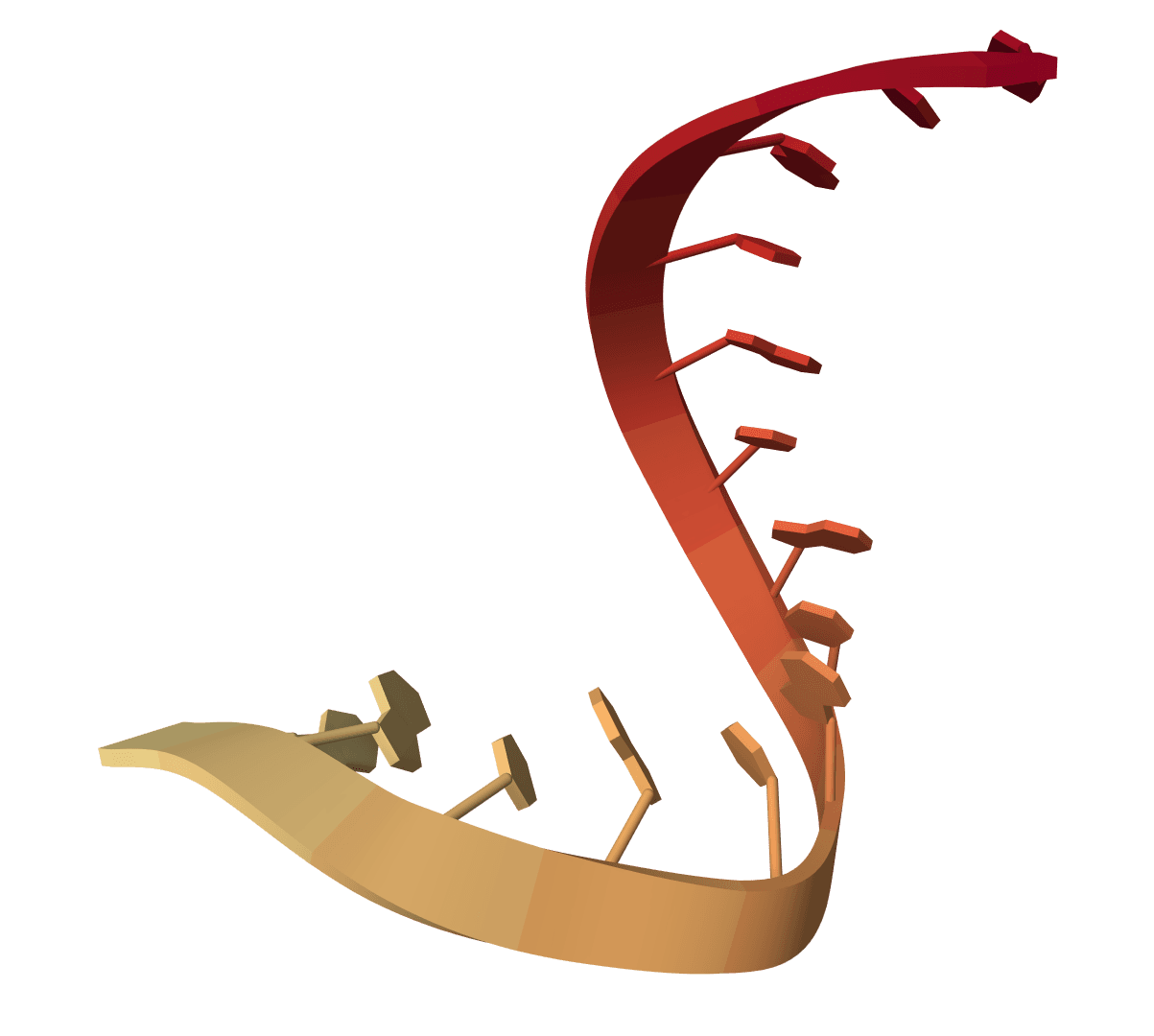
RNALfold computes locally stable RNA secondary structures using a sliding window approach. Part of the ViennaRNA Package, it identifies regions within long sequences that can form stable hairpins, stems, and other structural motifs without requiring the entire sequence to fold cooperatively.
The algorithm scales linearly with sequence length when the window size is fixed, using O(n + L²) memory and O(n · L²) CPU time where n is sequence length and L is window size. This efficiency makes RNALfold practical for scanning entire chromosomes or genomes to identify structured elements.
When to use RNALfold
RNALfold is designed for scenarios where global folding is inappropriate or computationally prohibitive:
- Long sequences: mRNAs, viral genomes, or chromosomal regions where global folding would be meaningless
- Local structure discovery: Finding hairpins, stem-loops, or regulatory elements embedded in longer contexts
- Genome annotation: Screening for structured non-coding RNAs like miRNA precursors or riboswitches
How does RNALfold work?
RNALfold applies the Zuker minimum free energy algorithm within a sliding window. For each position in the sequence, it considers only base pairs where both partners fall within a window of the specified size. This constraint prevents unrealistic long-range pairings that would never form in a biological context.
The algorithm reports locally optimal structures: those that cannot be improved by small perturbations within their region. A structure is reported only if it represents a genuine local minimum in the energy landscape, filtering out suboptimal folds that would be outcompeted by nearby alternatives.
Relationship to RNAplfold
While RNALfold returns discrete structures (in dot-bracket notation), RNAplfold computes base pair probabilities across the ensemble of possible local structures. RNALfold answers "what is the most stable local structure here?" while RNAplfold answers "how likely is each position to be paired?"
For most applications involving target site accessibility or structural diversity, RNAplfold provides more informative output. RNALfold is better suited when specific structural predictions are needed.
How to use RNALfold online
Paste an RNA sequence of any length, choose a window size, and RNALfold scans the full sequence for locally stable secondary structures. Each hit is returned with its dot-bracket notation, free energy, and exact start/end coordinates on the input sequence.
Input
| Input | Description |
|---|---|
RNA Sequences | One or more RNA sequences in FASTA format or plain text. Supports very long sequences (up to 50 MB). |
Settings
Local folding options
| Setting | Description |
|---|---|
Window size | Maximum span of local structures (50-500, default 150). Larger values detect longer-range pairings but increase computation time. |
Temperature | Folding temperature in degrees Celsius (0-100, default 37). Affects thermodynamic stability calculations. |
Output
Results are returned as a spreadsheet with multiple rows per input sequence (one per local structure found):
| Column | Description |
|---|---|
Sequence ID | Identifier from FASTA header or auto-generated |
Structure # | Index of the local structure within this sequence |
Start Position | 1-based start coordinate of the local structure on the input sequence |
End Position | 1-based end coordinate of the local structure on the input sequence |
Window Span | Number of nucleotides between the start and end positions |
Length | Length of the local structure in nucleotides |
Local Structure | Dot-bracket notation showing the structure |
Energy | Free energy of the local structure in kcal/mol |
Choosing window size
The window size parameter determines the maximum span of detectable structures:
| Window Size | Suitable For |
|---|---|
| 50-100 | Small hairpins, miRNA precursors |
| 100-200 | Typical regulatory elements, tRNAs |
| 200-300 | Larger riboswitches, some ribozymes |
| 300-500 | Complex structured domains |
Smaller windows run faster and produce more focused results. Larger windows can detect more complex structures but may report many overlapping alternatives.
Limitations
RNALfold shares limitations common to ViennaRNA tools:
- No pseudoknots: The algorithm cannot predict structures with crossing base pairs
- Thermodynamic model only: Kinetic effects and co-transcriptional folding are not considered
- No tertiary interactions: Only secondary structure (base pairing) is predicted
For very long sequences, the number of reported structures can be large. The output is limited to 50 structures per sequence to keep results manageable.
Related tools
RNAdos
RNAdos calculates density-of-states summaries for RNA sequences, reporting representative structures and state counts across energy bands.
RNAeval
RNAeval calculates the free energy of an RNA secondary structure for a given sequence. Evaluates if a proposed structure is thermodynamically favorable.
RNAfold
RNAfold predicts RNA secondary structure using minimum free energy (MFE) algorithms and optionally returns partition-function ensemble metrics when explicitly enabled.
RNAplfold
RNAplfold computes local base pair probabilities using a sliding window approach. Useful for analyzing accessibility and identifying binding sites in long RNA sequences.
RNAsubopt
RNAsubopt enumerates all RNA secondary structures within a specified energy range above the minimum free energy (MFE). Useful for exploring the structural ensemble and identifying alternative conformations.
ViennaRNA
ViennaRNA supports a curated set of ViennaRNA 2.7.2 workflows for RNA folding, density-of-states analysis, interaction prediction, local accessibility, plotting, inverse folding, and structure analysis.
RNAcofold
RNAcofold predicts the joint secondary structure of two interacting RNA molecules and optionally reports partition-function and concentration-dependent equilibrium metrics.
RNAdistance
RNAdistance compares RNA secondary structures using the selected native ViennaRNA distance representation and comparison mode.
RNAduplex
RNAduplex computes the hybridization structure between two RNA sequences. Predicts the optimal duplex formation and binding energy.
RNAplex
RNAplex predicts fast query-target RNA interactions, reporting parsed hit coordinates, structures, and energies.