ProteinMPNN vs LigandMPNN: which to use
What ligand context adds to sequence design, and what a recovery gain does not prove

Matic Broz, PhD10 min
What is the difference between ProteinMPNN and LigandMPNN?
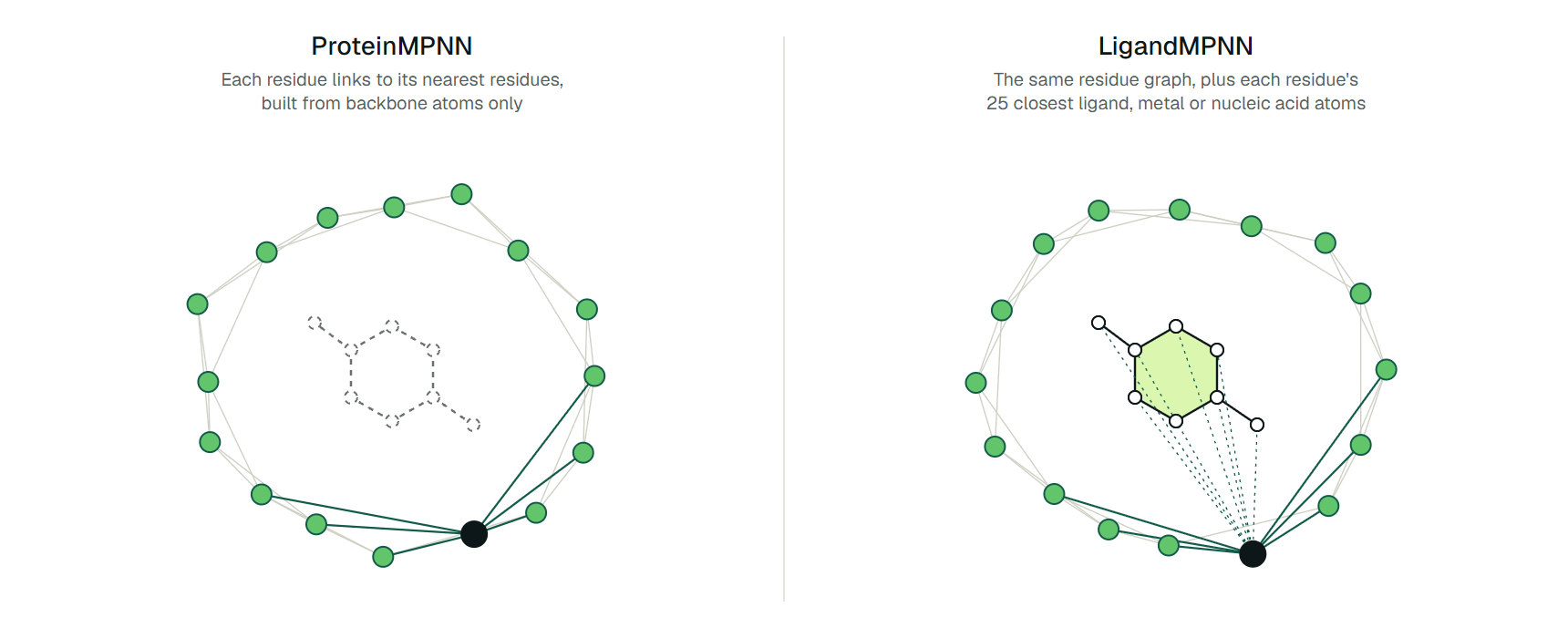
ProteinMPNN designs a sequence from the protein backbone alone. LigandMPNN designs from the same backbone plus the coordinates of nearby ligand, metal and nucleic acid atoms, so it can pick residues that pack against, hydrogen-bond to or coordinate those atoms.[2]
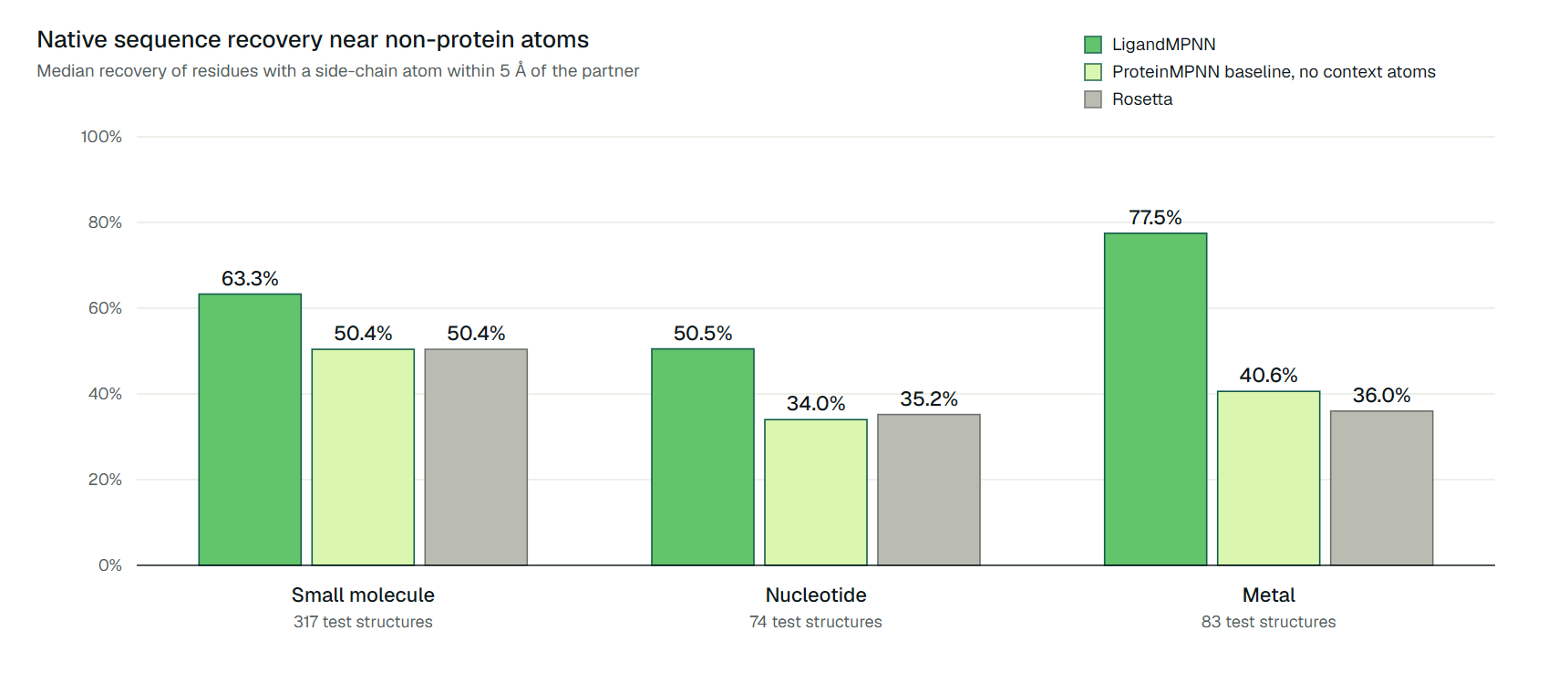
The gain depends heavily on the partner. In the LigandMPNN preprint, a ProteinMPNN baseline that the authors retrained without any context atoms got only 40.6% of metal-contacting residues right on native proteins, so it missed almost 6 of every 10. LigandMPNN got 77.5%, missing about 2 of 10.[3]
Around small molecules the same comparison was 50.4% against 63.3%, a smaller step, and the authors note that the two models' recoveries correlate closely there.[3]
Three things decide which model fits a job: whether the pocket partner is positioned in your structure, what kind of partner it is, and whether native-sequence recovery is even the right measure of success. The sections below take each in turn.
 LigandMPNNDesign protein sequences around ligands, metals, and nucleotides for enzyme engineering and binding-site optimization.Open tool
How each model sees the pocket
ProteinMPNN turns a backbone into a graph in which each residue is a node linked to its 32 to 48 nearest neighbors, with distances between N, Cα, C, O and a virtual Cβ atom as the features. On native backbones it recovered 52.4% of residues, against 32.9% for Rosetta, and it designed a sequence in about a second where Rosetta took minutes.[1]
Nothing in that representation knows a ligand exists, so a designed pocket is shaped only by the protein around it.
LigandMPNN keeps that graph and adds a second one. For each residue it takes the 25 closest ligand atoms, measured from the residue's virtual Cβ, and encodes each atom by its element and its distances to the residue's backbone atoms.[3] The preprint reports 2.62 million parameters against 1.66 million for ProteinMPNN.[3]
Element identity matters most where chemistry decides the answer. Removing the element type from the inputs cost about 8% recovery near metals and little near small molecules or nucleotides, which fits the large metal gain above.[3]
What the recovery benchmark measures
The comparison uses native sequence recovery: design a sequence for a crystal structure, then count how many residues match the natural protein. Here the count is restricted to residues with a side-chain atom within 5 Å of a non-protein atom. The test set was drawn from PDB entries as of December 2022 at better than 3.5 Å resolution, split by clustering sequences at 30% identity, and each value is a median over ten designed sequences per protein.[3]
Figure 2 restates the published medians. Converted into residues missed per ten contacts, which is a number you can feel, LigandMPNN misses 3.7 near small molecules against 5.0 for the baseline, 5.0 against 6.6 near nucleotides and 2.3 against 5.9 near metals. Those are our calculation, 10 times (1 minus recovery).
The catch is the baseline. The authors retrained ProteinMPNN on the same data with 0.1 Å of coordinate noise and no context atoms, so that the only difference was the ligand input.[3] That is a clean test of what ligand context is worth, but it is not a test of the released ProteinMPNN weights, and the preprint abstract and results text differ by a tenth of a point on the small-molecule baseline (50.5% and 50.4%).[3]
Noise also moves the numbers. In the same preprint, training at 0.05 Å raised recovery by about 2% and training at 0.2 Å lowered it by about 2%, and the authors warn that methods should be compared at similar noise levels.[3] Both tools on ProteinIQ expose several noise checkpoints, so a side-by-side run should use the same one for each.
Recovery is not success
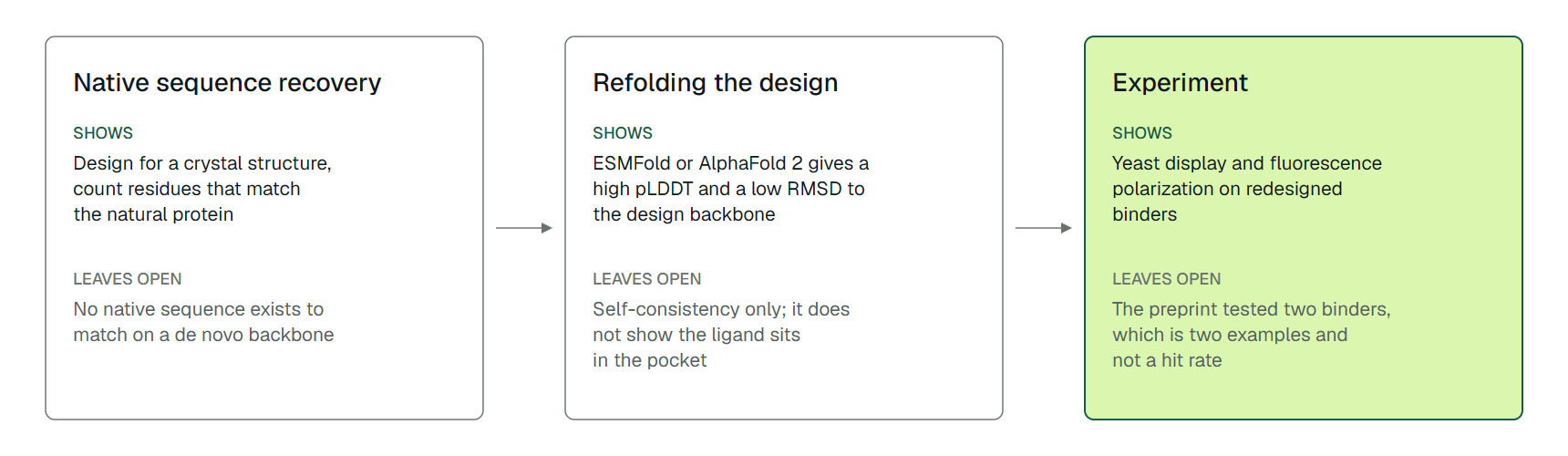
A recovered residue is a residue evolution already chose. That makes recovery a useful sanity check on a native enzyme or binder and a meaningless one on a de novo backbone, which has no native sequence to match. A model can also score well on recovery and still produce a protein that fails to express, fold or bind.
The LigandMPNN preprint is open about this. It reports no success rate. Its experimental section describes redesigning two Rosetta-designed binders, one for rocuronium that had shown no binding and one for cholic acid that bound weakly, and testing the new sequences by yeast display and fluorescence polarization.[3] Those are two examples, not a hit rate, and a pocket recovery number from native proteins says nothing about either.
The check that does carry weight is the one used for any designed sequence: refold it with ESMFold or AlphaFold 2, confirm a high pLDDT and a low RMSD to the design backbone, then test it. That evidence is about self-consistency, as the protein design guide explains, and it does not tell you whether a ligand still sits in the pocket.
Reading the gain in your own pocket
The medians in Figure 2 become expected counts once you pick a pocket size. Take a small-molecule pocket of 15 contacting residues: 63.3% and 50.4% imply about 9.5 and 7.6 native residues recovered, a difference of roughly 2 residues. For a metal site of 6 contacting residues, 77.5% and 40.6% imply about 4.7 and 2.4, a difference of more than 2 residues out of 6.
Those are expected values from published medians, not predictions for any particular protein, and we have not run a job for this article. Spread across proteins is large, and the preprint says only that LigandMPNN was higher for most proteins, not all.[3]
The practical reading is that ligand context buys a couple of residues per pocket, concentrated at metals and, to a lesser degree, nucleic acids. If your design needs those specific residues right, the difference is large. If it needs a stable scaffold around a pocket you will validate anyway, it may not be.
Where ESM-IF1 and the other variants fit
ESM-IF1 is a second backbone-only designer, trained on 12 million structures predicted by AlphaFold2, with 51% native recovery overall and 72% for buried residues on its held-out backbones.[4] That 51% and ProteinMPNN's 52.4% come from different test sets, so they do not rank the two models.
The useful comparison is practical: running both on one backbone shows how many sequences the structure really allows, which the inverse folding use case describes.
Variants of ProteinMPNN cover other priorities. SolubleMPNN targets solubility and HyperMPNN thermostability. For a design built around a ligand, the choice is still between the backbone-only family and LigandMPNN.
Choosing between them
Table 1 turns the argument into a starting point. In every row, hold the temperature, noise checkpoint and number of sequences the same across models, or the comparison measures settings instead of models.
| Your situation | Start with | Add | Check |
|---|---|---|---|
| Backbone only, no cofactor or partner | ProteinMPNN | ESM-IF1 on the same backbone | Refold and compare pLDDT and RMSD |
| Pocket around a positioned small molecule or cofactor | LigandMPNN | ProteinMPNN at the same noise as a baseline | That the ligand pose is right, because the model takes it as given |
| Metal binding site | LigandMPNN | Fixed positions on residues known to coordinate | Coordination geometry in the refolded model |
| DNA or RNA interface | LigandMPNN | ProteinMPNN baseline | Contacts to the nucleic acid in the design |
| Solubility or thermostability matters most | SolubleMPNN or HyperMPNN | LigandMPNN if a ligand is present | Expression, in the lab |
| New backbone from a diffusion model, with a target ligand | LigandMPNN | ProteinMPNN for backbone-only filtering | Whether the pocket still forms after refolding |
One setting trips people up. Turning off Use atom context in the LigandMPNN tool masks the ligand atoms but still runs the LigandMPNN checkpoint, so the result is not the same as running ProteinMPNN. For a true backbone-only baseline, use the ProteinMPNN tool.
Sequence design tools on ProteinIQ
Design the sequences first, then refold them and check the pocket. A LigandMPNN job starts at 50 credits and a ProteinMPNN job at 25, so a ProteinMPNN baseline on the same structure is cheap to add.
- Design sequences for a backbone alone: ProteinMPNN
- Design around ligands, metals or nucleic acids: LigandMPNN
- Get a second, independent backbone-only design: ESM-IF1
- Prioritize solubility or thermostability: SolubleMPNN or HyperMPNN
- Generate a new backbone to design on: RFdiffusion
- Refold designs and check the pocket: ESMFold or Boltz-2
Frequently asked questions
Is LigandMPNN better than ProteinMPNN?
Near ligands, metals and nucleotides, yes on native sequence recovery: 63.3% against 50.4% for small molecules, 50.5% against 34.0% for nucleotides and 77.5% against 40.6% for metals, measured against a ProteinMPNN baseline the authors retrained without context atoms.[3] That is a recovery result on natural proteins, not an experimental success rate.
Can ProteinMPNN design around a ligand?
It only sees the protein, so it designs as if the ligand were absent. You can keep ligand-contacting residues fixed to protect a known pocket, but the model will not choose new residues to complement the ligand. LigandMPNN is built for that case.[2]
What does sequence recovery mean?
It is the fraction of designed residues that match the natural sequence of the same backbone. It checks that a model learned the structure's preferences, and it says nothing about whether a design folds, expresses or functions.[1]
How does ProteinMPNN compare with ESM-IF1?
ESM-IF1 reports 51% native recovery overall and 72% on buried residues, and ProteinMPNN reports 52.4%, but they were measured on different held-out sets.[1][4] Running both on the same backbone is the fair comparison.
Does the noise checkpoint matter?
Yes. In the LigandMPNN preprint, training at 0.05 Å raised recovery by about 2% and training at 0.2 Å lowered it by about 2%, so compare tools at the same noise level.[3]