A custom peptide from a catalog supplier costs about $2 to $4.50 per amino acid for a crude product and about $12 per amino acid for one purified to more than 95%. For a typical 20-residue peptide made at the smallest scale, 1 to 4 milligrams, that comes to roughly $40 to $90 crude and $200 to $240 at high purity. Suppliers quote these prices per residue, meaning per amino acid in the chain, and then add fees for modifications, difficult sequences and larger amounts.
These are list prices, what a customer pays, not what it costs the supplier to make the peptide. Peptides that come out of design workflows as sequences on a screen must be built chemically one residue at a time, and each step leaves a little unwanted material behind that has to be removed. That single feature of the chemistry explains most of what follows: why purity is the largest price lever, why length and sequence matter, and why the same molecule costs a small fraction as much when a manufacturer makes it by the kilogram.
How much does custom peptide synthesis cost?
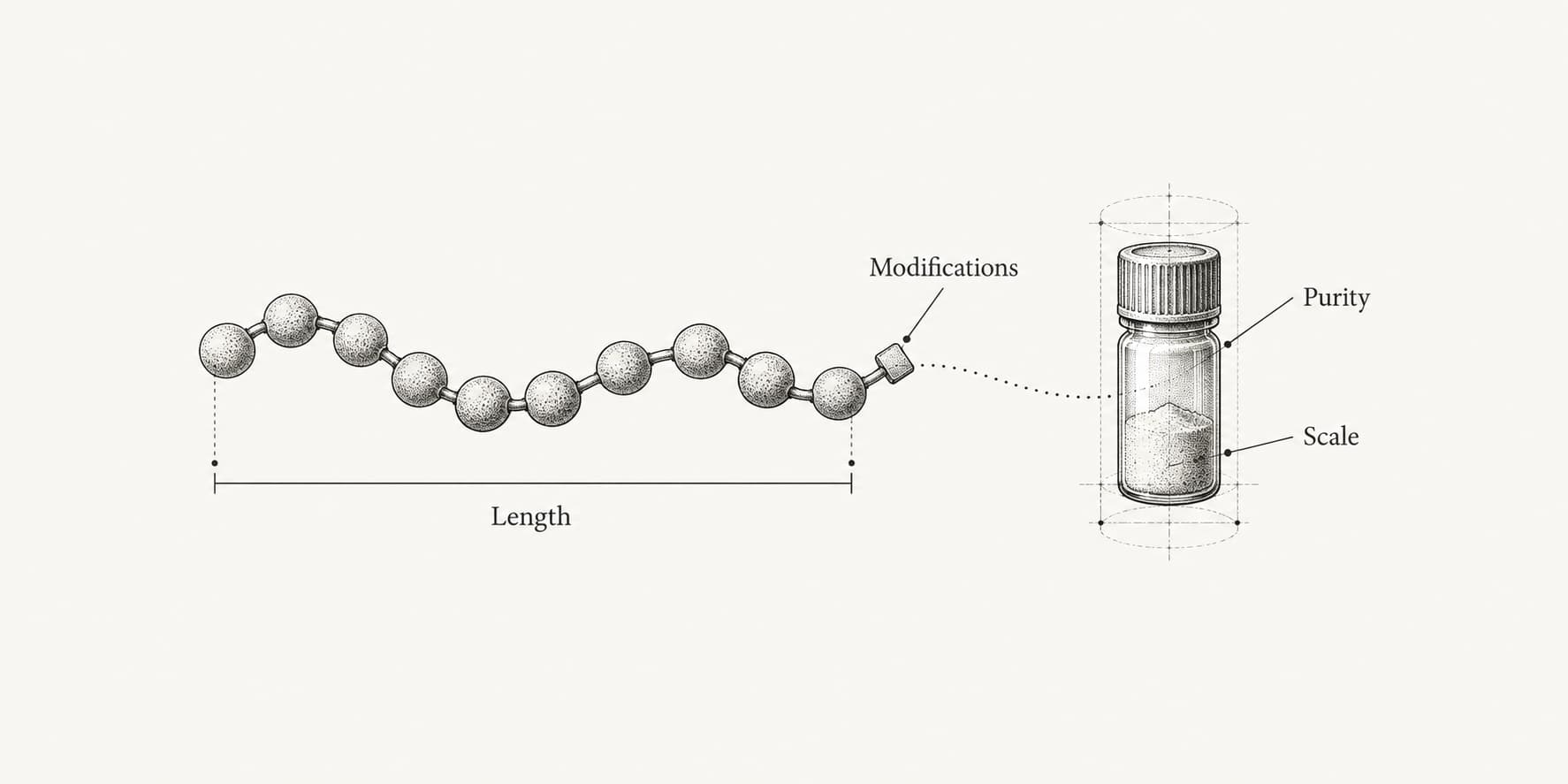
Catalog suppliers price a custom peptide as a per-residue rate multiplied by its length, and the rate depends on the purity grade and the amount ordered. At the smallest scale, Bio Basic lists crude peptide at $3.35 per residue and peptide above 95% purity at $11.65, while ABI Scientific lists $2 and $12 at 5 milligrams.[1][2] Crude peptide is the product exactly as it comes off the synthesizer. Each higher grade has been purified by chromatography until the stated share of the material is the intended sequence.
| Purity grade | Bio Basic | ABI Scientific |
|---|---|---|
| Crude | $3.35 | $2.00 |
| Desalted | $4.42 | $4.00 |
| >75% | $7.45 | $7.00 |
| >80% | $8.74 | $8.00 |
| >85% | $9.90 | $9.00 |
| >90% | $10.83 | $11.00 |
| >95% | $11.65 | $12.00 |
| >98% | $17.47 | $18.00 |
Multiplying by length gives the price of a specific peptide. A 20-residue peptide at Bio Basic costs 20 × $3.35 = $67.00 crude and 20 × $11.65 = $233.00 at more than 95% purity. LifeTein, which publishes a worked 20-residue table rather than a per-residue grid, lists $85 crude, $160 above 85% and $200 above 95% at the same 1 to 4 mg scale, and AAPPTec lists crude peptide at $3.50 to $4.50 per residue, or $70 to $90 for 20 residues.[3][4] At above 85% and above 95% purity the three suppliers fall within about 20% of one another, whereas crude prices span $40 to $90 because the cheapest grade is also the one that suppliers use as a headline rate.
| Purity grade | Bio Basic | ABI Scientific | LifeTein |
|---|---|---|---|
| Crude | $67.00 | $40 | $85 |
| >85% | $198.00 | $180 | $160 |
| >95% | $233.00 | $240 | $200 |
| >98% | $349.40 | $360 | Not listed |
The per-residue formula breaks down for very short peptides because suppliers also set a minimum charge per peptide, and the lowest advertised rates apply only to the cheapest grade. ProteoGenix advertises rates from $2.12 per residue with a $69 minimum, LifeTein from $2 with a $100 minimum, and AAPPTec a $125 minimum.[5][3][4] Lead times are similar across suppliers: ABI Scientific and LifeTein both state 1 to 2 weeks for unpurified peptides and 2 to 3 weeks for purified ones, and ProteoGenix starts at 10 business days.[2][3][5]
| Supplier | Lowest listed rate per residue | Minimum charge per peptide | Stated length range |
|---|---|---|---|
| Bio Basic | $3.35 (crude, 1 to 4 mg) | Not stated | Longer peptides by inquiry |
| ABI Scientific | $2 (crude, 5 mg) | Not stated | Up to 150 residues |
| LifeTein | $2 | $100 | Up to 150 residues |
| AAPPTec | $3.50 to $4.50 (crude) | $125 | Not stated |
| ProteoGenix | $2.12 | $69 | Above 150 residues offered |
Why does peptide purity raise the price so much?
Purity is the largest price difference at a given length and scale: at Bio Basic, a peptide above 95% purity costs 3.5 times as much per residue as the crude product, and one above 98% costs 5.2 times as much. Even the last three percentage points are expensive, since Bio Basic charges 50% more per residue for above 98% than for above 95%.[1]
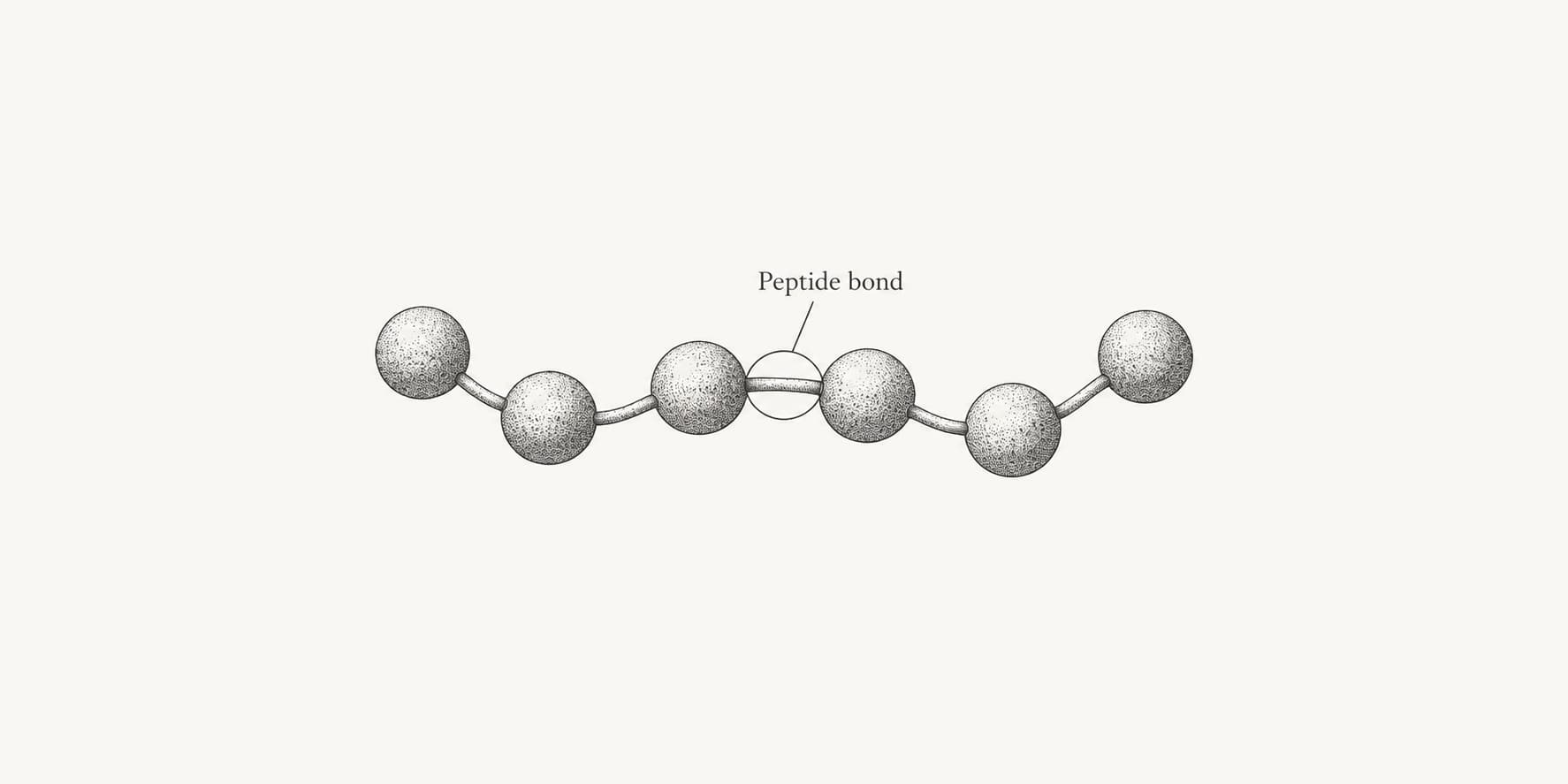
The reason lies in how peptides are made. In solid-phase synthesis, the chain is anchored to a resin bead at its C-terminal end and grown one amino acid at a time, and a chain of n residues requires n − 1 peptide bonds to form in sequence. No coupling step is perfectly efficient. A chain that misses one step lacks a residue but continues growing, so the crude product is a mixture of the target and many near-identical relatives. If each coupling succeeds with probability p, the fraction of chains that reach full length falls geometrically with the number of couplings:
Figure 2 and Table 4 apply this simplest model to three assumed success rates. The rates are illustrations, not measurements from any supplier, and the model ignores side reactions other than a missed coupling, so it understates how messy a real crude product can be.
| Length | p = 0.98 | p = 0.99 | p = 0.995 |
|---|---|---|---|
| 10 residues | 83.4% | 91.4% | 95.6% |
| 20 residues | 68.1% | 82.6% | 90.9% |
| 30 residues | 55.7% | 74.7% | 86.5% |
| 40 residues | 45.5% | 67.6% | 82.2% |
| 50 residues | 37.2% | 61.1% | 78.2% |
Because a truncated chain differs from the target by only one or two residues, it cannot be filtered out by size and has to be separated by preparative chromatography, which is slow and uses large volumes of solvent. In an industry survey of peptide manufacturing processes from 14 pharmaceutical companies, synthesis and purification together accounted for 30% to 70% of the waste generated, and the dilute solutions used in preparative chromatography were an important contributor.[6] A stricter specification means keeping only the cleanest fractions and discarding those where the target is mixed with its neighbors, so less finished peptide is recovered from each synthesis as the grade rises.
Some sequences are harder than their length suggests. Mohapatra and colleagues analyzed 35,427 deprotection reactions from an automated flow synthesizer and found that sequence-dependent events such as aggregation, in which growing chains stick to one another on the resin, slow the chemistry and reduce yield.[7] AAPPTec accordingly states that its price table gives estimates for typical peptides and that the actual price may vary with the hydrophobicity and difficulty of the sequence.[4] A hydrophobicity plot shows where a sequence is likely to be hard before you request a quote.
The purity that a project needs is usually lower than the highest grade on offer. GenScript's guidance places screening, mutation scanning and sequence optimization at crude purity, ELISA and peptide arrays at above 75%, in vitro bioassays and epitope mapping at above 85%, quantitative binding and NMR work at above 95%, and crystallography, structure-activity studies and clinical-grade material at above 98%.[8] The supplier's mass-spectrometry check should match the mass you expect for the sequence, which you can compute with the protein molecular weight calculator. Choosing the right grade matters in money terms: a 20-residue peptide at Bio Basic costs $149.00 at above 75%, $233.00 at above 95% and $349.40 at above 98%.[1]
| Grade | Recommended uses |
|---|---|
| Crude | First-pass screening, mutation screening, sequence optimization |
| >75% | ELISA, peptide arrays, antigens for polyclonal antibodies |
| >85% | In vitro bioassays, epitope mapping, phosphorylation studies |
| >95% | NMR, quantitative receptor-ligand and competitive inhibition studies, proteolysis studies |
| >98% | Crystallography, structure-activity studies, GMP peptides for drug studies, clinical trials |
How do length, sequence and modifications change the price?
Length raises the price roughly in proportion, and modifications add flat fees that can outweigh the peptide itself. At Bio Basic, a 40-residue peptide above 95% purity costs 40 × $11.65 = $466, twice the $233 of a 20-mer, before any allowance for the lower yield that Table 4 implies for longer chains.[1]
Length also runs into a practical ceiling. Suppliers here advertise peptides of up to 150 residues, but the industry survey by Kekessie and colleagues puts the practical limit of solid-phase synthesis at about 100 residues, beyond which manufacturers turn to hybrid strategies that combine solid-phase and liquid-phase chemistry.[2][3][6] Automated flow chemistry has pushed the boundary in the laboratory: Hartrampf and colleagues made chains of up to 164 residues through 327 consecutive reactions in hours, although these were research syntheses rather than catalog products.[9]
Modifications are priced as add-ons. ABI Scientific states the rule directly: add the price of an extra residue at the chosen quantity and purity, plus the charge for the modification.[2] Simple changes to the ends of the chain are cheap, and amidation of the C-terminus is free. Chemistry that alters the backbone or joins parts of the chain together is not: at ABI Scientific, a 20-residue peptide above 95% purity costs $240, and adding an amide cyclization at $1,000 raises the price to $1,240, about 5.2 times as much.
| Modification | ABI Scientific | LifeTein |
|---|---|---|
| N-terminal acetylation | $20 | Not listed |
| C-terminal amidation | Free | Not listed |
| Biotin with a linker (Ahx) | $65 | Not listed |
| FITC with a linker (Ahx) | $130 | Not listed |
| All D-amino acids | $65 | Not listed |
| N-methyl amino acids | $495 | Not listed |
| Phosphorylation (one site) | $150 | $100 |
| KLH or BSA conjugation | $200 | Not listed |
| First disulfide bridge | $300 | $200 |
| Second disulfide bridge | $900 | $400 for two bridges |
| Amide cyclization | $1,000 | $500 |
The final multiplier is the number of peptides. Every peptide in an order carries its own minimum charge or per-residue price, so a set of overlapping fragments tiled along a protein costs the sum of its members. The overlapping peptide generator builds such libraries from a sequence and shows how many peptides a chosen length and overlap will require before you order them.
How much cheaper are peptides made at industrial scale?
Cost per milligram falls steeply with scale even within a catalog: for a 20-residue peptide above 95% purity at Bio Basic, the price per milligram falls from about $58 at the top of the 1 to 4 mg band to about $2.15 at 1 gram. The rate per residue rises 9.2 times between these two scales, from $11.65 to $107.51, but the amount ordered rises 250 times, so the price per milligram falls about 27-fold.[1]
| Amount ordered | Rate per residue | Price of a 20-residue peptide | Price per milligram |
|---|---|---|---|
| 1 to 4 mg | $11.65 | $233.00 | $58.25 |
| 10 to 14 mg | $16.07 | $321.40 | $22.96 |
| 30 to 39 mg | $23.64 | $472.80 | $12.12 |
| 80 to 100 mg | $35.87 | $717.40 | $7.17 |
| 1,000 mg | $107.51 | $2,150.20 | $2.15 |
Manufacturers who make peptides by the kilogram still face the same chemistry, and their main cost is waste rather than time. In the industry survey, commercial and phase 3 solid-phase processes for peptides of 6 to 43 residues averaged 13,063 kilograms of waste per kilogram of peptide, with a range of 1,684 to 34,585, compared with a median of 168 to 308 for small-molecule drugs and about 8,300 for biopharmaceuticals.[6] The standard solvent, dimethylformamide, has been restricted in the European Union under the REACH chemicals regulation since December 2021, which makes solvent use a concern for manufacturers as well as an expense.[6]
A widely sold peptide drug shows how far scale can push the price down, although not by catalog chemistry. Semaglutide, the active substance in Ozempic and Wegovy, is produced by recombinant DNA technology in yeast followed by chemical modification, according to the European Medicines Agency, so its bulk price is not a solid-phase synthesis price.[10] Levi and colleagues, in a preprint that has not been peer reviewed, used shipment records of semaglutide imports and exports to and from India between November 2024 and November 2025 to estimate an ingredient cost of about $0.12 per 2.4 mg dose.[11] That implies about $0.05 per milligram, or roughly $50 per gram. A gram of a 20-residue custom peptide above 95% purity lists at $2.15 per milligram at Bio Basic, so we calculate that the catalog price is about 40 times the implied bulk price of semaglutide. The comparison is a contrast of scale, not a like-for-like price: the molecules, the production methods and the purity specifications differ, and one figure is a list price while the other comes from trade data.
Manufacturing cost is a small part of what patients pay for such drugs. Barber and colleagues estimated a cost-based price of $0.89 to $4.73 per month for injectable semaglutide, against lowest market prices of $38.21 to $353.74 across 12 countries in 2023 dollars.[12] How the rest of the price arises is a separate question, covered in the guide to drug development cost and the guide to semaglutide itself.
Taken together, a peptide price is the product of four things that all trace back to stepwise chemistry: the number of residues, the purity that must be separated out, the amount made and the chemistry added beyond a plain linear chain. The prices in this guide are US dollar list prices from suppliers that publish them, retrieved on one day, and they do not capture negotiated discounts, shipping or quotes for unusual sequences. A short, plain, moderately pure linear peptide in milligram amounts should land close to the tables above. The further a peptide departs from that description, the more its quote will depend on the sequence itself.