How many peptide bonds are in a peptide?
A linear peptide with n amino acid residues has n − 1 peptide bonds. A tripeptide has 2, a tetrapeptide has 3, and a 100-residue chain has 99.
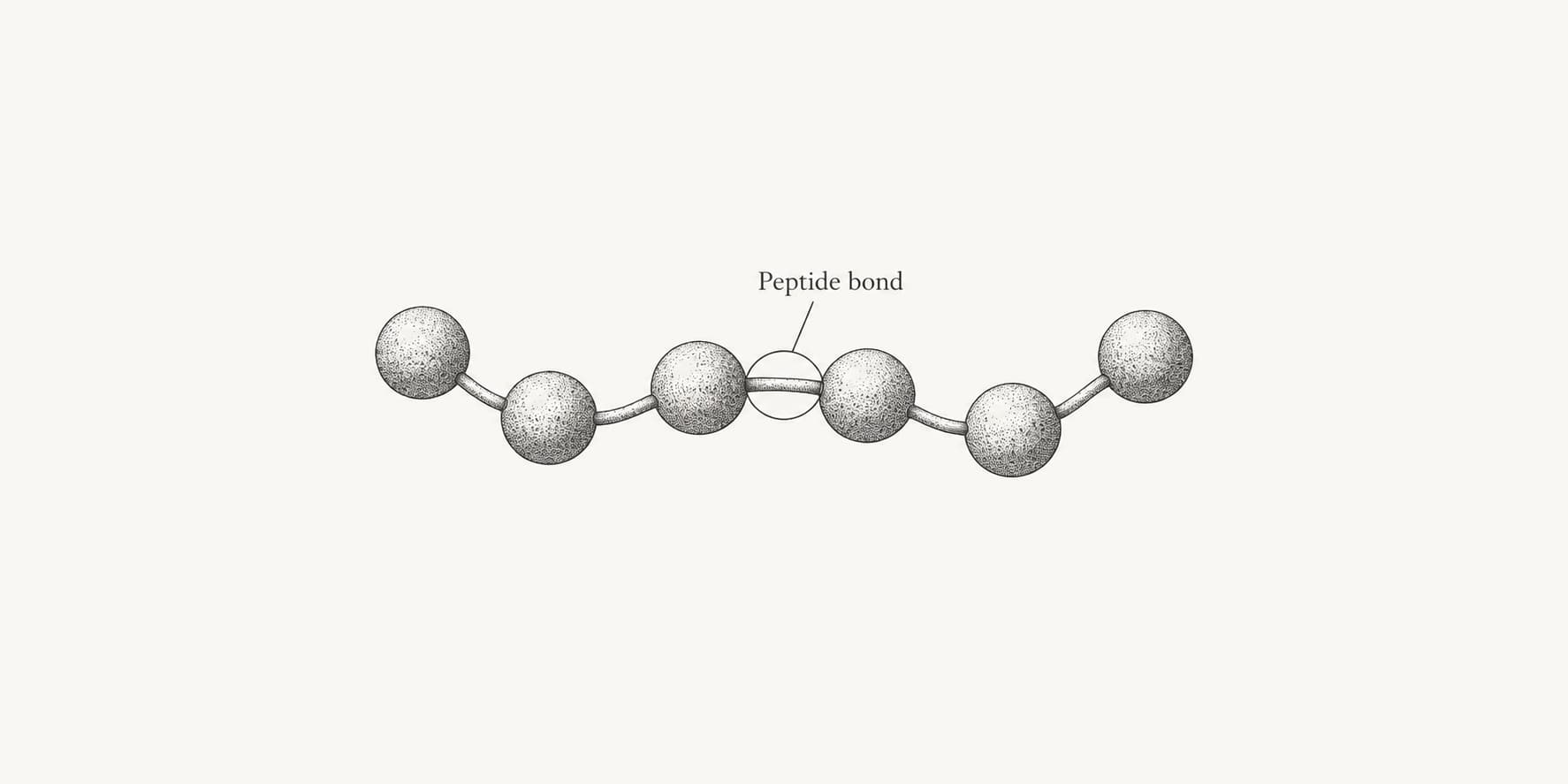
A linear tripeptide contains 2 peptide bonds. A single linear chain with amino acid residues has peptide bonds.
That gives 1 bond in a dipeptide, 3 in a tetrapeptide, 4 in a pentapeptide, 5 in a hexapeptide, and 99 in a chain of 100 amino acid residues. Multi-chain and cyclic molecules need a different count.
How many peptide bonds are in a tripeptide?
A linear tripeptide has 3 amino acid residues joined by 2 peptide bonds.[1][2]
Each bond connects one residue to the next. Written as three residue symbols, Gly-Ala-Ser, the two hyphens represent the two peptide bonds. The same count applies no matter which amino acids make up the tripeptide.
| Peptide | Amino acid residues | Peptide bonds |
|---|---|---|
| Dipeptide | 2 | 1 |
| Tripeptide | 3 | 2 |
| Tetrapeptide | 4 | 3 |
| Pentapeptide | 5 | 4 |
| Hexapeptide | 6 | 5 |
| Linear chain of 100 residues | 100 | 99 |
The values follow the IUPAC peptide definition and the relationship formalized for linear peptide structures in ChEBI.[1][2]
How do you calculate the number of peptide bonds?
For one linear peptide chain, subtract 1 from the number of amino acid residues:
A peptide bond is the amide bond formed when the carbonyl carbon of one amino acid joins the nitrogen of another, with the formal loss of water.[1] Adding the first residue starts the chain but creates no peptide bond. Every additional residue extends the chain by one bond.
For several separate linear chains, subtract the number of chains from the total number of residues:
This counts backbone peptide bonds, not disulfide bonds or other cross-links. Sequence length also affects molecular weight, because forming each peptide bond removes the elements of one water molecule.
How many peptide bonds are in insulin?
Mature human insulin contains 49 peptide bonds: 20 in its 21-residue A chain and 29 in its 30-residue B chain.
The two chains contain 51 residues in total, but they are separate peptide chains:
The calculation gives 20 bonds in the A chain and 29 in the B chain.[3]
Three disulfide bonds stabilize insulin: two connect the A and B chains, and one lies within the A chain.[3] They do not change the peptide-bond count. Insulin often appears in comparisons of the smallest proteins, but subtracting 1 from its combined 51 residues gives the wrong answer because it has two chains.
Do cyclic peptides have the same number of peptide bonds?
A head-to-tail cyclic peptide with amino acid residues has peptide bonds because one additional peptide bond closes the ring.
A cyclic tripeptide of this type therefore has 3 peptide bonds, while its linear counterpart has 2. IUPAC calls a cyclic peptide whose ring consists entirely of standard backbone peptide bonds a homodetic cyclic peptide.[1]
Not every cyclic peptide closes through a peptide bond. Rings can also form through a disulfide, ester, carbon-carbon, or other covalent link, so the peptide-bond count depends on the molecular structure.[1] These distinctions matter when building or predicting cyclic peptides.