Cyclic peptide structure prediction with CycPOEM-enhanced AlphaFold2 Learn more
Input
What is HighFold?
HighFold predicts the three-dimensional structures of cyclic peptides — molecules where the chain loops back on itself through a head-to-tail peptide bond, sometimes reinforced by disulfide bridges. Standard protein structure prediction methods like AlphaFold 2 treat sequences as linear chains and encode residue positions accordingly, which means they systematically misrepresent the topology of cyclic peptides.
HighFold solves this by replacing AlphaFold's linear position encoding with CycPOEM (Cyclic Position Offset Encoding Matrix), a distance matrix that accounts for head-to-tail cyclization and disulfide bond shortcuts. The rest of the AlphaFold2/ColabFold pipeline — MSA generation, Evoformer attention, and structure module — remains unchanged. The result is substantially more accurate cyclic peptide structures without retraining any neural network weights.
The method was developed at Zhejiang University of Technology and Shanghai Highslab Therapeutics, published in Briefings in Bioinformatics (2024).
How CycPOEM works
AlphaFold encodes the relative position between two residues as a simple linear offset: residue and residue are apart. For a cyclic peptide of length , this ignores that residues 1 and are covalently bonded.
CycPOEM constructs a more accurate distance matrix using a modified Floyd-Warshall shortest-path algorithm:
- An adjacency matrix is initialized with distance 1 between consecutive residues
- A head-to-tail edge connects residue 1 to residue (distance 1)
- If disulfide bonds are specified, each pair of bridged cysteine residues also receives distance 1
- The Floyd-Warshall algorithm then computes the shortest path between every pair of residues through this graph
This means two residues on opposite sides of a 20-residue cyclic peptide are encoded as being 10 apart rather than 19 — reflecting the actual molecular topology.
Sign strategies
CycPOEM also encodes directionality. The Upper Negative (UN) strategy, which assigns negative values to the upper triangle of the matrix, produced the best results in benchmarks. This captures the asymmetric nature of peptide bonds (N→C directionality).
Benchmark results
On a test set of 63 NMR-resolved cyclic peptide structures, HighFold achieved a median backbone RMSD of 1.058 Å, compared to 1.737 Å for AfCycDesign and 1.956 Å for standard AlphaFold. For cyclic peptides with disulfide bridges, the improvement was even more pronounced: 1.720 Å average RMSD versus 3.256 Å for AfCycDesign.
How to use HighFold online
ProteinIQ runs HighFold on A100 GPU infrastructure with pre-loaded AlphaFold2 model weights, eliminating the need to configure ColabFold, install HighFold's overlay, or manage GPU environments locally.
Input
| Input | Description |
|---|---|
Cyclic peptide | Amino acid sequence in FASTA or raw format. Single chain only. Standard amino acids (20 canonical residues). |
Cyclization settings
| Setting | Description |
|---|---|
Disulfide bond pairs | Optional, explicitly known cysteine pairs, e.g. 1 5, 3 8. Residue numbers are 1-based, every referenced residue must be cysteine, and a cysteine can appear in only one pair. Leave empty for head-to-tail cyclization only. ProteinIQ does not infer unknown disulfide connectivity. |
Prediction settings
| Setting | Default | Description |
|---|---|---|
Number of models | 5 | AlphaFold2 models to run (1–5). All five gives the most reliable ranking but increases runtime proportionally. |
Random seeds | 1 | Number of random seeds per model (1–5). More seeds produce greater diversity in predicted conformations. |
Recycles | 3 | Number of recycling iterations through the model (1–20). More recycles can improve accuracy for difficult targets but increases runtime. |
Model type | AlphaFold2-pTM | Model variant. AlphaFold2-pTM adds pTM confidence output. HighFold preserves the source model ranking by pLDDT for monomeric cyclic peptides. |
MSA settings
| Setting | Default | Description |
|---|---|---|
MSA mode | UniRef+Environmental | Database for multiple sequence alignment generation via MMseqs2. UniRef+Environmental searches UniRef and environmental sequence databases. UniRef only is faster. No MSA runs single-sequence mode (no evolutionary information). |
Use templates | On | Query the PDB for structural templates. Useful when homologous structures exist. |
Max MSA sequences | Auto | Maximum number of MSA sequences to use. Leave empty for automatic selection. Lower values speed up prediction at the cost of accuracy. |
Advanced settings
| Setting | Default | Description |
|---|---|---|
AMBER relaxation | On | Run OpenMM/AMBER energy minimization on predicted structures. Recommended for cyclic peptides, where strained geometry is common. |
Structures to relax | 1 | Number of top-ranked predictions to relax (0–5). Only applies when AMBER relaxation is enabled. |
Early stop tolerance | Disabled | Stop recycling early if pLDDT improvement is below this threshold (e.g. 0.5). Speeds up prediction for easy targets. |
Random seed | 0 | Random seed for reproducibility. Use the same seed and settings to reproduce identical results. |
Output
Each prediction run produces up to the selected model count multiplied by the selected seed count. Results preserve HighFold's source ranking and include:
- PDB files: 3D coordinates for each ranked prediction, viewable in the built-in 3D viewer
- Unrelaxed structures: The native unrelaxed PDB is retained alongside an AMBER-relaxed structure when both exist
- pLDDT scores: Per-residue confidence (0–100), averaged across the structure for ranking
- pTM scores: Predicted TM-score (when available), returned as a secondary confidence metric
- PAE and score files: Native ColabFold JSON outputs, including predicted aligned error data when generated
- MSA alignment: The multiple sequence alignment used as input (
.a3mformat) - ColabFold plots: Coverage and pLDDT visualization plots (
.png) - Run provenance: Native configuration, citation, and log files generated by HighFold/ColabFold
Interpreting confidence scores
| pLDDT | Interpretation |
|---|---|
| > 90 | High confidence — backbone and sidechain positions likely accurate |
| 70–90 | Good confidence — backbone probably correct, sidechains less certain |
| 50–70 | Low confidence — treat with caution, may need experimental validation |
| < 50 | Very low confidence — structure unreliable in this region |
For cyclic peptides, pLDDT values tend to be lower than for globular proteins of similar size, particularly in loop regions. A pLDDT of 70+ for a short cyclic peptide generally indicates a successful prediction.
Limitations
- Natural amino acids only: HighFold supports the 20 canonical amino acids. Cyclic peptides containing non-natural amino acids, N-methylated residues, or D-amino acids cannot be modeled. (The successor HighFold3 addresses this limitation but is not yet available here.)
- Single chain: Only monomeric cyclic peptides are supported. Cyclic peptide–protein complexes require HighFold_Multimer, which uses a different model architecture.
- Sequence length: Very short peptides (< 5 residues) may not generate meaningful MSAs, reducing prediction quality. Consider using
No MSAmode for very short sequences. - AMBER relaxation failures: Energy minimization can fail on highly strained or unusual cyclic topologies. When this happens, the unrelaxed structure is returned with a warning rather than being reported as relaxed.
Related tools
Boltz-2
Boltz-2 is a biomolecular foundation model for structure and binding affinity prediction. Supports proteins, ligands, DNA, and RNA in multi-component complexes. Automatically scales GPU resources for large complexes. Predicts binding affinity with near-FEP accuracy at 1000x faster speed.
LMI4Boltz
LMI4Boltz is a low-memory fork of Boltz for biomolecular structure and binding affinity prediction. It preserves Boltz inference behavior while reducing VRAM use with in-place pair updates, CPU offload, reduced precision pair representation, and aggressive chunking.
PeptideBuilder
Build all-atom peptide PDB structures from amino acid sequences using PeptideBuilder geometry defaults, with optional backbone angle controls for simple model peptides.
ABodyBuilder3
ABodyBuilder3 predicts antibody variable-domain structures from paired heavy and light chain sequences. It returns a PDB structure and, for the pLDDT checkpoint, per-residue confidence values.
AlphaFlow
Generate protein conformational ensembles with AlphaFlow or ESMFlow from a sequence, optional MSA, and supported reference-structure checkpoints.
AlphaFold2
AlphaFold2 via ColabFold for protein structure prediction. Free runs use single-sequence mode; paid plans add MMseqs2 MSA generation. Supports monomer and multimer prediction.
Chai-1
Chai-1 is a multi-modal foundation model for molecular structure prediction. Predicts 3D structures for proteins, ligands, DNA, RNA, and multi-component complexes with high accuracy.
ESMfold
ESMfold is a fast, single-sequence protein structure predictor from Meta AI. Predicts 3D protein structures directly from amino acid sequences without requiring multiple sequence alignments (MSA), making it significantly faster than AlphaFold while automatically scaling GPU resources for larger proteins.
ESMFold2
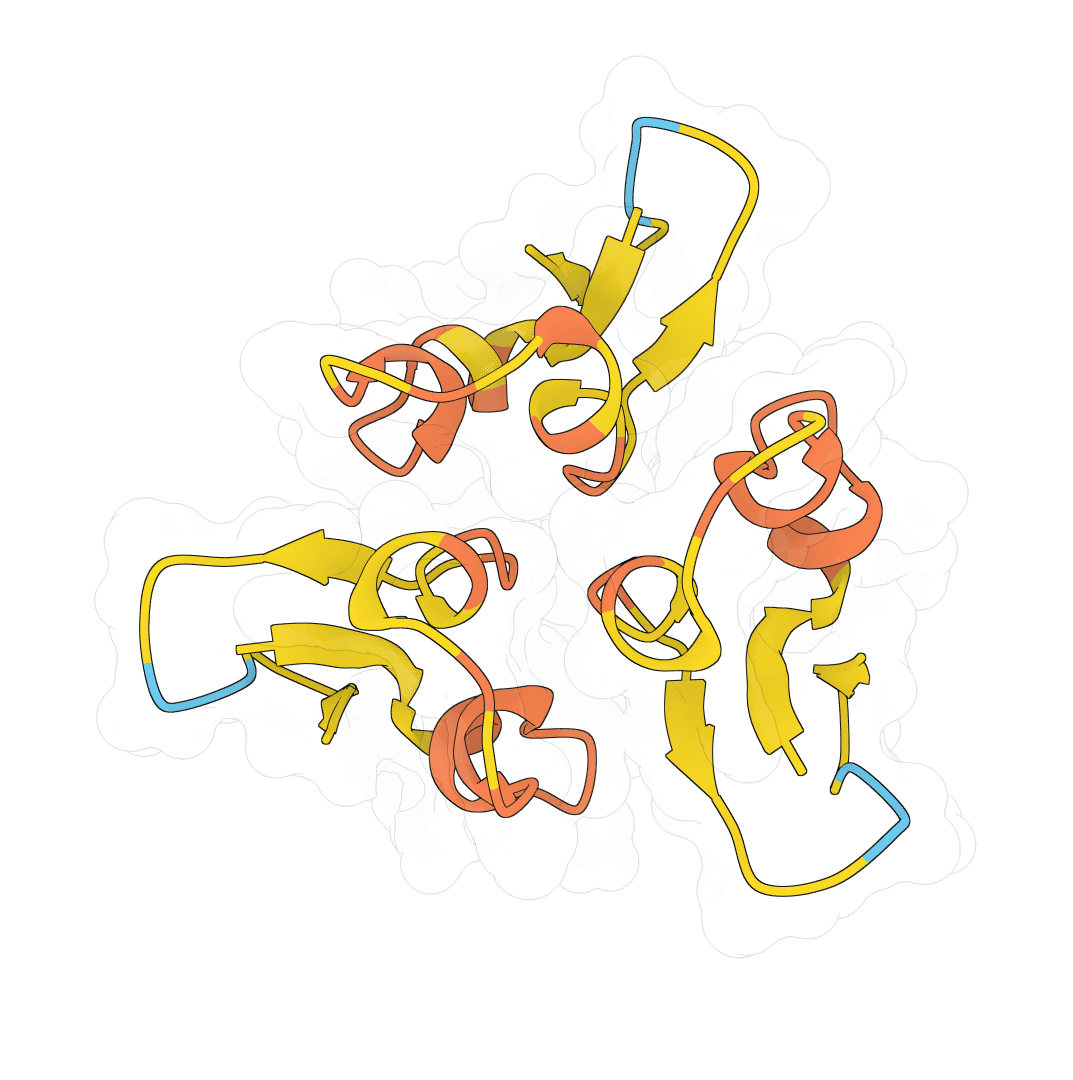
ESMFold2 predicts protein structures and multi-chain protein complexes from amino acid sequences using Biohub protein language models. The first ProteinIQ release focuses on sequence-based protein folding with confidence metrics, native mmCIF structures, and optional PAE and pair-chain iPTM outputs.
ImmuneBuilder
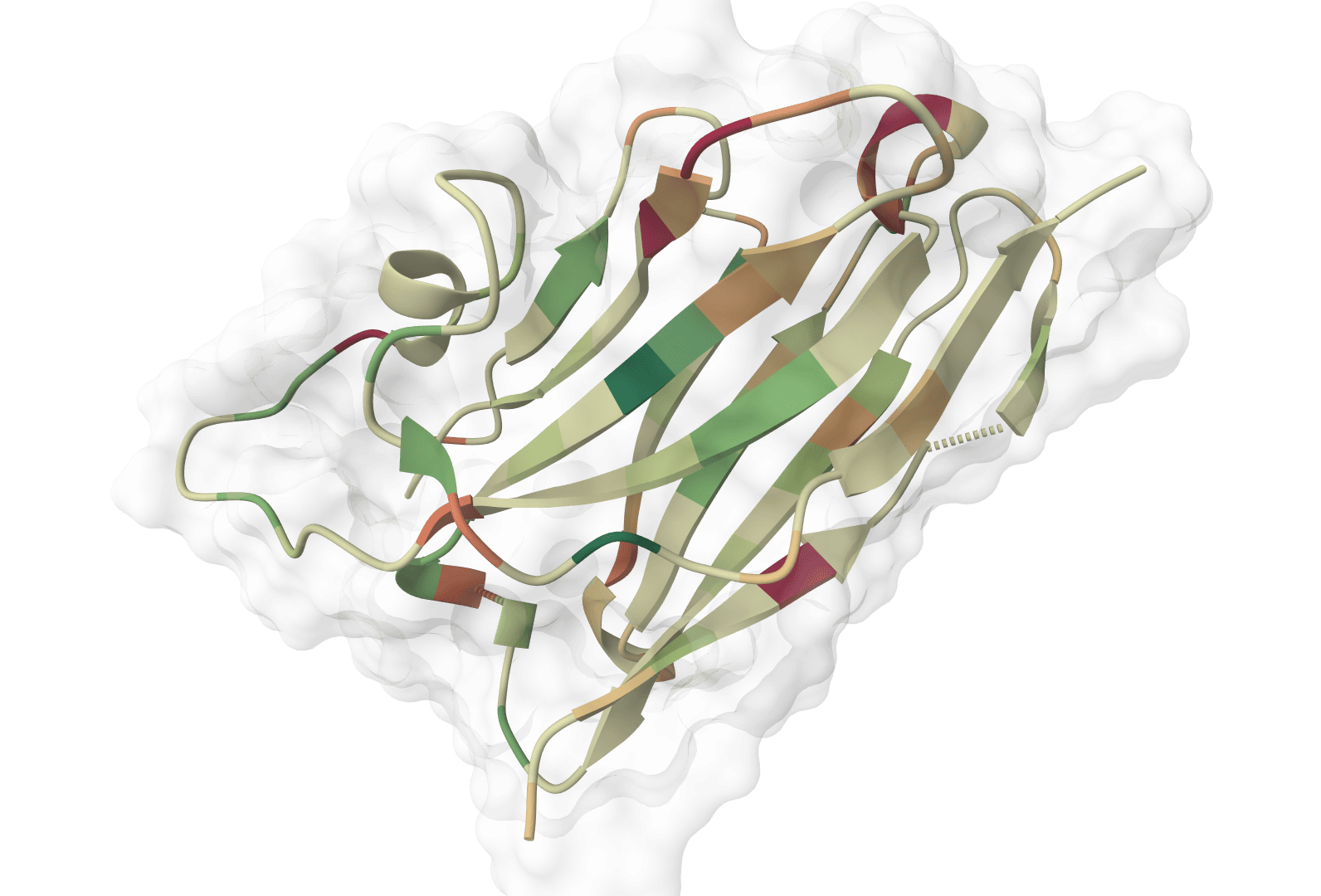
ImmuneBuilder predicts 3D structures of immune receptor proteins including antibodies, nanobodies, and T-cell receptors. It uses ABodyBuilder2, NanoBodyBuilder2, and TCRBuilder2/TCRBuilder2+ to generate structures with per-residue error estimates and optional ensemble artifacts.