How many amino acids are there?
Proteins use 20 standard amino acids. Selenocysteine brings the human encoded set to 21; pyrrolysine extends the natural set across life to 22.
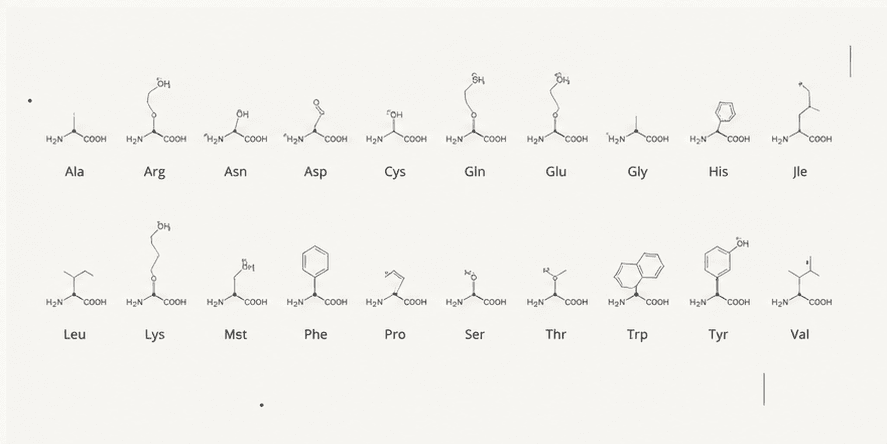
There are 20 standard amino acids used to build proteins. Including selenocysteine brings the genetically encoded set in humans to 21, while pyrrolysine brings the naturally encoded set across known life to 22. These counts describe amino acid types incorporated into proteins during translation, the process by which cells read genetic instructions to assemble a protein.
The broader chemical category contains hundreds of amino acids. The answer therefore depends on whether we are counting protein building blocks, dietary requirements, or amino acids regardless of their role in proteins.
Are there 20, 21, or 22 amino acids?
The conventional protein alphabet contains 20 amino acids. This is the set meant by the familiar textbook answer and by the NHGRI glossary.[1] Humans also incorporate selenocysteine through specialized translation machinery, bringing the human encoded set to 21.[2][3] Pyrrolysine, found in some archaea and bacteria, extends the naturally genetically encoded set across life to 22.[4]
These are nested sets rather than competing estimates. The count of 22 spans organisms with different translation machinery; it does not mean that every organism uses all 22. Likewise, nine essential amino acids is a dietary count within the standard 20, rather than an alternative estimate of the entire protein alphabet.[4][5]
The chart combines the standard alphabet, the human and cross-species genetic counts, and the healthy-adult nutritional classification. Its values count distinct amino acid types, not their abundance in a protein or body.[1][2][3][4][5]
The distinction between types and residues also matters. A residue is an amino acid unit within a peptide or protein chain, where the same type can occur many times. A protein can therefore contain hundreds of residues while using only the standard alphabet. The average protein size guide covers chain lengths rather than the number of available building blocks.
What are the 22 genetically encoded amino acids?
The list consists of the 20 standard amino acids plus selenocysteine and pyrrolysine. The table gives their sequence codes and separates the human dietary classification from their inclusion in the genetic alphabet.
| Amino acid | Three-letter code | One-letter code | Healthy-adult dietary classification |
|---|---|---|---|
| Alanine | Ala | A | Nonessential |
| Arginine | Arg | R | Nonessential |
| Asparagine | Asn | N | Nonessential |
| Aspartic acid | Asp | D | Nonessential |
| Cysteine | Cys | C | Nonessential |
| Glutamic acid | Glu | E | Nonessential |
| Glutamine | Gln | Q | Nonessential |
| Glycine | Gly | G | Nonessential |
| Histidine | His | H | Essential |
| Isoleucine | Ile | I | Essential |
| Leucine | Leu | L | Essential |
| Lysine | Lys | K | Essential |
| Methionine | Met | M | Essential |
| Phenylalanine | Phe | F | Essential |
| Proline | Pro | P | Nonessential |
| Serine | Ser | S | Nonessential |
| Threonine | Thr | T | Essential |
| Tryptophan | Trp | W | Essential |
| Tyrosine | Tyr | Y | Nonessential |
| Valine | Val | V | Essential |
| Selenocysteine | Sec | U | Outside the standard 9/11 classification |
| Pyrrolysine | Pyl | O | Not encoded by humans |
Sequence notation follows UniProt; the dietary labels for the standard 20 follow MedlinePlus. Selenocysteine and pyrrolysine are listed separately because the 9-essential/11-nonessential division applies to the standard 20.[6][5] The nonessential category includes amino acids that can become conditionally essential, as explained below.
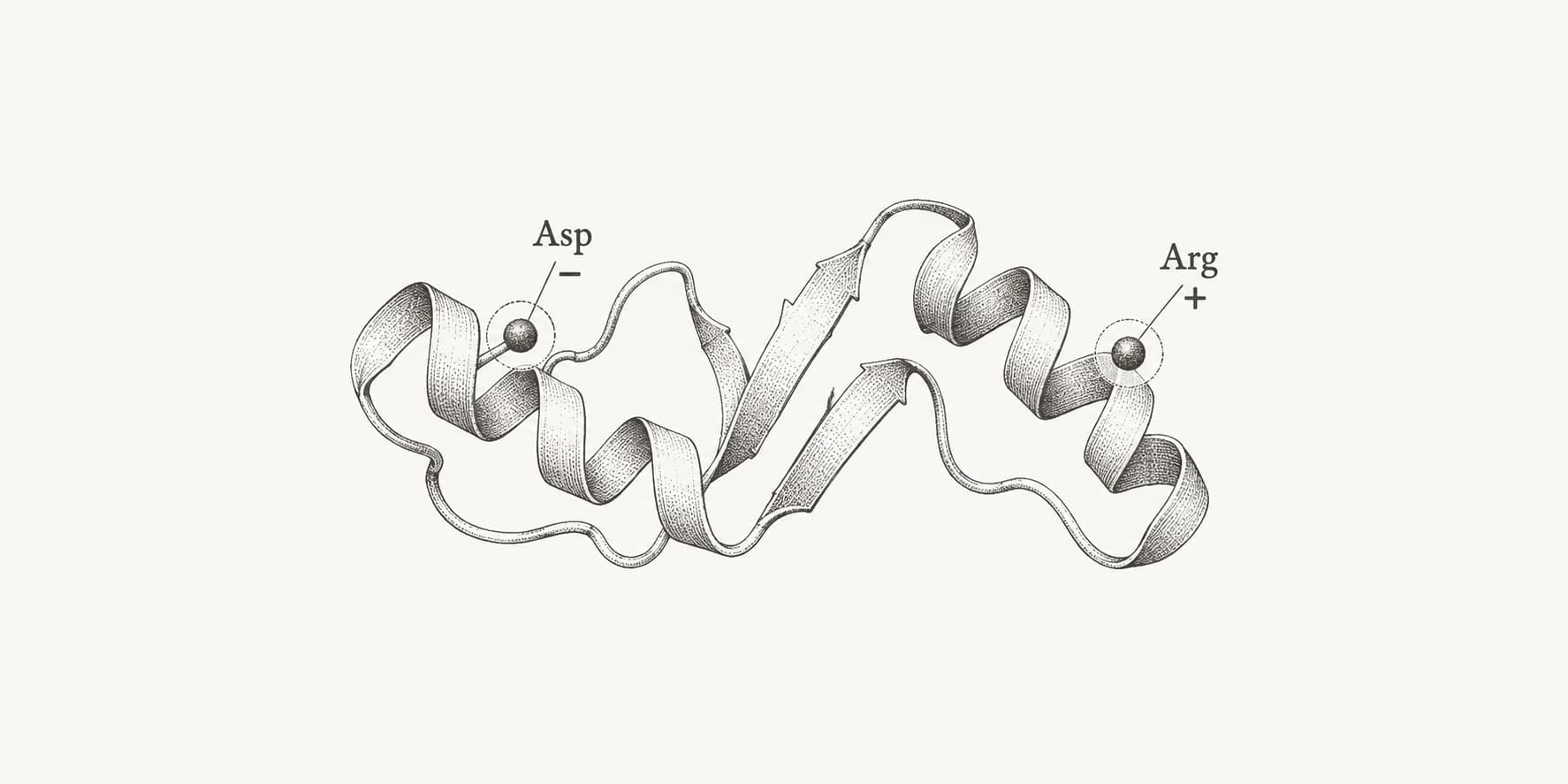
Aspartic acid and glutamic acid are often called aspartate and glutamate when discussing their ionized forms. These names do not add two more amino acid types. Their charge, like that of other ionizable groups, depends on pH and the surrounding chemical environment.
The largest amino acid by mass also depends on the set being compared. Among the standard 20, tryptophan has the highest average residue mass, about 186.21 Da, while glycine has the lowest, about 57.05 Da. Including all 22 genetically encoded types makes pyrrolysine the heaviest, at about 237.30 Da per residue. These are masses of residues within a chain, not free amino acids; the latter include the equivalent of an additional water molecule.[7]
Residue mass also distinguishes peptides with the same length. Among unmodified linear dipeptides made from the standard 20 amino acids, Trp-Trp is heavier than Tyr-Tyr because tryptophan residues are heavier than tyrosine residues. Both peptides have the same terminal groups, so Tyr-Tyr is not the highest-mass dipeptide in that set.[7] Peptide-bond count alone cannot determine molecular mass.
How many amino acids are in the human body?
Human protein synthesis uses 21 genetically encoded amino acids, but the body contains amino acids beyond that set. The count of 21 includes the standard 20 and selenocysteine; it is not a complete inventory of human amino acid chemistry.[1][3]
Selenocysteine is inserted at selected UGA codons, which ordinarily signal the end of translation. Specialized machinery allows those positions to specify an amino acid instead.[2] The human genome contains 25 selenoprotein genes. That is a count of genes whose products contain selenocysteine, not 25 additional amino acid types.[3] Their products participate in processes including thyroid hormone metabolism and protection against oxidative damage.[8]
The body synthesizes the selenocysteine needed for these proteins using dietary selenium. Food can supply selenium in several forms, including selenocysteine and selenomethionine. Selenium remains an essential mineral even though the body makes its own selenocysteine for protein synthesis.[8]
Other amino acids have metabolic roles outside the encoded protein alphabet. Ornithine and citrulline, for example, participate in the urea cycle, which clears waste nitrogen.[9] Including such metabolites changes the question from which amino acids are genetically encoded to which amino acids are present in the body. The latter requires a defined tissue, sample, and chemical scope before a count can be interpreted.
How many amino acids are essential for humans?
Healthy adults require nine essential amino acids from food, listed in the table above. The body normally makes the other 11 standard amino acids.[5] Essential describes dietary supply rather than biological importance.
Some become conditionally essential when synthesis cannot meet demand. MedlinePlus lists arginine, cysteine, glutamine, tyrosine, glycine, proline, and serine, particularly in illness or stress.[5] The classification depends on physiological context, so conditional essentiality does not define a fixed third group to add to the 20.
This also explains the term complete protein: nutritional completeness concerns the supply of the nine essential amino acids. It does not require a food to contain every amino acid found across nature.
Why do some sources say there are hundreds of amino acids?
Counts in the hundreds include amino acids beyond the genetically encoded protein building blocks. These broader chemical inventories have different inclusion rules from the 20-, 21-, and 22-member sets.
For example, Fowden's 1981 review described more than 200 nonprotein amino acids characterized as plant products. That figure is a historical count for a particular group of compounds, not a current total for all amino acids in nature.[10] It cannot be compared directly with the number of amino acids specified during protein translation.
A useful count should therefore name its scope. For ordinary protein building blocks, use 20; for the naturally encoded human set, include selenocysteine; for the naturally encoded set across known life, also include pyrrolysine. A broader chemical census needs its own definition and evidence.