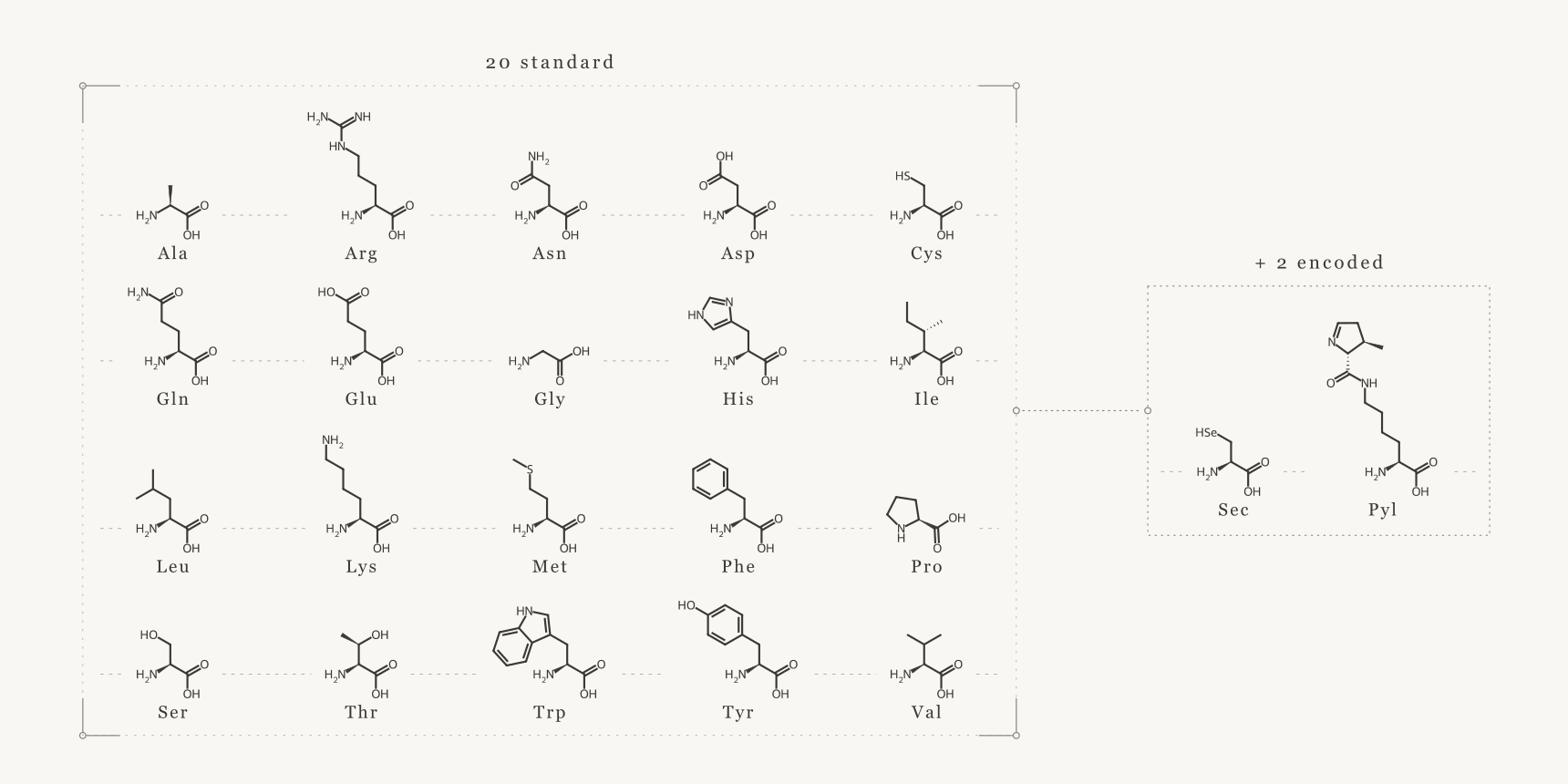
Arginine is the most basic standard amino acid, and aspartic acid is the most acidic. The cleanest ranking uses side-chain pKa: arginine has the highest reference side-chain pKa, while aspartic acid has the lowest.
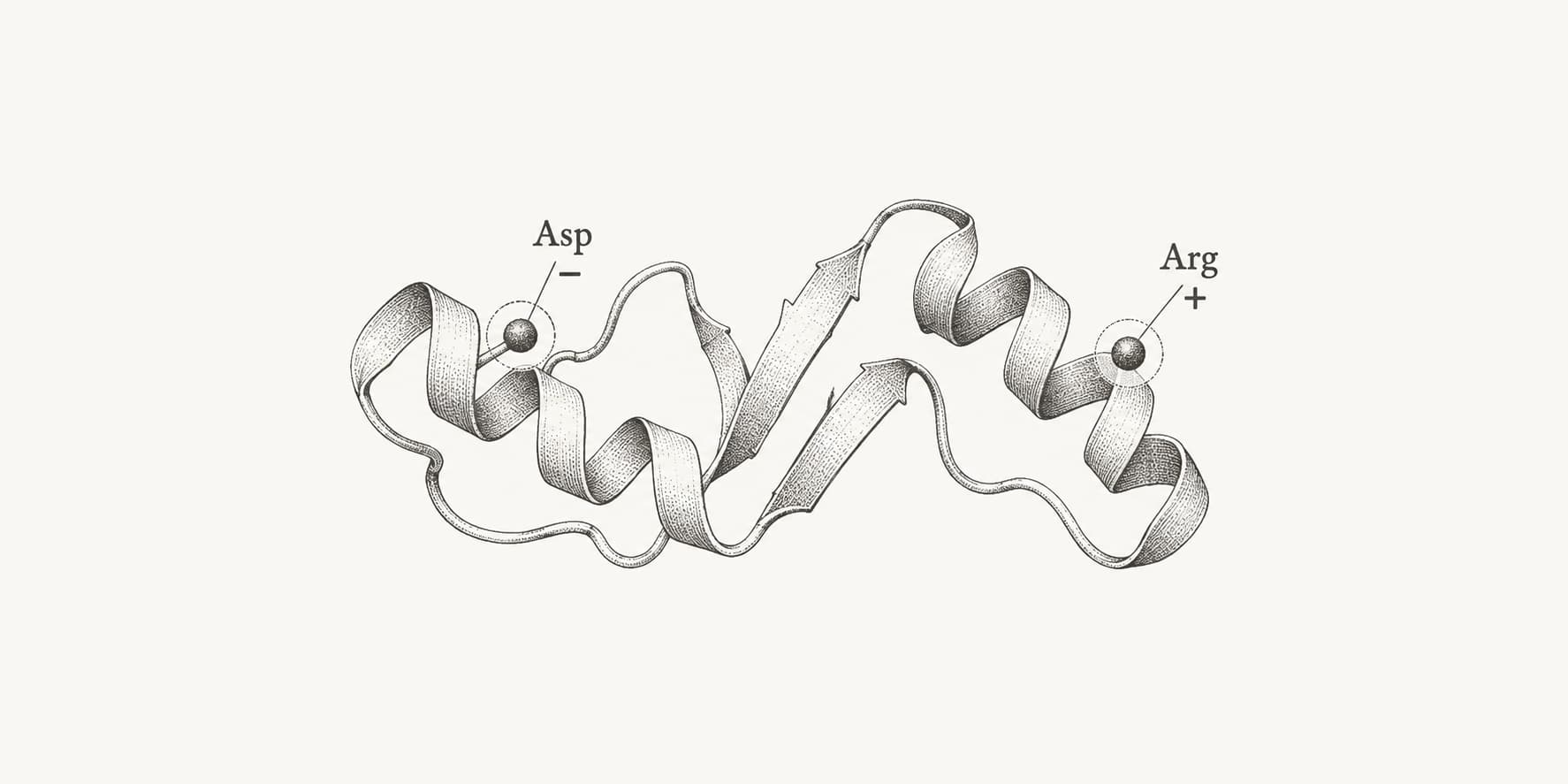
That difference is not just a label. At pH 7.4, arginine is essentially always positively charged, while aspartic acid is essentially always negatively charged as aspartate.
Which amino acids are the most acidic and basic?
Arginine is the most basic of the 20 standard amino acids, and aspartic acid is the most acidic. In the MilliporeSigma amino acid reference chart, arginine has a side-chain pKa of 12.48, while aspartic acid has a side-chain pKa of 3.65.[1]
A higher side-chain pKa means a basic group holds onto a proton at higher pH. A lower side-chain pKa means an acidic group gives up a proton more readily. That is why arginine sits at the basic extreme and aspartic acid sits at the acidic extreme.
| Extreme | Amino acid | 3-letter | 1-letter | Side-chain pKa | pI |
|---|---|---|---|---|---|
| Most basic | Arginine | Arg | R | 12.48 | 10.76 |
| Most acidic | Aspartic acid | Asp | D | 3.65 | 2.77 |
Source: MilliporeSigma amino acid reference chart.[1]
The isoelectric point gives the same broad answer: arginine has the highest pI in the reference chart, and aspartic acid has the lowest. But pI describes the whole free amino acid, while side-chain pKa is the better number for comparing acidic and basic side chains.
This is a chemistry ranking, not an abundance ranking. The most common amino acid in curated protein sequences is leucine, not arginine or aspartic acid.
How do charged amino acids compare at pH 7.4?
At pH 7.4, arginine and lysine are almost fully positive, histidine is mostly neutral, and aspartic acid and glutamic acid are almost fully negative.
The charge percentages below use the Henderson-Hasselbalch relationship and the side-chain pKa values in the reference chart. EMBL-EBI summarizes the rule: when pH is below pKa, side chains are predominantly protonated; when pH is above pKa, they are predominantly deprotonated.[1][2]
| Amino acid | Side-chain pKa | Charge at pH 7.4 | Charged share |
|---|---|---|---|
| Arginine | 12.48 | Positive | 99.999% positive |
| Lysine | 10.53 | Positive | 99.93% positive |
| Histidine | 6.00 | Mostly neutral | 3.8% positive |
| Aspartic acid | 3.65 | Negative | 99.98% negative |
| Glutamic acid | 4.25 | Negative | 99.93% negative |
The two acidic amino acids are usually named aspartate and glutamate in proteins at neutral pH because their side chains have lost a proton and carry a negative charge. The same naming pattern is less visible for arginine and lysine because their protonated, positively charged forms dominate across a much wider pH range.
Why is arginine more basic than lysine?
Arginine is more basic than lysine because its guanidinium side chain remains protonated at a higher pH than lysine's amino side chain.
The common reference values are 12.48 for arginine and 10.53 for lysine. That gap is large: at pH 10.5, lysine is near its 50% protonation point, while arginine is still overwhelmingly protonated.[1]
There is also a useful wrinkle. A 2015 Protein Science paper revisited arginine's pKa and reported that the guanidinium group has a pKa of 13.8 to 13.9 in free arginine and a blocked tripeptide. That is higher than many textbook and reference-table values, and it strengthens the same conclusion: arginine is the basic extreme among the standard amino acids.[3]
Histidine is different. Its side-chain pKa is close enough to neutral pH that small pH or local-environment changes can noticeably change its charge state. That makes histidine important in enzyme active sites, but it does not make histidine the most basic amino acid.
Can the answer change inside a protein?
The reference answer usually stays the same, but the actual pKa of a residue can shift inside a folded protein.
EMBL-EBI notes that a residue's effective pKa can shift depending on whether it is solvent-exposed or buried and what charges sit nearby. That matters because pKa controls electrostatic interactions, hydrogen bonding, salt bridges, stability, and activity.[2]
Measured protein pKa values show how large those shifts can be. A 2009 Protein Science summary tabulated 541 measured pK values from 78 folded proteins and reported averages of 3.5 for aspartate, 4.2 for glutamate, 6.6 for histidine, and 10.5 for lysine. The same dataset included unusual cases such as aspartate as high as 9.2 and lysine as low as 5.7.[4]
So the practical rule is simple: for the 20 standard amino acids, arginine is the most basic and aspartic acid is the most acidic. For a specific residue inside a specific protein, the local structure can matter enough that the pKa needs to be measured or predicted in context.