TM-align vs Dali vs Foldseek vs US-align
Four structure comparison tools that answer different questions

Matic Broz, PhD14 min
Which structure comparison tool should you use?
Use TM-align or US-align when you already have the two structures and want to know how alike they are; US-align is the same algorithm extended to complexes, RNA and DNA, and reordered chains. Use Foldseek to search a database of millions of structures in seconds. Use the Dali server when you want one of the most sensitive searches for distant relatives and can wait minutes to hours for it.
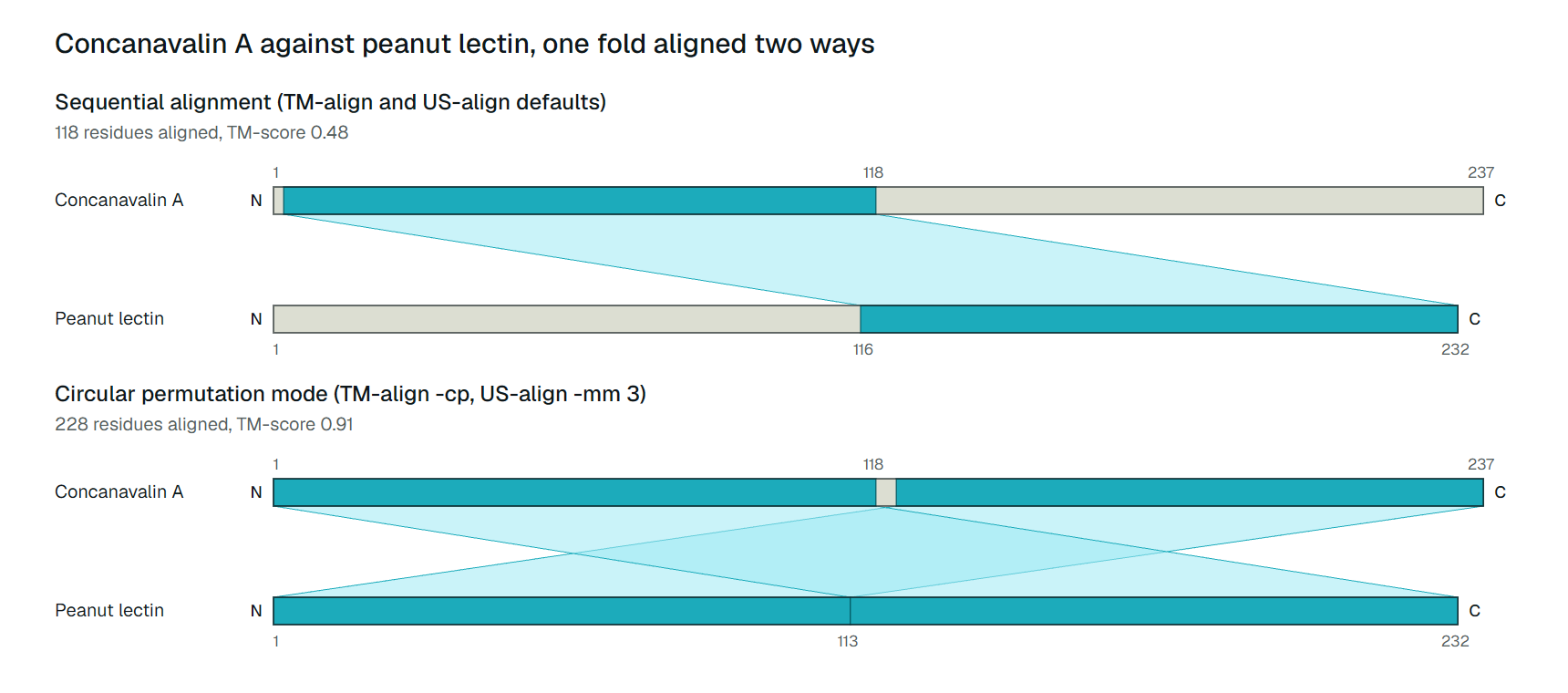
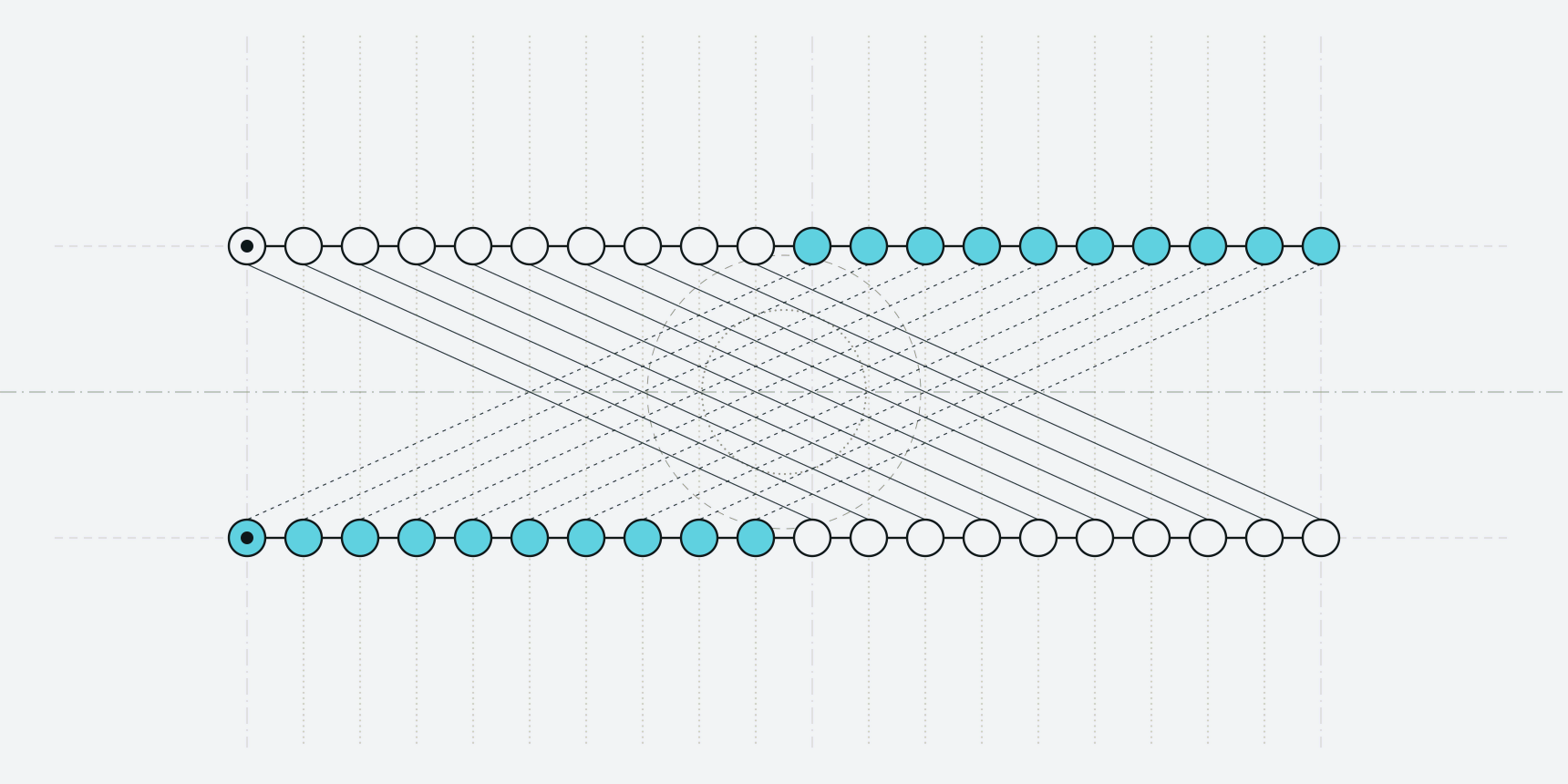
The catch is that each can give a confident answer that depends on a setting you never chose. Concanavalin A and peanut lectin share the legume lectin fold, but concanavalin A's chain starts in the middle of it.[15] TM-align at its defaults scores the pair (PDB 3CNA and 2PEL) at 0.48 over 118 residues, just under the 0.5 that usually means "same fold". Its circular permutation mode gives 0.91 over 228 residues, from the same two files (Figure 1).
The four tools differ in what they compare (superposed coordinates, internal distances or a structural alphabet), in the score they print and in whether they compare two structures or search a database. Those three things decide which one fits a question, and they also decide how each one fails.
 USAlignAlign two structures, complexes or RNAs and get TM-scores, RMSD and the residue mapping. Set Alignment mode to Circular permutation for reordered chains.Open tool
TM-align fits one rigid superposition
TM-align, published by Zhang and Skolnick in 2005, looks for the residue pairing and the single rigid superposition that give the highest TM-score.[1] It starts from secondary structure and threading guesses, then alternates superposition and dynamic programming until the alignment stops changing. In the original benchmark it was about 20 times faster than Dali and ranked first of four programs by average TM-score.[1]
It prints two TM-scores, one normalized by each structure's length, with the number of aligned residues, the RMSD over them and their sequence identity. That makes it what most people mean by a TM-score calculator, and it needs no shared residue numbering.
Its limit is the word "rigid". One superposition cannot fit two domains that moved relative to each other, and residue order has to run the same way in both chains. A -cp option for circular permutations was added in 2019, according to the change log in its source, but it is off by default.[2] The licence allows any use, including commercial, as long as the notices are kept.[2]
US-align extends TM-align to complexes and nucleic acids
US-align comes from the same group and keeps TM-align's objective, the TM-score, while widening what it can align: protein and RNA or DNA chains, whole complexes with chain matching, and mixed protein and nucleic acid assemblies.[3] The TM-align page now points readers to it as the extension of TM-align.[2] A -mm option chooses the mode:[5]
-mm 1aligns two multi-chain complexes and works out which chain matches which.-mm 3handles circular permutations, and-mm 5and-mm 6allow fully and semi non-sequential alignments.[4]-mm 4builds a consensus alignment of several structures.-mm 7, added in August 2026, is a flexible alignment with hinges.[5] The 2026 Nature Protocols paper still described US-align as not designed for flexible alignment, so this mode is newer than any published description of it.[4]
For two single protein chains, the default mode gave us exactly TM-align's numbers, on the lectin pair and on hen against T4 lysozyme (1LYZ, 2LZM), both built from US-align commit 1fa25a9. On these two pairs the choice made no difference. An alignment typically takes under a second, and the licence is the same as TM-align's.[4][5] The US-align tool on ProteinIQ offers these modes in its form, circular permutation included.
Dali compares distance matrices, not superpositions
Dali, from Holm and Sander, never superimposes the structures while it aligns them. It describes each protein by the distances between all its Cα atoms, breaks that matrix into small contact patterns of six residues against six, and searches for the residue pairing that preserves the most internal distances.[6] The score is elastic: a deviation counts relative to the distance it changes, so a 1 Å shift between residues 20 Å apart costs less than the same shift between neighbours.[7]
Because it compares distances within each structure, Dali does not care how domains are oriented, so two conformations of a hinge protein still look alike to it. The 1993 method could align segments in any order; the current version is constrained to sequential alignments, so it reports no circular permutations, and it ignores similarities spanning more than one chain.[6][7]
Dali's score is a Z-score, which says how far a match sits above what unrelated structures of that size reach; it is a measure of significance, not of geometric closeness. The cutoff for similarity is Z = 2, and the Z-score depends on protein size, so compare Z-scores only between hits of similar length.[7] Whether a match means common ancestry, Holm writes, depends on wider context. A Z-score cannot be converted into a TM-score or an RMSD.
The Dali server searches the PDB, a 25% identity subset of it and AlphaFold Database models, and compares up to 10 structures pairwise or 64 all against all.[8][10] It is free with no login,[8] but a PDB search takes upwards of 10 to 15 minutes before any queue.[10] The standalone DaliLite v5 is GPLv3, though the old DSSP program bundled with it is licensed for academic use.[10]
On fold detection, Holm reported that DaliLite beat TM-score based methods at every level of his benchmark.[9] Like every head-to-head comparison in this article, that one was run by the authors of one of the tools.
Foldseek turns structure into a sequence
Foldseek, from the Söding and Steinegger groups, describes each residue by its geometry relative to its closest neighbour in space and assigns it one of 20 states, the 3Di alphabet, so a structure becomes a string that sequence search machinery can scan.[11] The default is a local Smith-Waterman alignment of the 3Di and amino acid strings; TM-align and LoLalign modes are options.[12]
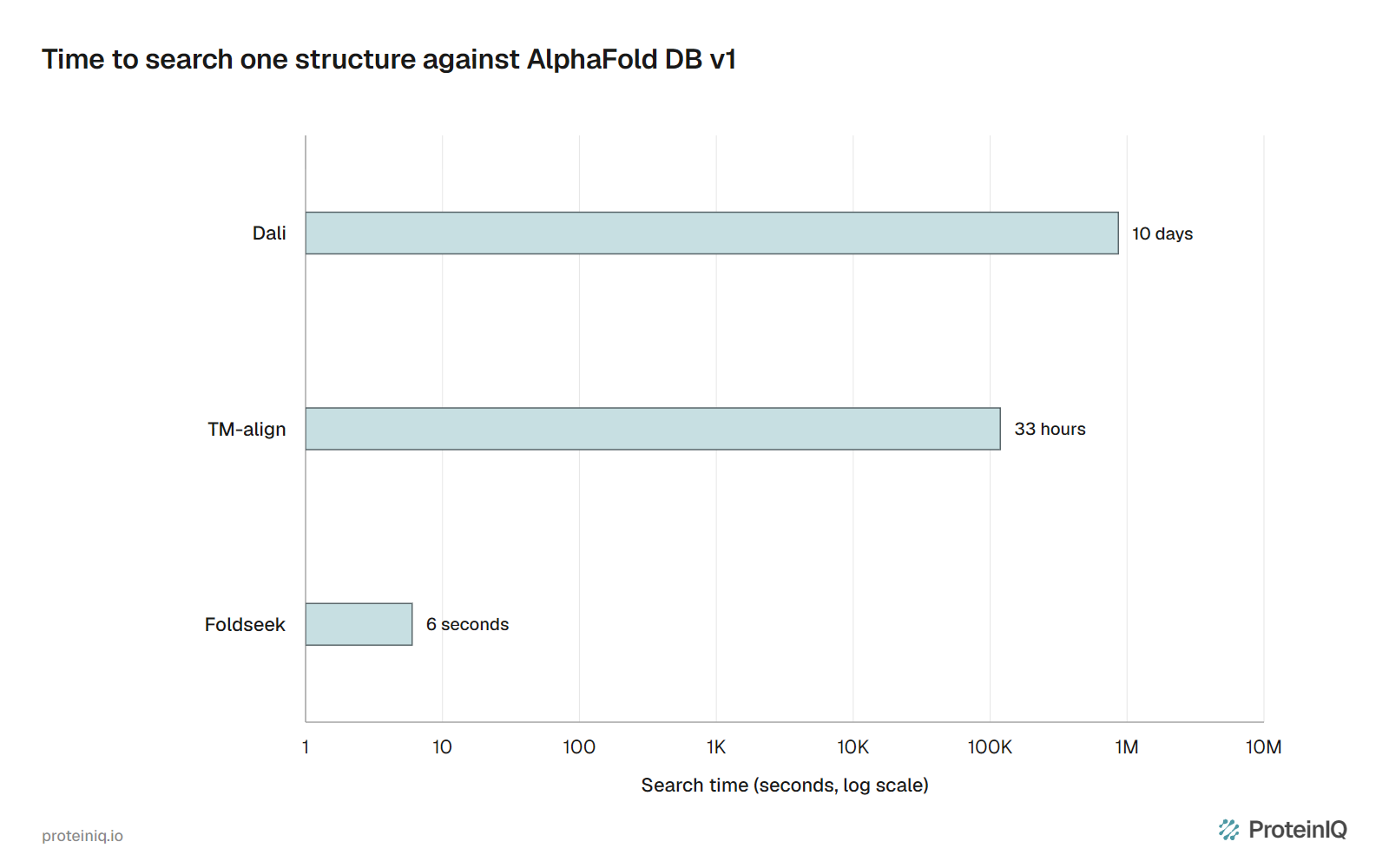
The speed changes what is possible. On SCOPe domains, Foldseek ran more than 4,000 times faster than TM-align and Dali. For one 942-residue query against the 2021 AlphaFold Database, Dali took 10 days, TM-align 33 hours and Foldseek 6 seconds.[11] The cost is some sensitivity: Foldseek found 86% as many true relatives as Dali, 88% as many as TM-align and 133% as many as CE.[11]
Hits come with an E-value and a probability that query and target are homologous.[12] Robert Edgar, who wrote the competing aligner Reseek, found Foldseek E-values underestimated by several orders of magnitude, so treat them as a ranking, not an error rate.[14]
Foldseek-Multimer extends the search to complexes, 1,000 to 10,000 times faster than US-align in database search.[13] Foldseek is GPLv3 and has a public search server.[12] The Foldseek tool on ProteinIQ runs searches, pairwise comparisons and clustering.
One lectin pair aligned two ways
Concanavalin A is the textbook natural circular permutation. Cunningham and colleagues found in 1979 that the β chain of favin, another legume lectin, matches concanavalin A from residue 120 to its C-terminus and then on through its first 69 residues.[15] The plant cuts the precursor and ligates the pieces in a new order.[16] We compared it with peanut lectin, another legume lectin (2PEL, chain A, 232 modelled residues),[17] using chain A of the concanavalin A entry 3CNA (237 residues).[18]
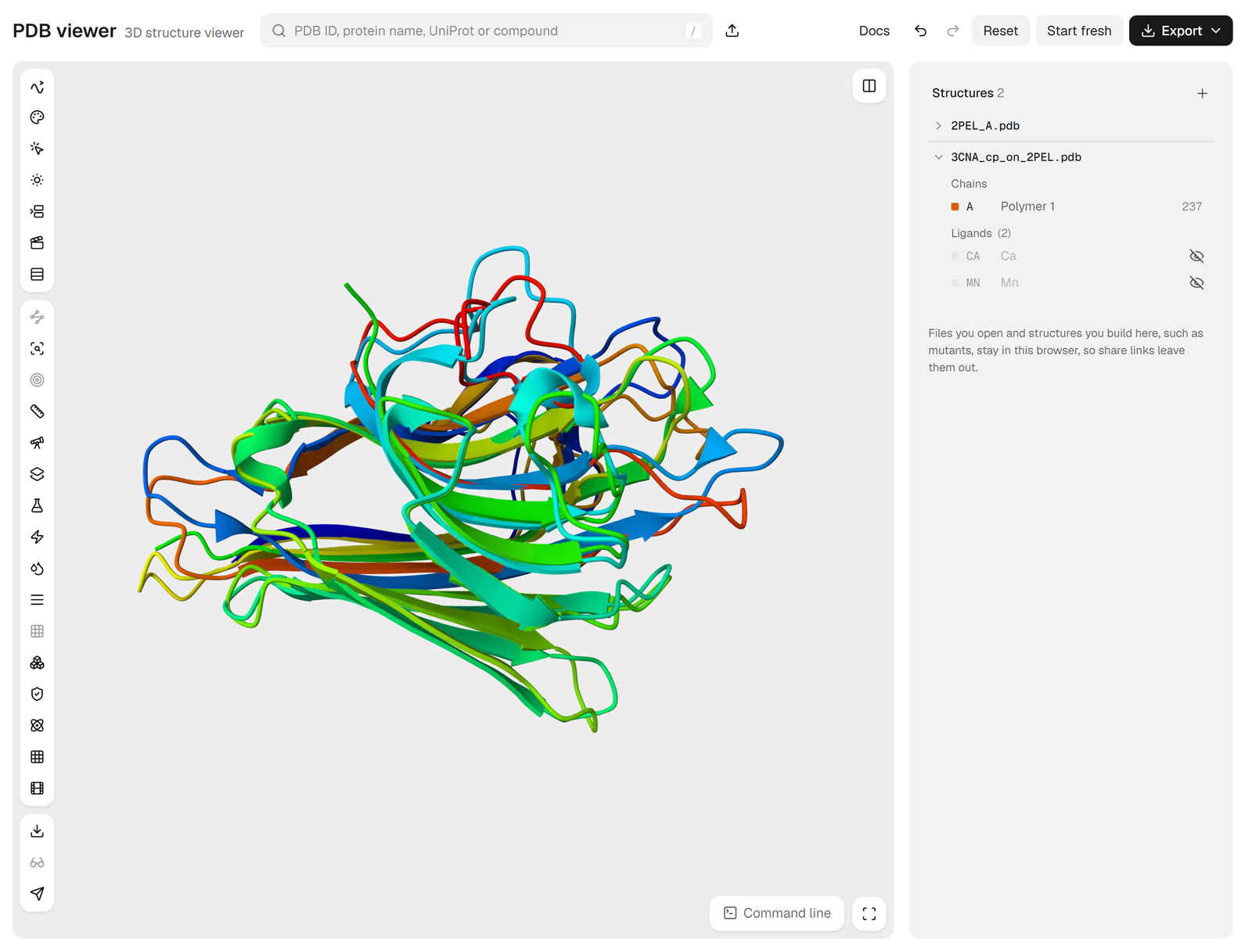
TM-align at its defaults paired 118 residues at 1.63 Å, all but two of them in one block: the first half of concanavalin A (residues 3 to 118) against the second half of peanut lectin (116 to 232), TM-score 0.480 normalized by peanut lectin. Having used up peanut lectin's C-terminal half, a sequential alignment cannot go back for the rest. US-align's default mode printed the same numbers. In circular permutation mode (TM-align -cp or US-align -mm 3) both programs paired 228 residues at 1.93 Å, and the TM-score rose to 0.909, as Figure 1 shows.
The cut point we found, between concanavalin A residues 118 and 123, sits where Cunningham placed it from sequence alone. The sequences are 41% identical across the 228 permuted pairs, so this is not a pair that sequence search would miss. It is a topology trap: the fold is the same, and the residue order breaks any aligner that assumes it runs the same way in both chains.
We did not run Dali or Foldseek on this pair. Both align residues in order: Dali by design in its current version, and Foldseek in its default Smith-Waterman and its TM-align modes.[7][12] A single sequential alignment can pair at most one half of this protein, so neither can report the full match in one alignment, however significant the half they find.
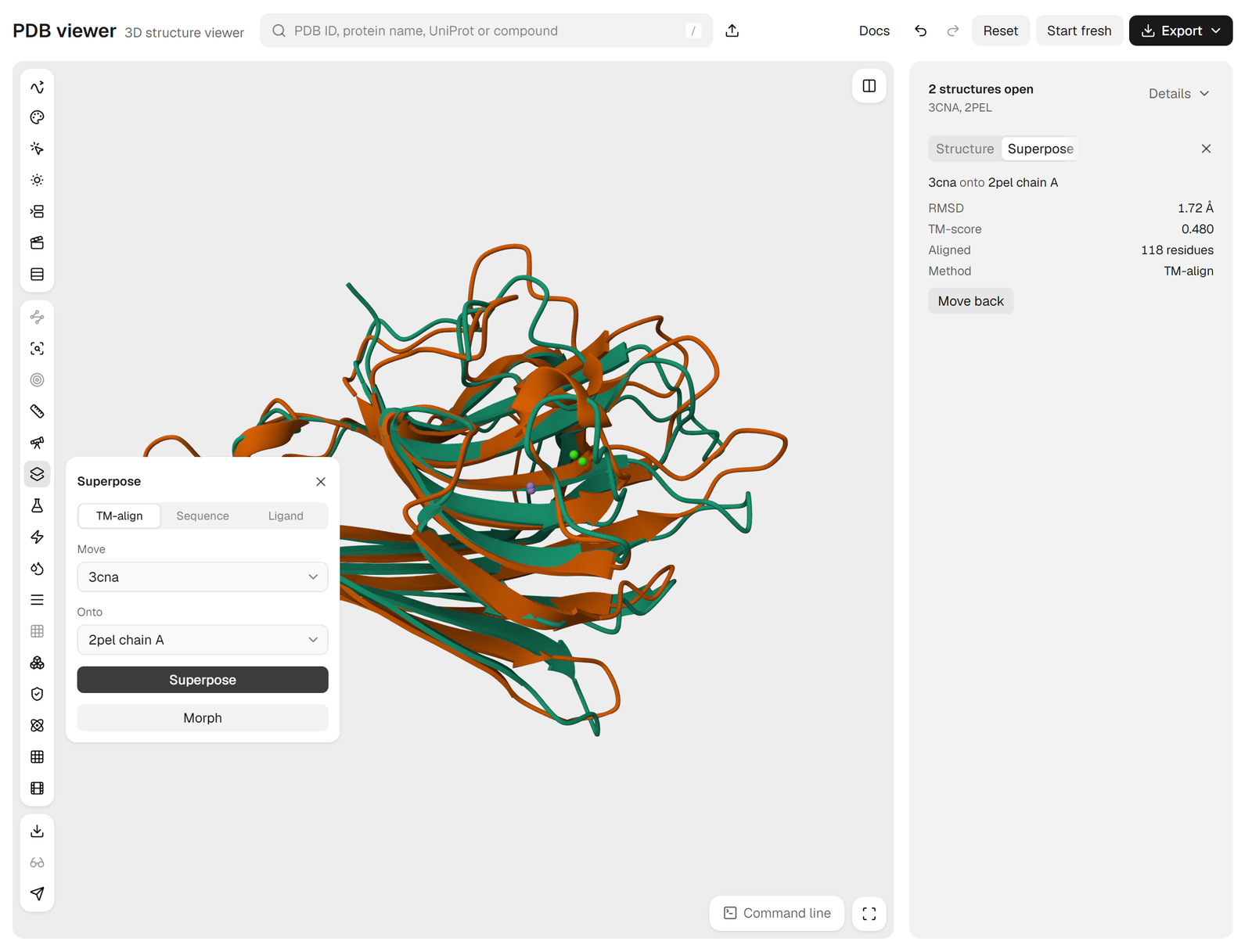
The PDB viewer by ProteinIQ reproduces the first result in the browser. With 3CNA (as its asymmetric unit, under Assemblies) and 2PEL open, Superpose with TM-align, moving 3cna onto 2pel chain A, gave 1.72 Å over 118 residues and a TM-score of 0.480 (Figure 3). The viewer runs its own TM-align implementation, which pairs the same 118 residues at 1.72 Å instead of 1.63 Å, and with no permutation mode it gives the sequential answer.
To see the permutation itself, we saved the -mm 3 superposition from US-align and opened it in the viewer, coloured from blue at the N-terminus to red at the C-terminus with spectrum count, rainbow, polymer. The strands overlay, but the colours do not: the blue start of concanavalin A lies on the green middle of peanut lectin (Figure 4).
The pattern to watch for is a TM-score near 0.5 where the aligned block covers one end of one chain and the opposite end of the other. Rerun in permutation mode before concluding that two proteins have different folds.
How to choose by question
The right first tool depends on whether you have two structures or one query, whether the chains are single proteins, and how far apart the structures are (Table 1).
| Your question | Start with | Then check |
|---|---|---|
| How far apart are two models of the same protein? | RMSD Calculator, which pairs residues by number | The share of residues matched, and a per-residue profile for one moving loop |
| Do two structures share a fold? | US-align or TM-align | Both normalizations, the aligned length and which residues aligned |
| Is a low TM-score hiding a reordered chain? | US-align -mm 3, or -mm 5 and -mm 6 for non-sequential matches | Whether the aligned block sits at opposite ends of the two chains |
| Do two complexes or RNAs match? | US-align -mm 1 or the RNA mode | The chain mapping it chose |
| What known structure, experimental or predicted, looks like mine? | Foldseek | TM-scores of the top hits by US-align, since E-values are only a ranking |
| Does a distant relative exist that Foldseek missed? | Dali server | Z above 2, compared only between hits of similar length |
Write down the program, version, mode and normalization with every score you report. A TM-score of 0.48 and one of 0.91 for the same pair are both correct outputs, and only the settings tell a reader which question each one answers. The usual reporting rules for TM-score and RMSD apply on top of this, and the commands to superimpose protein structures in PyMOL, ChimeraX or the browser are the same whatever program chose the pairs.
Structure comparison tools on ProteinIQ
Fetch or upload the structures, compare a pair or search a database, then look at the result in 3D. Protein structure alignment and multiple structure alignment put these tools in order for common tasks.
- US-align: align two chains, complexes or nucleic acids, including circular permutation and non-sequential modes
- Foldseek: search structure databases, or compare and cluster your own set
- RMSD Calculator: measure RMSD against one reference when residue numbering matches
- pyRMSD: compute every pairwise RMSD across an ensemble of the same protein
- PDB viewer by ProteinIQ: superpose structures by TM-align or sequence and read RMSD and TM-score in the browser

Frequently asked questions
Is US-align the same as TM-align?
US-align is the same group's extension of TM-align and uses the same TM-score objective, adding complexes, RNA and DNA, permuted and non-sequential alignments and multiple alignment.[3] On two single protein chains its default mode gave us the same numbers as TM-align. Use US-align when anything beyond a pair of monomers is involved.
What is a good Dali Z-score?
Dali reports matches with a Z-score above 2, which is its cutoff for similarity, and an empty result means the folds are dissimilar.[7] The Z-score depends on protein size, so compare Z-scores only between hits of similar length. It measures significance, not distance, and cannot be read as a TM-score.
Is Foldseek as accurate as Dali?
Not quite. On SCOPe domains Foldseek found 86% as many true relatives as Dali and 88% as many as TM-align, while running thousands of times faster.[11] Use Foldseek to search large databases and recheck the hits that matter with US-align or Dali.
Is the Dali server free?
Yes. The Dali server is free and open to all users without a login, and the standalone DaliLite v5 is released under GPLv3, with an old DSSP program inside that is licensed for academic use.[8][10] Expect a PDB search to take 10 to 15 minutes or more.[10]
How do I calculate a TM-score online?
Upload the two structures to US-align, which runs the native program and reports TM-scores normalized by each structure, the RMSD and the aligned residues. When both files share residue numbering, the RMSD Calculator gives the RMSD over every matched residue instead of only the aligned core.